The Hong Kong Stablecoin Ordinance (hereinafter referred to as the Ordinance) officially came into effect on August 1, 2025. The Ordinance has established strict rules for the issuance and operationThe Hong Kong Stablecoin Ordinance (hereinafter referred to as the Ordinance) officially came into effect on August 1, 2025. The Ordinance has established strict rules for the issuance and operation

A week after the stablecoin regulation came into effect, Hong Kong's over-the-counter market size dropped by 33%.

2025/08/13 09:00

The Hong Kong Stablecoin Ordinance (hereinafter referred to as the Ordinance) officially came into effect on August 1, 2025. The Ordinance has established strict rules for the issuance and operation of stablecoins, explicitly prohibiting the offer, promotion and sale of stablecoins without a license, and does not provide a transition period.

As institutions whose main business is exchanging stablecoins and fiat currencies, Hong Kong's local cryptocurrency money changers are the first to be affected. After the regulations came into effect, many over-the-counter trading service providers announced the suspension of stablecoin-related businesses while waiting to apply for licenses.

This article aims to provide regulators with an on-chain perspective on the impact of the regulations by disclosing TRC20-USDT outflow data from Hong Kong Over-the-Counter Trading Service Providers (HKVAOTC) addresses over the past 70 days.

Data Description

Bitrace has been monitoring the business address traffic of VAOTC entities located in Hong Kong or primarily serving Hong Kong customers. The latter are classified as store-type service providers that primarily serve offline customers or real-name customers, and non-store-type service providers that primarily serve online customers or anonymous customers.

The data disclosed in this survey will include the TRC20-USDT transfer data of all service providers in the two time periods of June 1 to July 31 and August 1 to August 8, 2025, Beijing time.

The following data have excluded non-operational transit activities between business addresses.

The volume of stablecoin transactions in the over-the-counter market fell by 32.94%.

Between June 1 and July 31, all business addresses transferred out a total of 3.17B USDT, with an average daily amount of 52.04M USDT; between August 1 and August 8, all business addresses transferred out a total of 279M USDT, with an average daily amount of 34.90M USDT.
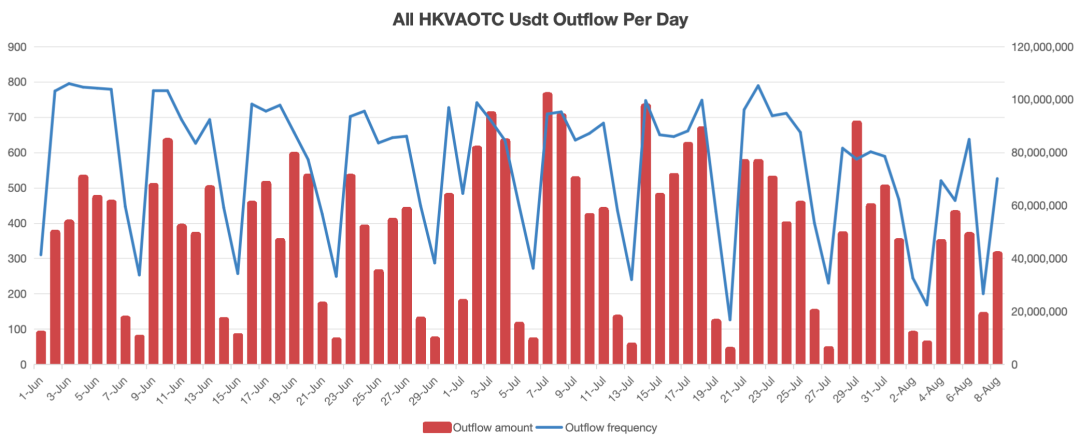
Compared with before the regulations came into effect, the overall size of the stablecoin exchange market decreased by 32.94% after August 1. This sensitivity shows the profound impact of the regulations on Hong Kong's local crypto industry.

Store type service providers reduce the scale to a larger

Traffic statistics are collected separately for store-type and non-store-type service provider business addresses.
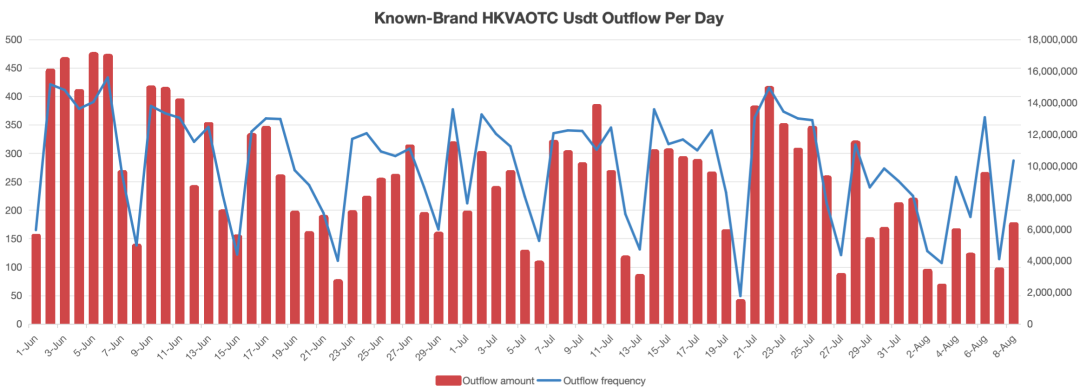
After the regulations came into effect, the average daily USDT outflow volume of store-type service providers decreased by 43.20% (9.47M -> 5.38M), while the business addresses of non-store-type service providers decreased by 30.65% (42.57M -> 29.52M).
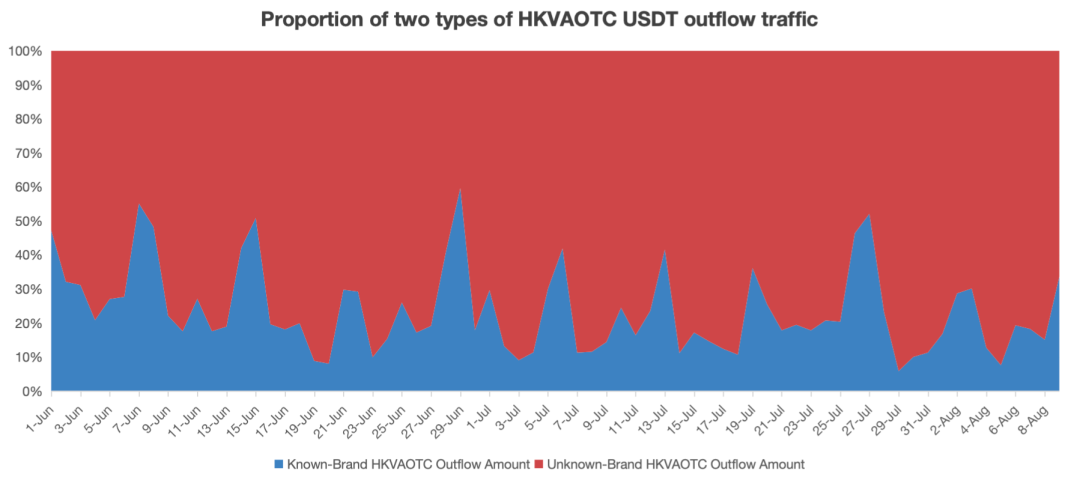
The impact on store-type service providers is significantly greater than that on non-store-type services, indicating that after the regulations came into effect, some businesses in Hong Kong's over-the-counter trading service industry tended to go underground in a short period of time.

Final Thoughts

The introduction of the Stablecoin Ordinance marks a significant step forward in regulatory compliance for Hong Kong's crypto industry, and will have a significant impact on the local over-the-counter (OTC) trading services sector in the short term. Among relevant practitioners, some are choosing to comply with regulations and apply for licenses, while others are turning to underground operations, presenting a diverse range of choices.


Market Opportunity
Effect AI Logo
Effect AI Price(EFFECT)
$0,005138
$0,005138$0,005138
+%0,03
USD
Effect AI (EFFECT) Live Price Chart
Disclaimer: The articles reposted on this site are sourced from public platforms and are provided for informational purposes only. They do not necessarily reflect the views of MEXC. All rights remain with the original authors. If you believe any content infringes on third-party rights, please contact service@support.mexc.com for removal. MEXC makes no guarantees regarding the accuracy, completeness, or timeliness of the content and is not responsible for any actions taken based on the information provided. The content does not constitute financial, legal, or other professional advice, nor should it be considered a recommendation or endorsement by MEXC.

You May Also Like

The Channel Factories We’ve Been Waiting For

The Channel Factories We’ve Been Waiting For

The post The Channel Factories We’ve Been Waiting For appeared on BitcoinEthereumNews.com. Visions of future technology are often prescient about the broad strokes while flubbing the details. The tablets in “2001: A Space Odyssey” do indeed look like iPads, but you never see the astronauts paying for subscriptions or wasting hours on Candy Crush.  Channel factories are one vision that arose early in the history of the Lightning Network to address some challenges that Lightning has faced from the beginning. Despite having grown to become Bitcoin’s most successful layer-2 scaling solution, with instant and low-fee payments, Lightning’s scale is limited by its reliance on payment channels. Although Lightning shifts most transactions off-chain, each payment channel still requires an on-chain transaction to open and (usually) another to close. As adoption grows, pressure on the blockchain grows with it. The need for a more scalable approach to managing channels is clear. Channel factories were supposed to meet this need, but where are they? In 2025, subnetworks are emerging that revive the impetus of channel factories with some new details that vastly increase their potential. They are natively interoperable with Lightning and achieve greater scale by allowing a group of participants to open a shared multisig UTXO and create multiple bilateral channels, which reduces the number of on-chain transactions and improves capital efficiency. Achieving greater scale by reducing complexity, Ark and Spark perform the same function as traditional channel factories with new designs and additional capabilities based on shared UTXOs.  Channel Factories 101 Channel factories have been around since the inception of Lightning. A factory is a multiparty contract where multiple users (not just two, as in a Dryja-Poon channel) cooperatively lock funds in a single multisig UTXO. They can open, close and update channels off-chain without updating the blockchain for each operation. Only when participants leave or the factory dissolves is an on-chain transaction…
Share
BitcoinEthereumNews2025/09/18 00:09
Onyxcoin Price Breakout Coming — Is a 38% Move Next?

Onyxcoin Price Breakout Coming — Is a 38% Move Next?

The post Onyxcoin Price Breakout Coming — Is a 38% Move Next? appeared on BitcoinEthereumNews.com. Onyxcoin price action has entered a tense standoff between bulls
Share
BitcoinEthereumNews2026/01/14 00:33
Trading time: Tonight, the US GDP and the upcoming non-farm data will become the market focus. Institutions are bullish on BTC to $120,000 in the second quarter.

Trading time: Tonight, the US GDP and the upcoming non-farm data will become the market focus. Institutions are bullish on BTC to $120,000 in the second quarter.

Daily market key data review and trend analysis, produced by PANews.
Share
PANews2025/04/30 13:50