Speculation over a second mainnet migration in 2025 has stirred excitement in the Pi Network community while PI dropped 5% in the past 24 hours. The post Pi Network (PI) Price Watch: 2nd Mainnet Migration Speculation Sends Token Tanking appeared first on Coinspeaker.Speculation over a second mainnet migration in 2025 has stirred excitement in the Pi Network community while PI dropped 5% in the past 24 hours. The post Pi Network (PI) Price Watch: 2nd Mainnet Migration Speculation Sends Token Tanking appeared first on Coinspeaker.

Pi Network (PI) Price Watch: 2nd Mainnet Migration Speculation Sends Token Tanking

A Pi Network PI $0.35 24h volatility: 5.7% Market cap: $2.79 B Vol. 24h: $81.33 M community moderator suggested the possibility of a second mainnet migration in 2025.

The comment, which emerged during a discussion around long-delayed referral bonuses and unverified balances, brought PI back in the spotlight.

Influencer Woody Lightyear shared the discussion on X, pointing out that Pi moderators have acknowledged that a second migration is indeed possible this year.

The Times of PiNetwork later explained that such a migration would specifically focus on tokens that remain unmigrated, including referral mining rewards and balances from users who recently completed KYC verification.

Why a second migration matters

The first migration proved Pi’s scalability, onboarding early adopters. A second migration, however, would address frustrations that have built up over years of delays.

Many pioneers still hold balances that cannot be transferred, leaving parts of the community sidelined. By unlocking these tokens, Pi could significantly increase the number of active wallets and strengthen network liquidity.

Meanwhile, analysts caution that the Pi Core Team may deliberately delay a large-scale release. With Pi’s price hovering between $0.30 and $0.40, a sudden injection of new supply could increase selling pressure.

Pi price analysis: bearish breakdown in play

On the 3-hour chart, PI recently broke down from a symmetrical triangle pattern, suggesting bearish momentum is gaining ground. The token currently trades near $0.36, slipping below the key $0.37 support zone.

Interestingly, the RSI has dropped to 26, signaling oversold conditions but also reflecting the strong selling pressure. The CMF sits at –0.18, showing capital outflows, while the BoP indicator shows a deeply negative reading of –0.89.
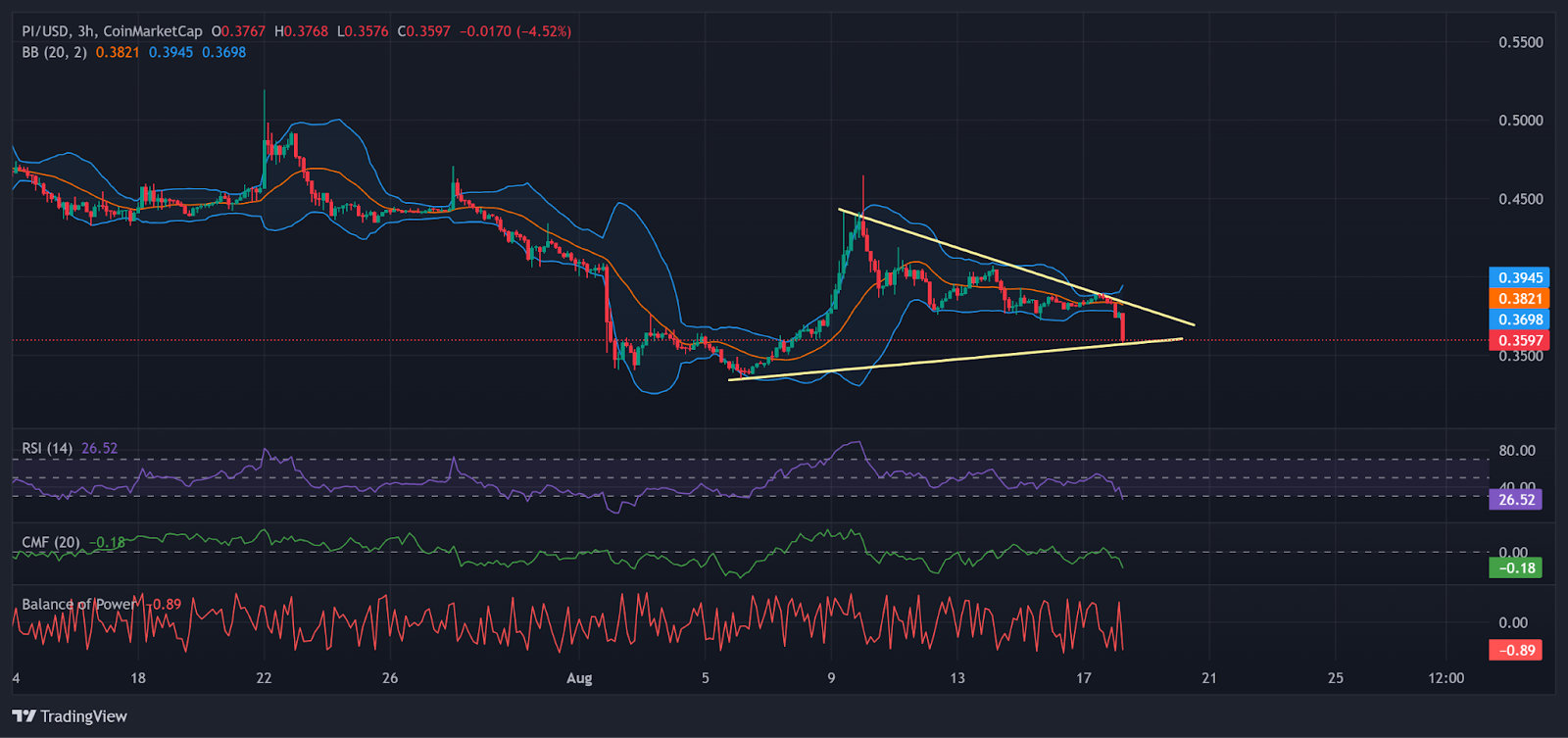
PI Network’s daily chart with a symmetrical triangle pattern. | Source: TradingView

If downside momentum continues, PI could retest the $0.35 psychological level and possibly slide toward $0.32 in the short term.

On the upside, recovery would require reclaiming $0.38, followed by a stronger push toward $0.40, making PI a top crypto to buy in 2025. Until then, volatility is likely to persist, with community speculation doing little to offset price weakness.

next

The post Pi Network (PI) Price Watch: 2nd Mainnet Migration Speculation Sends Token Tanking appeared first on Coinspeaker.


Market Opportunity
TokenFi Logo
TokenFi Price(TOKEN)
$0.005168
$0.005168$0.005168
+2.56%
USD
TokenFi (TOKEN) Live Price Chart
Disclaimer: The articles reposted on this site are sourced from public platforms and are provided for informational purposes only. They do not necessarily reflect the views of MEXC. All rights remain with the original authors. If you believe any content infringes on third-party rights, please contact service@support.mexc.com for removal. MEXC makes no guarantees regarding the accuracy, completeness, or timeliness of the content and is not responsible for any actions taken based on the information provided. The content does not constitute financial, legal, or other professional advice, nor should it be considered a recommendation or endorsement by MEXC.

You May Also Like

Polygon Tops RWA Rankings With $1.1B in Tokenized Assets

Polygon Tops RWA Rankings With $1.1B in Tokenized Assets

The post Polygon Tops RWA Rankings With $1.1B in Tokenized Assets appeared on BitcoinEthereumNews.com. Key Notes A new report from Dune and RWA.xyz highlights Polygon’s role in the growing RWA sector. Polygon PoS currently holds $1.13 billion in RWA Total Value Locked (TVL) across 269 assets. The network holds a 62% market share of tokenized global bonds, driven by European money market funds. The Polygon POL $0.25 24h volatility: 1.4% Market cap: $2.64 B Vol. 24h: $106.17 M network is securing a significant position in the rapidly growing tokenization space, now holding over $1.13 billion in total value locked (TVL) from Real World Assets (RWAs). This development comes as the network continues to evolve, recently deploying its major “Rio” upgrade on the Amoy testnet to enhance future scaling capabilities. This information comes from a new joint report on the state of the RWA market published on Sept. 17 by blockchain analytics firm Dune and data platform RWA.xyz. The focus on RWAs is intensifying across the industry, coinciding with events like the ongoing Real-World Asset Summit in New York. Sandeep Nailwal, CEO of the Polygon Foundation, highlighted the findings via a post on X, noting that the TVL is spread across 269 assets and 2,900 holders on the Polygon PoS chain. The Dune and https://t.co/W6WSFlHoQF report on RWA is out and it shows that RWA is happening on Polygon. Here are a few highlights: – Leading in Global Bonds: Polygon holds 62% share of tokenized global bonds (driven by Spiko’s euro MMF and Cashlink euro issues) – Spiko U.S.… — Sandeep | CEO, Polygon Foundation (※,※) (@sandeepnailwal) September 17, 2025 Key Trends From the 2025 RWA Report The joint publication, titled “RWA REPORT 2025,” offers a comprehensive look into the tokenized asset landscape, which it states has grown 224% since the start of 2024. The report identifies several key trends driving this expansion. According to…
Share
BitcoinEthereumNews2025/09/18 00:40
Modernizing Legacy E-Commerce Platforms: From Oracle ATG To Cloud-Native Architectures

Modernizing Legacy E-Commerce Platforms: From Oracle ATG To Cloud-Native Architectures

Oracle ATG Commerce was the platform of record for large enterprises for many years. But the e-commerce game has changed, and now, speed, agility, and scalability are the name of the game.
Share
Hackernoon2025/09/18 04:42
EUR/CHF slides as Euro struggles post-inflation data

EUR/CHF slides as Euro struggles post-inflation data

The post EUR/CHF slides as Euro struggles post-inflation data appeared on BitcoinEthereumNews.com. EUR/CHF weakens for a second straight session as the euro struggles to recover post-Eurozone inflation data. Eurozone core inflation steady at 2.3%, headline CPI eases to 2.0% in August. SNB maintains a flexible policy outlook ahead of its September 25 decision, with no immediate need for easing. The Euro (EUR) trades under pressure against the Swiss Franc (CHF) on Wednesday, with EUR/CHF extending losses for the second straight session as the common currency struggles to gain traction following Eurozone inflation data. At the time of writing, the cross is trading around 0.9320 during the American session. The latest inflation data from Eurostat showed that Eurozone price growth remained broadly stable in August, reinforcing the European Central Bank’s (ECB) cautious stance on monetary policy. The Core Harmonized Index of Consumer Prices (HICP), which excludes volatile items such as food and energy, rose 2.3% YoY, in line with both forecasts and the previous month’s reading. On a monthly basis, core inflation increased by 0.3%, unchanged from July, highlighting persistent underlying price pressures in the bloc. Meanwhile, headline inflation eased to 2.0% YoY in August, down from 2.1% in July and slightly below expectations. On a monthly basis, prices rose just 0.1%, missing forecasts for a 0.2% increase and decelerating from July’s 0.2% rise. The inflation release follows last week’s ECB policy decision, where the central bank kept all three key interest rates unchanged and signaled that policy is likely at its terminal level. While officials acknowledged progress in bringing inflation down, they reiterated a cautious, data-dependent approach going forward, emphasizing the need to maintain restrictive conditions for an extended period to ensure price stability. On the Swiss side, disinflation appears to be deepening. The Producer and Import Price Index dropped 0.6% in August, marking a sharp 1.8% annual decline. Broader inflation remains…
Share
BitcoinEthereumNews2025/09/18 03:08