July 2025 has turned out to be a truly hot month for NFTs. Trading volumes and user activity have surged across the sector, while the value of many collections has jumped — in some cases, by several multiples. The numbers are still far from their all-time highs, but for the first time in 2025, the […] Сообщение Punks, Pokémon, and Zora: Why the NFT Market Is Growing — and Will It Last? появились сначала на INCRYPTED .July 2025 has turned out to be a truly hot month for NFTs. Trading volumes and user activity have surged across the sector, while the value of many collections has jumped — in some cases, by several multiples. The numbers are still far from their all-time highs, but for the first time in 2025, the […] Сообщение Punks, Pokémon, and Zora: Why the NFT Market Is Growing — and Will It Last? появились сначала на INCRYPTED .

Punks, Pokémon, and Zora: Why the NFT Market Is Growing — and Will It Last?

In this article:

1. The “Summer” of NFTs

2. The First Sign

3. Punks Not Dead

4. Polygon! I Choose You!

5. Favorable Environment

6. Cautious Optimism

July 2025 has turned out to be a truly hot month for NFTs. Trading volumes and user activity have surged across the sector, while the value of many collections has jumped — in some cases, by several multiples.

The numbers are still far from their all-time highs, but for the first time in 2025, the “forgotten” corner of the industry is showing signs of a real comeback. Some call it a mere “dead cat bounce,” while others believe the market is entering a steady upward trend. But what’s really going on?

At Incrypted, we took a closer look at how the NFT landscape has changed, what might be driving the recent uptick, and whether we’re actually witnessing the revival of the 2021–2022 “NFT fever.”

Since May 2025, the NFT market has been showing signs of recovery. At first, the momentum was shaky — likely fueled by the launch of giveaways on Telegram.  

But by June the growth had continued, and in July it accelerated even further. According to CryptoSlam, total trading volume in July reached about $580 million — a 35% increase compared to June’s $389 million, and even surpassing the hype-driven May figure of $474 million. That makes July the strongest month for NFT growth in over a year.

NFT market trends: monthly trading volumes (black), along with the number of unique buyers (blue) and sellers (orange). Source: CryptoSlam.

According to CoinGecko, the total market capitalization of NFTs doubled in July — jumping from $3.4 billion to $6.8 billion.

Total NFT market capitalization. Source: CoinGecko.

However, this growth isn’t uniform across the board. While “blue-chip” NFTs like CryptoPunks and Pudgy Penguins have seen explosive gains, the CryptoSlam 500 NFT Index remains near its lows and hasn’t even recovered to June levels.

Price trends of the most expensive NFT collections. Source: Coingecko CryptoSlam 500 NFT Index. Source: CryptoSlam.

Another feature of this cycle is Bitcoin’s contribution to the market’s growth. So-called “Bitcoin NFTs,” built on the Inscriptions protocol, helped the network climb to fourth place in terms of trading volume. 

NFT trading volumes across different blockchains. Source: CryptoSlam.

However, the number and value of transactions on the Bitcoin network remain an order of magnitude lower than its closest competitor, Polygon. Alongside TON and Ethereum, Polygon played a key role in driving the July rally.
One of the earliest indicators of renewed interest in NFTs in 2025 came from Telegram — specifically, its internal gifting system, some of which was issued as NFTs on the TON blockchain.

At first, users saw these gifts simply as an in-app feature. But once it became clear that some digital items were limited in supply and could be traded on marketplaces, a local “NFT fever” erupted on TON.

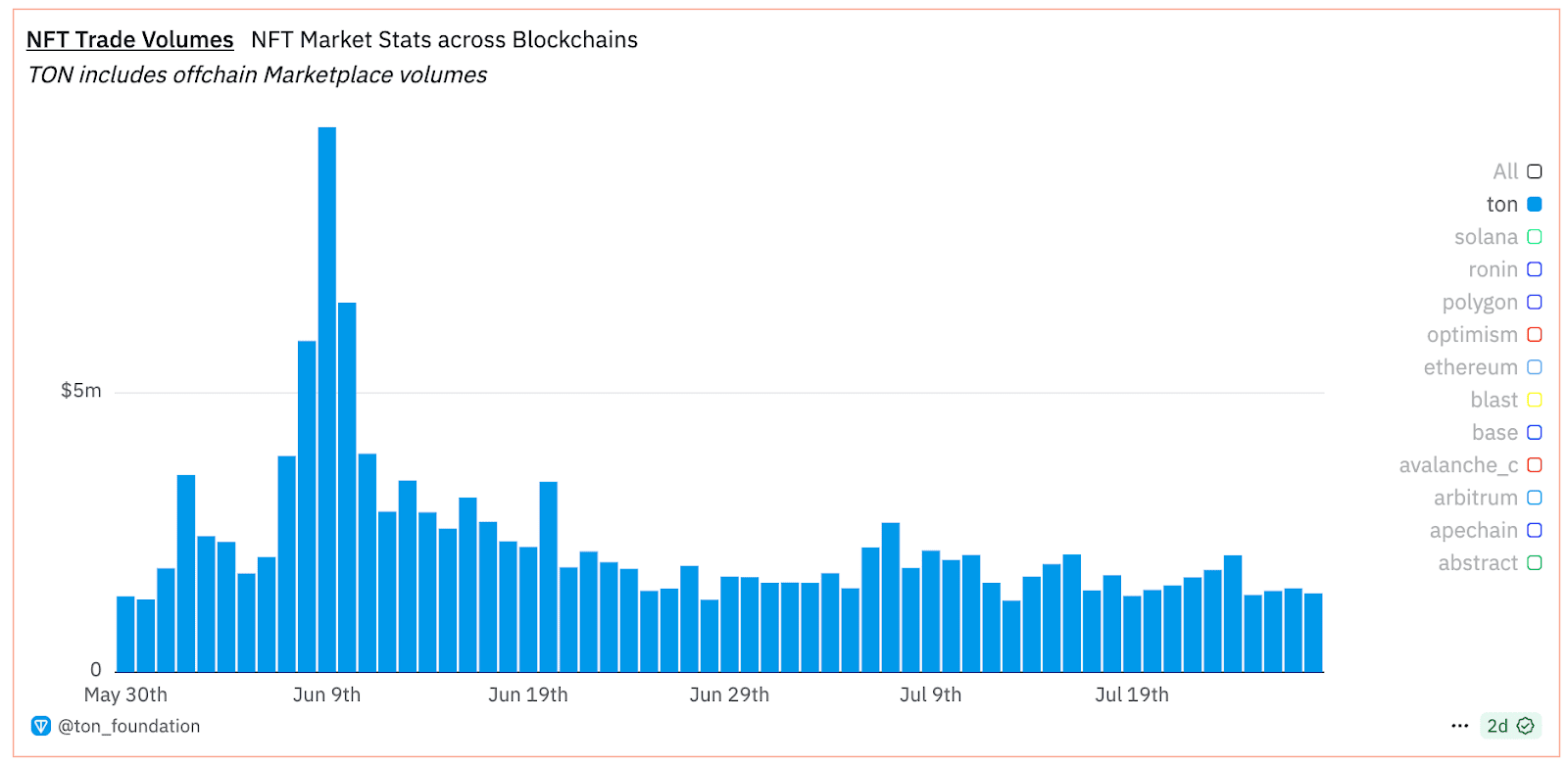
In total, over 300,000 unique addresses interacted with the gifts, more than 60% of which joined the network only in 2025. According to the developers, daily trading volumes of these gifts reached $3 million in June, helping TON secure second place in overall NFT trading rankings. 

Active trading of the gifts also boosted the blockchain’s key metrics:

  • Daily active wallets approached 250,000; 
  • Monthly transactions exceeded 70 million; 
  • NFT trading volumes in June hit a peak of $9.7 million per day, roughly five times higher than the May average.
NFT trading volume on the TON network. Source: Dune. Trading volumes of Telegram gifts across different marketplaces. Source: Dune.
Shifting Sentiment

Telegram gifts accounted for only about one-third of TON’s total NFT trading volume, yet the trend sparked active discussions on X over several weeks, highlighting its impact on retail user sentiment.


This influence is indirectly confirmed by the Plush Pepe collection, which shot into the top 5 NFT collections by value in early June — with its floor price doubling in just one week.


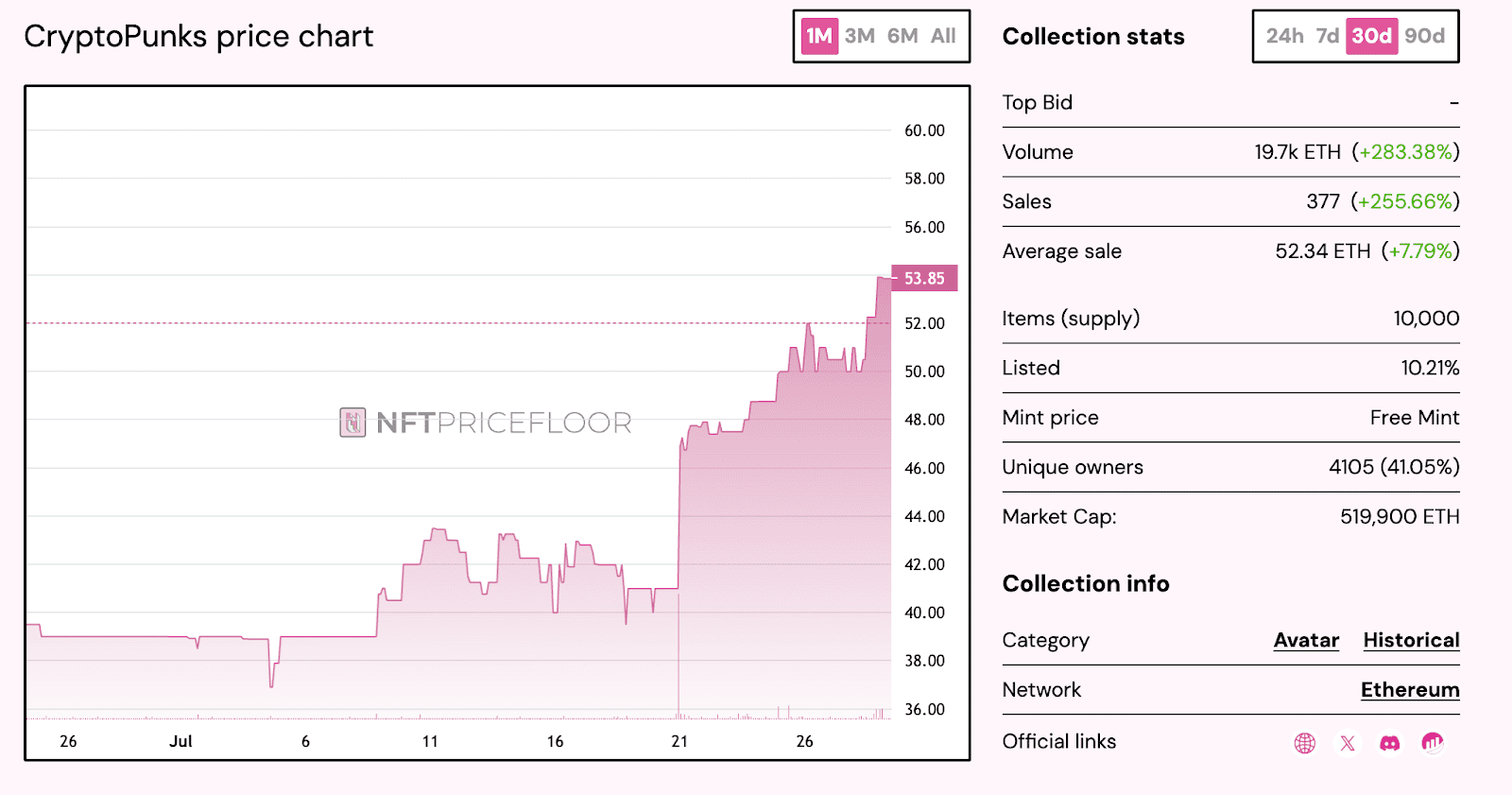
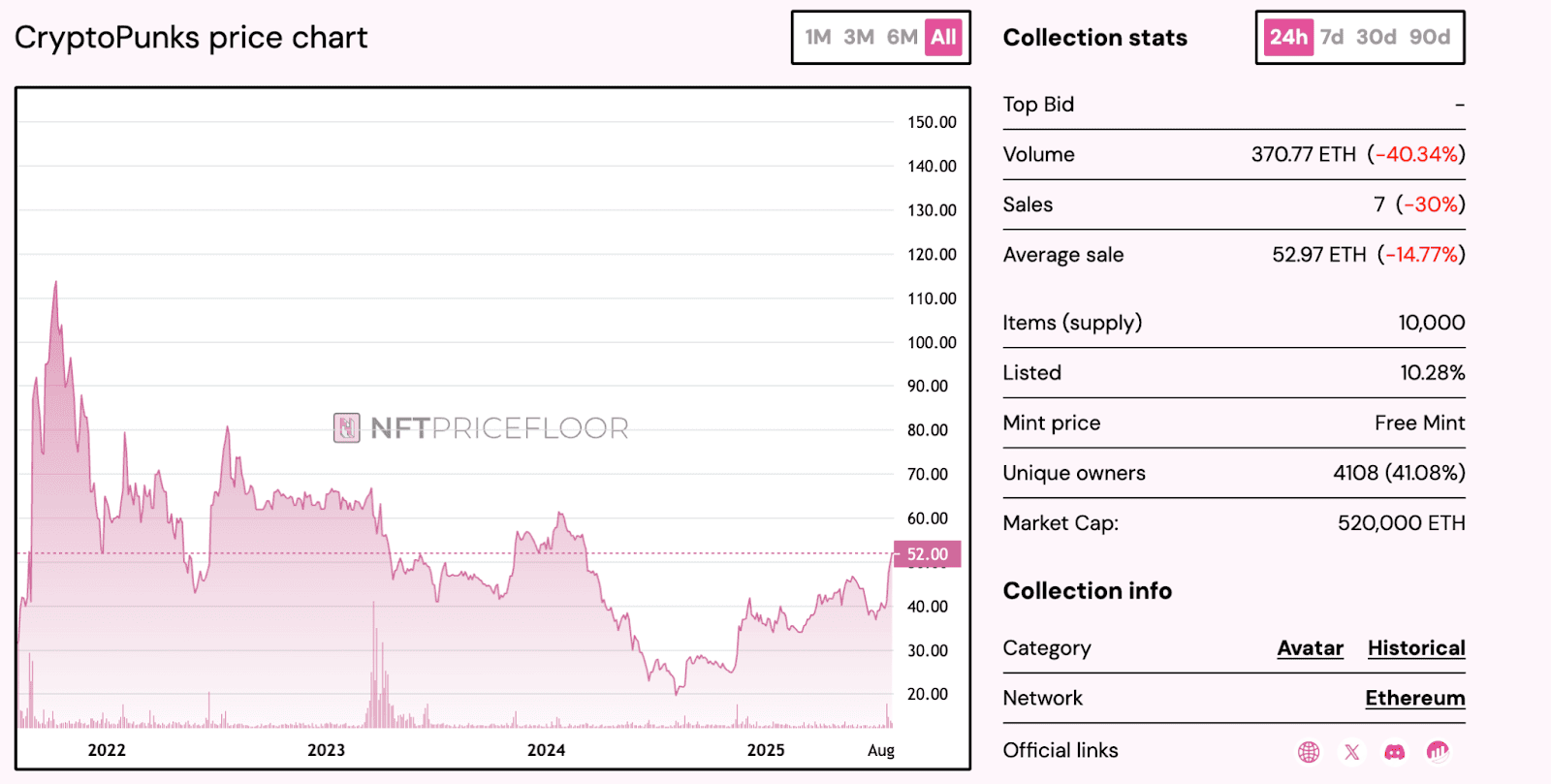
A standout event in July was the activity of an NFT whale, who purchased 48 CryptoPunks tokens, spending around $8.5 million. Additionally, another NFT — CryptoPunk #5577 — was acquired by the publicly traded company GameSquare. 

This event not only drew widespread market attention but also boosted the collection’s value by 15.9%, from 40 ETH to 47 ETH. In total, 88 NFTs were sold in a single day, marking one of the most active days for CryptoPunks in recent times. 

CryptoPunks NFT prices. Source: Nftpricefloor.

This transaction acted as a catalyst for other “blue-chip” NFTs. The Pudgy Penguins rose to 16.6 ETH, while their trading volume nearly quintupled — reaching $24.7 million in July compared to $5.3 million in June. Collections like  Bored Ape Yacht Club, Milady Maker and Moonbirds also saw price increases, all amid a sharp surge in trading activity.

Daily NFT trading volumes across different networks. Source: Dune.

However, “blue-chip” NFTs come with a high entry barrier and, as a result, see a relatively low number of transactions. Between July 28 and August 3, only 86 CryptoPunks tokens were sold. Despite any FOMO effect, these top collections are aimed at a small niche of investors and don’t significantly influence overall retail activity. 

Another project, however, managed to fill that gap. 

For several months, one of the busiest marketplaces has been Courtyard on the Polygon network. Its main offering is a tokenization service that allows owners of Pokémon, NBA, or MLB cards to turn them into NFTs.

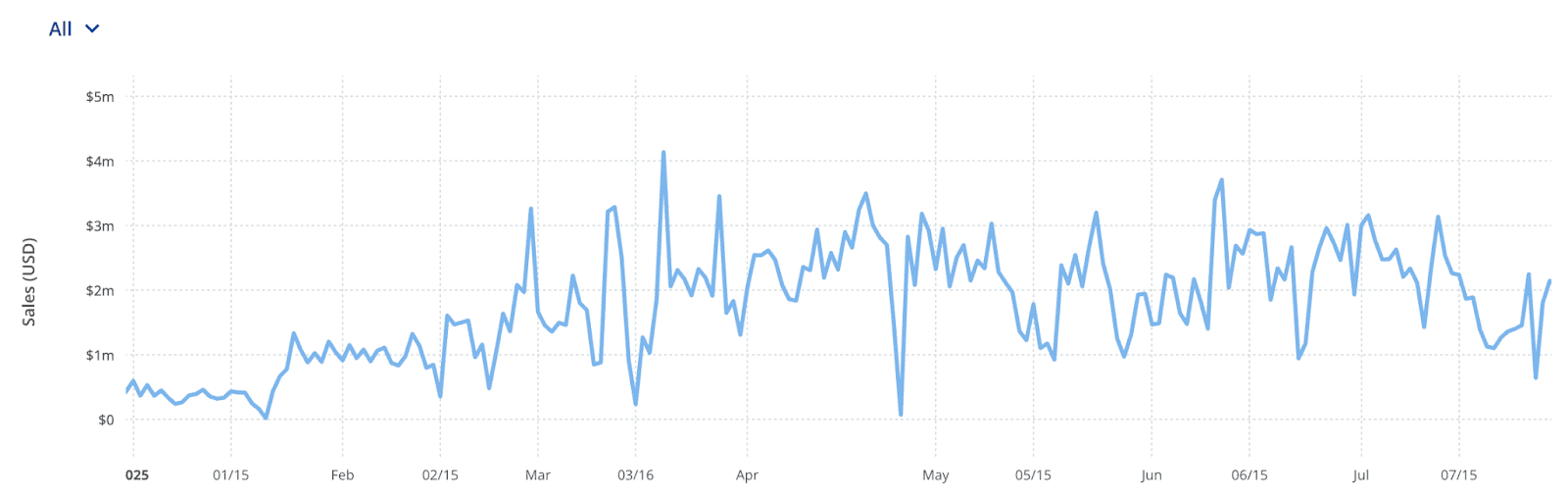
These tokens have been popular among collectors, providing the platform with steady trading activity for several months. However, July saw a notable surge — weekly trading volume on Courtyard exceeded $20.7 million, and the number of users nearly doubled to 39,000, briefly making Polygon the leading network in the NFT market.

Number of transactions on Courtyard in July 2025. Source: CryptoSlam. Trading volumes on Courtyard in 2025. Source: CryptoSlam.
Amid this growth, Courtyard secured $30 million in funding. This milestone can also be seen as a sign of institutional investor interest in the NFT market.

A Different Format

Courtyard is not just a marketplace — it’s also a tokenization platform. The tokens traded there fall into the category of “phygital assets”, making Courtyard, in some ways, closer to RWA (real-world asset) projects than traditional NFTs.


The fact that these tokenized assets attracted retail interest may indicate a shift in the market structure. It’s likely that the “revival” will be felt mainly by the iconic collections of the previous cycle, while the broader adoption of NFTs will come through new classes of tokens, including those tied to physical assets.

The NFT rebound took place against the backdrop of a broader crypto market rally, particularly for Ethereum. Its price surged over 55% in July, reaching $3,900.

Ethereum price trends in July 2025. Source: TradingView.

Rising prices have a strong impact on NFTs, since Ethereum is the leading network in the sector and most top collections are valued in ETH. As a result:

  • Crypto-denominated tokens also rise in dollar terms, providing holders with a sort of passive income. Buying NFTs can also be seen as an indirect bet on Ethereum.
  • ETH holders realized significant profits, which they could redirect into riskier investments, especially considering that in mid-July the Crypto Fear & Greed Index reached 79 points — the “greed zone.” 

Just as Solana’s growth positively influences the meme coin market, Ethereum boosts NFT demand, acting as a kind of meme-token analogue within this ecosystem.

Notably, NFTs have outpaced Ethereum in growth, nearly doubling its gains, showing that price increases aren’t solely due to a revaluation in dollar terms.

CryptoSlam ETH NFT Composite Index in July 2025. Source: CryptoSlam.

This trend is historically confirmed — a simple comparison of the cryptocurrency’s price chart with the NFT market capitalization makes it clear.

Total NFT market capitalization. Source: Coingecko. Ethereum price trends. Source: TradingView.
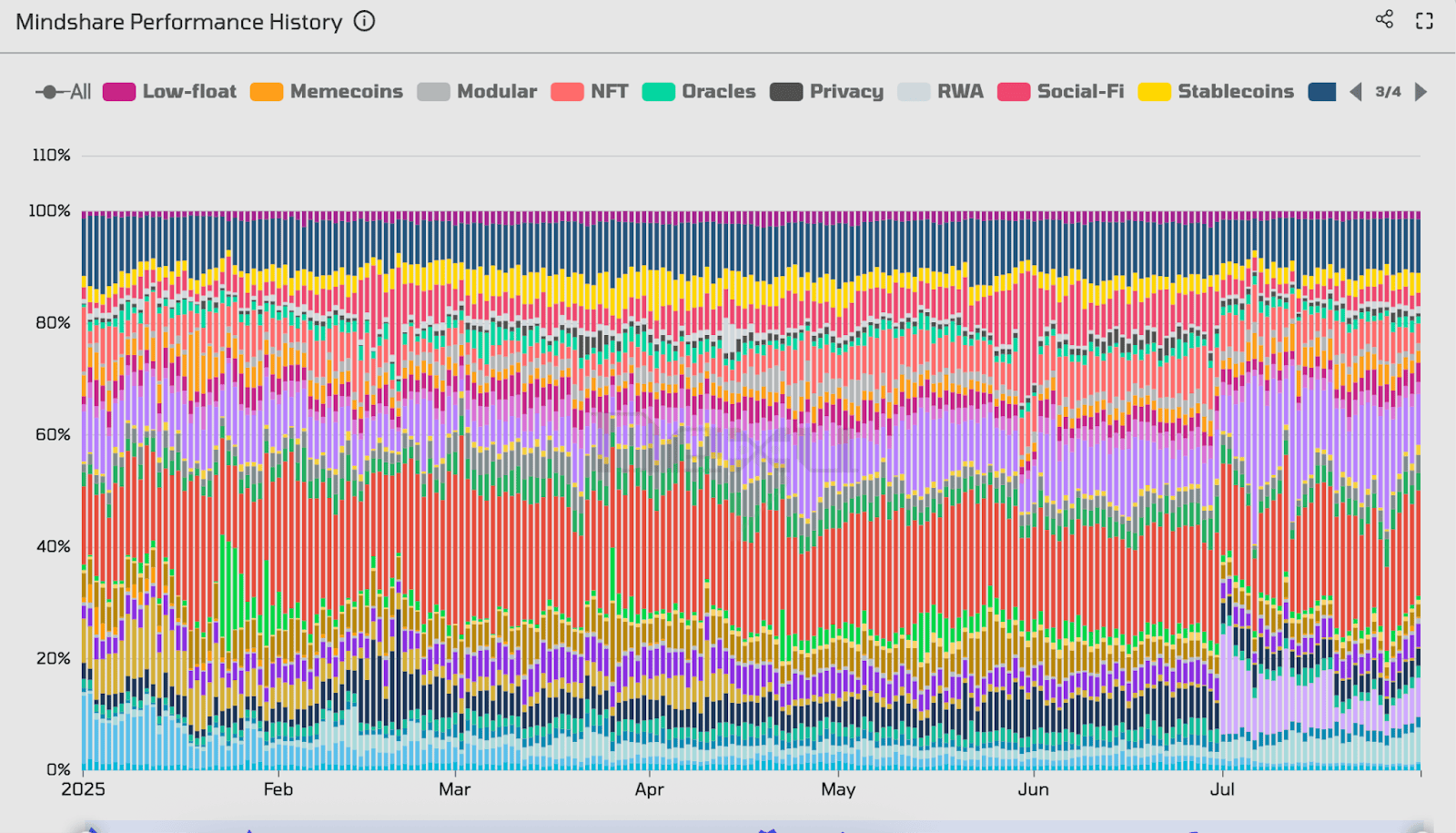
According to Dexu.ai at the peak of the July rally, NFTs captured over 8% of social media attention, becoming one of the most talked-about narratives. Only L1 blockchains and launchpads received a higher share of attention.

Social media attention trends for different crypto narratives. Source: Dexu.ai.

Over a 90-day period, NFTs emerged as one of the most profitable sectors, trailing only SocialFi and launchpads in performance.

Price trends of crypto market narratives. Source: Dexu.ai.
A New Format?

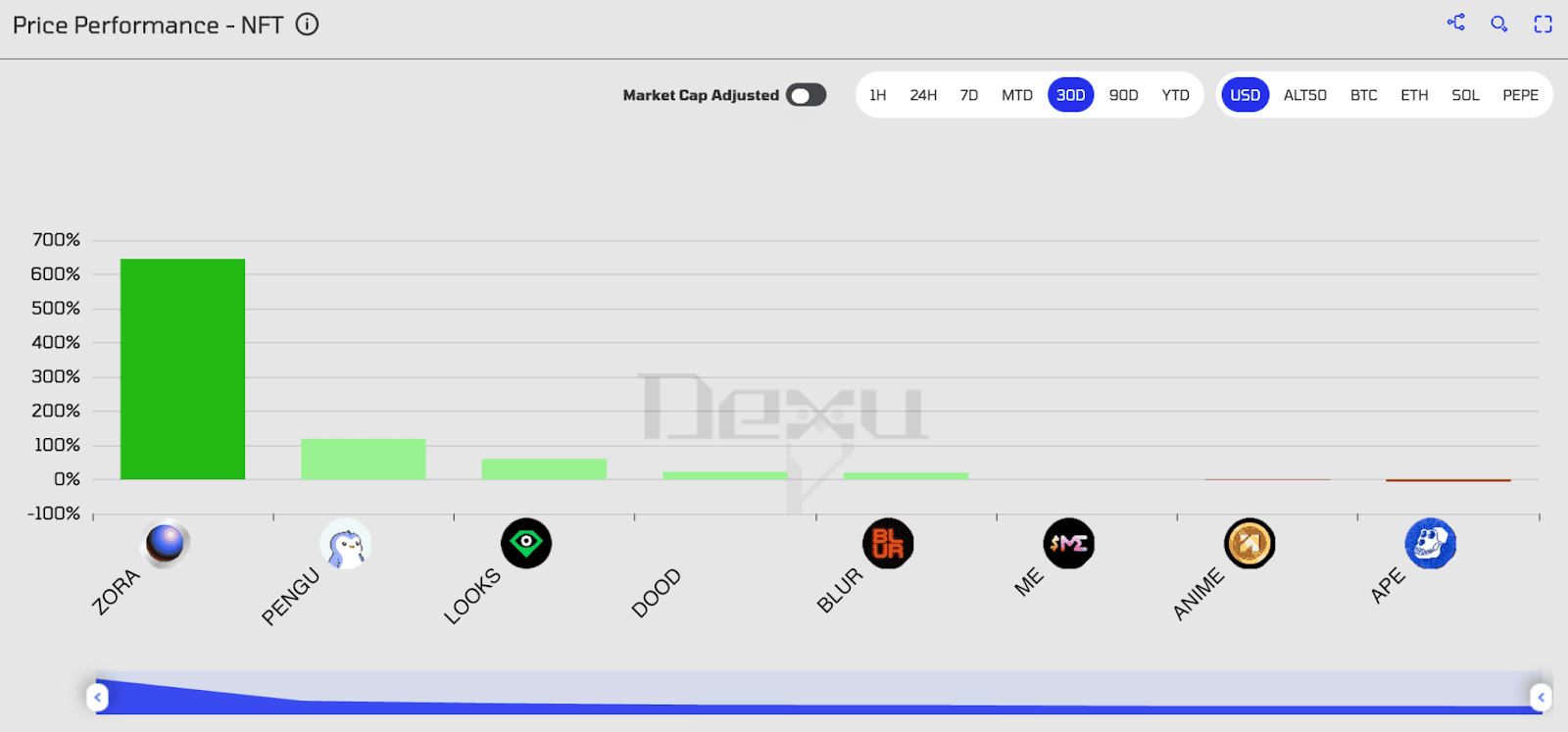
Another notable event in the NFT market in July was the explosive growth of Zora Protocol. Zora is a decentralized NFT marketplace and content tokenization platform. Its integration with the Base App as part of a super app allowed users to monetize their posts and treat them as speculative assets.


This partnership drove the project’s token to nearly eightfold growth, drawing significant community attention and impacting NFT market metrics.


Price dynamics of the largest projects in the NFT sector. Data: Dexu.ai.

However, the popularization of Zora could have long-term implications for the NFT sector.


The platform significantly simplifies NFT creation and trading. Combined with its social component, these tokens could occupy an intermediate niche between meme coins and unique asset collections, or even boost the visibility and capital appeal of the latter.

In summary, the July NFT rally was fueled both by broader market factors — shifts in sentiment and the flow of capital from Ethereum into riskier assets — and by local trends. But the key question remains: how sustainable is this effect, and have NFTs managed to capture not only the minds but also the wallets of the community?

Looking at the factors above, the NFT market in July experienced a sort of “perfect storm”:

  • Retail engagement through user-friendly apps and collecting;
  • Mini-rallies of blue-chip collections from the previous cycle;
  • Overall market recovery and Ethereum’s surge.

However, short-term impulses don’t always translate into a sustainable trend. Even with the recovery, market activity and capitalization remain below 2024 levels during the so-called “Trump rally,” let alone the heights of 2021–2022.

Total NFT market capitalization since November 2024. Source: Coingecko.
According to DappRadar, in July the average NFT price rose significantly more than the number of transactions — 40% versus 7%. Analysts suggest this indicates a shift of investors toward higher-value assets, aligning with demand for top collections and whale-driven activity.

The market remains highly fragmented, resembling the meme coin segment: some collections surge 200% in a week, while others lose liquidity and traders. Even among “blue-chip” NFTs, many haven’t recovered to the bear-market levels of 2023–2024.

CryptoPunks NFT prices. Source: Nftpricefloor.

Regarding user attention, despite data showing growing interest in the narrative, Google Trends search volume remains well below spring 2025 levels.

Search frequency for the term “NFT” in 2024–2025. Source: Google Trends.

Additionally, NFTs now face a new competitor for attention and capital — memecoins, which also leverage social and cultural narratives.

It’s likely that part of the liquidity that would have gone into NFT collections is now flowing into meme coins, which are easier and faster to trade. This reduces the likelihood of a broad-based rally, especially for new collections.

However, against the backdrop of the overall recovery, NFTs outpaced meme coins in growth — their market capitalization rose 100%, compared to roughly 80% for the largest meme coin segments. This suggests that we may be witnessing a more systemic shift in attention.

Total NFT market capitalization in June–July 2025. Source: Coingecko. Market capitalization of the largest meme coins in June–July 2025. Source: Coingecko.

Overall, the July growth is targeted, driven by specific collections and platforms rather than a broad revival of the entire ecosystem. NFTs are indeed waking from their slumber, but for now, it feels like a “probe” by major players to gauge audience interest and growth potential.

However, if the price rally continues and user-friendly apps along with “affordable” collections attract a wider audience, NFTs could experience a full-fledged growth phase that surpasses the “Trump rally.”  

Market Opportunity
Holo Token Logo
Holo Token Price(HOT)
$0.0005493
$0.0005493$0.0005493
+1.25%
USD
Holo Token (HOT) Live Price Chart
Disclaimer: The articles reposted on this site are sourced from public platforms and are provided for informational purposes only. They do not necessarily reflect the views of MEXC. All rights remain with the original authors. If you believe any content infringes on third-party rights, please contact service@support.mexc.com for removal. MEXC makes no guarantees regarding the accuracy, completeness, or timeliness of the content and is not responsible for any actions taken based on the information provided. The content does not constitute financial, legal, or other professional advice, nor should it be considered a recommendation or endorsement by MEXC.

You May Also Like

Husky Inu (HINU) Completes Move To $0.00020688

Husky Inu (HINU) Completes Move To $0.00020688

Husky Inu (HINU) has completed its latest price jump, rising from $0.00020628 to $0.00020688. The price jump is part of the project’s pre-launch phase, which began on April 1, 2025.
Share
Cryptodaily2025/09/18 01:10
US Senate Releases Draft Crypto Bill Establishing Clear Regulatory Framework for Digital Assets

US Senate Releases Draft Crypto Bill Establishing Clear Regulatory Framework for Digital Assets

TLDR: Bill resolves SEC-CFTC conflict by assigning clear regulatory authority over securities and commodities respectively. Ancillary assets category exempts network
Share
Blockonomi2026/01/14 04:57
Unprecedented Surge: Gold Price Hits Astounding New Record High

Unprecedented Surge: Gold Price Hits Astounding New Record High

BitcoinWorld Unprecedented Surge: Gold Price Hits Astounding New Record High While the world often buzzes with the latest movements in Bitcoin and altcoins, a traditional asset has quietly but powerfully commanded attention: gold. This week, the gold price has once again made headlines, touching an astounding new record high of $3,704 per ounce. This significant milestone reminds investors, both traditional and those deep in the crypto space, of gold’s enduring appeal as a store of value and a hedge against uncertainty. What’s Driving the Record Gold Price Surge? The recent ascent of the gold price to unprecedented levels is not a random event. Several powerful macroeconomic forces are converging, creating a perfect storm for the precious metal. Geopolitical Tensions: Escalating conflicts and global instability often drive investors towards safe-haven assets. Gold, with its long history of retaining value during crises, becomes a preferred choice. Inflation Concerns: Persistent inflation in major economies erodes the purchasing power of fiat currencies. Consequently, investors seek assets like gold that historically maintain their value against rising prices. Central Bank Policies: Many central banks globally are accumulating gold at a significant pace. This institutional demand provides a strong underlying support for the gold price. Furthermore, expectations around interest rate cuts in the future also make non-yielding assets like gold more attractive. These factors collectively paint a picture of a cautious market, where investors are looking for stability amidst a turbulent economic landscape. Understanding Gold’s Appeal in Today’s Market For centuries, gold has held a unique position in the financial world. Its latest record-breaking performance reinforces its status as a critical component of a diversified portfolio. Gold offers a tangible asset that is not subject to the same digital vulnerabilities or regulatory shifts that can impact cryptocurrencies. While digital assets offer exciting growth potential, gold provides a foundational stability that appeals to a broad spectrum of investors. Moreover, the finite supply of gold, much like Bitcoin’s capped supply, contributes to its perceived value. The current market environment, characterized by economic uncertainty and fluctuating currency values, only amplifies gold’s intrinsic benefits. It serves as a reliable hedge when other asset classes, including stocks and sometimes even crypto, face downward pressure. How Does This Record Gold Price Impact Investors? A soaring gold price naturally raises questions for investors. For those who already hold gold, this represents a significant validation of their investment strategy. For others, it might spark renewed interest in this ancient asset. Benefits for Investors: Portfolio Diversification: Gold often moves independently of other asset classes, offering crucial diversification benefits. Wealth Preservation: It acts as a robust store of value, protecting wealth against inflation and economic downturns. Liquidity: Gold markets are highly liquid, allowing for relatively easy buying and selling. Challenges and Considerations: Opportunity Cost: Investing in gold means capital is not allocated to potentially higher-growth assets like equities or certain cryptocurrencies. Volatility: While often seen as stable, gold prices can still experience significant fluctuations, as evidenced by its rapid ascent. Considering the current financial climate, understanding gold’s role can help refine your overall investment approach. Looking Ahead: The Future of the Gold Price What does the future hold for the gold price? While no one can predict market movements with absolute certainty, current trends and expert analyses offer some insights. Continued geopolitical instability and persistent inflationary pressures could sustain demand for gold. Furthermore, if global central banks continue their gold acquisition spree, this could provide a floor for prices. However, a significant easing of inflation or a de-escalation of global conflicts might reduce some of the immediate upward pressure. Investors should remain vigilant, observing global economic indicators and geopolitical developments closely. The ongoing dialogue between traditional finance and the emerging digital asset space also plays a role. As more investors become comfortable with both gold and cryptocurrencies, a nuanced understanding of how these assets complement each other will be crucial for navigating future market cycles. The recent surge in the gold price to a new record high of $3,704 per ounce underscores its enduring significance in the global financial landscape. It serves as a powerful reminder of gold’s role as a safe haven asset, a hedge against inflation, and a vital component for portfolio diversification. While digital assets continue to innovate and capture headlines, gold’s consistent performance during times of uncertainty highlights its timeless value. Whether you are a seasoned investor or new to the market, understanding the drivers behind gold’s ascent is crucial for making informed financial decisions in an ever-evolving world. Frequently Asked Questions (FAQs) Q1: What does a record-high gold price signify for the broader economy? A record-high gold price often indicates underlying economic uncertainty, inflation concerns, and geopolitical instability. Investors tend to flock to gold as a safe haven when they lose confidence in traditional currencies or other asset classes. Q2: How does gold compare to cryptocurrencies as a safe-haven asset? Both gold and some cryptocurrencies (like Bitcoin) are often considered safe havens. Gold has a centuries-long history of retaining value during crises, offering tangibility. Cryptocurrencies, while newer, offer decentralization and can be less susceptible to traditional financial system failures, but they also carry higher volatility and regulatory risks. Q3: Should I invest in gold now that its price is at a record high? Investing at a record high requires careful consideration. While the price might continue to climb due to ongoing market conditions, there’s also a risk of a correction. It’s crucial to assess your personal financial goals, risk tolerance, and consider diversifying your portfolio rather than putting all your capital into a single asset. Q4: What are the main factors that influence the gold price? The gold price is primarily influenced by global economic uncertainty, inflation rates, interest rate policies by central banks, the strength of the U.S. dollar, and geopolitical tensions. Demand from jewelers and industrial uses also play a role, but investment and central bank demand are often the biggest drivers. Q5: Is gold still a good hedge against inflation? Historically, gold has proven to be an effective hedge against inflation. When the purchasing power of fiat currencies declines, gold tends to hold its value or even increase, making it an attractive asset for preserving wealth during inflationary periods. To learn more about the latest crypto market trends, explore our article on key developments shaping Bitcoin’s price action. This post Unprecedented Surge: Gold Price Hits Astounding New Record High first appeared on BitcoinWorld.
Share
Coinstats2025/09/18 02:30




