

Latest Bitcoin & Ethereum News, Crypto Prices & Indexes

Ethereum (CRYPTO: ETH) has slipped into a zone that market watchers associate with capitulation, as on-chain signals flash bearish, yet opt for caution on whether a definitive bottom is in place. The focal point is the MVRV Z-Score, a gauge that compares current market value to the realized value, effectively measuring how much investors are paying relative to the price at which Ether last moved. A reading around -0.42 indicates Ether is trading below its realized value, a sign historically linked to stress but not a sole predictor of a lasting bottom. While some analysts argue this signals a clear capitulation phase, others warn that the current slide may not reach the extremes observed in past bear markets.
The MVRV Z-Score was designed to flag phases of euphoria or capitulation by showing when market value diverges markedly from realized value. In practice, a notably negative score has preceded bottoming behavior in prior cycles, albeit without a guaranteed timetable. Joao Wedson, a crypto Quant analyst and founder of Alphractal, described the current reading as “showing that Ethereum is indeed going through a clear capitulation process.” Yet, he cautioned that today’s data do not match the intensity of the 2018 and 2022 bear-market lows. The record low for the metric sits at -0.76, observed in December 2018, underscoring the scale of the slide that would be needed for a historical parallel.
Ether MVRV Z-Score tanks below zero in capitulation. Source: AlphractalThe near-term horizon, however, remains contested. Wedson noted that further downside is possible before any sustained recovery takes hold, citing continued market stress and the possibility of liquidity constraints during tax season. “The market is already under stress, but historically, there is still room for further downside before a definitive structural bottom is formed,” he said. Ether’s price action has been volatile, with a sharp decline followed by a tentative rebound, complicating the call on whether the capitulation phase is nearing its end.
The recent price action has been punishing: Ether has fallen about 30% over the past two weeks, sinking to a bear-market low near $1,825 on a Friday before a modest rebound to roughly $2,100 on the following Monday. The moves come amid broader macro fragility and shifting risk sentiment within crypto markets, prompting both caution and opportunism among analysts. Some traders and researchers see this as a rare “buy fear” window, while others warn that risk remains elevated until on-chain dynamics confirm a bottom.
HashKey Group senior researcher Tim Sun told Cointelegraph that historical performance has reinforced the view that Ethereum’s MVRV Z-Score can be a reliable indicator for identifying bottoming zones, particularly when combined with evolving on-chain activity and long-term ecosystem development. “Judging by on-chain activity, protocol evolution, and long-term ecosystem structure, Ethereum’s fundamentals have not seen any substantive deterioration. On the contrary, they continue to improve across several key dimensions,” he said. Still, Sun stressed that current trajectories could change if the primary drivers of decline persist, suggesting that a definitive bottom remains contingent on future liquidity and demand signals.
Meanwhile, other observers offered a more optimistic read. Michaël van de Poppe, founder of MN Fund, argued that the drawdown presents a rare opportunity to consider ETH as an investable bet, noting a substantial gap between the current price and the “fair price” implied by the MVRV ratio. “I think that this is a tremendous opportunity to be looking at ETH,” he tweeted, positing that negative deviations historically precede substantial recoveries when macro and on-chain conditions align. The narrative held that Ether’s network metrics and the broader ecosystem strength underpin a case for accumulation once the weak hands have been flushed out.
Other voices joined the chorus of potential catalysts for a rebound. Andri Fauzan Adziima, Bitrue’s research lead, suggested that persistent negative MVRV zones have historically preceded strong recoveries in subsequent cycles. He contended that ETH’s network fundamentals remained robust and that a long-term accumulation stance could emerge once price risk subsides. “Brutal capitulation now, but historically one of the best ‘buy fear’ windows for ETH,” Adziima said, underscoring the tension between near-term price action and longer-term structural factors.
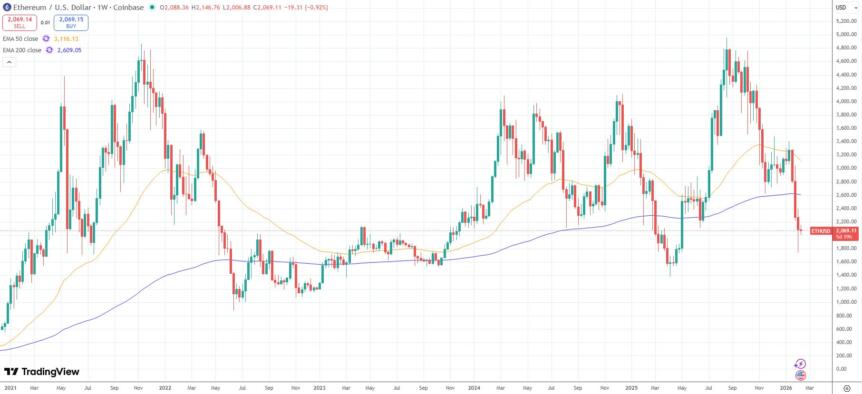 ETH prices have tanked back to long-term cycle lows. Source: TradingView
Market participants acknowledged that the current pullback may be overshadowed by longer-term catalysts such as network upgrades and continued ecosystem maturation, even as price action remains sensitive to near-term liquidity and macro dynamics. The narrative that “buying fear” can yield outsized returns if followed by demand recovery continues to gain traction among several traders, though it remains balanced by caution regarding April liquidity and potential tax-related squeezes.
One of the best “buy fear” windows for Ether
Despite the caution, several observers argued that the current environment could present one of the more compelling entry points for ETH in recent memory. Van de Poppe’s commentary echoed a view shared by others that a sharp deviation below fair value can precede a robust rebound when demand returns and on-chain indicators resume strengthening. The notion is that ETH’s price could be primed for a longer-term recovery even if the immediate path remains choppy.
As the debate continues, sentiment remains nuanced. Some participants emphasize that negative MVRV conditions have historically aligned with durable recoveries once the weak hands capitulate, while others warn that liquidity constraints around the April tax season could delay any sustained recovery. The balance between on-chain fundamentals and macro stressors will likely shape Ether’s trajectory over the coming weeks and into the next quarter.
For investors watching the tape, the key takeaway is that volatility may persist even as underlying fundamentals show resilience. The combination of a negative MVRV reading and persistent price pressure suggests that any bottoming process will require a convergence of favorable liquidity and sustained demand, rather than a simple technical bounce.
Why it matters
The ongoing discussion around Ether’s valuation and bottoming prospects matters for multiple stakeholders. For traders, MVRV-based indicators provide a framework to interpret on-chain signals amid price volatility, while investors may view the current setup as an opportunity to accumulate at a discount relative to realized value. For developers and ecosystem participants, the narrative about Ethereum’s fundamentals—network activity, upgrade timelines, and long-term growth—matters for capital allocation, governance engagement, and potential product developments that could draw renewed user interest.
From a market-wide perspective, Ethereum’s fate remains a bellwether for risk appetite in crypto markets. A clear bottom in ETH could bolster sentiment across altcoins and contribute to a broader risk-on environment, while a protracted drawdown could reinforce caution and delay recovery for other assets. In either case, the episode underscores the importance of on-chain metrics as a corroborating lens for price action, beyond headlines and short-term moves.
What to watch next
- Monitor liquidity conditions around the April tax season for potential downside or relief catalysts.
- Track on-chain indicators related to MVRV Z-Score and general network activity to assess whether a structural bottom forms.
- Watch for sustained price stabilization above recent lows and any acceleration in demand signals that could precede a rebound.
- Observe broader macro factors and crypto market flows that could influence risk sentiment and capital allocation.
Sources & verification
- On-chain MVRV Z-Score interpretation and commentary by Joao Wedson of Alphractal (tweet/status referenced in the article).
- Cointelegraph reports on Ether’s 30% decline over a two-week period and the subsequent move to around $2,100.
- HashKey Group insights from Tim Sun regarding MVRV Z-Score reliability and Ethereum fundamentals.
- Industry commentary from Michaël van de Poppe and Bitrue’s Andri Fauzan Adziima on negative MVRV zones and potential buy opportunities.
https://platform.twitter.com/widgets.js
This article was originally published as Latest Bitcoin & Ethereum News, Crypto Prices & Indexes on Crypto Breaking News – your trusted source for crypto news, Bitcoin news, and blockchain updates.


You May Also Like

Moscow Exchange prepares to start trading cryptocurrencies this year

Breaking Down Settlement Factors in Formula Injury Lawsuits

India Busts ₹226 Crore Crypto Network Linked to Drugs and Terror Financing



