Ethereum steadies its dominance in the stablecoin market, as it commands a staggering monthly transfer volume per holder. Stablecoins mostly flow on the Ethereum network, according to recent data from the on-chain analytical platform Our Network. The report, shared by the head of research at Onchain Foundation, Leon Waidemann, identified that Ethereum has the largest share of monthly stablecoin transactions in the crypto space. Ethereum Averages $521K Stablecoin Transfer Per User For context, the report ranked blockchains by monthly transfer volume per holder. Unsurprisingly, Ethereum led the chart, with an impressive $521,000 moved per holder over 30 days in the network. Notably, this indicates that massive capital flows through Ethereum and stablecoins account for a considerable part of it. This comes as no surprise, as the smart contract-infused blockchain hosts 51% of the total stablecoin market cap, around $142.6 billion. Meanwhile, this further confirms a trend of massive institutional stablecoin use case, especially on Ethereum. Fiat-pegged cryptocurrencies are gaining increasing attention from large financial institutions, which have identified their use case in settlements. Interestingly, the total stablecoin market cap is slowly growing, as issuers inject more liquidity into the market in response to user demand. The total stablecoin market has grown to $275.5 billion, adding $9.06 billion (3.40%) in the past seven days alone. The majority of these supplies are being transacted on Ethereum, providing use cases and fee revenue for the network. Some believe this would boost revenue, increase Ether’s utility, and consequently drive prices to unprecedented levels. A New Contender to Ethereum’s Stablecoin Dominance? Meanwhile, despite holding a mere 0.64% ($1.77 billion) of the stablecoin supply, Avalanche recorded an impressive monthly transfer volume per holder. Users moved stablecoins on the chain at an average volume of $206,000 per holder, signaling stablecoin interest on Avalanche. Stablecoin Chain Ranking by Monthly Transfer Per Holder Notably, Avalanche has expanded its stablecoin ecosystem lately in collaborations with institutional players. Visa recently announced adding Avalanche to its stablecoin settlement network, with Wyoming testing America’s first state-issued stablecoin, WYST, on the blockchain. Other chains in the top five by monthly transfer volume per holder include Optimism at $82,000, Tron network at $71,000, and Aptos at $56,000. Meanwhile, the list featured other notable networks such as Solana, BNB, and the XRP Ledger, where users transferred an average of $41,000, $36,000, and $26,000, respectively, per holder.Ethereum steadies its dominance in the stablecoin market, as it commands a staggering monthly transfer volume per holder. Stablecoins mostly flow on the Ethereum network, according to recent data from the on-chain analytical platform Our Network. The report, shared by the head of research at Onchain Foundation, Leon Waidemann, identified that Ethereum has the largest share of monthly stablecoin transactions in the crypto space. Ethereum Averages $521K Stablecoin Transfer Per User For context, the report ranked blockchains by monthly transfer volume per holder. Unsurprisingly, Ethereum led the chart, with an impressive $521,000 moved per holder over 30 days in the network. Notably, this indicates that massive capital flows through Ethereum and stablecoins account for a considerable part of it. This comes as no surprise, as the smart contract-infused blockchain hosts 51% of the total stablecoin market cap, around $142.6 billion. Meanwhile, this further confirms a trend of massive institutional stablecoin use case, especially on Ethereum. Fiat-pegged cryptocurrencies are gaining increasing attention from large financial institutions, which have identified their use case in settlements. Interestingly, the total stablecoin market cap is slowly growing, as issuers inject more liquidity into the market in response to user demand. The total stablecoin market has grown to $275.5 billion, adding $9.06 billion (3.40%) in the past seven days alone. The majority of these supplies are being transacted on Ethereum, providing use cases and fee revenue for the network. Some believe this would boost revenue, increase Ether’s utility, and consequently drive prices to unprecedented levels. A New Contender to Ethereum’s Stablecoin Dominance? Meanwhile, despite holding a mere 0.64% ($1.77 billion) of the stablecoin supply, Avalanche recorded an impressive monthly transfer volume per holder. Users moved stablecoins on the chain at an average volume of $206,000 per holder, signaling stablecoin interest on Avalanche. Stablecoin Chain Ranking by Monthly Transfer Per Holder Notably, Avalanche has expanded its stablecoin ecosystem lately in collaborations with institutional players. Visa recently announced adding Avalanche to its stablecoin settlement network, with Wyoming testing America’s first state-issued stablecoin, WYST, on the blockchain. Other chains in the top five by monthly transfer volume per holder include Optimism at $82,000, Tron network at $71,000, and Aptos at $56,000. Meanwhile, the list featured other notable networks such as Solana, BNB, and the XRP Ledger, where users transferred an average of $41,000, $36,000, and $26,000, respectively, per holder.
Ethereum Dominates Monthly Stablecoin Transfer Volume With $521K Per User

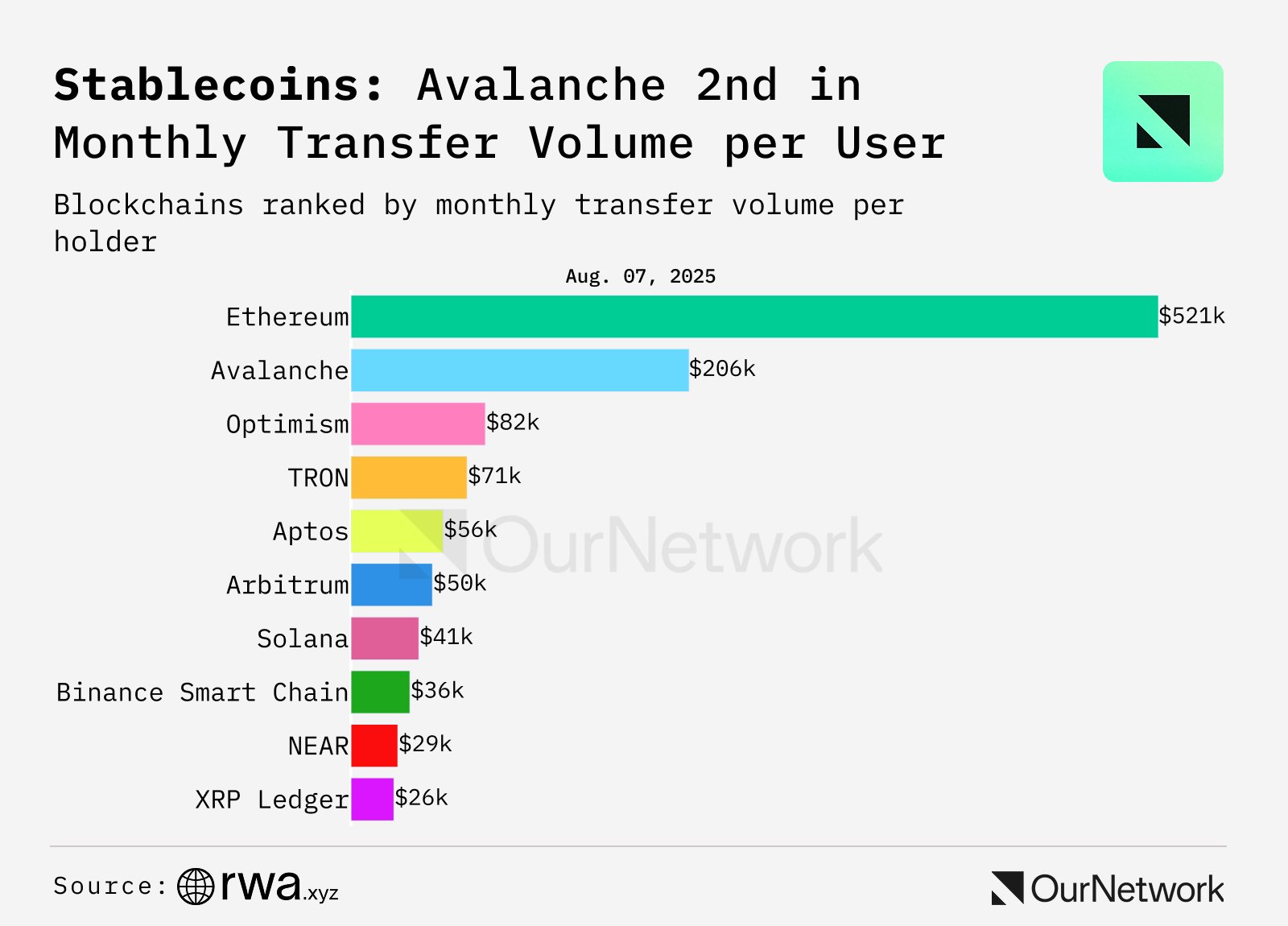
Ethereum steadies its dominance in the stablecoin market, as it commands a staggering monthly transfer volume per holder. Stablecoins mostly flow on the Ethereum network, according to recent data from the on-chain analytical platform Our Network. The report, shared by the head of research at Onchain Foundation, Leon Waidemann, identified that Ethereum has the largest share of monthly stablecoin transactions in the crypto space. Ethereum Averages $521K Stablecoin Transfer Per User For context, the report ranked blockchains by monthly transfer volume per holder. Unsurprisingly, Ethereum led the chart, with an impressive $521,000 moved per holder over 30 days in the network. Notably, this indicates that massive capital flows through Ethereum and stablecoins account for a considerable part of it. This comes as no surprise, as the smart contract-infused blockchain hosts 51% of the total stablecoin market cap, around $142.6 billion. Meanwhile, this further confirms a trend of massive institutional stablecoin use case, especially on Ethereum. Fiat-pegged cryptocurrencies are gaining increasing attention from large financial institutions, which have identified their use case in settlements. Interestingly, the total stablecoin market cap is slowly growing, as issuers inject more liquidity into the market in response to user demand. The total stablecoin market has grown to $275.5 billion, adding $9.06 billion (3.40%) in the past seven days alone. The majority of these supplies are being transacted on Ethereum, providing use cases and fee revenue for the network. Some believe this would boost revenue, increase Ether’s utility, and consequently drive prices to unprecedented levels. A New Contender to Ethereum’s Stablecoin Dominance? Meanwhile, despite holding a mere 0.64% ($1.77 billion) of the stablecoin supply, Avalanche recorded an impressive monthly transfer volume per holder. Users moved stablecoins on the chain at an average volume of $206,000 per holder, signaling stablecoin interest on Avalanche. Stablecoin Chain Ranking by Monthly Transfer Per Holder Notably, Avalanche has expanded its stablecoin ecosystem lately in collaborations with institutional players. Visa recently announced adding Avalanche to its stablecoin settlement network, with Wyoming testing America’s first state-issued stablecoin, WYST, on the blockchain. Other chains in the top five by monthly transfer volume per holder include Optimism at $82,000, Tron network at $71,000, and Aptos at $56,000. Meanwhile, the list featured other notable networks such as Solana, BNB, and the XRP Ledger, where users transferred an average of $41,000, $36,000, and $26,000, respectively, per holder.

Market Opportunity
Binance Coin Logo
Binance Coin Price(BNB)
$935.45
$935.45$935.45
+2.08%
USD
Binance Coin (BNB) Live Price Chart
Disclaimer: The articles reposted on this site are sourced from public platforms and are provided for informational purposes only. They do not necessarily reflect the views of MEXC. All rights remain with the original authors. If you believe any content infringes on third-party rights, please contact service@support.mexc.com for removal. MEXC makes no guarantees regarding the accuracy, completeness, or timeliness of the content and is not responsible for any actions taken based on the information provided. The content does not constitute financial, legal, or other professional advice, nor should it be considered a recommendation or endorsement by MEXC.

You May Also Like

The Channel Factories We’ve Been Waiting For

The Channel Factories We’ve Been Waiting For

The post The Channel Factories We’ve Been Waiting For appeared on BitcoinEthereumNews.com. Visions of future technology are often prescient about the broad strokes while flubbing the details. The tablets in “2001: A Space Odyssey” do indeed look like iPads, but you never see the astronauts paying for subscriptions or wasting hours on Candy Crush.  Channel factories are one vision that arose early in the history of the Lightning Network to address some challenges that Lightning has faced from the beginning. Despite having grown to become Bitcoin’s most successful layer-2 scaling solution, with instant and low-fee payments, Lightning’s scale is limited by its reliance on payment channels. Although Lightning shifts most transactions off-chain, each payment channel still requires an on-chain transaction to open and (usually) another to close. As adoption grows, pressure on the blockchain grows with it. The need for a more scalable approach to managing channels is clear. Channel factories were supposed to meet this need, but where are they? In 2025, subnetworks are emerging that revive the impetus of channel factories with some new details that vastly increase their potential. They are natively interoperable with Lightning and achieve greater scale by allowing a group of participants to open a shared multisig UTXO and create multiple bilateral channels, which reduces the number of on-chain transactions and improves capital efficiency. Achieving greater scale by reducing complexity, Ark and Spark perform the same function as traditional channel factories with new designs and additional capabilities based on shared UTXOs.  Channel Factories 101 Channel factories have been around since the inception of Lightning. A factory is a multiparty contract where multiple users (not just two, as in a Dryja-Poon channel) cooperatively lock funds in a single multisig UTXO. They can open, close and update channels off-chain without updating the blockchain for each operation. Only when participants leave or the factory dissolves is an on-chain transaction…
Share
BitcoinEthereumNews2025/09/18 00:09
Onyxcoin Price Breakout Coming — Is a 38% Move Next?

Onyxcoin Price Breakout Coming — Is a 38% Move Next?

The post Onyxcoin Price Breakout Coming — Is a 38% Move Next? appeared on BitcoinEthereumNews.com. Onyxcoin price action has entered a tense standoff between bulls
Share
BitcoinEthereumNews2026/01/14 00:33
CEO Sandeep Nailwal Shared Highlights About RWA on Polygon

CEO Sandeep Nailwal Shared Highlights About RWA on Polygon

The post CEO Sandeep Nailwal Shared Highlights About RWA on Polygon appeared on BitcoinEthereumNews.com. Polygon CEO Sandeep Nailwal highlighted Polygon’s lead in global bonds, Spiko US T-Bill, and Spiko Euro T-Bill. Polygon published an X post to share that its roadmap to GigaGas was still scaling. Sentiments around POL price were last seen to be bearish. Polygon CEO Sandeep Nailwal shared key pointers from the Dune and RWA.xyz report. These pertain to highlights about RWA on Polygon. Simultaneously, Polygon underlined its roadmap towards GigaGas. Sentiments around POL price were last seen fumbling under bearish emotions. Polygon CEO Sandeep Nailwal on Polygon RWA CEO Sandeep Nailwal highlighted three key points from the Dune and RWA.xyz report. The Chief Executive of Polygon maintained that Polygon PoS was hosting RWA TVL worth $1.13 billion across 269 assets plus 2,900 holders. Nailwal confirmed from the report that RWA was happening on Polygon. The Dune and https://t.co/W6WSFlHoQF report on RWA is out and it shows that RWA is happening on Polygon. Here are a few highlights: – Leading in Global Bonds: Polygon holds 62% share of tokenized global bonds (driven by Spiko’s euro MMF and Cashlink euro issues) – Spiko U.S.… — Sandeep | CEO, Polygon Foundation (※,※) (@sandeepnailwal) September 17, 2025 The X post published by Polygon CEO Sandeep Nailwal underlined that the ecosystem was leading in global bonds by holding a 62% share of tokenized global bonds. He further highlighted that Polygon was leading with Spiko US T-Bill at approximately 29% share of TVL along with Ethereum, adding that the ecosystem had more than 50% share in the number of holders. Finally, Sandeep highlighted from the report that there was a strong adoption for Spiko Euro T-Bill with 38% share of TVL. He added that 68% of returns were on Polygon across all the chains. Polygon Roadmap to GigaGas In a different update from Polygon, the community…
Share
BitcoinEthereumNews2025/09/18 01:10