

An AI-Led Path to Modernizing Airline Business Platforms
Navigating the Digital Storm: From Legacy Platforms to Intelligent Airline Enterprises
The global airline industry is standing at an inflection point. Constrained for decades by heavy regulation, slim profits,1 multiple dependencies and long change horizons, airlines now have an opportunity to harness AI to break out of this cycle and fundamentally change how their stakeholders interact.
What began as a gradual digitization of customer interfaces has accelerated into a full-scale reinvention of airline business platforms. Airlines today are not only competing on routes and fares; they are competing on experience, resilience, speed, and intelligence.
Passengers now expect airlines to operate like digital natives, anticipating disruptions, personalizing offers in real-time, and responding instantly across all channels. Yet behind a seemingly-modern front end lies a brittle operational core that was built decades ago. These legacy platforms were designed for stability over agility; for efficiency instead of intelligence.
Modernization, therefore, is no longer simply an IT refresh. It is a strategic imperative that touches every part of the airline, from network planning and flight operations to crew management, disruption handling, and revenue optimization. Flight Operations Systems (FOS) are a critical part of this journey, but they are only one piece of a much broader business platform transformation.
Industry Context: Airlines Are Betting Big on Platform Modernization
Leading carriers are already committing significant investments to future-proof their technology foundations:
- Southwest Airlines earmarked US $1.7 billion for technology and cloud initiatives2 in 2024, positioning digital platforms as growth enablers.
- British Airways is migrating nearly 700 systems to the cloud as part of a £750 million transformation3 to embed AI and automation across operations.
- Delta Air Lines completed a large-scale cloud migration,4 supporting record revenues of US $61.6 billion through data-driven operations.
While much of the early modernization focus was on customer-facing platforms, the next frontier is the operational backbone, which is tasked with preventing delays, optimizing crews, utilizing aircraft efficiently, and absorbing disruptions with minimal customer impact.
Why Operational Platforms Define Airline Performance
Despite the attention given to sleek mobile apps and modern Passenger Service Systems (PSS), the passenger experience is shaped long before a traveler opens a mobile app. On-time performance, recovery from disruption, crew availability, aircraft readiness, and regulatory compliance are all determined by the back-end operational platforms.
A modern airline business platform must unify:
- Network & schedule planning
- Flight and crew operations
- Maintenance and engineering
- Airport and ground operations
- Revenue, finance, and analytics
Among these, Flight Operations Systems (FOS) sit at the center, continuously coordinating aircraft, crew, flight plans, safety, and real-time control.
Understanding FOS: The Digital Nervous System of Airline Operations
An airline’s FOS manages the end-to-end operational lifecycle of a flight. It typically includes modules that handle:
- Flight planning and dispatch
- Crew management and rostering
- Aircraft assignment and tail management
- Operations Control Center (OCC)
- Load control and ground operations
- Safety, compliance, and operational analytics
Each of these modules depends on continuous real-time data exchange. A single aircraft swap can create a cascade of changes and tasks, including crew reassignments, load recalculations, maintenance checks, and rebooking passengers. Any delay or data inconsistency can trigger operational chaos and impact the traveler experience.
The Integration Reality: A Hyper-Connected Airline Ecosystem
A Flight Operations System (FOS) does not operate in isolation. It integrates with:
- Passenger Service Systems (PSS)
- Departure Control Systems (DCS)
- Maintenance & MRO platforms
- Finance and ERP systems
- External entities like ATC, airports, and regulators
This creates a dense web of integrations using diverse standards such as IATA AIDX, FIXM, XML, and JSON. Managing these interfaces at scale is one of the hardest aspects of modernization.
The Looming Crisis: The Mainframe Trap in Airline Operations
At the heart of the challenge lies the legacy mainframe, often TPF-based, which powers core operational and transactional workloads. For decades, these systems delivered unmatched reliability. Today, they have become a strategic liability.
Airlines attempting incremental modernization have discovered several hard truths:
- Talent erosion: Engineers with deep TPF and mainframe expertise are retiring, making skills scarce and costly.
- Operational rigidity: Monolithic architectures resist modular change and slow down innovation cycles.
- Data fragmentation: Real-time decisioning, AI-driven optimization, and personalization demand unified data, something legacy cores cannot were never designed to deliver.
As a result, airlines face longer time-to-market, higher operational costs, and an inability to respond dynamically during disruptions. The gap between what customers expect and what systems can deliver continues to widen.
Why “Lift and Shift” Fails: The Frankenstein Effect
In the rush to modernize, many airlines initially pursued “lift-and-shift” migrations, moving legacy workloads to the cloud without re-architecting them. The advantage of this approach is the relative speed with which it can be executed, but more often than not it results in a so-called “Frankenstein” architecture. The monolith is replaced by a fragmented landscape of multiple tightly-coupled applications that run on modern infrastructure but behave like legacy systems.
This patchwork architecture creates:
- Higher cloud costs without flexibility
- Complex integrations and brittle interfaces
- Minimal gains in agility or innovation
True modernization is not about changing where systems run; it is about changing how they are designed, connected, and how they evolve. Airlines are now realizing that the real challenge lies in extracting business logic, mapping dependencies, and orchestrating across many different platforms.
From Duplication to Orchestration: The Third Path to Airline Platform Modernization
True modernization is not about copying legacy systems into the cloud; it is about orchestrating business logic, data, and decision flows for a fundamentally new operating model that supports continuous change and real-time improvements. Without re-engineering how airline platforms work, cloud migration delivers neither flexibility nor cost efficiency, and innovation remains elusive.
As airlines confront this reality, they face a familiar dilemma:
- Buy pre-packaged COTS solutions, which accelerate deployment but sacrifice differentiation and long-term agility
- Build bespoke platforms tailored to their specific needs, but at the cost of speed, scale, and economic viability
Neither path alone delivers meaningful transformation, which is why most airlines adopt a hybrid approach.
The Hybrid Modernization Strategy: Buy + Build Done Right
For most airlines, the solution is to try to find the right balance between the build and buy scenarios. Typically, they will use COTS products for mission-critical functions like flight planning, crew management, and OCC, whilebuilding custom applications for differentiation, disruption management, fuel optimization, advanced analytics, and AI-driven insights.
This strategy balances reliability with innovation, but it introduces new challenges:
| Challenge | Why It Matters |
| Integration standardization | Multiple vendors use different data models and standards |
| Real-time synchronization | OCC decisions require split-second updates |
| Data consistency | Single source of truth is essential for safety and efficiency |
| Regulatory compliance | FAA/EASA/ICAO alignment demands precise logging |
| Parallel operations | Legacy and new systems must coexist safely |
| Resilience & security | Uniform SLAs, DR, and cybersecurity are mandatory |
These challenges underscore the need for modernization to be platform-led, rather than system-led. Without a strong orchestration layer, hybrid modernization can quickly become unmanageable.
What airlines need is a third path: One that intelligently balances modernization velocity, operational resilience, and business value.
The AI Inflection Point: From Manual Integration to Intelligent Orchestration
Generative AI and Agentic AI have the potential to fundamentally change the modernization equation and provide the right solution to modernizing critical back-end operational systems.
How GenAI Accelerates Modernization
- Automatically reverse-engineers legacy code and documentation
- Extracts business rules and requirements
- Generates data mappings, integration logic, and test cases
How Agentic AI Transforms Operations
- Continuously monitors integration pipelines
- Detects data breaks and latency issues
- Self-corrects workflows across FOS, PSS, MRO, and airport systems
Together, GenAI and Agentic AI can enable airlines to shift from brittle, manual integration to adaptive, self-healing platforms. When brittle systems break, they create bottlenecks that have an ecosystem-wide impact that can affect other systems that would otherwise be functioning properly.
With self-healing operations, AI agents can dynamically re-route data and workflows in real time while the underlying problem is addressed — minimizing the operational (and financial) impact.
The Solution: Blueprinting Airline Platforms Before Rebuilding
The most underestimated challenge in mainframe and legacy platform modernization is not code migration, but institutional memory loss. Across airlines, decades of embedded business rules govern:
- Flight dispatch logic
- Crew legality calculations
- Disruption handling priorities
- Revenue protection decisions
Much of this logic exists only in your application code, undocumented and deeply intertwined across systems. Attempting to modernize without understanding these dependencies ranges from risky to catastrophic — the equivalent of pulling one wire and watching your entire system go dark.
This is precisely where Coforge’s Forge-X platform5 comes into play, solving this problem at the source. Forge-X is backed up by our team’s deep airline and TPF expertise, dedicated mainframe and operations domain training, and Agentic AI and GenAI accelerators that deliver what traditional modernization approaches cannot.
How Forge-X works
Forge-X is an AI-led modernization framework that decodes, rationalizes, and orchestrates airline platforms before transformation begins, turning legacy complexity into an executable modernization blueprint. Its key features include:
- Dependency Intelligence:EliminatingHidden Failure Chains
Using our CodeInsight.AI accelerator, Forge-X automatically scans your legacy codebases to surface:
- Hidden inter-system dependencies
- Event sequencing logic
- Exception handling paths
This prevents cascading failures, often described as the “Christmas tree lights problem.”
- Business Logic Reconstruction at Scale
Where documentation no longer exists, our BlueSwan® platform6 leverages AI-driven reverse engineering to reconstruct and document:
- Operational business rules
- Data transformation logic
- Compliance constraints embedded in legacy workflows
BlueSwan prevents you from losing critical operational intelligence during modernization.
- Intelligent Application Rationalization
Forge-X also delivers critical portfolio rationalization insights and recommendations, classifying applications and services as:
- Retain – Systems that remain stable and cost-effective
- Modernize – Platforms that benefit from re-architecture and cloud-native design
- Replace – Functions better served by modern COTS or AI-native solutions
Powered by Quasar, we enable you to create a prioritized, low-risk modernization roadmap.
From Migration to Orchestration: Building Airline Platforms That Think
Using Quasar and BlueSwan, Forge-X takes the guesswork out of modernization and provides the foundation for informed, data-driven decision making. It helps:
- Align modernization decisions to business outcomes
- Enable event-driven, API-first architectures
- Embed AI agents to monitor, adapt, and optimize platform behavior
The result is a cohesive airline business platform that is intelligent, resilient, and future-ready.
The Real Catalyst: Customer-Centricity Meets Operational Intelligence
Modernization is no longer simply a technology play, but a growth agenda led by CMOs, CCOs, and CDOs. Emerging consumer segments — particularly Gen Z and Gen Alpha — are reshaping travel behavior through social platforms and influencer-driven discovery.
To compete, airlines must deliver:
- Hyper-personalized offers
- Dynamic pricing and bundling
- Real-time recovery during disruptions
Forge-X enables this convergence by ensuring that operational platforms connect and coordinate with customer and revenue systems in real-time.
The Path Forward: An Outcome-Driven Approach to Airline Modernization
The new modernization paradigm requires a shift in thinking, from a focus on technology goals to one that considers business outcomes first. For airlines, these outcomes might be:
- Faster disruption recovery
- Improved crew utilization
- Reduced operational cost leakage
- New ancillary and personalization revenue streams
At Coforge, we first ask “What do you want to change about how your airline operates, recovers, sells, or serves?”
Then, we work backwards from these goals, using Forge-X to design your modernization journey — applying our platforms, AI accelerators, and airline domain expertise to deliver measurable results.
Conclusion: The Airline of the Future Is a Platform Company
As the industry moves toward AI-driven, customer-centric ecosystems, airlines that embrace orchestration over duplication, intelligence over infrastructure, and outcomes over assets will have a distinct edge. Modernization is not about replacing systems in isolation. It is about building intelligent, interconnected ecosystems. Airlines that embrace an AI-led, platform-centric model will move faster, be more resilient, and have a sustainable competitive advantage. From complex platform migrations to enterprise-wide system integration, Coforge leverages three decades of airline domain expertise combined with AI-driven modernization accelerators like Forge-X to make your transformation executable.
Modernization is no longer optional. Tomorrow’s airline is being built now, and it is being driven by Coforge. Contact us to learn how we can forge your future today.


You May Also Like

TrapDoor Malware Targets Crypto and AI Developers in Supply Chain Attack
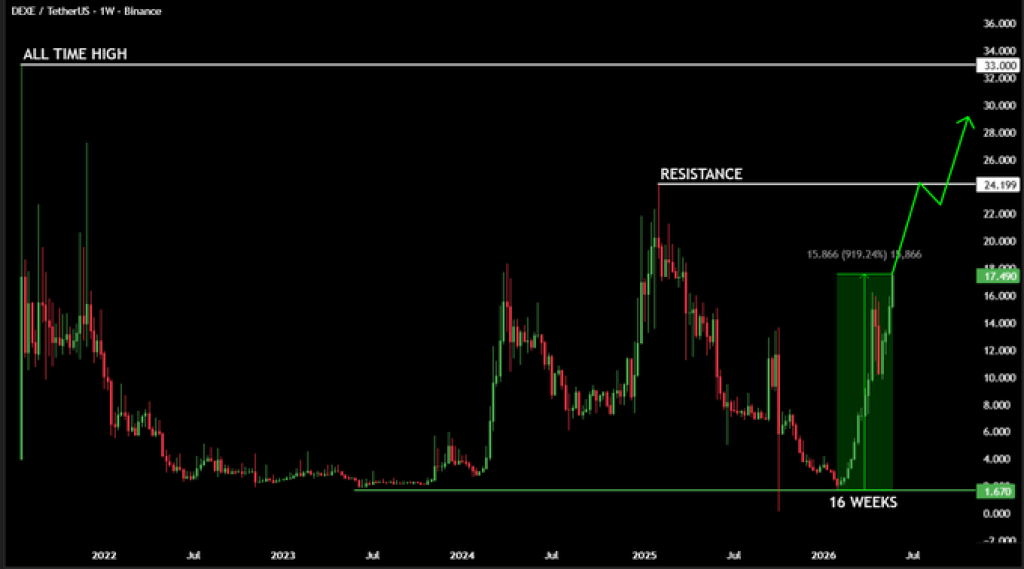
Here’s Why DeXe (DEXE) Price is Pumping Today

Alabama Enacts Dual Legislative Breakthrough in Blockchain and Judicial Reform



