

XRPL Validator Says $100 XRP Price Will Certainly Happen. Here’s why
Cryptocurrency markets often appear unpredictable, swinging between hype and skepticism, yet some trends follow clear structural logic. XRP, designed as a bridge asset for global payments and tokenized finance, is increasingly evaluated not merely as a speculative token but as a foundational component in a high-volume financial system.
Understanding its role reveals why its eventual price appreciation may be less about speculation and more about systemic necessity.
XRPL analyst 24HRSCRYPTO highlighted this perspective in a recent X post, asserting that a $100 XRP price is not only possible but inevitable. “Mathematically and logically, it has to fulfill its purpose,” the post explained, emphasizing XRP’s function as a bridge asset capable of facilitating trillions in daily cross-border settlements, tokenized securities flows, stablecoin liquidity, and real-time collateral movement.
According to 24HRSCRYPTO, the token cannot remain priced like a microcap if it is to support the scale of global financial activity it was designed for.
XRP’s Utility in a Tokenized Economy
XRP’s primary value comes from its ability to act as a settlement layer for massive financial flows. Stablecoins alone are projected to reach multi-trillion-dollar circulation in the coming years, while tokenized real-world assets could total $10–30 trillion by 2030.
Cross-border payment flows exceed $150 trillion annually, and XRP is uniquely positioned to serve as the bridge that absorbs even a fraction of this liquidity efficiently. Without scaling in price, XRP’s capacity to perform this role would be constrained, limiting its utility within a tokenized financial ecosystem.
The XRP Ledger (XRPL) supports billions of dollars in daily transactions with near-instant settlement and low transaction costs. Its interoperability with multiple financial rails further strengthens XRP’s position as a core bridge asset, ensuring that liquidity can move seamlessly across tokenized instruments.
The Economic Logic Behind Price Growth
Utility-driven assets naturally reprice according to the value they secure. In XRP’s case, systemic demand will exert upward pressure on price as the network absorbs growing volumes of tokenized assets and settlement flows.
24HRSCRYPTO frames the $100 valuation as a logical equilibrium: the bridge asset must reach a level that reflects the scale of financial activity it underpins.
Implications for Investors
For long-term holders and ecosystem participants, XRP’s trajectory demonstrates that its value is tied not just to speculation but to measurable utility within the financial system. While short-term volatility will continue, the structural rationale for price appreciation aligns with the token’s functional purpose.
Ultimately, as global finance continues to tokenize assets and demand real-time liquidity, XRP’s role as a bridge asset ensures that its price will scale accordingly. The $100 mark is not mere speculation—it represents a natural valuation aligned with XRP’s systemic importance in the next generation of financial infrastructure.
Disclaimer: This content is meant to inform and should not be considered financial advice. The views expressed in this article may include the author’s personal opinions and do not represent Times Tabloid’s opinion. Readers are urged to do in-depth research before making any investment decisions. Any action taken by the reader is strictly at their own risk. Times Tabloid is not responsible for any financial losses.
Follow us on Twitter, Facebook, Telegram, and Google News
The post XRPL Validator Says $100 XRP Price Will Certainly Happen. Here’s why appeared first on Times Tabloid.


You May Also Like

TrapDoor Malware Campaign Infiltrates Developer Supply Chains to Target Crypto and AI Projects

TrapDoor Malware Targets Crypto and AI Developers in Supply Chain Attack
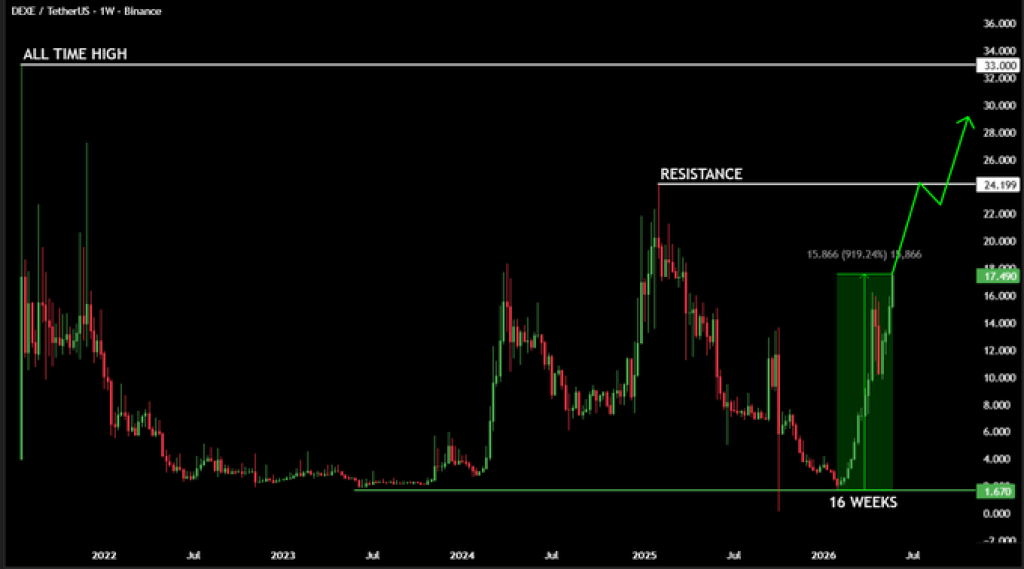
Here’s Why DeXe (DEXE) Price is Pumping Today



