

SPARC Symposium: CX Lessons in Global Collaboration and AI Translation
When CX Silos Stall Innovation: What CX Leaders Can Learn from SPARC’s Global Research Collaboration
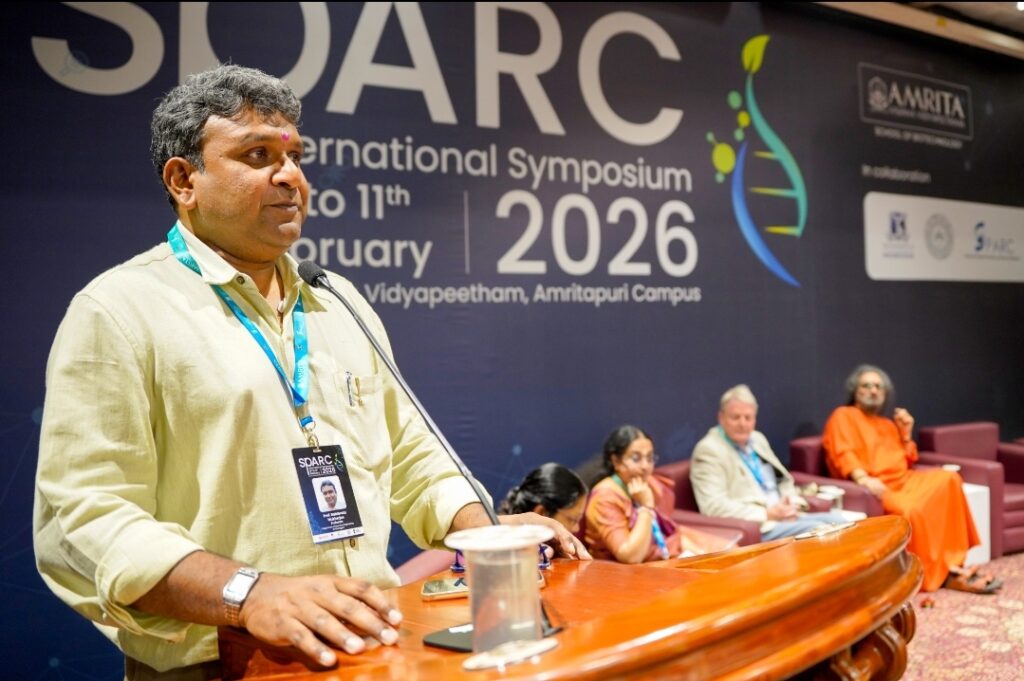
International SPARC Symposium hosted by Amrita Vishwa Vidyapeetham in February 2026.
Ever watched a high-potential CX initiative stall because teams spoke different languages—data, technology, policy, or purpose?
One team ships models. Another waits for governance. A third questions relevance. Customers feel the friction long before leaders see it.
Now imagine coordinating scientists, clinicians, policymakers, AI researchers, and universities across continents—and still producing momentum.
That is exactly what happened in Kerala this week.
From February 9–11, 2026, an international symposium at Amrita Vishwa Vidyapeetham brought together global leaders in biotechnology, AI, and translational health under the SPARC initiative. While the headlines focus on science, the deeper lesson is unmistakably CX.
This was journey orchestration at ecosystem scale.
And CX/EX leaders should pay attention.
What Is the SPARC Symposium and Why Should CX Leaders Care?
SPARC is a government-led collaboration framework that aligns institutions, talent, and outcomes across borders.
For CX leaders, it offers a blueprint for breaking silos, accelerating AI adoption, and translating insight into real-world impact.
The International SPARC Symposium on Advanced Biomedical and Translational Research was jointly organized by:
Amrita School of Biotechnology
Indian Institute of Technology Kanpur
University of Melbourne
Ministry of Education under the SPARC program
On paper, this looks like academic news.
In practice, it is experience architecture at scale.
Why CX Transformation Fails in Complex Organizations
Most CX failures are not technology failures. They are orchestration failures.
CXQuest’s research consistently shows three systemic blockers:
- Siloed ownership across functions and partners
- AI without translation, stuck in pilots
- Journey fragmentation, where value leaks between handoffs
SPARC confronted all three—head-on.
How SPARC Solved the “Last-Mile CX” Problem in Research
SPARC reframes success from outputs to outcomes.
Not papers. Not prototypes. But translation into societal impact.
The symposium focused on:
- Molecular therapeutics and diagnostics
- Disease biology and antimicrobial resistance (AMR)
- Computational and AI tools in medicine
- Immunity and clinical translation
Each theme crossed disciplinary boundaries by design.
That mirrors modern CX reality: customers do not experience functions; they experience outcomes.
What CX Leaders Can Learn from SPARC’s Collaboration Model
SPARC succeeds because it treats collaboration as a system, not a meeting.
Let’s break this down.
1. Shared Purpose Beats Shared Dashboards
SPARC anchors collaboration in national and societal priorities.
This creates emotional alignment before operational alignment.
As Richard Strugnell, Professor of Microbiology and Immunology at the University of Melbourne, observed:
CX takeaway:
Purpose is the fastest way to dissolve silos.
2. Interdisciplinary Design Prevents AI Theater
AI was embedded, not showcased.
Computational tools sat alongside clinicians and biologists.
According to Sandeep Verma, Professor at IIT Kanpur:
CX takeaway:
AI belongs inside the journey, not beside it.
3. Governance Enables Speed—It Doesn’t Kill It
Many CX teams fear governance. SPARC proves the opposite.
With the SPARC framework, roles, funding pathways, and expectations were clear. That clarity accelerated trust.
CX takeaway:
Well-designed governance is an experience enabler.
The CX Parallel: From Research Translation to Journey Translation
SPARC’s biggest insight is translation.
Discovery means nothing until it changes lived experience.
In CX terms:
| Research World | CX World |
|---|---|
| Lab discovery | Insight generation |
| Pilot study | Proof of concept |
| Clinical validation | Journey testing |
| Public health impact | Customer value realization |
Most CX teams stall between pilot and impact.
SPARC was built specifically to close that gap.
What Role Did Leadership Play in Sustaining Momentum?
Leadership framed collaboration as a long-term ecosystem, not a one-off event.
Bipin Nair, Dean – Life Sciences at Amrita, highlighted the balance:
Meanwhile, Maneesha V. Ramesh, Pro Vice Chancellor, emphasized translation into public value.
CX takeaway:
Sustainable CX transformation needs executive narrative, not just executive sponsorship.
Common CX Pitfalls SPARC Actively Avoided
These are the traps SPARC side-stepped—and CX teams often fall into.
- Treating collaboration as coordination
- Letting expertise compete instead of complement
- Measuring activity instead of impact
- Isolating AI teams from domain experts
SPARC designed against all four.
A Practical Framework: The SPARC CX Orchestration Model
CXQuest proposes adapting SPARC into a five-layer CX framework:
1. Purpose Layer
Define the why beyond KPIs.
2. Capability Layer
Map complementary strengths across teams and partners.
3. Translation Layer
Assign owners for turning insight into action.
4. Governance Layer
Create clear rules for decision-making and accountability.
5. Impact Layer
Measure outcomes customers actually feel.
This is CX beyond touchpoints.
Why This Matters Now for CX and EX Leaders
CX complexity is exploding.
Journeys span platforms, partners, regulators, and AI systems.
SPARC shows that ecosystem CX is not optional anymore.
India’s growing role as a global research hub mirrors what many enterprises face:
global scale, local relevance, and real accountability.
FAQ: CX Lessons from the SPARC Symposium
How is SPARC different from typical collaboration programs?
SPARC is outcome-driven, with translation built into the model, not added later.
Can enterprises replicate this without government backing?
Yes. The principles—purpose, governance, translation—are organizational, not political.
What does this mean for AI-led CX programs?
AI must sit inside domain workflows, not operate as a parallel function.
How does this help employee experience (EX)?
Clear purpose and interdisciplinary respect reduce friction and burnout.
Is this model scalable for large enterprises?
SPARC proves scale improves alignment when orchestration is intentional.
Actionable Takeaways for CX Leaders
Use these steps to apply SPARC thinking immediately:
- Redefine CX success in outcome language customers recognize.
- Map siloed teams by capability, not hierarchy.
- Embed AI teams inside journey ownership, not innovation labs.
- Design governance that accelerates decisions, not approvals.
- Create explicit translation roles from insight to execution.
- Anchor CX programs in societal or customer purpose, not metrics alone.
- Invest in ecosystems, not just platforms.
- Measure what changes for customers—not what ships internally.
Final Thought
The SPARC Symposium was not just a research event.
It was a masterclass in orchestration, trust, and translation.
For CXQuest readers, the message is clear:
The future of CX belongs to leaders who can design ecosystems—not just journeys.
And that future is already here.
The post SPARC Symposium: CX Lessons in Global Collaboration and AI Translation appeared first on CX Quest.


You May Also Like

Trump warns of major US strikes on Iran within weeks

Silver Price Analysis: XAG/USD Plummets to $70.50 as Bearish Pressure Intensifies



