Google Cloud is moving forward with plans to launch its own layer-1 (L1) blockchain, positioning the network as neutral infrastructure for global finance at a time when fintech competitors are developing out their own distributed ledgers.In a LinkedIn post published Tuesday, Rich Widmann, Google’s head of Web3 strategy, provided fresh details on the project, known as the Google Cloud Universal Ledger (GCUL). He described the platform as a credibly neutral, high-performance blockchain designed for institutions, supporting Python-based smart contracts to make it more accessible to developers and financial engineers.“Any financial institution can build with GCUL,” Widmann said, arguing that while companies like Tether may be unlikely to adopt Circle’s blockchain and payment firms like Adyen may hesitate to use Stripe’s, Google’s neutral infrastructure removes those barriers. He also expanded on a comparative chart by fintech strategist Chuk Okpalugo, highlighting how GCUL differs from Stripe’s Tempo and Circle’s Arc, two other high-profile L1 efforts.In setting out Google’s case for the Universal Ledger, Widmann drew contrasts with other high-profile entrants. Stripe’s project, Tempo, is rooted in its payments empire, effectively extending the company’s existing merchant rails into a vertically coffntrolled chain. Circle’s Arc, by contrast, places its stablecoin at the center of the system, treating USDC as the protocol’s native fuel and promising lightning-fast settlement with built-in currency exchange. Google’s approach is different still: the Universal Ledger is designed as a shared infrastructure layer, intended to be credibly neutral and accessible to any institution rather than bound to a single payments ecosystem.Timelines also set the projects apart. Circle has already begun piloting Arc, while Stripe is targeting a launch next year. Google and CME, meanwhile, have completed an initial integration of GCUL, with broader testing to follow later this year and full services expected in 2026.The distribution story reinforces those distinctions. Stripe can lean on more than a trillion dollars in annual merchant payment flows. Circle can count on USDC’s global footprint and liquidity integrations. Google brings the reach of its cloud platform, along with the promise of scaling a ledger that can support billions of users and hundreds of institutions.Features further differentiate the chains. Arc’s focus is speed and seamless foreign exchange, Tempo’s is merchant integration, and GCUL’s is programmability through Python-based smart contracts and institutional-grade tokenization.The result, Widmann argued, is divergent positioning. Stripe’s and Circle’s ledgers may serve their own ecosystems well but risk deterring competitors, while Google is pitching GCUL as neutral ground — a ledger that anyone, from exchanges to payment providers, can use without fear of strengthening a rival.The institutional-first positioning is not new. In March, Google Cloud and CME Group jointly announced GCUL, unveiling it as a programmable distributed ledger tailored for wholesale payments and asset tokenization. CME Group said it had already completed the first phase of integration and testing, describing the technology as a potential breakthrough for collateral, settlement, and fee payments in markets that are increasingly moving toward 24/7 trading.“As the President and new Administration have encouraged Congress to create landmark legislation for common-sense market structure, we are pleased to partner with Google Cloud to enable innovative solutions for low-cost, digital transfer of value,” CME Chairman and CEO Terry Duffy said at the time. He suggested GCUL could deliver meaningful efficiencies across core market functions, including margin and collateral management.According to the March announcement, CME and Google plan to begin direct testing with market participants later this year, with an eye to launching services in 2026. Widmann’s Aug. 26 remarks add new detail to that roadmap, reinforcing GCUL’s role as infrastructure designed to be broadly adopted across the financial sector rather than controlled by a single payments company. By positioning GCUL against Stripe’s Tempo and Circle’s Arc, Google is signaling that competition among major technology firms to define the next generation of financial settlement rails is accelerating.Technical details on GCUL’s architecture remain limited, though Widmann said more would be released in the coming months. For now, Google is presenting the Universal Ledger as a foundation for global-scale payments, institutional tokenization and around-the-clock capital markets infrastructure.Read More: Why Circle and Stripe (And Many Others) Are Launching Their Own BlockchainsGoogle Cloud is moving forward with plans to launch its own layer-1 (L1) blockchain, positioning the network as neutral infrastructure for global finance at a time when fintech competitors are developing out their own distributed ledgers.In a LinkedIn post published Tuesday, Rich Widmann, Google’s head of Web3 strategy, provided fresh details on the project, known as the Google Cloud Universal Ledger (GCUL). He described the platform as a credibly neutral, high-performance blockchain designed for institutions, supporting Python-based smart contracts to make it more accessible to developers and financial engineers.“Any financial institution can build with GCUL,” Widmann said, arguing that while companies like Tether may be unlikely to adopt Circle’s blockchain and payment firms like Adyen may hesitate to use Stripe’s, Google’s neutral infrastructure removes those barriers. He also expanded on a comparative chart by fintech strategist Chuk Okpalugo, highlighting how GCUL differs from Stripe’s Tempo and Circle’s Arc, two other high-profile L1 efforts.In setting out Google’s case for the Universal Ledger, Widmann drew contrasts with other high-profile entrants. Stripe’s project, Tempo, is rooted in its payments empire, effectively extending the company’s existing merchant rails into a vertically coffntrolled chain. Circle’s Arc, by contrast, places its stablecoin at the center of the system, treating USDC as the protocol’s native fuel and promising lightning-fast settlement with built-in currency exchange. Google’s approach is different still: the Universal Ledger is designed as a shared infrastructure layer, intended to be credibly neutral and accessible to any institution rather than bound to a single payments ecosystem.Timelines also set the projects apart. Circle has already begun piloting Arc, while Stripe is targeting a launch next year. Google and CME, meanwhile, have completed an initial integration of GCUL, with broader testing to follow later this year and full services expected in 2026.The distribution story reinforces those distinctions. Stripe can lean on more than a trillion dollars in annual merchant payment flows. Circle can count on USDC’s global footprint and liquidity integrations. Google brings the reach of its cloud platform, along with the promise of scaling a ledger that can support billions of users and hundreds of institutions.Features further differentiate the chains. Arc’s focus is speed and seamless foreign exchange, Tempo’s is merchant integration, and GCUL’s is programmability through Python-based smart contracts and institutional-grade tokenization.The result, Widmann argued, is divergent positioning. Stripe’s and Circle’s ledgers may serve their own ecosystems well but risk deterring competitors, while Google is pitching GCUL as neutral ground — a ledger that anyone, from exchanges to payment providers, can use without fear of strengthening a rival.The institutional-first positioning is not new. In March, Google Cloud and CME Group jointly announced GCUL, unveiling it as a programmable distributed ledger tailored for wholesale payments and asset tokenization. CME Group said it had already completed the first phase of integration and testing, describing the technology as a potential breakthrough for collateral, settlement, and fee payments in markets that are increasingly moving toward 24/7 trading.“As the President and new Administration have encouraged Congress to create landmark legislation for common-sense market structure, we are pleased to partner with Google Cloud to enable innovative solutions for low-cost, digital transfer of value,” CME Chairman and CEO Terry Duffy said at the time. He suggested GCUL could deliver meaningful efficiencies across core market functions, including margin and collateral management.According to the March announcement, CME and Google plan to begin direct testing with market participants later this year, with an eye to launching services in 2026. Widmann’s Aug. 26 remarks add new detail to that roadmap, reinforcing GCUL’s role as infrastructure designed to be broadly adopted across the financial sector rather than controlled by a single payments company. By positioning GCUL against Stripe’s Tempo and Circle’s Arc, Google is signaling that competition among major technology firms to define the next generation of financial settlement rails is accelerating.Technical details on GCUL’s architecture remain limited, though Widmann said more would be released in the coming months. For now, Google is presenting the Universal Ledger as a foundation for global-scale payments, institutional tokenization and around-the-clock capital markets infrastructure.Read More: Why Circle and Stripe (And Many Others) Are Launching Their Own Blockchains

Google Advances Its Layer-1 Blockchain; Here’s What We Know So Far

2025/08/27 20:06
4 min read

Google Cloud is moving forward with plans to launch its own layer-1 (L1) blockchain, positioning the network as neutral infrastructure for global finance at a time when fintech competitors are developing out their own distributed ledgers.

In a LinkedIn post published Tuesday, Rich Widmann, Google’s head of Web3 strategy, provided fresh details on the project, known as the Google Cloud Universal Ledger (GCUL). He described the platform as a credibly neutral, high-performance blockchain designed for institutions, supporting Python-based smart contracts to make it more accessible to developers and financial engineers.

“Any financial institution can build with GCUL,” Widmann said, arguing that while companies like Tether may be unlikely to adopt Circle’s blockchain and payment firms like Adyen may hesitate to use Stripe’s, Google’s neutral infrastructure removes those barriers.

He also expanded on a comparative chart by fintech strategist Chuk Okpalugo, highlighting how GCUL differs from Stripe’s Tempo and Circle’s Arc, two other high-profile L1 efforts.
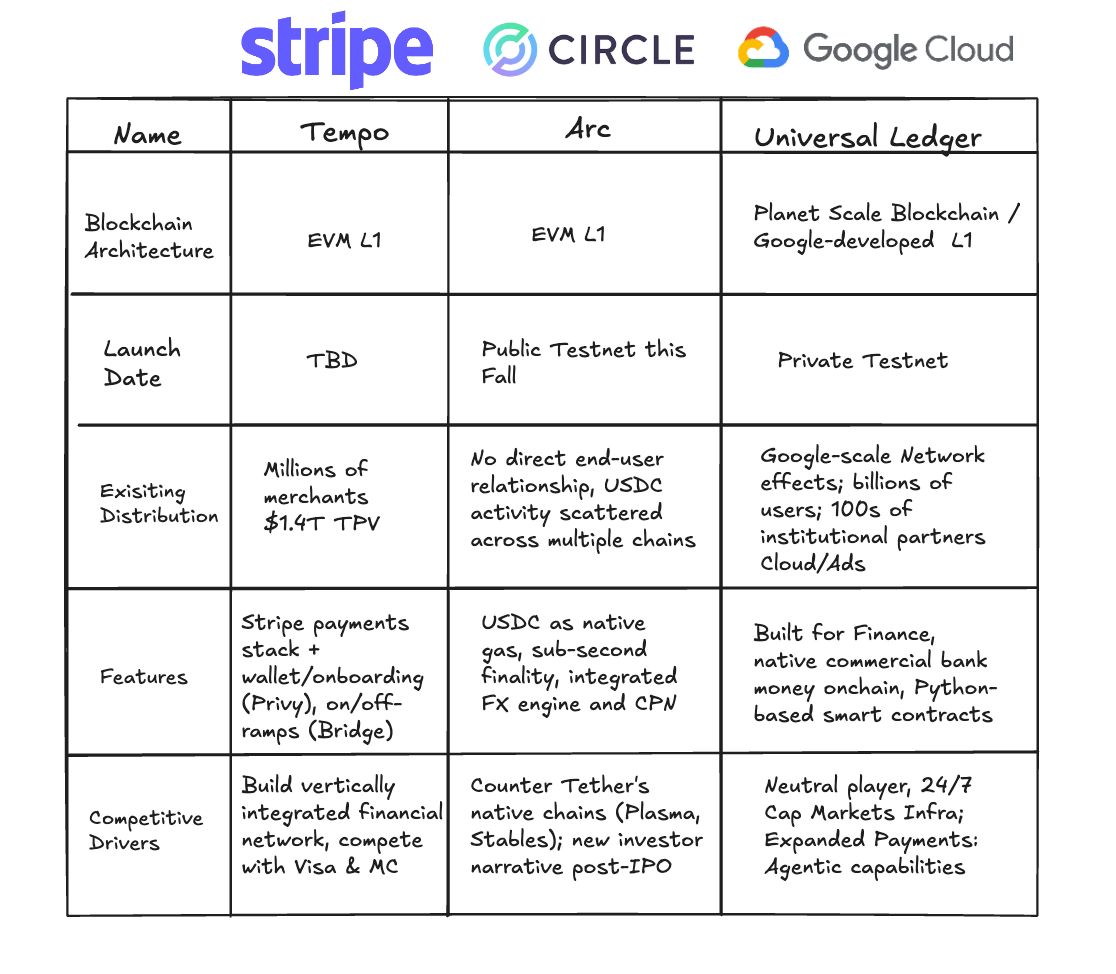
Chart from Rich Widmann comparing Stripe, Circle, and Google Cloud blockchains

In setting out Google’s case for the Universal Ledger, Widmann drew contrasts with other high-profile entrants.

Stripe’s project, Tempo, is rooted in its payments empire, effectively extending the company’s existing merchant rails into a vertically coffntrolled chain. Circle’s Arc, by contrast, places its stablecoin at the center of the system, treating USDC as the protocol’s native fuel and promising lightning-fast settlement with built-in currency exchange.

Google’s approach is different still: the Universal Ledger is designed as a shared infrastructure layer, intended to be credibly neutral and accessible to any institution rather than bound to a single payments ecosystem.

Timelines also set the projects apart. Circle has already begun piloting Arc, while Stripe is targeting a launch next year. Google and CME, meanwhile, have completed an initial integration of GCUL, with broader testing to follow later this year and full services expected in 2026.

The distribution story reinforces those distinctions. Stripe can lean on more than a trillion dollars in annual merchant payment flows. Circle can count on USDC’s global footprint and liquidity integrations. Google brings the reach of its cloud platform, along with the promise of scaling a ledger that can support billions of users and hundreds of institutions.

Features further differentiate the chains. Arc’s focus is speed and seamless foreign exchange, Tempo’s is merchant integration, and GCUL’s is programmability through Python-based smart contracts and institutional-grade tokenization.

The result, Widmann argued, is divergent positioning. Stripe’s and Circle’s ledgers may serve their own ecosystems well but risk deterring competitors, while Google is pitching GCUL as neutral ground — a ledger that anyone, from exchanges to payment providers, can use without fear of strengthening a rival.

The institutional-first positioning is not new.

In March, Google Cloud and CME Group jointly announced GCUL, unveiling it as a programmable distributed ledger tailored for wholesale payments and asset tokenization.

CME Group said it had already completed the first phase of integration and testing, describing the technology as a potential breakthrough for collateral, settlement, and fee payments in markets that are increasingly moving toward 24/7 trading.

“As the President and new Administration have encouraged Congress to create landmark legislation for common-sense market structure, we are pleased to partner with Google Cloud to enable innovative solutions for low-cost, digital transfer of value,” CME Chairman and CEO Terry Duffy said at the time. He suggested GCUL could deliver meaningful efficiencies across core market functions, including margin and collateral management.

According to the March announcement, CME and Google plan to begin direct testing with market participants later this year, with an eye to launching services in 2026. Widmann’s Aug. 26 remarks add new detail to that roadmap, reinforcing GCUL’s role as infrastructure designed to be broadly adopted across the financial sector rather than controlled by a single payments company.

By positioning GCUL against Stripe’s Tempo and Circle’s Arc, Google is signaling that competition among major technology firms to define the next generation of financial settlement rails is accelerating.

Technical details on GCUL’s architecture remain limited, though Widmann said more would be released in the coming months. For now, Google is presenting the Universal Ledger as a foundation for global-scale payments, institutional tokenization and around-the-clock capital markets infrastructure.

Read More: Why Circle and Stripe (And Many Others) Are Launching Their Own Blockchains


Market Opportunity
Moonveil Logo
Moonveil Price(MORE)
$0.0006356
$0.0006356$0.0006356
-3.40%
USD
Moonveil (MORE) Live Price Chart
Disclaimer: The articles reposted on this site are sourced from public platforms and are provided for informational purposes only. They do not necessarily reflect the views of MEXC. All rights remain with the original authors. If you believe any content infringes on third-party rights, please contact service@support.mexc.com for removal. MEXC makes no guarantees regarding the accuracy, completeness, or timeliness of the content and is not responsible for any actions taken based on the information provided. The content does not constitute financial, legal, or other professional advice, nor should it be considered a recommendation or endorsement by MEXC.

You May Also Like

Crypto News: Donald Trump-Aligned Fed Governor To Speed Up Fed Rate Cuts?

Crypto News: Donald Trump-Aligned Fed Governor To Speed Up Fed Rate Cuts?

The post Crypto News: Donald Trump-Aligned Fed Governor To Speed Up Fed Rate Cuts? appeared on BitcoinEthereumNews.com. In recent crypto news, Stephen Miran swore in as the latest Federal Reserve governor on September 16, 2025, slipping into the board’s last open spot right before the Federal Open Market Committee kicks off its two-day rate discussion. Traders are betting heavily on a 25-basis-point trim, which would bring the federal funds rate down to 4.00%-4.25%, based on CME FedWatch Tool figures from September 15, 2025. Miran, who’s been Trump’s top economic advisor and a supporter of his trade ideas, joins a seven-member board where just three governors come from Democratic picks, according to the Fed’s records updated that same day. Crypto News: Miran’s Background and Quick Path to Confirmation The Senate greenlit Miran on September 15, 2025, with a tight 48-47 vote, following his nomination on September 2, 2025, as per a recent crypto news update. His stint runs only until January 31, 2026, stepping in for Adriana D. Kugler, who stepped down in August 2025 for reasons not made public. Miran earned his economics Ph.D. from Harvard and worked at the Treasury back in Trump’s first go-around. Afterward, he moved to Hudson Bay Capital Management as an economist, then looped back to the White House in December 2024 to head the Council of Economic Advisers. There, he helped craft Trump’s “reciprocal tariffs” approach, aimed at fixing trade gaps with China and the EU. He wouldn’t quit his White House gig, which irked Senator Elizabeth Warren at the September 7, 2025, confirmation hearings. That limited time frame means Miran gets to cast a vote straight away at the FOMC session starting September 16, 2025. The full board now features Chair Jerome H. Powell (Trump pick, term ends 2026), Vice Chair Philip N. Jefferson (Biden, to 2036), and folks like Lisa D. Cook (Biden, to 2028) and Michael S. Barr…
Share
BitcoinEthereumNews2025/09/18 03:14
Vitalik Buterin Backs an Altcoin Focused on Privacy and Finality

Vitalik Buterin Backs an Altcoin Focused on Privacy and Finality

Vitalik Buterin has quietly reinforced his long-standing view that privacy remains core to crypto’s future, backing a major Zcash consensus upgrade at a moment
Share
Ethnews2026/02/07 17:58
Strategy’s Balance Sheet Safe Unless Bitcoin Drops Below $8K, CEO Says

Strategy’s Balance Sheet Safe Unless Bitcoin Drops Below $8K, CEO Says

TLDR Strategy’s CEO claims balance sheet is safe unless Bitcoin stays below $8K for five years. Charles Hoskinson loses $3 billion in crypto but has no plans to
Share
Coincentral2026/02/07 18:34




