

Bitcoin Reclaims $65K as Dollar Weakens: Rally or 25% Drop Next?
This article was first published on The Bit Journal.
Bitcoin price has climbed back above $65,000, drawing renewed attention from investors who have endured weeks of volatility and steep losses. The rebound offers a spark of optimism, yet it unfolds against a backdrop of fragile sentiment and unresolved technical risks that continue to weigh on the broader market.
According to the source, Bitcoin price reclaimed roughly $65,400 early Wednesday as a softer U.S. dollar and a strong rally in Asian equities combined to create a risk-on environment across global markets.
Updated figures on a verified crypto data platform showed Bitcoin trading near $65,254 during the move, reflecting steady but cautious buying interest rather than aggressive accumulation.
Market Cap Retests Critical Support as Tension Builds
The broader crypto market capitalization had slipped to approximately $2.19 trillion earlier in the week, placing it dangerously close to the lows recorded during the Feb. 5 crash. That retest of prior support levels has become a focal point for technical analysts who often view such moments as decisive inflection points.
Roughly ten days before this rebound, the total crypto market briefly pushed toward $2.47 trillion before losing momentum. That level now stands as a meaningful resistance barrier. If the current recovery extends beyond that ceiling, confidence may strengthen across trading desks. If momentum fades again, sellers could interpret the failure as confirmation that the downtrend remains intact.
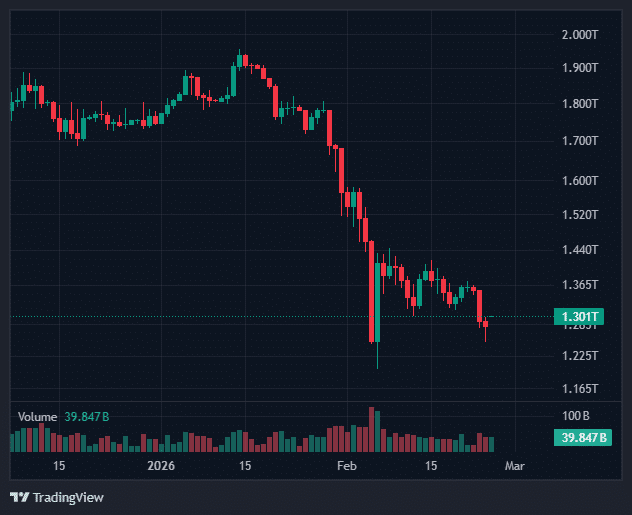 Source: Coinmarketcap
Bitcoin Price and the Double Bottom Question
Bitcoin price is now at the center of a debate surrounding a potential double bottom formation, which is a classic W-shaped chart pattern that sometimes signals a reversal after a prolonged decline. This pattern develops when price falls to a low, rebounds, revisits that low, and then climbs again toward a breakout level.
Alex Kuptsikevich, chief market analyst at FxPro, stated that if support holds, the formation could imply roughly 10 percent upside from current levels. However, he also warned that failure to sustain the rebound would “signal the end of the recovery, opening the potential for a further 25% decline,” a view reported by a major international financial news outlet.
The implication is clear. A confirmed breakout above the midpoint of the W would strengthen the bullish case for Bitcoin price. A breakdown below support would deepen fears that the market has not yet reached its ultimate bottom.
U.S. Dollar Weakness Provides a Temporary Tailwind
The U.S. dollar has played a significant role in shaping this recovery. The Bloomberg Dollar Spot Index edged lower following President Trump’s State of the Union address, during which he reaffirmed tariff policies despite the Supreme Court striking down global import taxes and even suggested tariffs could eventually replace income taxes.
Historically, Bitcoin price has often benefited when the U.S. dollar weakens because global investors tend to rotate capital into higher-risk or alternative assets during periods of currency softness. Nevertheless, this correlation has proven inconsistent during the current drawdown cycle, which suggests that macro dynamics alone cannot guarantee sustained upside.
Should the U.S. dollar regain strength, it could quickly reintroduce pressure across digital asset markets, especially if risk appetite in equities begins to cool.
Altcoins Rise, Yet a Crisis of Confidence Persists
The rebound extended beyond Bitcoin price into the broader altcoin space, where Ether gained approximately 4.2 percent, Solana advanced nearly 7 percent, and XRP added around 3 percent. At the same time, MSCI’s gauge of Asian equities climbed 1.4 percent to a record high, led by technology-driven gains in South Korea and Taiwan ahead of major earnings announcements.
Despite these gains, analysts describe an ongoing crisis of confidence in Bitcoin price after its nearly 50 percent slide from all-time highs. Institutional investors appear hesitant to commit significant capital without a stronger catalyst, and some market observers argue that genuine capitulation, marked by intense panic selling, may still lie ahead.
Conclusion
Bitcoin price has reclaimed an important psychological level, supported in part by weakness in the U.S. dollar and renewed global risk appetite. However, resistance near $2.47 trillion in total market capitalization and warnings from analysts about potential further downside highlight the fragile nature of this recovery.
For financial students, blockchain developers, and analysts, this period offers a powerful lesson in how macroeconomics, technical analysis, and investor psychology intersect in real time.
Whether Bitcoin price confirms a durable double bottom or retreats once more will likely depend on sustained buying conviction and continued moderation in the U.S. dollar. The coming sessions may determine whether this rebound represents the beginning of a new phase or merely a pause within a broader correction.
This article is for informational purposes only and does not constitute financial advice. Readers should conduct their own research before making investment decisions.
Glossary of Key Terms
Double Bottom Pattern: A W-shaped chart formation that indicates a possible trend reversal following an extended downward movement.
Market Capitalization: The total value of all circulating cryptocurrencies within the market.
Capitulation: The market condition that results in extreme panic selling before the establishment of a permanent market low.
Risk-On Sentiment: A market environment that leads investors to choose high-risk investments because they seek greater financial returns.
FAQs About Bitcoin Price
Why did Bitcoin price rebound above $65,000?
Bitcoin price benefited from a weaker U.S. dollar and strong gains in Asian equity markets, which improved overall risk sentiment.
What does the double bottom pattern indicate?
The pattern may signal a potential reversal if price breaks above key resistance after retesting previous lows.
How does the U.S. dollar influence Bitcoin price?
A weaker U.S. dollar often encourages investors to shift toward alternative assets such as cryptocurrencies.
Could Bitcoin price decline again?
Analysts warn that failure to hold support levels could open the door to a deeper correction of up to 25 percent.
Sources and References
Coindesk
Coinmarketcap
Bloomberg
Read More: Bitcoin Reclaims $65K as Dollar Weakens: Rally or 25% Drop Next?">Bitcoin Reclaims $65K as Dollar Weakens: Rally or 25% Drop Next?


You May Also Like

E.l.f. Beauty (ELF) Stock Surges Despite Disappointing Forward Guidance After Q4 Earnings Beat

Deere (DE) Stock Falls After Q2 Beat as Flat Farm Income Spooks Investors

Oman slashes budget deficit on higher hydrocarbon revenues



