Original article: that1618guy , market researcher at Delphi Digital Compiled by Yuliya, PANews The market generally expects the Federal Reserve to cut interest rates for the first time this cycle in September. Historically, Bitcoin has tended to rise before easing policies are implemented, but retreat after rate cuts are implemented. However, this pattern doesn't always hold true. This article will review the performance in 2019, 2020, and 2024 to predict possible trends in September 2025. 2019: Expected rise, then a fall In 2019, Bitcoin rebounded from $3,000 at the end of 2018 to $13,000 in June. The Federal Reserve announced interest rate cuts on July 31, September 18, and October 30, respectively. Each rate cut decision signals the near exhaustion of Bitcoin's upward momentum. BTC surged before the meeting, but was subsequently sold off as the reality of weak economic growth resurfaced. This suggests the market had already priced in the positive impact of the rate cut, leaving the reality of slowing economic growth to dominate subsequent price movements. 2020: An exception to the emergency rate cut March 2020, when the Federal Reserve slashed interest rates to zero in response to the panic caused by the coronavirus pandemic, was not a typical cycle. During this liquidity crisis, BTC plummeted along with stocks, but subsequently rebounded strongly thanks to massive fiscal and monetary policy support. Therefore, this was a unique case driven by the crisis and cannot be used as a template for predicting trends in 2025. 2024: Narratives trump liquidity The trend changed in 2024. BTC did not fall back after the interest rate cut, but continued its upward momentum. The reasons are: Trump's campaign turned cryptocurrency into an election issue. Spot ETFs are attracting record inflows. MicroStrategy continues to see strong buying demand at the balance sheet level. In this context, the importance of liquidity has declined, with structural buying and political factors overriding traditional economic cycle influences. September 2025: Conditional market launch The current market backdrop is different from the runaway rallies of past cycles. Bitcoin has been consolidating since late August, ETF inflows have slowed significantly, and corporate balance sheet buying, once a persistent tailwind, has begun to wane. This makes the September rate cut a conditional market trigger rather than a direct catalyst. If Bitcoin rises sharply before the interest rate meeting, the risk of history repeating itself will increase - that is, traders "sell the fact" after the easing policy is implemented, resulting in a "rise followed by a fall" situation. But if prices remain stable or move slightly lower before the decision, much of the excess positioning may have been eliminated, making the rate cut more of a stabilizing force in the market rather than an end to the upward momentum. Core Viewpoint The current trend of Bitcoin may be affected by the Federal Reserve’s September interest rate meeting and related liquidity changes. Overall, Bitcoin may see a wave of increases before the FOMC meeting, but the increase may be difficult to break through new highs. If prices rise sharply before the meeting, then a "sell the news" pullback is likely; However, if prices consolidate or fall between early September and the meeting, there is a possibility of an unexpected rise due to interest rate adjustments. However, even if there is a rebound, the market still needs to be cautious. The next leg up may form a lower high (around $118,000 to $120,000). Assuming this lower high occurs, it could set the stage for the second half of Q4, when liquidity conditions are expected to stabilize and demand may pick up again, pushing Bitcoin to new highs. Original article: that1618guy , market researcher at Delphi Digital Compiled by Yuliya, PANews The market generally expects the Federal Reserve to cut interest rates for the first time this cycle in September. Historically, Bitcoin has tended to rise before easing policies are implemented, but retreat after rate cuts are implemented. However, this pattern doesn't always hold true. This article will review the performance in 2019, 2020, and 2024 to predict possible trends in September 2025. 2019: Expected rise, then a fall In 2019, Bitcoin rebounded from $3,000 at the end of 2018 to $13,000 in June. The Federal Reserve announced interest rate cuts on July 31, September 18, and October 30, respectively. Each rate cut decision signals the near exhaustion of Bitcoin's upward momentum. BTC surged before the meeting, but was subsequently sold off as the reality of weak economic growth resurfaced. This suggests the market had already priced in the positive impact of the rate cut, leaving the reality of slowing economic growth to dominate subsequent price movements. 2020: An exception to the emergency rate cut March 2020, when the Federal Reserve slashed interest rates to zero in response to the panic caused by the coronavirus pandemic, was not a typical cycle. During this liquidity crisis, BTC plummeted along with stocks, but subsequently rebounded strongly thanks to massive fiscal and monetary policy support. Therefore, this was a unique case driven by the crisis and cannot be used as a template for predicting trends in 2025. 2024: Narratives trump liquidity The trend changed in 2024. BTC did not fall back after the interest rate cut, but continued its upward momentum. The reasons are: Trump's campaign turned cryptocurrency into an election issue. Spot ETFs are attracting record inflows. MicroStrategy continues to see strong buying demand at the balance sheet level. In this context, the importance of liquidity has declined, with structural buying and political factors overriding traditional economic cycle influences. September 2025: Conditional market launch The current market backdrop is different from the runaway rallies of past cycles. Bitcoin has been consolidating since late August, ETF inflows have slowed significantly, and corporate balance sheet buying, once a persistent tailwind, has begun to wane. This makes the September rate cut a conditional market trigger rather than a direct catalyst. If Bitcoin rises sharply before the interest rate meeting, the risk of history repeating itself will increase - that is, traders "sell the fact" after the easing policy is implemented, resulting in a "rise followed by a fall" situation. But if prices remain stable or move slightly lower before the decision, much of the excess positioning may have been eliminated, making the rate cut more of a stabilizing force in the market rather than an end to the upward momentum. Core Viewpoint The current trend of Bitcoin may be affected by the Federal Reserve’s September interest rate meeting and related liquidity changes. Overall, Bitcoin may see a wave of increases before the FOMC meeting, but the increase may be difficult to break through new highs. If prices rise sharply before the meeting, then a "sell the news" pullback is likely; However, if prices consolidate or fall between early September and the meeting, there is a possibility of an unexpected rise due to interest rate adjustments. However, even if there is a rebound, the market still needs to be cautious. The next leg up may form a lower high (around $118,000 to $120,000). Assuming this lower high occurs, it could set the stage for the second half of Q4, when liquidity conditions are expected to stabilize and demand may pick up again, pushing Bitcoin to new highs.

Delphi Digital: How will interest rate cuts impact Bitcoin's short-term performance, based on historical data?
2025/09/02 13:45
4 min read

Original article: that1618guy , market researcher at Delphi Digital

Compiled by Yuliya, PANews

The market generally expects the Federal Reserve to cut interest rates for the first time this cycle in September. Historically, Bitcoin has tended to rise before easing policies are implemented, but retreat after rate cuts are implemented. However, this pattern doesn't always hold true. This article will review the performance in 2019, 2020, and 2024 to predict possible trends in September 2025.

2019: Expected rise, then a fall
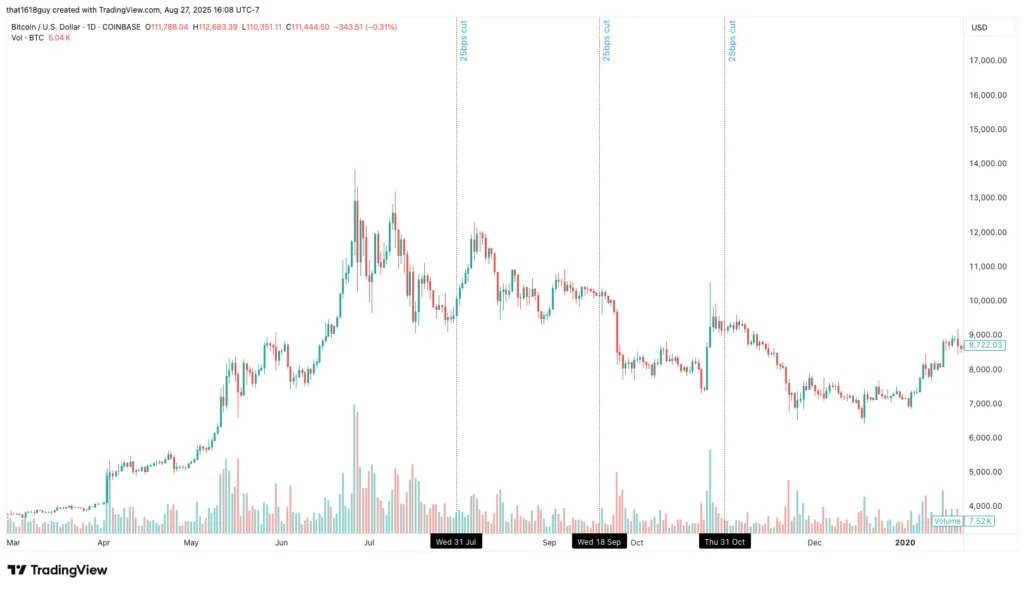
In 2019, Bitcoin rebounded from $3,000 at the end of 2018 to $13,000 in June. The Federal Reserve announced interest rate cuts on July 31, September 18, and October 30, respectively.

Each rate cut decision signals the near exhaustion of Bitcoin's upward momentum. BTC surged before the meeting, but was subsequently sold off as the reality of weak economic growth resurfaced. This suggests the market had already priced in the positive impact of the rate cut, leaving the reality of slowing economic growth to dominate subsequent price movements.

2020: An exception to the emergency rate cut
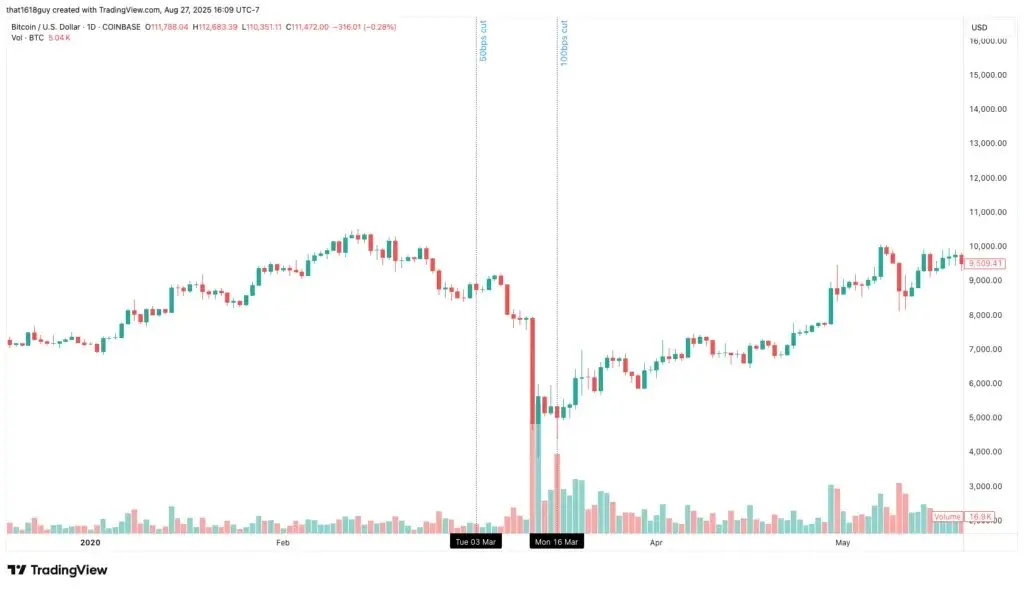
March 2020, when the Federal Reserve slashed interest rates to zero in response to the panic caused by the coronavirus pandemic, was not a typical cycle.

During this liquidity crisis, BTC plummeted along with stocks, but subsequently rebounded strongly thanks to massive fiscal and monetary policy support. Therefore, this was a unique case driven by the crisis and cannot be used as a template for predicting trends in 2025.

2024: Narratives trump liquidity
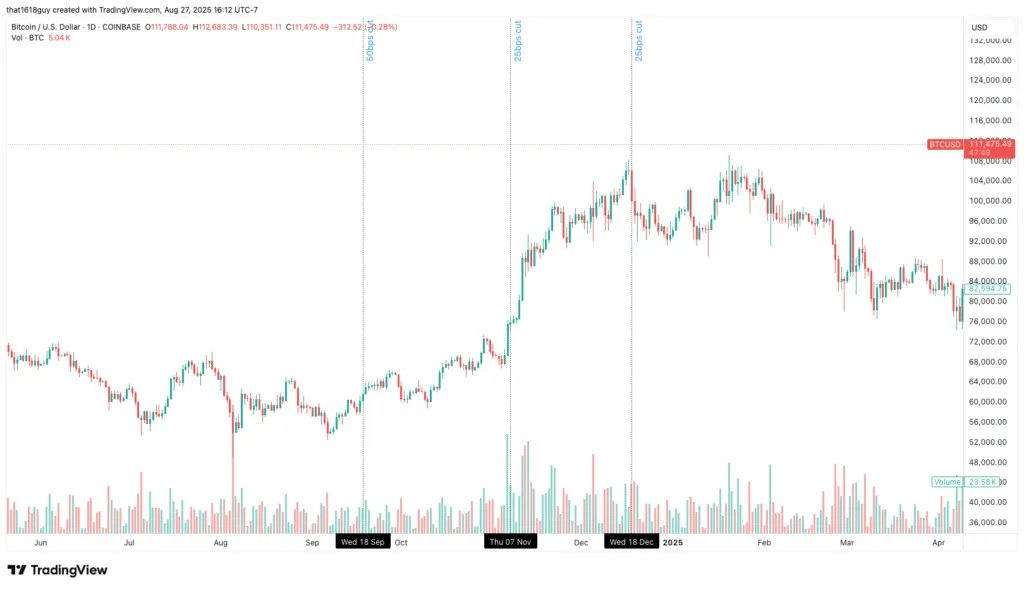
The trend changed in 2024. BTC did not fall back after the interest rate cut, but continued its upward momentum.

The reasons are:

  • Trump's campaign turned cryptocurrency into an election issue.
  • Spot ETFs are attracting record inflows.
  • MicroStrategy continues to see strong buying demand at the balance sheet level.

In this context, the importance of liquidity has declined, with structural buying and political factors overriding traditional economic cycle influences.

September 2025: Conditional market launch

The current market backdrop is different from the runaway rallies of past cycles. Bitcoin has been consolidating since late August, ETF inflows have slowed significantly, and corporate balance sheet buying, once a persistent tailwind, has begun to wane.

This makes the September rate cut a conditional market trigger rather than a direct catalyst.

  • If Bitcoin rises sharply before the interest rate meeting, the risk of history repeating itself will increase - that is, traders "sell the fact" after the easing policy is implemented, resulting in a "rise followed by a fall" situation.
  • But if prices remain stable or move slightly lower before the decision, much of the excess positioning may have been eliminated, making the rate cut more of a stabilizing force in the market rather than an end to the upward momentum.

Core Viewpoint

The current trend of Bitcoin may be affected by the Federal Reserve’s September interest rate meeting and related liquidity changes. Overall, Bitcoin may see a wave of increases before the FOMC meeting, but the increase may be difficult to break through new highs.

  • If prices rise sharply before the meeting, then a "sell the news" pullback is likely;
  • However, if prices consolidate or fall between early September and the meeting, there is a possibility of an unexpected rise due to interest rate adjustments.

However, even if there is a rebound, the market still needs to be cautious. The next leg up may form a lower high (around $118,000 to $120,000).

Assuming this lower high occurs, it could set the stage for the second half of Q4, when liquidity conditions are expected to stabilize and demand may pick up again, pushing Bitcoin to new highs.

Market Opportunity
NEAR Logo
NEAR Price(NEAR)
$1.0906
$1.0906$1.0906
-1.45%
USD
NEAR (NEAR) Live Price Chart
Disclaimer: The articles reposted on this site are sourced from public platforms and are provided for informational purposes only. They do not necessarily reflect the views of MEXC. All rights remain with the original authors. If you believe any content infringes on third-party rights, please contact crypto.news@mexc.com for removal. MEXC makes no guarantees regarding the accuracy, completeness, or timeliness of the content and is not responsible for any actions taken based on the information provided. The content does not constitute financial, legal, or other professional advice, nor should it be considered a recommendation or endorsement by MEXC.

You May Also Like

SEC Adopts Final Rules Under HFIA Act to Boost Foreign Insider Transparency

SEC Adopts Final Rules Under HFIA Act to Boost Foreign Insider Transparency

TLDR: The HFIA Act was enacted on December 18, 2025, mandating SEC action within 90 days of enactment. FPI directors and officers must file Section 16 reports electronically
Share
Blockonomi2026/02/28 07:17
CME Group to Launch Solana and XRP Futures Options

CME Group to Launch Solana and XRP Futures Options

The post CME Group to Launch Solana and XRP Futures Options appeared on BitcoinEthereumNews.com. An announcement was made by CME Group, the largest derivatives exchanger worldwide, revealed that it would introduce options for Solana and XRP futures. It is the latest addition to CME crypto derivatives as institutions and retail investors increase their demand for Solana and XRP. CME Expands Crypto Offerings With Solana and XRP Options Launch According to a press release, the launch is scheduled for October 13, 2025, pending regulatory approval. The new products will allow traders to access options on Solana, Micro Solana, XRP, and Micro XRP futures. Expiries will be offered on business days on a monthly, and quarterly basis to provide more flexibility to market players. CME Group said the contracts are designed to meet demand from institutions, hedge funds, and active retail traders. According to Giovanni Vicioso, the launch reflects high liquidity in Solana and XRP futures. Vicioso is the Global Head of Cryptocurrency Products for the CME Group. He noted that the new contracts will provide additional tools for risk management and exposure strategies. Recently, CME XRP futures registered record open interest amid ETF approval optimism, reinforcing confidence in contract demand. Cumberland, one of the leading liquidity providers, welcomed the development and said it highlights the shift beyond Bitcoin and Ethereum. FalconX, another trading firm, added that rising digital asset treasuries are increasing the need for hedging tools on alternative tokens like Solana and XRP. High Record Trading Volumes Demand Solana and XRP Futures Solana futures and XRP continue to gain popularity since their launch earlier this year. According to CME official records, many have bought and sold more than 540,000 Solana futures contracts since March. A value that amounts to over $22 billion dollars. Solana contracts hit a record 9,000 contracts in August, worth $437 million. Open interest also set a record at 12,500 contracts.…
Share
BitcoinEthereumNews2025/09/18 01:39
SEC is seeking to regain crypto ground following ‘missed opportunity,’ Chairman Atkins says

SEC is seeking to regain crypto ground following ‘missed opportunity,’ Chairman Atkins says

The SEC is working to regain momentum on crypto after what Atkins described as a “big missed opportunity” under the prior administration.
Share
Coinstats2026/02/28 06:40