We show that one can simultaneously achieve strong secrecy and strong privacy, i.e., the conditional mutual information terms in (2) and (3), respectively, are negligible, by using a large private key K. The lossy secure and and private source coding region RD is characterized below; see Section V for its proof. We next take the liberty to use the lossy rate region in Corollary 1, characterized for discrete memoryless channels, for the model in (29)-(31)We show that one can simultaneously achieve strong secrecy and strong privacy, i.e., the conditional mutual information terms in (2) and (3), respectively, are negligible, by using a large private key K. The lossy secure and and private source coding region RD is characterized below; see Section V for its proof. We next take the liberty to use the lossy rate region in Corollary 1, characterized for discrete memoryless channels, for the model in (29)-(31)

Can Coding Be Both Lossless and Private?

Abstract and I. Introduction

II. System Model

III. Secure and Private Source Coding Regions

IV. Gaussian Sources and Channels

V. Proof for Theorem 1

Acknowledgment and References

III. SECURE AND PRIVATE SOURCE CODING REGIONS

A. Lossy Source Coding

\ The lossy secure and and private source coding region RD is characterized below; see Section V for its proof.

\
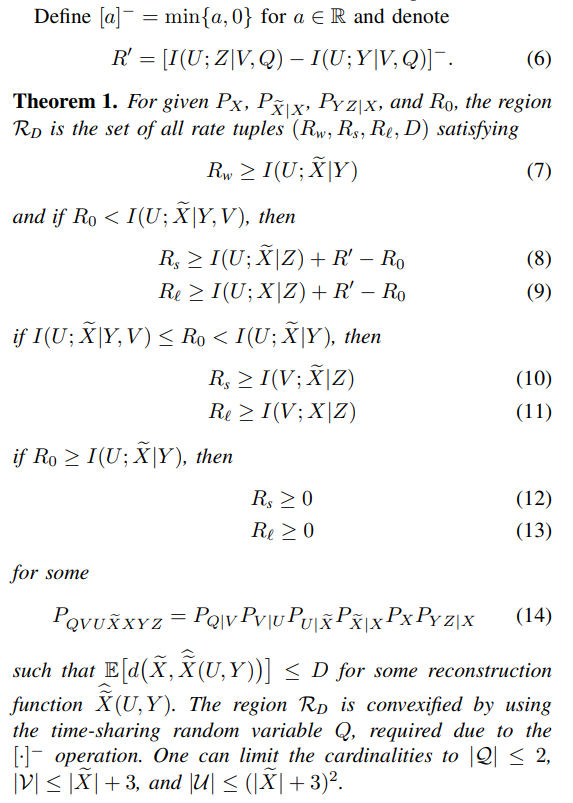
\ We remark that (12) and (13) show that one can simultaneously achieve strong secrecy and strong privacy, i.e., the conditional mutual information terms in (2) and (3), respectively, are negligible, by using a large private key K, which is a result missing in some recent works on secure source coding with private key.

\ B. Lossless Source Coding

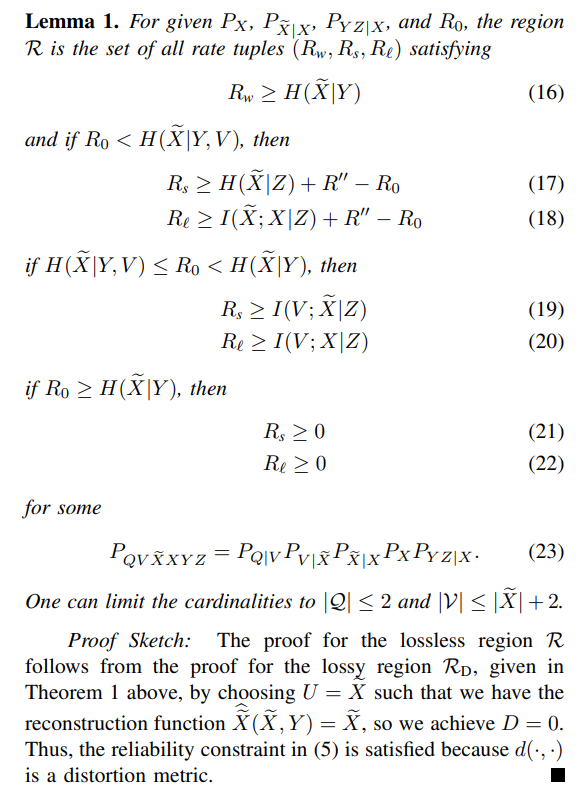
\ The lossless secure and and private source coding region R is characterized next; see below for a proof sketch.

\ Denote

\

\
\

IV. GAUSSIAN SOURCES AND CHANNELS
\
\ Suppose the following scalar discrete-time Gaussian source and channel model for the lossy source coding problem depicted in Fig.

\
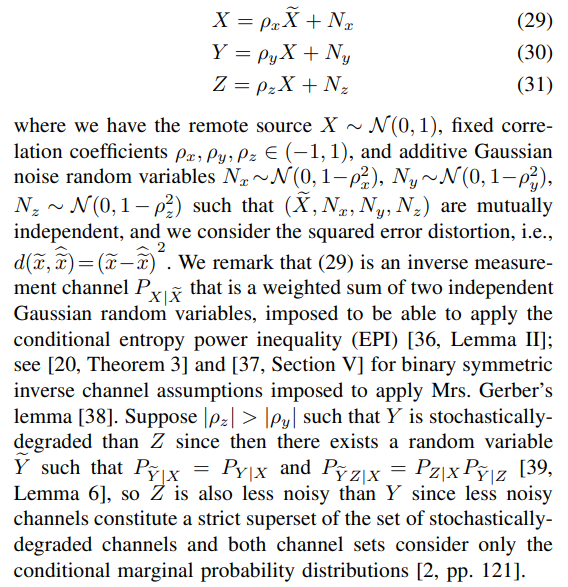
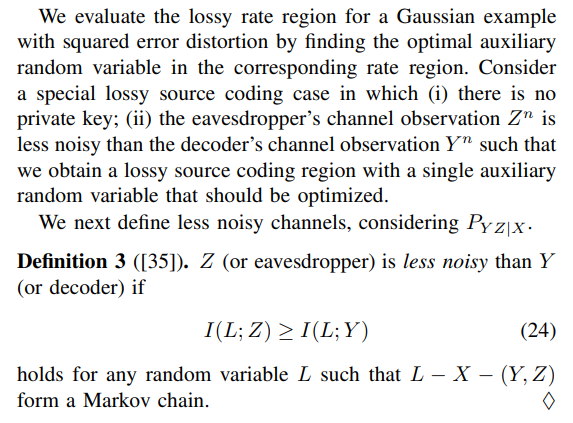
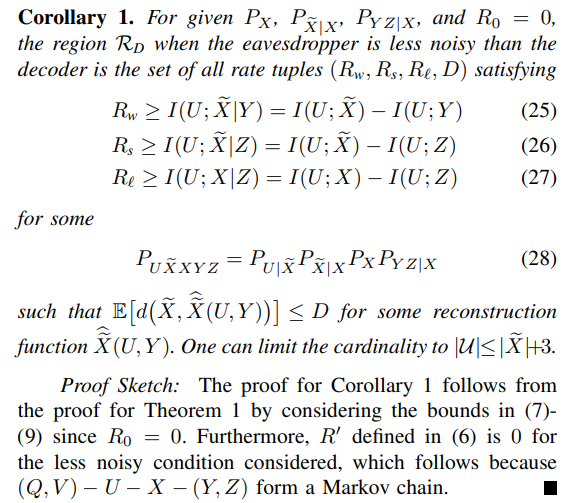
\ We next take the liberty to use the lossy rate region in Corollary 1, characterized for discrete memoryless channels, for the model in (29)-(31). This is common in the literature since there is a discretization procedure to extend the achievability proof to well-behaved continuous-alphabet random variables and the converse proof applies to arbitrary random variables; see [2, Remark 3.8]. For Gaussian sources and channels, we use differential entropy and eliminate the cardinality bound on the auxiliary random variable. The lossy source coding region for the model in (29)-(31) without a private key is given below.

\
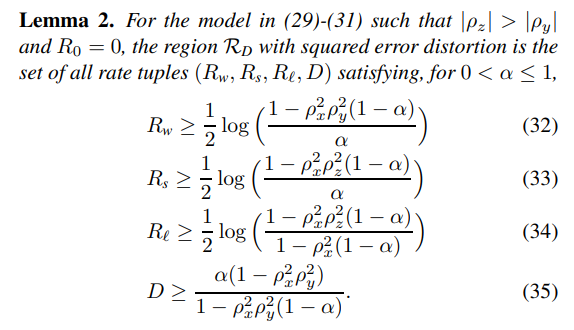
\
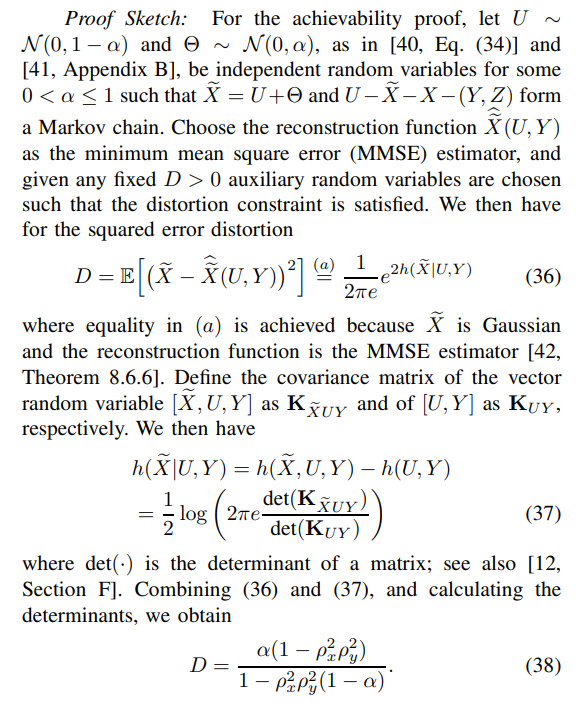
\ One can also show that

\
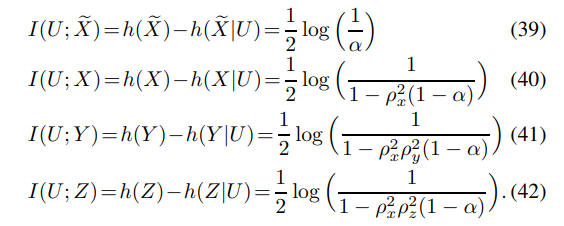
\ Thus, by calculating (25)-(27), the achievability proof follows.

\ For the converse proof, one can first show that

\
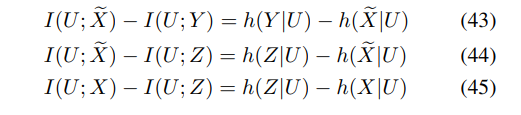
\
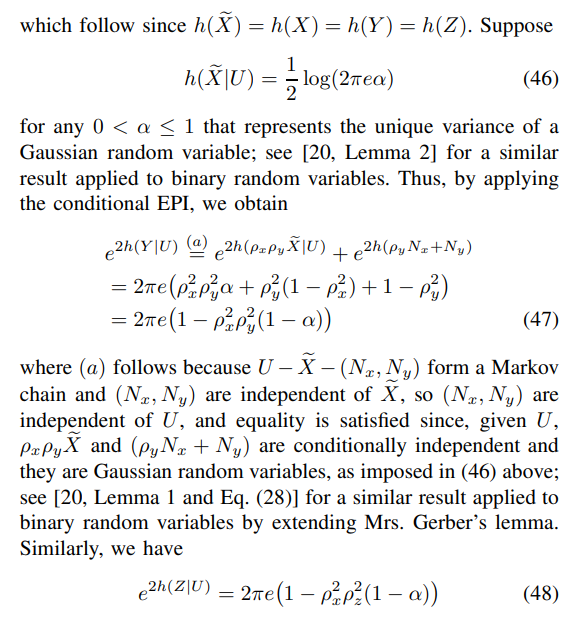
\
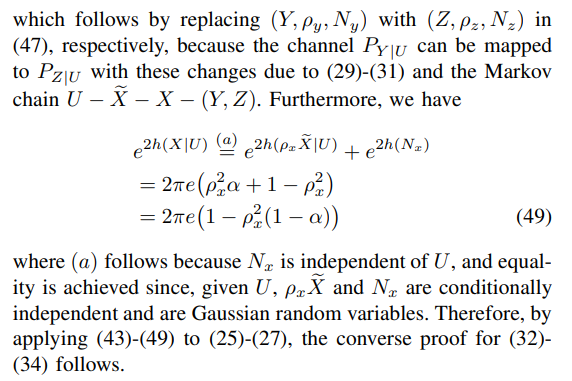
\ Next, consider

\
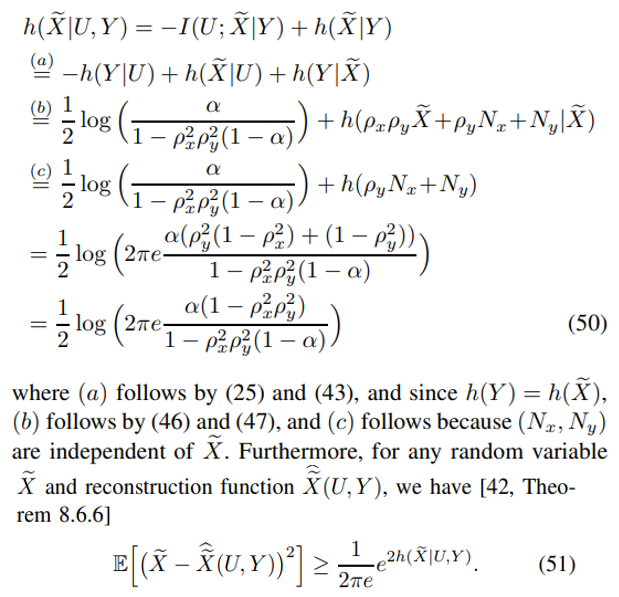
\ Combining the distortion constraint given in Corollary 1 with (50) and (51), the converse proof for (35) follows.

\ \

:::info Authors:

(1) Onur Gunlu, Chair of Communications Engineering and Security, University of Siegen and Information Coding Division, Department of Electrical Engineering, Linkoping University (onur.guenlue@uni-siegen.de);

(2) Rafael F. Schaefer, Chair of Communications Engineering and Security, University of Siegen (rafael.schaefer@uni-siegen.de);

(3) Holger Boche, Chair of Theoretical Information Technology, Technical University of Munich, CASA: Cyber Security in the Age of Large-Scale Adversaries Exzellenzcluster, Ruhr-Universitat Bochum, and BMBF Research Hub 6G-Life, Technical University of Munich (boche@tum.de);

(4) H. Vincent Poor, Department of Electrical and Computer Engineering, Princeton University (poor@princeton.edu).

:::


:::info This paper is available on arxiv under CC BY 4.0 DEED license.

:::

\

Market Opportunity
Sidekick Logo
Sidekick Price(K)
$0.010179
$0.010179$0.010179
+144.04%
USD
Sidekick (K) Live Price Chart
Disclaimer: The articles reposted on this site are sourced from public platforms and are provided for informational purposes only. They do not necessarily reflect the views of MEXC. All rights remain with the original authors. If you believe any content infringes on third-party rights, please contact service@support.mexc.com for removal. MEXC makes no guarantees regarding the accuracy, completeness, or timeliness of the content and is not responsible for any actions taken based on the information provided. The content does not constitute financial, legal, or other professional advice, nor should it be considered a recommendation or endorsement by MEXC.

You May Also Like

Sunmi Cuts Clutter and Boosts Speed with New All-in-One Mobile Terminal & Scanner-Printer

Sunmi Cuts Clutter and Boosts Speed with New All-in-One Mobile Terminal & Scanner-Printer

SINGAPORE, Jan. 16, 2026 /PRNewswire/ — Business Challenge: Stores today face dual pressures: the need for faster, more flexible customer service beyond fixed counters
Share
AI Journal2026/01/16 20:31
Franklin Templeton CEO Dismisses 50bps Rate Cut Ahead FOMC

Franklin Templeton CEO Dismisses 50bps Rate Cut Ahead FOMC

The post Franklin Templeton CEO Dismisses 50bps Rate Cut Ahead FOMC appeared on BitcoinEthereumNews.com. Franklin Templeton CEO Jenny Johnson has weighed in on whether the Federal Reserve should make a 25 basis points (bps) Fed rate cut or 50 bps cut. This comes ahead of the Fed decision today at today’s FOMC meeting, with the market pricing in a 25 bps cut. Bitcoin and the broader crypto market are currently trading flat ahead of the rate cut decision. Franklin Templeton CEO Weighs In On Potential FOMC Decision In a CNBC interview, Jenny Johnson said that she expects the Fed to make a 25 bps cut today instead of a 50 bps cut. She acknowledged the jobs data, which suggested that the labor market is weakening. However, she noted that this data is backward-looking, indicating that it doesn’t show the current state of the economy. She alluded to the wage growth, which she remarked is an indication of a robust labor market. She added that retail sales are up and that consumers are still spending, despite inflation being sticky at 3%, which makes a case for why the FOMC should opt against a 50-basis-point Fed rate cut. In line with this, the Franklin Templeton CEO said that she would go with a 25 bps rate cut if she were Jerome Powell. She remarked that the Fed still has the October and December FOMC meetings to make further cuts if the incoming data warrants it. Johnson also asserted that the data show a robust economy. However, she noted that there can’t be an argument for no Fed rate cut since Powell already signaled at Jackson Hole that they were likely to lower interest rates at this meeting due to concerns over a weakening labor market. Notably, her comment comes as experts argue for both sides on why the Fed should make a 25 bps cut or…
Share
BitcoinEthereumNews2025/09/18 00:36
State Street Corporation (NYSE: STT) Reports Fourth-Quarter and Full-Year 2025 Financial Results

State Street Corporation (NYSE: STT) Reports Fourth-Quarter and Full-Year 2025 Financial Results

BOSTON–(BUSINESS WIRE)–State Street Corporation (NYSE: STT) reported its fourth-quarter and full-year 2025 financial results today. The news release, presentation
Share
AI Journal2026/01/16 20:46





