Spot bitcoin exchange-traded funds (ETFs) roared back into the spotlight on Tuesday, attracting $332.7 million in net inflows, even as Ethereum funds posted sharp withdrawals. The move suggests a potential rotation back to Bitcoin after Ethereum dominated ETF flows throughout August. According to SoSoValue, Fidelity’s FBTC led the charge with $132.7 million in inflows, followed by BlackRock’s IBIT at $72.8 million. Other issuers, including Grayscale, Ark & 21Shares, Bitwise, VanEck, and Invesco, also logged gains.Source: SoSoValue In contrast, Ethereum products recorded $135.3 million in daily net outflows, weighed down by Fidelity’s FETH shedding $99.2 million and Bitwise’s ETHW losing $24.2 million. Ethereum’s August Surge vs. Bitcoin’s September History August had been Ethereum’s month. Analysts described a “rotational shift” toward ETH, driven by yield-bearing staking, improving regulatory signals, and rising adoption by corporate treasuries. Ethereum ETFs attracted $3.87 billion in net inflows last month, compared to Bitcoin’s $751 million in outflows. Trading activity showed the divergence, with Ethereum ETF volume surging to $58.37 billion in August, nearly doubling July’s $33.87 billion, while Bitcoin ETF volume dipped slightly to $78.14 billion. The price action reinforced that enthusiasm. Ethereum notched a new all-time high of $4,953.73 in August, and public company holdings of ETH swelled dramatically. 71 companies disclosed a combined $119.68 billion in Ethereum by August 31st, up from 67 firms with $98.97 billion the prior month. Bitcoin, by contrast, saw outflows and lagged in performance despite maintaining a far larger total ETF inflow base of $54.24 billion cumulatively. But September tells a different story. Historically, Ethereum has stumbled during the month: in September 2024, ETH ETFs saw $46.54 million in outflows, registering redemptions in three out of four weeks. Bitcoin ETFs, meanwhile, posted a $1.26 billion inflow over the same period, benefiting from risk-averse positioning as markets cooled. What’s Fueling the Rotation from Ethereum to Bitcoin? Market watchers suggest this September may again favor Bitcoin. Historically, September has been a “cool-down” month for crypto, with ETH often underperforming due to weaker seasonal flows and lower risk appetite. Bitcoin, seen as the safer benchmark asset, typically regains inflows when volatility rises. Macro forces are also at play. With global central banks signaling caution and bond yields holding firm, investors appear to be trimming higher-risk ETH exposure in favor of Bitcoin, still viewed as the digital reserve asset of choice. The derivatives market shows the shift. Over the past 24 hours, Ethereum futures saw $1.22 billion in outflows, nearly double Bitcoin’s $646.7 million in outflows, according to Coinglass. Also, Bitcoin treasuries remain a magnet for institutional flows. As of Sept. 1, weekly bitcoin net inflows totaled 3,102 BTC (about $335.8 million), with Michael Saylor’s MicroStrategy adding 4,048 BTC worth $449 million on Sept. 2 alone. By contrast, Ethereum treasuries have lagged, with fewer corporate balance sheets disclosing significant ETH allocations despite August’s record price run-up. The gap shows a key reason for the rotation: while ETH may offer yield and programmability, Bitcoin continues to dominate as the go-to institutional treasury asset. That hunt for yield is exactly where the danger lies, according to Sharplink Gaming co-CEO Joseph Chalom. Speaking on Bankless, Chalom warned that companies piling into Ether to squeeze out extra returns could expose themselves to cascading risks if markets turn. “There will be people just like in traditional finance who want that last 100 basis points of yield and think it’s riskless,” Chalom said, noting that double-digit ETH yields often carry credit, counterparty, duration, and smart contract risks. The greater concern, he added, is that firms already behind the curve may double down imprudently in an attempt to catch up. “The sector could be tainted by people that do imprudent things—whether in how they raise capital or in the kind of yield strategies they chase with their ETH holdings,” he cautioned. As of late Tuesday, Bitcoin rose 0.55% to $110,943, while Ethereum slipped 1% to $4,327. Whether this marks the start of a sustained September rotation back into Bitcoin or just a short-term rebalancing remains the key question hanging over crypto marketsSpot bitcoin exchange-traded funds (ETFs) roared back into the spotlight on Tuesday, attracting $332.7 million in net inflows, even as Ethereum funds posted sharp withdrawals. The move suggests a potential rotation back to Bitcoin after Ethereum dominated ETF flows throughout August. According to SoSoValue, Fidelity’s FBTC led the charge with $132.7 million in inflows, followed by BlackRock’s IBIT at $72.8 million. Other issuers, including Grayscale, Ark & 21Shares, Bitwise, VanEck, and Invesco, also logged gains.Source: SoSoValue In contrast, Ethereum products recorded $135.3 million in daily net outflows, weighed down by Fidelity’s FETH shedding $99.2 million and Bitwise’s ETHW losing $24.2 million. Ethereum’s August Surge vs. Bitcoin’s September History August had been Ethereum’s month. Analysts described a “rotational shift” toward ETH, driven by yield-bearing staking, improving regulatory signals, and rising adoption by corporate treasuries. Ethereum ETFs attracted $3.87 billion in net inflows last month, compared to Bitcoin’s $751 million in outflows. Trading activity showed the divergence, with Ethereum ETF volume surging to $58.37 billion in August, nearly doubling July’s $33.87 billion, while Bitcoin ETF volume dipped slightly to $78.14 billion. The price action reinforced that enthusiasm. Ethereum notched a new all-time high of $4,953.73 in August, and public company holdings of ETH swelled dramatically. 71 companies disclosed a combined $119.68 billion in Ethereum by August 31st, up from 67 firms with $98.97 billion the prior month. Bitcoin, by contrast, saw outflows and lagged in performance despite maintaining a far larger total ETF inflow base of $54.24 billion cumulatively. But September tells a different story. Historically, Ethereum has stumbled during the month: in September 2024, ETH ETFs saw $46.54 million in outflows, registering redemptions in three out of four weeks. Bitcoin ETFs, meanwhile, posted a $1.26 billion inflow over the same period, benefiting from risk-averse positioning as markets cooled. What’s Fueling the Rotation from Ethereum to Bitcoin? Market watchers suggest this September may again favor Bitcoin. Historically, September has been a “cool-down” month for crypto, with ETH often underperforming due to weaker seasonal flows and lower risk appetite. Bitcoin, seen as the safer benchmark asset, typically regains inflows when volatility rises. Macro forces are also at play. With global central banks signaling caution and bond yields holding firm, investors appear to be trimming higher-risk ETH exposure in favor of Bitcoin, still viewed as the digital reserve asset of choice. The derivatives market shows the shift. Over the past 24 hours, Ethereum futures saw $1.22 billion in outflows, nearly double Bitcoin’s $646.7 million in outflows, according to Coinglass. Also, Bitcoin treasuries remain a magnet for institutional flows. As of Sept. 1, weekly bitcoin net inflows totaled 3,102 BTC (about $335.8 million), with Michael Saylor’s MicroStrategy adding 4,048 BTC worth $449 million on Sept. 2 alone. By contrast, Ethereum treasuries have lagged, with fewer corporate balance sheets disclosing significant ETH allocations despite August’s record price run-up. The gap shows a key reason for the rotation: while ETH may offer yield and programmability, Bitcoin continues to dominate as the go-to institutional treasury asset. That hunt for yield is exactly where the danger lies, according to Sharplink Gaming co-CEO Joseph Chalom. Speaking on Bankless, Chalom warned that companies piling into Ether to squeeze out extra returns could expose themselves to cascading risks if markets turn. “There will be people just like in traditional finance who want that last 100 basis points of yield and think it’s riskless,” Chalom said, noting that double-digit ETH yields often carry credit, counterparty, duration, and smart contract risks. The greater concern, he added, is that firms already behind the curve may double down imprudently in an attempt to catch up. “The sector could be tainted by people that do imprudent things—whether in how they raise capital or in the kind of yield strategies they chase with their ETH holdings,” he cautioned. As of late Tuesday, Bitcoin rose 0.55% to $110,943, while Ethereum slipped 1% to $4,327. Whether this marks the start of a sustained September rotation back into Bitcoin or just a short-term rebalancing remains the key question hanging over crypto markets

Bitcoin ETFs Pull $332.7M in a Day as Ethereum Sees $135M Outflows — Rotation Back into BTC?

Spot bitcoin exchange-traded funds (ETFs) roared back into the spotlight on Tuesday, attracting $332.7 million in net inflows, even as Ethereum funds posted sharp withdrawals. The move suggests a potential rotation back to Bitcoin after Ethereum dominated ETF flows throughout August.

According to SoSoValue, Fidelity’s FBTC led the charge with $132.7 million in inflows, followed by BlackRock’s IBIT at $72.8 million. Other issuers, including Grayscale, Ark & 21Shares, Bitwise, VanEck, and Invesco, also logged gains.
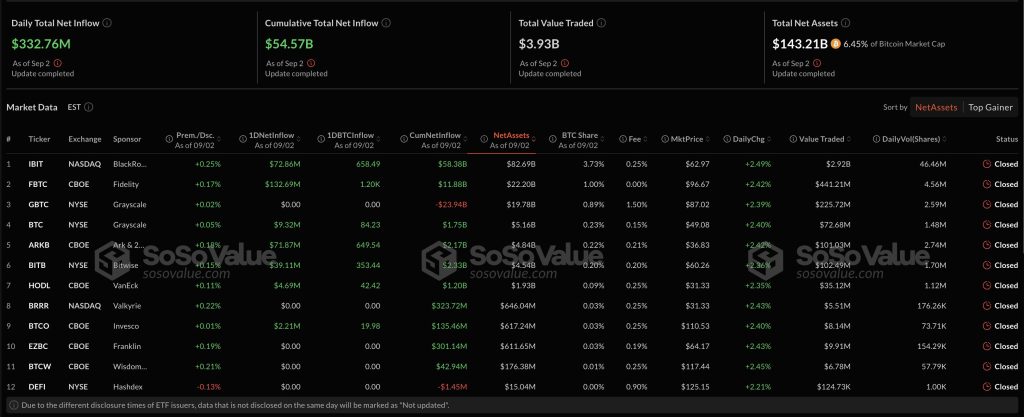
Source: SoSoValue

In contrast, Ethereum products recorded $135.3 million in daily net outflows, weighed down by Fidelity’s FETH shedding $99.2 million and Bitwise’s ETHW losing $24.2 million.

Ethereum’s August Surge vs. Bitcoin’s September History

August had been Ethereum’s month. Analysts described a “rotational shift” toward ETH, driven by yield-bearing staking, improving regulatory signals, and rising adoption by corporate treasuries.

Ethereum ETFs attracted $3.87 billion in net inflows last month, compared to Bitcoin’s $751 million in outflows. Trading activity showed the divergence, with Ethereum ETF volume surging to $58.37 billion in August, nearly doubling July’s $33.87 billion, while Bitcoin ETF volume dipped slightly to $78.14 billion.

The price action reinforced that enthusiasm. Ethereum notched a new all-time high of $4,953.73 in August, and public company holdings of ETH swelled dramatically. 71 companies disclosed a combined $119.68 billion in Ethereum by August 31st, up from 67 firms with $98.97 billion the prior month.

Bitcoin, by contrast, saw outflows and lagged in performance despite maintaining a far larger total ETF inflow base of $54.24 billion cumulatively.

But September tells a different story. Historically, Ethereum has stumbled during the month: in September 2024, ETH ETFs saw $46.54 million in outflows, registering redemptions in three out of four weeks.

Bitcoin ETFs, meanwhile, posted a $1.26 billion inflow over the same period, benefiting from risk-averse positioning as markets cooled.

What’s Fueling the Rotation from Ethereum to Bitcoin?

Market watchers suggest this September may again favor Bitcoin. Historically, September has been a “cool-down” month for crypto, with ETH often underperforming due to weaker seasonal flows and lower risk appetite. Bitcoin, seen as the safer benchmark asset, typically regains inflows when volatility rises.

Macro forces are also at play. With global central banks signaling caution and bond yields holding firm, investors appear to be trimming higher-risk ETH exposure in favor of Bitcoin, still viewed as the digital reserve asset of choice.

The derivatives market shows the shift. Over the past 24 hours, Ethereum futures saw $1.22 billion in outflows, nearly double Bitcoin’s $646.7 million in outflows, according to Coinglass.

Also, Bitcoin treasuries remain a magnet for institutional flows. As of Sept. 1, weekly bitcoin net inflows totaled 3,102 BTC (about $335.8 million), with Michael Saylor’s MicroStrategy adding 4,048 BTC worth $449 million on Sept. 2 alone.

By contrast, Ethereum treasuries have lagged, with fewer corporate balance sheets disclosing significant ETH allocations despite August’s record price run-up. The gap shows a key reason for the rotation: while ETH may offer yield and programmability, Bitcoin continues to dominate as the go-to institutional treasury asset.

That hunt for yield is exactly where the danger lies, according to Sharplink Gaming co-CEO Joseph Chalom. Speaking on Bankless, Chalom warned that companies piling into Ether to squeeze out extra returns could expose themselves to cascading risks if markets turn.

“There will be people just like in traditional finance who want that last 100 basis points of yield and think it’s riskless,” Chalom said, noting that double-digit ETH yields often carry credit, counterparty, duration, and smart contract risks. The greater concern, he added, is that firms already behind the curve may double down imprudently in an attempt to catch up.

“The sector could be tainted by people that do imprudent things—whether in how they raise capital or in the kind of yield strategies they chase with their ETH holdings,” he cautioned.

As of late Tuesday, Bitcoin rose 0.55% to $110,943, while Ethereum slipped 1% to $4,327. Whether this marks the start of a sustained September rotation back into Bitcoin or just a short-term rebalancing remains the key question hanging over crypto markets.


Market Opportunity
Bitcoin Logo
Bitcoin Price(BTC)
$95.081,7
$95.081,7$95.081,7
-%0,51
USD
Bitcoin (BTC) Live Price Chart
Disclaimer: The articles reposted on this site are sourced from public platforms and are provided for informational purposes only. They do not necessarily reflect the views of MEXC. All rights remain with the original authors. If you believe any content infringes on third-party rights, please contact service@support.mexc.com for removal. MEXC makes no guarantees regarding the accuracy, completeness, or timeliness of the content and is not responsible for any actions taken based on the information provided. The content does not constitute financial, legal, or other professional advice, nor should it be considered a recommendation or endorsement by MEXC.

You May Also Like

Gold Hits $3,700 as Sprott’s Wong Says Dollar’s Store-of-Value Crown May Slip

Gold Hits $3,700 as Sprott’s Wong Says Dollar’s Store-of-Value Crown May Slip

The post Gold Hits $3,700 as Sprott’s Wong Says Dollar’s Store-of-Value Crown May Slip appeared on BitcoinEthereumNews.com. Gold is strutting its way into record territory, smashing through $3,700 an ounce Wednesday morning, as Sprott Asset Management strategist Paul Wong says the yellow metal may finally snatch the dollar’s most coveted role: store of value. Wong Warns: Fiscal Dominance Puts U.S. Dollar on Notice, Gold on Top Gold prices eased slightly to $3,678.9 […] Source: https://news.bitcoin.com/gold-hits-3700-as-sprotts-wong-says-dollars-store-of-value-crown-may-slip/
Share
BitcoinEthereumNews2025/09/18 00:33
Franklin Templeton CEO Dismisses 50bps Rate Cut Ahead FOMC

Franklin Templeton CEO Dismisses 50bps Rate Cut Ahead FOMC

The post Franklin Templeton CEO Dismisses 50bps Rate Cut Ahead FOMC appeared on BitcoinEthereumNews.com. Franklin Templeton CEO Jenny Johnson has weighed in on whether the Federal Reserve should make a 25 basis points (bps) Fed rate cut or 50 bps cut. This comes ahead of the Fed decision today at today’s FOMC meeting, with the market pricing in a 25 bps cut. Bitcoin and the broader crypto market are currently trading flat ahead of the rate cut decision. Franklin Templeton CEO Weighs In On Potential FOMC Decision In a CNBC interview, Jenny Johnson said that she expects the Fed to make a 25 bps cut today instead of a 50 bps cut. She acknowledged the jobs data, which suggested that the labor market is weakening. However, she noted that this data is backward-looking, indicating that it doesn’t show the current state of the economy. She alluded to the wage growth, which she remarked is an indication of a robust labor market. She added that retail sales are up and that consumers are still spending, despite inflation being sticky at 3%, which makes a case for why the FOMC should opt against a 50-basis-point Fed rate cut. In line with this, the Franklin Templeton CEO said that she would go with a 25 bps rate cut if she were Jerome Powell. She remarked that the Fed still has the October and December FOMC meetings to make further cuts if the incoming data warrants it. Johnson also asserted that the data show a robust economy. However, she noted that there can’t be an argument for no Fed rate cut since Powell already signaled at Jackson Hole that they were likely to lower interest rates at this meeting due to concerns over a weakening labor market. Notably, her comment comes as experts argue for both sides on why the Fed should make a 25 bps cut or…
Share
BitcoinEthereumNews2025/09/18 00:36
[Tambay] Tres niños na bagitos

[Tambay] Tres niños na bagitos

Mga bagong lublób sa malupit na mundo ng Philippine politics ang mga newbies na sina Leviste, Barzaga, at San Fernando, kaya madalas nakakangilo ang kanilang ikinikilos
Share
Rappler2026/01/18 10:00