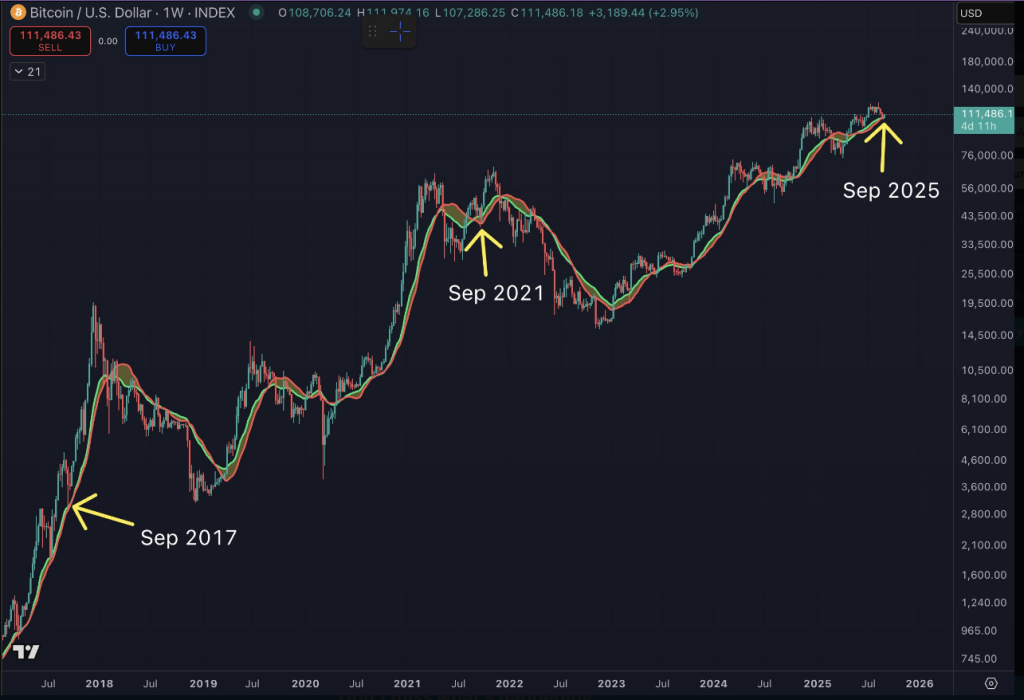
Bitcoin has bounced back above $112,000 after slipping to $107,000 last week, its lowest mark since July. The rebound has stirred hope among traders, but analysts remain split on whether the current upswing can hold through September. Related Reading: XRP Faces Crucial Test With ETF Approval Chances Now At 87% September’s Track Record Under Scrutiny Historical data shows September hasn’t been kind to Bitcoin during post-halving years. In 2017, the coin ended the month with a close to 8% loss, while in 2021 the decline was 7%. Even further back, in 2013, Bitcoin dropped 1.60% in the same month. That pattern has led some experts to argue that a retest of key technical levels this year is nothing unusual. Benjamin Cowen, head of ITC Crypto, has repeatedly pointed to the 20-week simple moving average as a marker. According to him, September tends to bring price dips toward that level before a fourth-quarter recovery takes hold. Cowen believes the recent pullback fits the broader rhythm seen in earlier cycles. Historically, #Bitcoin finds a low in September of the post-halving year, and then bounces off of it into the market cycle top that occurs in Q4. pic.twitter.com/CVbcPOUojM — Benjamin Cowen (@intocryptoverse) September 3, 2025 Mixed Views On Cycle Consistency Not everyone is convinced. Some analysts have raised questions about whether the cycle is breaking from tradition. They highlighted that Bitcoin normally records gains in August before falling back in September. This time, however, the opposite occurred. Bitcoin closed August with a 6.25% loss. That stands in stark contrast to August 2017, when the coin surged 64%, and August 2021, when it gained 15%. Those two robust months were each followed by abrupt September declines. Analysts believe that current data indicate a different configuration could be at work, with macroeconomic parameters such as rate cuts being more pronounced over price action. Calls That The Bottom Is Already In Despite the cautious tone from some analysts, there are voices pointing to a brighter near-term outlook, saying the low for September may already be behind Bitcoin. The asset opened the month at $108,200, touched a high of $110,100, and fell to $107,000 before rebounding. Based on that sequence, analysts suggest the market may avoid setting new lows this month. Related Reading: XRP Faces Crucial Test With ETF Approval Chances Now At 87% Cowen, however, continues to stress that corrections after setting fresh highs are part of the cycle. He points to August’s new record peak as evidence that the market is following the same blueprint as previous years. In his view, the retreat to the 20-week SMA is less a warning sign than a setup for a strong year-end rally. While the debate over September’s outcome continues, most analysts agree on one point: short-term turbulence is unlikely to alter the long-term picture. Recent data have made clear that despite temporary dips, Bitcoin is expected to trade far higher in the years ahead. Featured image from Meta, chart from TradingViewBitcoin has bounced back above $112,000 after slipping to $107,000 last week, its lowest mark since July. The rebound has stirred hope among traders, but analysts remain split on whether the current upswing can hold through September. Related Reading: XRP Faces Crucial Test With ETF Approval Chances Now At 87% September’s Track Record Under Scrutiny Historical data shows September hasn’t been kind to Bitcoin during post-halving years. In 2017, the coin ended the month with a close to 8% loss, while in 2021 the decline was 7%. Even further back, in 2013, Bitcoin dropped 1.60% in the same month. That pattern has led some experts to argue that a retest of key technical levels this year is nothing unusual. Benjamin Cowen, head of ITC Crypto, has repeatedly pointed to the 20-week simple moving average as a marker. According to him, September tends to bring price dips toward that level before a fourth-quarter recovery takes hold. Cowen believes the recent pullback fits the broader rhythm seen in earlier cycles. Historically, #Bitcoin finds a low in September of the post-halving year, and then bounces off of it into the market cycle top that occurs in Q4. pic.twitter.com/CVbcPOUojM — Benjamin Cowen (@intocryptoverse) September 3, 2025 Mixed Views On Cycle Consistency Not everyone is convinced. Some analysts have raised questions about whether the cycle is breaking from tradition. They highlighted that Bitcoin normally records gains in August before falling back in September. This time, however, the opposite occurred. Bitcoin closed August with a 6.25% loss. That stands in stark contrast to August 2017, when the coin surged 64%, and August 2021, when it gained 15%. Those two robust months were each followed by abrupt September declines. Analysts believe that current data indicate a different configuration could be at work, with macroeconomic parameters such as rate cuts being more pronounced over price action. Calls That The Bottom Is Already In Despite the cautious tone from some analysts, there are voices pointing to a brighter near-term outlook, saying the low for September may already be behind Bitcoin. The asset opened the month at $108,200, touched a high of $110,100, and fell to $107,000 before rebounding. Based on that sequence, analysts suggest the market may avoid setting new lows this month. Related Reading: XRP Faces Crucial Test With ETF Approval Chances Now At 87% Cowen, however, continues to stress that corrections after setting fresh highs are part of the cycle. He points to August’s new record peak as evidence that the market is following the same blueprint as previous years. In his view, the retreat to the 20-week SMA is less a warning sign than a setup for a strong year-end rally. While the debate over September’s outcome continues, most analysts agree on one point: short-term turbulence is unlikely to alter the long-term picture. Recent data have made clear that despite temporary dips, Bitcoin is expected to trade far higher in the years ahead. Featured image from Meta, chart from TradingView

Bitcoin Could Slip In September Before Q4 Rally, Cycle Data Shows

2025/09/05 03:30
3 min read

Bitcoin has bounced back above $112,000 after slipping to $107,000 last week, its lowest mark since July. The rebound has stirred hope among traders, but analysts remain split on whether the current upswing can hold through September.

September’s Track Record Under Scrutiny

Historical data shows September hasn’t been kind to Bitcoin during post-halving years. In 2017, the coin ended the month with a close to 8% loss, while in 2021 the decline was 7%.

Even further back, in 2013, Bitcoin dropped 1.60% in the same month. That pattern has led some experts to argue that a retest of key technical levels this year is nothing unusual.

Benjamin Cowen, head of ITC Crypto, has repeatedly pointed to the 20-week simple moving average as a marker.

According to him, September tends to bring price dips toward that level before a fourth-quarter recovery takes hold. Cowen believes the recent pullback fits the broader rhythm seen in earlier cycles.
Mixed Views On Cycle Consistency

Not everyone is convinced. Some analysts have raised questions about whether the cycle is breaking from tradition. They highlighted that Bitcoin normally records gains in August before falling back in September. This time, however, the opposite occurred.

Bitcoin closed August with a 6.25% loss. That stands in stark contrast to August 2017, when the coin surged 64%, and August 2021, when it gained 15%.

Those two robust months were each followed by abrupt September declines. Analysts believe that current data indicate a different configuration could be at work, with macroeconomic parameters such as rate cuts being more pronounced over price action.

Calls That The Bottom Is Already In

Despite the cautious tone from some analysts, there are voices pointing to a brighter near-term outlook, saying the low for September may already be behind Bitcoin.

The asset opened the month at $108,200, touched a high of $110,100, and fell to $107,000 before rebounding. Based on that sequence, analysts suggest the market may avoid setting new lows this month.

Cowen, however, continues to stress that corrections after setting fresh highs are part of the cycle. He points to August’s new record peak as evidence that the market is following the same blueprint as previous years.

In his view, the retreat to the 20-week SMA is less a warning sign than a setup for a strong year-end rally.

While the debate over September’s outcome continues, most analysts agree on one point: short-term turbulence is unlikely to alter the long-term picture.

Recent data have made clear that despite temporary dips, Bitcoin is expected to trade far higher in the years ahead.

Featured image from Meta, chart from TradingView

Market Opportunity
NEAR Logo
NEAR Price(NEAR)
$1.0647
$1.0647$1.0647
-0.19%
USD
NEAR (NEAR) Live Price Chart
Disclaimer: The articles reposted on this site are sourced from public platforms and are provided for informational purposes only. They do not necessarily reflect the views of MEXC. All rights remain with the original authors. If you believe any content infringes on third-party rights, please contact crypto.news@mexc.com for removal. MEXC makes no guarantees regarding the accuracy, completeness, or timeliness of the content and is not responsible for any actions taken based on the information provided. The content does not constitute financial, legal, or other professional advice, nor should it be considered a recommendation or endorsement by MEXC.

You May Also Like

OpenVPP accused of falsely advertising cooperation with the US government; SEC commissioner clarifies no involvement

OpenVPP accused of falsely advertising cooperation with the US government; SEC commissioner clarifies no involvement

PANews reported on September 17th that on-chain sleuth ZachXBT tweeted that OpenVPP ( $OVPP ) announced this week that it was collaborating with the US government to advance energy tokenization. SEC Commissioner Hester Peirce subsequently responded, stating that the company does not collaborate with or endorse any private crypto projects. The OpenVPP team subsequently hid the response. Several crypto influencers have participated in promoting the project, and the accounts involved have been questioned as typical influencer accounts.
Share
PANews2025/09/17 23:58
Aave DAO to Shut Down 50% of L2s While Doubling Down on GHO

Aave DAO to Shut Down 50% of L2s While Doubling Down on GHO

The post Aave DAO to Shut Down 50% of L2s While Doubling Down on GHO appeared on BitcoinEthereumNews.com. Aave DAO is gearing up for a significant overhaul by shutting down over 50% of underperforming L2 instances. It is also restructuring its governance framework and deploying over $100 million to boost GHO. This could be a pivotal moment that propels Aave back to the forefront of on-chain lending or sparks unprecedented controversy within the DeFi community. Sponsored Sponsored ACI Proposes Shutting Down 50% of L2s The “State of the Union” report by the Aave Chan Initiative (ACI) paints a candid picture. After a turbulent period in the DeFi market and internal challenges, Aave (AAVE) now leads in key metrics: TVL, revenue, market share, and borrowing volume. Aave’s annual revenue of $130 million surpasses the combined cash reserves of its competitors. Tokenomics improvements and the AAVE token buyback program have also contributed to the ecosystem’s growth. Aave global metrics. Source: Aave However, the ACI’s report also highlights several pain points. First, regarding the Layer-2 (L2) strategy. While Aave’s L2 strategy was once a key driver of success, it is no longer fit for purpose. Over half of Aave’s instances on L2s and alt-L1s are not economically viable. Based on year-to-date data, over 86.6% of Aave’s revenue comes from the mainnet, indicating that everything else is a side quest. On this basis, ACI proposes closing underperforming networks. The DAO should invest in key networks with significant differentiators. Second, ACI is pushing for a complete overhaul of the “friendly fork” framework, as most have been unimpressive regarding TVL and revenue. In some cases, attackers have exploited them to Aave’s detriment, as seen with Spark. Sponsored Sponsored “The friendly fork model had a good intention but bad execution where the DAO was too friendly towards these forks, allowing the DAO only little upside,” the report states. Third, the instance model, once a smart…
Share
BitcoinEthereumNews2025/09/18 02:28
Banking Regulator Floats New Stablecoin Yield Rules—Do They Hurt Coinbase?

Banking Regulator Floats New Stablecoin Yield Rules—Do They Hurt Coinbase?

The post Banking Regulator Floats New Stablecoin Yield Rules—Do They Hurt Coinbase? appeared on BitcoinEthereumNews.com. In brief The OCC proposed rules that would
Share
BitcoinEthereumNews2026/03/01 00:34
