

Could the Iran War Push Oil Past $100? What It Means for Stocks and Your Bills
TLDR
- A prolonged Iran war could push oil above $100 a barrel, raising inflation risks globally
- Fed officials say it’s too early to judge the war’s impact on U.S. interest rate decisions
- The S&P 500 has historically recovered from geopolitical shocks within weeks
- ECB’s Joachim Nagel warns a long conflict would raise eurozone inflation and slow growth
- U.S. gas prices jumped over 22 cents in one week, with electricity costs up 6.3% year-on-year
The war in Iran has rattled global energy markets and raised fresh questions about inflation, interest rates, and asset prices heading into spring 2026.
Gas prices in the U.S. hit $3.19 per gallon as of Wednesday, up more than 22 cents from the prior week, according to AAA. Brent Crude jumped above $85 per barrel on Tuesday, its highest level since July 2024.
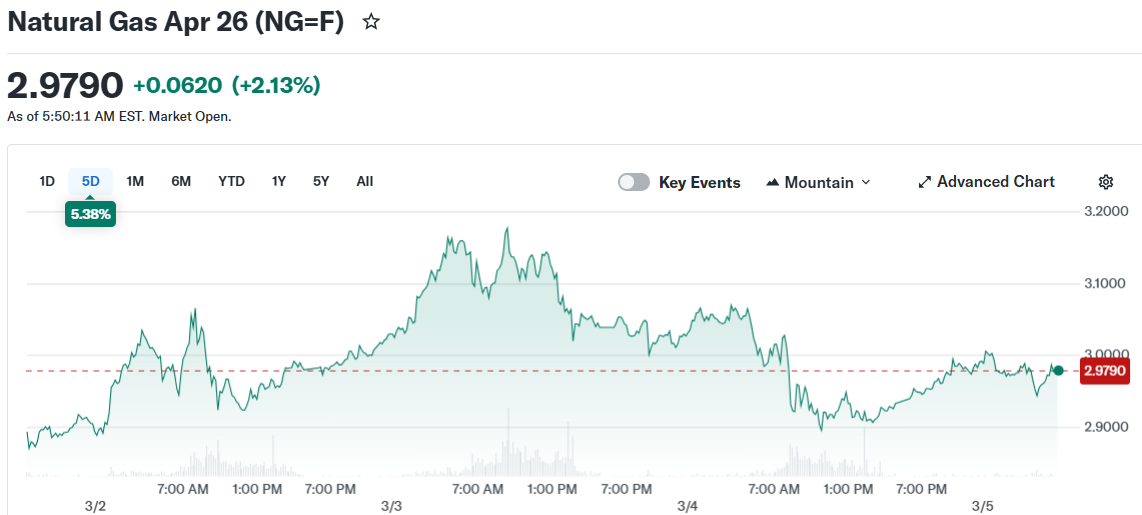 Natural Gas Apr 26 (NG=F)
Some analysts say oil could top $100 a barrel if the conflict drags on. That would add pressure to an inflation picture that was already showing cracks before the first shots were fired.
Electricity prices in the U.S. rose 6.3% in the 12 months ending January 2026, more than double the headline inflation rate of 2.5%. Average residential electricity costs climbed from just under 16 cents per kilowatt hour in January 2025 to nearly 18 cents in November 2025.
Federal Reserve Bank of Cleveland President Beth Hammack echoed that view, telling the New York Times it was too early to gauge the war’s impact. She said she favored holding interest rates steady for “quite some time.”
CME FedWatch data shows combined odds of a rate cut at the July Fed meeting sitting at 54.7%. Odds for March and April remain low at 2.7% and 12.8% respectively.
How Stocks Have Responded
LPL Financial analysts noted that across more than two dozen geopolitical events since World War II, the S&P 500 averaged a one-day drop of just 1%. Markets have typically stabilized and recovered within weeks.
The S&P 500 fell 1.2% when Iran attacked Israel in April 2024 and recovered in just over two weeks. The index actually rose 1% after the U.S. and Israel struck Iran in June 2025.
LPL analyst Kristian Ker wrote that any sustained disruption to oil and gas flows could “influence inflation expectations, weigh on business confidence, and elevate volatility across asset classes.”
ECB Flags Eurozone Risk
In Europe, European Central Bank policymaker Joachim Nagel warned Thursday that a prolonged war in Iran would push up eurozone inflation and hurt growth.
He added it was too early to draw conclusions for interest rate settings. The Bundesbank’s 2025 annual report showed a loss of 8.6 billion euros tied to bonds purchased during past stimulus programs.
Wells Fargo’s chief economist Tom Porcelli wrote that projected oil price increases of up to 30% do not come close to triggering a recession, and that absent a prolonged conflict, the impact on inflation and monetary policy “should remain modest.”
The post Could the Iran War Push Oil Past $100? What It Means for Stocks and Your Bills appeared first on CoinCentral.
You May Also Like

Why Owning Just 10 Pi Could Be a Game-Changer in the Future of Crypto

‘Marriage penalty’ in Washington state’s new tax stirs debate

