

A new analysis explores the potential XRP price if the world’s top 10 central banks allocate a portion of their combined $13 trillion in reserves to the coin. The results show that even a modest level of adoption at this scale could propel XRP to new heights. XRP's Current Market Position Notably, XRP is currently trading at around $2.81, with a circulating supply of approximately 59.4 billion tokens. This gives it a market cap of about $172.3 billion, making it one of the largest digital assets in circulation. Despite this substantial valuation, the entry of central banks could completely reshape XRP’s trajectory. Allocation Scenarios from $130B to $822B in XRP If the top 10 central banks—including those in China, Japan, Switzerland, India, Russia, the United States, and others—were to allocate just 1% of their reserves (around $130 billion) to XRP, its market cap would rise to over $302 billion. This would push the token’s price to approximately $5.09. A 3% allocation, representing $390 billion, would drive XRP’s value to about $9.47. At the upper end, a 5% allocation equal to $650 billion would result in a market cap of more than $822 billion, translating to a token price near $13.84. Extended Outlook at 10% Looking beyond modest allocations, a 10% commitment from central bank reserves, roughly $1.3 trillion, could raise XRP’s market cap to $1.47 trillion. In this scenario, XRP price could climb to around $22.58 per coin, nearly eight times its current value. Speculative prices for XRP on goverment allocationSpeculative prices for XRP on government allocation However, it is important to note that these figures are based on basic market cap arithmetic, assuming that central bank inflows would translate directly into increased valuation. In reality, such massive buying pressure from institutions of this size would likely create a multiplier effect, potentially driving XRP’s price well beyond these projections. Even a $1 billion government allocation could trigger significant market reactions, making inflows of $130 billion to $1.3 trillion far more impactful than the raw numbers might suggest. Consider the market frenzy that would likely follow an announcement that the U.S. government is purchasing $1 billion worth of XRP. But Is There Any Chance These Governments Will Hold XRP? The idea of governments holding XRP is compelling, especially amid a global push for crypto innovation and adoption at the governmental level, which has reached unprecedented momentum this year. The U.S. government has signed into law a bill on stablecoins, marking a historic milestone for crypto legitimacy. Furthermore, the government is working toward establishing a national crypto reserve that could hold up to 1 million BTC, along with a diversified crypto stockpile including XRP, Ethereum, Cardano, and Solana. However, the U.S. has not expressed readiness to purchase any cryptocurrency beyond Bitcoin. In countries like Russia and China, most discussions around crypto have focused on Bitcoin and stablecoins, often viewed as tools to promote their local currencies. Regarding Bitcoin, institutional FOMO remains high. Governments that currently hold BTC show no signs of selling. Notably, countries such as the U.S., China, the U.K., Ukraine, Bhutan, El Salvador, and four others collectively hold 517,298 BTC—worth over $56.76 billion. In essence, the current institutional focus is overwhelmingly on Bitcoin, while altcoins like XRP remain in the background. Takeaway This analysis highlights the potentially outsized impact of institutional adoption on XRP, particularly at the highest level. However, the scenario of governments allocating between $130 billion and $1.3 trillion into XRP remains highly speculative. As it stands, Bitcoin is the more likely candidate for such large-scale government adoption. Countries holding Bitcoin | https://bitbo.io/treasuries/countries/A new analysis explores the potential XRP price if the world’s top 10 central banks allocate a portion of their combined $13 trillion in reserves to the coin. The results show that even a modest level of adoption at this scale could propel XRP to new heights. XRP's Current Market Position Notably, XRP is currently trading at around $2.81, with a circulating supply of approximately 59.4 billion tokens. This gives it a market cap of about $172.3 billion, making it one of the largest digital assets in circulation. Despite this substantial valuation, the entry of central banks could completely reshape XRP’s trajectory. Allocation Scenarios from $130B to $822B in XRP If the top 10 central banks—including those in China, Japan, Switzerland, India, Russia, the United States, and others—were to allocate just 1% of their reserves (around $130 billion) to XRP, its market cap would rise to over $302 billion. This would push the token’s price to approximately $5.09. A 3% allocation, representing $390 billion, would drive XRP’s value to about $9.47. At the upper end, a 5% allocation equal to $650 billion would result in a market cap of more than $822 billion, translating to a token price near $13.84. Extended Outlook at 10% Looking beyond modest allocations, a 10% commitment from central bank reserves, roughly $1.3 trillion, could raise XRP’s market cap to $1.47 trillion. In this scenario, XRP price could climb to around $22.58 per coin, nearly eight times its current value. Speculative prices for XRP on goverment allocationSpeculative prices for XRP on government allocation However, it is important to note that these figures are based on basic market cap arithmetic, assuming that central bank inflows would translate directly into increased valuation. In reality, such massive buying pressure from institutions of this size would likely create a multiplier effect, potentially driving XRP’s price well beyond these projections. Even a $1 billion government allocation could trigger significant market reactions, making inflows of $130 billion to $1.3 trillion far more impactful than the raw numbers might suggest. Consider the market frenzy that would likely follow an announcement that the U.S. government is purchasing $1 billion worth of XRP. But Is There Any Chance These Governments Will Hold XRP? The idea of governments holding XRP is compelling, especially amid a global push for crypto innovation and adoption at the governmental level, which has reached unprecedented momentum this year. The U.S. government has signed into law a bill on stablecoins, marking a historic milestone for crypto legitimacy. Furthermore, the government is working toward establishing a national crypto reserve that could hold up to 1 million BTC, along with a diversified crypto stockpile including XRP, Ethereum, Cardano, and Solana. However, the U.S. has not expressed readiness to purchase any cryptocurrency beyond Bitcoin. In countries like Russia and China, most discussions around crypto have focused on Bitcoin and stablecoins, often viewed as tools to promote their local currencies. Regarding Bitcoin, institutional FOMO remains high. Governments that currently hold BTC show no signs of selling. Notably, countries such as the U.S., China, the U.K., Ukraine, Bhutan, El Salvador, and four others collectively hold 517,298 BTC—worth over $56.76 billion. In essence, the current institutional focus is overwhelmingly on Bitcoin, while altcoins like XRP remain in the background. Takeaway This analysis highlights the potentially outsized impact of institutional adoption on XRP, particularly at the highest level. However, the scenario of governments allocating between $130 billion and $1.3 trillion into XRP remains highly speculative. As it stands, Bitcoin is the more likely candidate for such large-scale government adoption. Countries holding Bitcoin | https://bitbo.io/treasuries/countries/
Here’s XRP Price If It Becomes the First Coin Held by Top 10 Central Banks
For feedback or concerns regarding this content, please contact us at crypto.news@mexc.com
A new analysis explores the potential XRP price if the world’s top 10 central banks allocate a portion of their combined $13 trillion in reserves to the coin. The results show that even a modest level of adoption at this scale could propel XRP to new heights. XRP's Current Market Position Notably, XRP is currently trading at around $2.81, with a circulating supply of approximately 59.4 billion tokens. This gives it a market cap of about $172.3 billion, making it one of the largest digital assets in circulation. Despite this substantial valuation, the entry of central banks could completely reshape XRP’s trajectory. Allocation Scenarios from $130B to $822B in XRP If the top 10 central banks—including those in China, Japan, Switzerland, India, Russia, the United States, and others—were to allocate just 1% of their reserves (around $130 billion) to XRP, its market cap would rise to over $302 billion. This would push the token’s price to approximately $5.09. A 3% allocation, representing $390 billion, would drive XRP’s value to about $9.47. At the upper end, a 5% allocation equal to $650 billion would result in a market cap of more than $822 billion, translating to a token price near $13.84. Extended Outlook at 10% Looking beyond modest allocations, a 10% commitment from central bank reserves, roughly $1.3 trillion, could raise XRP’s market cap to $1.47 trillion. In this scenario, XRP price could climb to around $22.58 per coin, nearly eight times its current value. 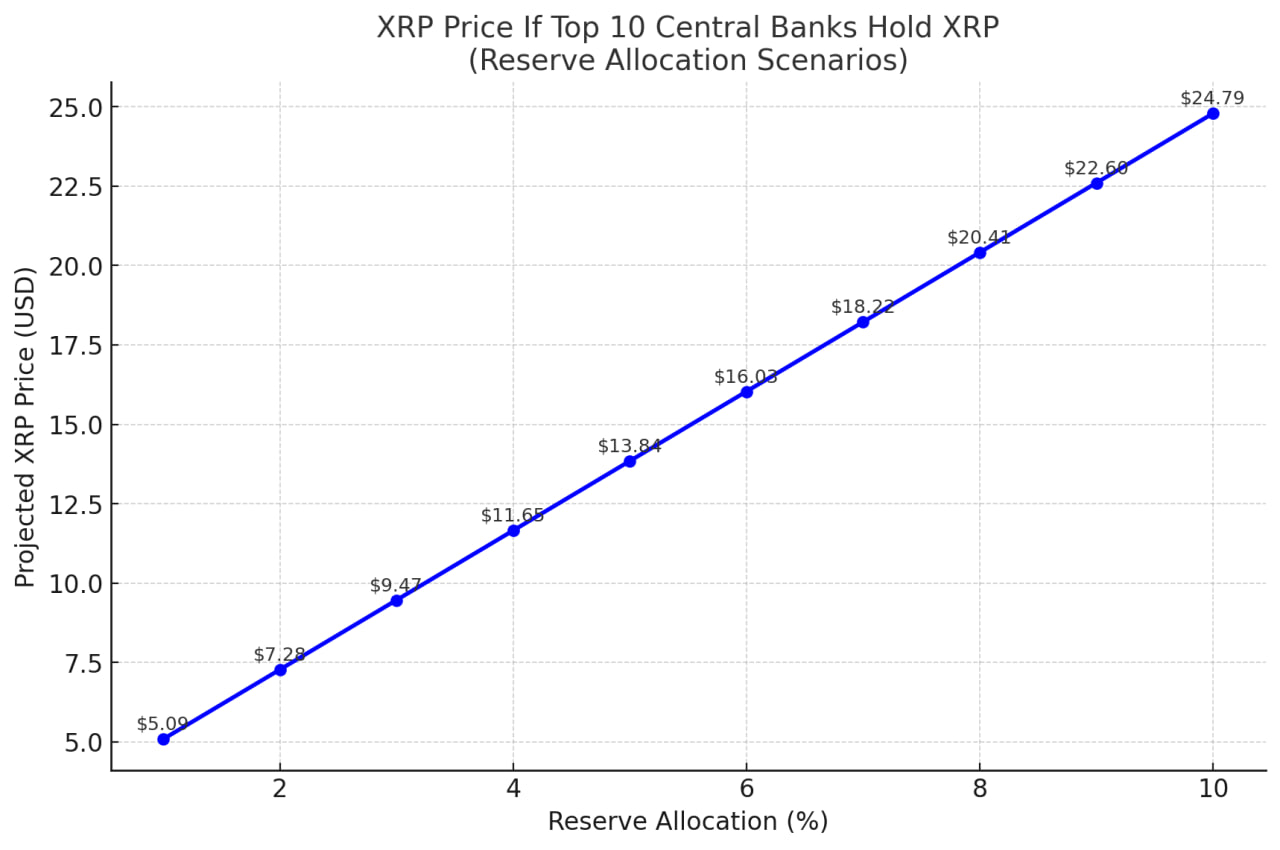 Speculative prices for XRP on goverment allocationSpeculative prices for XRP on government allocation However, it is important to note that these figures are based on basic market cap arithmetic, assuming that central bank inflows would translate directly into increased valuation. In reality, such massive buying pressure from institutions of this size would likely create a multiplier effect, potentially driving XRP’s price well beyond these projections. Even a $1 billion government allocation could trigger significant market reactions, making inflows of $130 billion to $1.3 trillion far more impactful than the raw numbers might suggest. Consider the market frenzy that would likely follow an announcement that the U.S. government is purchasing $1 billion worth of XRP. But Is There Any Chance These Governments Will Hold XRP? The idea of governments holding XRP is compelling, especially amid a global push for crypto innovation and adoption at the governmental level, which has reached unprecedented momentum this year. The U.S. government has signed into law a bill on stablecoins, marking a historic milestone for crypto legitimacy. Furthermore, the government is working toward establishing a national crypto reserve that could hold up to 1 million BTC, along with a diversified crypto stockpile including XRP, Ethereum, Cardano, and Solana. However, the U.S. has not expressed readiness to purchase any cryptocurrency beyond Bitcoin. In countries like Russia and China, most discussions around crypto have focused on Bitcoin and stablecoins, often viewed as tools to promote their local currencies. Regarding Bitcoin, institutional FOMO remains high. Governments that currently hold BTC show no signs of selling. Notably, countries such as the U.S., China, the U.K., Ukraine, Bhutan, El Salvador, and four others collectively hold 517,298 BTC—worth over $56.76 billion. In essence, the current institutional focus is overwhelmingly on Bitcoin, while altcoins like XRP remain in the background. Takeaway This analysis highlights the potentially outsized impact of institutional adoption on XRP, particularly at the highest level. However, the scenario of governments allocating between $130 billion and $1.3 trillion into XRP remains highly speculative. As it stands, Bitcoin is the more likely candidate for such large-scale government adoption.
 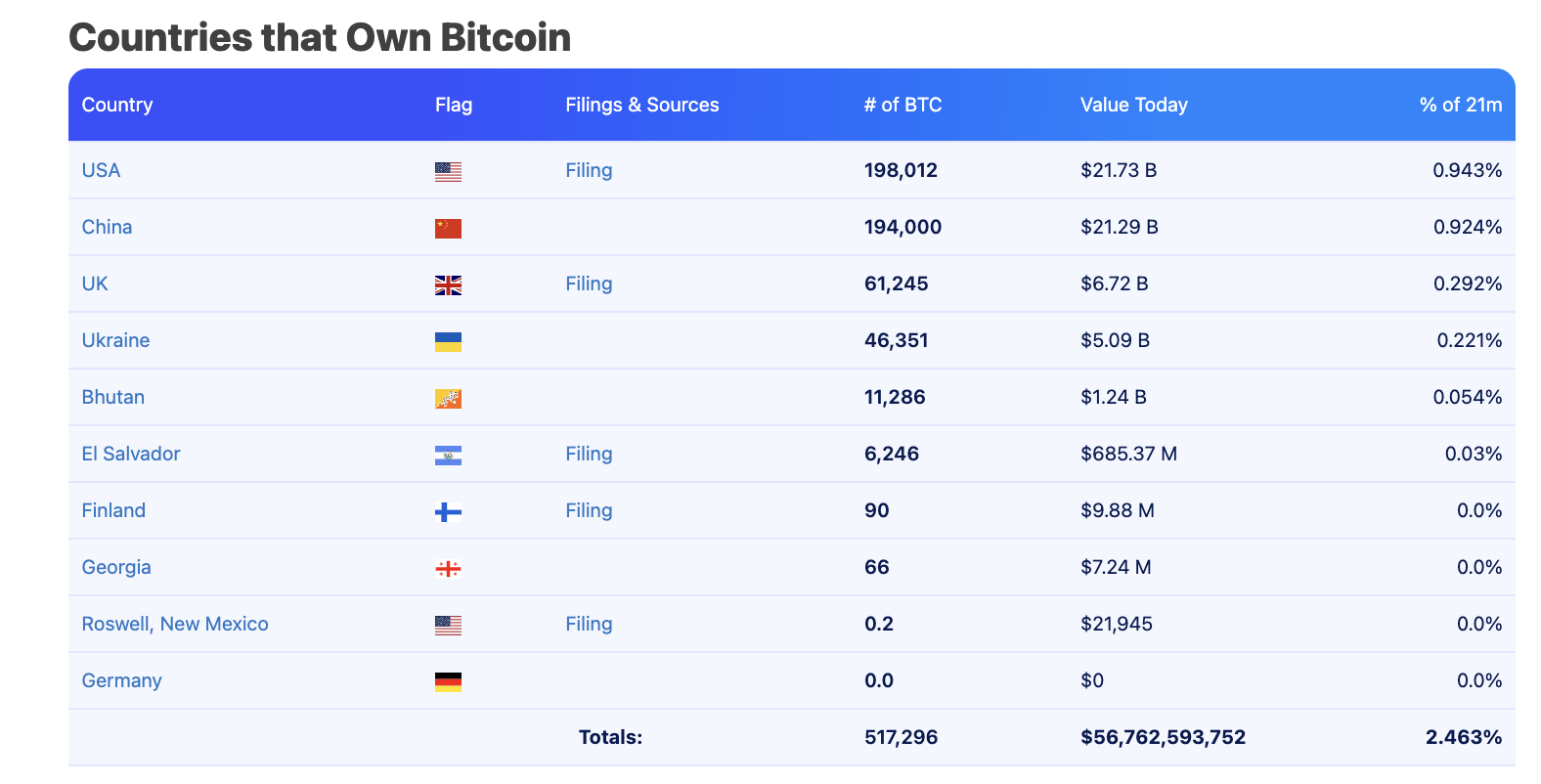 Countries holding Bitcoin | https://bitbo.io/treasuries/countries/
Speculative prices for XRP on goverment allocationSpeculative prices for XRP on government allocation However, it is important to note that these figures are based on basic market cap arithmetic, assuming that central bank inflows would translate directly into increased valuation. In reality, such massive buying pressure from institutions of this size would likely create a multiplier effect, potentially driving XRP’s price well beyond these projections. Even a $1 billion government allocation could trigger significant market reactions, making inflows of $130 billion to $1.3 trillion far more impactful than the raw numbers might suggest. Consider the market frenzy that would likely follow an announcement that the U.S. government is purchasing $1 billion worth of XRP. But Is There Any Chance These Governments Will Hold XRP? The idea of governments holding XRP is compelling, especially amid a global push for crypto innovation and adoption at the governmental level, which has reached unprecedented momentum this year. The U.S. government has signed into law a bill on stablecoins, marking a historic milestone for crypto legitimacy. Furthermore, the government is working toward establishing a national crypto reserve that could hold up to 1 million BTC, along with a diversified crypto stockpile including XRP, Ethereum, Cardano, and Solana. However, the U.S. has not expressed readiness to purchase any cryptocurrency beyond Bitcoin. In countries like Russia and China, most discussions around crypto have focused on Bitcoin and stablecoins, often viewed as tools to promote their local currencies. Regarding Bitcoin, institutional FOMO remains high. Governments that currently hold BTC show no signs of selling. Notably, countries such as the U.S., China, the U.K., Ukraine, Bhutan, El Salvador, and four others collectively hold 517,298 BTC—worth over $56.76 billion. In essence, the current institutional focus is overwhelmingly on Bitcoin, while altcoins like XRP remain in the background. Takeaway This analysis highlights the potentially outsized impact of institutional adoption on XRP, particularly at the highest level. However, the scenario of governments allocating between $130 billion and $1.3 trillion into XRP remains highly speculative. As it stands, Bitcoin is the more likely candidate for such large-scale government adoption. Countries holding Bitcoin | https://bitbo.io/treasuries/countries/Market Opportunity
NEAR Price(NEAR)
$1.3723
$1.3723$1.3723
USD
NEAR (NEAR) Live Price Chart


Disclaimer: The articles reposted on this site are sourced from public platforms and are provided for informational purposes only. They do not necessarily reflect the views of MEXC. All rights remain with the original authors. If you believe any content infringes on third-party rights, please contact crypto.news@mexc.com for removal. MEXC makes no guarantees regarding the accuracy, completeness, or timeliness of the content and is not responsible for any actions taken based on the information provided. The content does not constitute financial, legal, or other professional advice, nor should it be considered a recommendation or endorsement by MEXC.
You May Also Like
Trump admin tables new crypto 401(k) plans. President's 'Wall Street buddies' are the winners, critics say
Donald Trump; Illustration: Andrés Tapia ; Source: Shutterstock;
Share
DL News2026/04/09 23:22

The Best Online Gambling Site: Why Spartans.com Completely Dominates Stake, Roobet, Rainbet & Bet365
Finding the absolute best online gambling site can feel like searching for a needle in a massive digital haystack. There are so many options out there today, and
Share
LiveBitcoinNews2026/04/10 07:00

Rivalry Reignites: $1 Billion Showdown Unfolds Between Binance And OKX Founders
A familiar feud in crypto’s upper ranks has flared up again, this time centered not on trading platforms, but on the founders behind them. Binance founder Changpeng
Share
Bitcoinist2026/04/10 06:37



