Payment Processing Solutions Statistics 2026: Fintech Growth
In today’s rapidly evolving digital world, payment processing solutions have become the backbone of global commerce. Picture a bustling marketplace, but online, where transactions are instant, secure, and borderless. With the explosive growth of e-commerce and mobile payments, businesses and consumers alike are adopting innovative payment methods at an unprecedented pace.
This shift towards digital transactions isn’t just a trend; it’s shaping the future of finance. In this article, we’ll dive deep into today’s payment processing landscape, uncovering key statistics, emerging trends, and the technologies driving this essential industry forward.
Editor’s Choice
- In the U.S., 69% of adults use digital wallets.
- Global cross-border payments hit $397.37 billion.
- The global payments market grows to $3.5 trillion.
- In the U.S., digital wallets account for 39% of online transactions.
- Peer-to-peer mobile payments dominate U.S. digital transactions.
- The global digital wallet user base exceeds 5.2 billion.
- Apple Pay accounts for 14% of global e-commerce sales.
Recent Developments
- Apple Pay Later has been discontinued in favor of third‑party BNPL providers.
- Over 75% of top marketplaces use Stripe Connect for multi-party payouts.
- Stripe processed $1.4 trillion in payments in 2024, up 40% year over year.
- Global BNPL transaction value is projected to reach $576 billion.
- BNPL revenues are expected to hit $28.44 billion.
- Stripe serves merchants in over 50 countries worldwide.
- More than 100 Stripe customers process over $1 billion annually each.
Payment Processing Solutions Market Size and Growth
- The global payment processing solutions market reached $140.63 billion in 2025.
- The market is expected to grow to $164.97 billion in 2026, showing strong adoption of digital payment technologies.
- The industry is projected to grow at a 17.5% CAGR between 2026 and 2030, indicating rapid expansion in the digital payments sector.
- By 2030, the payment processing solutions market is forecast to reach $314.26 billion.
- The market is set to more than double in size from 2025 to 2030, driven by the rise of e-commerce, mobile payments, and digital wallets.
- Businesses continue to adopt online payment gateways and real-time payment systems, which help accelerate market growth.
- Increasing demand for secure, fast, and seamless payment processing solutions also supports the market’s strong growth outlook.
 (Reference: The Business Research Company)
Payment Processing Solutions Market Trends
- BNPL usage among U.S. consumers reaches 20%.
- Over 25,000 companies accept Bitcoin payments.
- India’s UPI powers 75% of real-time payment transactions.
- The embedded finance market reaches $197 billion.
- The virtual cards market totals $600 billion.
- The voice-based payment market hits $14.1 billion.
- Weekly subscriptions account for 47% of recurring revenue.
- 91.5 million Americans use BNPL services.
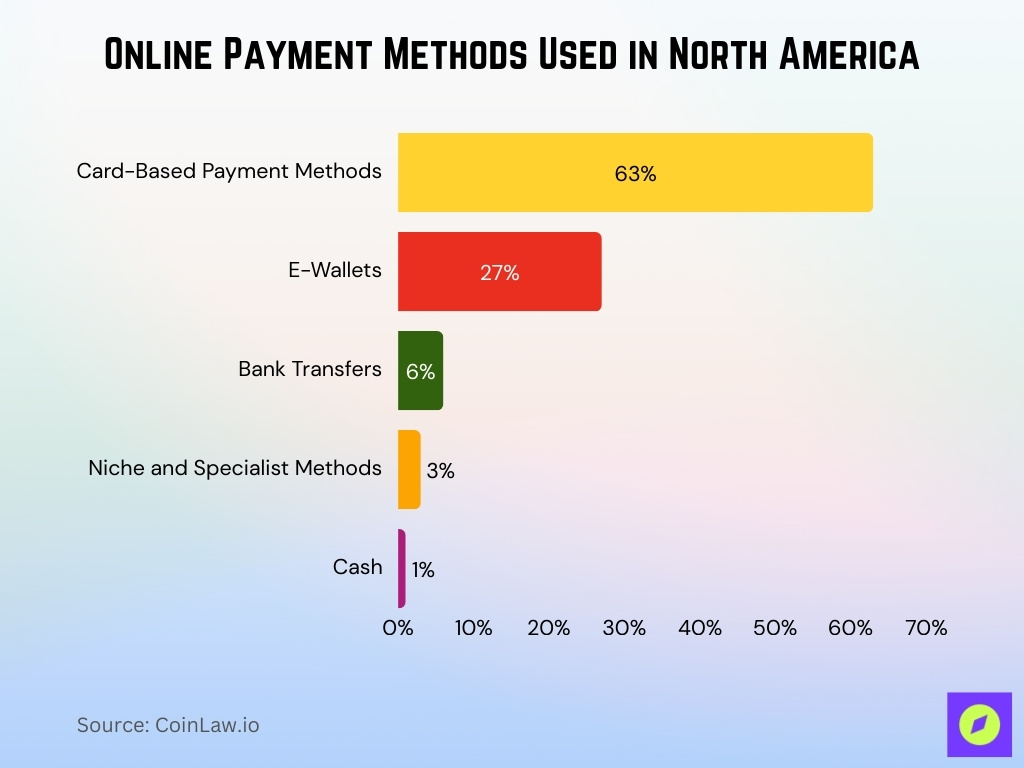
Online Payment Methods Used in North America
- Card-based payment methods lead online purchases in North America, accounting for 63% of transactions.
- E-wallets rank as the second most used option, making up 27% of online payments.
- Bank transfers represent 6% of online purchases, showing limited but steady use.
- Niche and specialist payment methods account for 3% of online transactions in the region.
- Cash payments are rarely used for online shopping, representing only 1% of purchases.
- The data shows that digital and card payments dominate online commerce in North America.
 (Reference: Market.us Scoop)
Key Players and Market Share in Payment Processing Solutions
- Visa and Mastercard control 52% and 25% of U.S. credit card transactions, totaling 77%.
- PayPal dominates global payment processing with 44.1% market share.
- Stripe holds 21% of the global market and a valuation of $91.5 billion.
- Block serves 4 million sellers, processing $210 billion annually.
- Apple Pay leads U.S. mobile wallets with 49% market share.
- Amazon Pay accounts for 6.5% of global digital payments.
- Adyen processes €1.39 trillion with net revenue of €2.36 billion.
- PayPal holds 39.2% payment gateway market share.
Mobile Bill Payments by Age Group
- 82% of Gen Z (18–24) prefer mobile for bill payments.
- 88% of Millennials (25–34) choose mobile to pay bills.
- 72% of lower-income consumers prefer mobile bill payment.
- 67% of middle-income consumers favor mobile for bill pay.
- 59% of high-income respondents use mobile for bill payments.
- Adults 18–24 make 45% of their payments with mobile.
- 31% of Gen Y have paid a bill via mobile device.
Main Issues Caused by Invoice Processing Challenges
- 32% of challenges are linked to stress on AP teams, remaining the top issue.
- 27% fall into other causes, reflecting various inefficiencies and hidden costs.
- 22% of problems arise from damaged relationships with vendors and suppliers.
- 19% lead to delays in the delivery of goods and services, impacting operations.
Adoption and Usage by Payment Method
- Digital wallets account for 55% of global e-commerce transactions.
- Credit cards represent 20% of digital transactions worldwide.
- Bank transfers and real-time payments comprise 25% of global digital transactions.
- Cryptocurrency payments reach 10% of global e-commerce transactions.
- BNPL transactions grow 18.9% year-over-year.
- 98% of Sweden’s transactions are digital.
- Contactless cards make up 50% of global in-store purchases.
- QR code payments hit 380 billion transactions globally.
Most Popular Online Payment Methods
- 45% of online shoppers prefer credit cards, remaining the top choice.
- 41% use electronic payment services like PayPal when available.
- 30% rely on debit cards for their online purchases.
- 22% still opt for cash on delivery, showing demand for flexible options.
- 21% of buyers use bank transfers, particularly for larger transactions.
- 16% prefer gift cards or vouchers as a secure payment method.
- 18% adopt mobile payments, reflecting digital wallet growth.
- 4% of online shoppers use cryptocurrencies like Bitcoin.
Technological Innovations in Payment Processing
- 85% of financial institutions have implemented blockchain solutions.
- 92% of financial institutions use AI for real-time fraud detection.
- AI fraud systems achieve 97% accuracy, reducing losses by 35%.
- 28% of digital transactions use biometric authentication.
- Tokenization secures 82% of e-commerce transactions.
- 15% of U.S. consumers use voice-activated purchases.
- 78% of terminals in developed markets support NFC.
- 65% of payments leverage machine learning analytics.
Key Abilities Valued in Accounts Receivable Payment Portals
- 52% of customers want the ability to pay invoices using multiple payment methods.
- 46% value communication and updates within the portal.
- 42% consider in-portal resolution of payment or invoice issues a top priority.
- 40% prefer being able to make multiple invoice payments at one time.
- 38% see importance in centralized visibility of interactions and account records.
- 35% want the option to make partial payments.
- 33% value the ability to schedule payments in advance.
- 31% look for the convenience of authorizing auto-payments.
Security and Fraud Prevention in Digital Payments
- Global digital payment fraud losses exceed $485 billion.
- Organizations lose an average of $60 million each to payment fraud annually.
- Businesses are projected to lose $15 billion to chargeback fraud.
- Global fraud losses reached $534 billion in 2025.
- Friendly fraud makes up 20% of all fraudulent disputes.
- Merchants win only 17.4% of fraud-coded chargebacks.
- Payment fraud costs businesses an average 3.3% of total revenue.
- U.S. fraud losses could reach $40 billion due to gen AI scams by 2027.
Frequently Asked Questions (FAQs)
Around 80% of the largest U.S. software companies used Stripe for payment processing in 2025.
PayPal reported approximately 434 million active accounts worldwide as of 2025.
Stripe powers payments on about 1.315 million active websites globally as of 2025.
Conclusion
As digital transactions continue to soar, payment processing solutions are evolving to keep pace with consumer demands and technological advancements. The trends and developments today highlight a clear move towards seamless, secure, and flexible payment options. From biometric authentication and AI-driven fraud prevention to the rise of CBDCs and mobile payment adoption, the future of payments is both dynamic and promising.
Businesses that adapt to these innovations will be well-positioned to thrive in an increasingly cashless society. As global economies become more interconnected, payment processors are not just facilitators; they’re shaping the digital economy of tomorrow.
The post Payment Processing Solutions Statistics 2026: Fintech Growth appeared first on CoinLaw.
You May Also Like

The $40 Million ‘Free Money’ Glitch in Crypto Prediction Markets

Trump Iran War Resolution: President Claims He Can End Conflict Anytime, Expects Swift Conclusion