A Dogecoin exchange-traded fund with the ticker DOJE is set to start trading in the US on September 11, 2025. According to reports, the fund is being launched by REX-Osprey and will provide US investors a regulated way to gain exposure to DOGE without holding the coin directly. Related Reading: Altcoins Feel The Pinch As Crypto Market Sentiment Sours Eric Balchunas, a senior ETF analyst at Bloomberg, told market watchers that the fund will hold an asset with “no utility on purpose,” and he publicly challenged supporters to point to clear real-world uses for Dogecoin beyond community interest and trading. Analyst Asks Supporters To Show Practical Uses According to Balchunas, DOJE will be the first US ETF that openly holds an asset whose backers say lacks practical functions. He pushed the community to list where DOGE is used as more than a token of speculation or culture. The Doge people (what do you call them, Doge-rs?) are objecting to my “no utility” comment. But the coin was literally started by two guys as a joke. So what’s the utility? https://t.co/6YtQPnCOTx — Eric Balchunas (@EricBalchunas) September 9, 2025 Some in the Dogecoin community pointed to limited payment tests and merchant experiments, while others emphasized the coin’s long history of publicity and social attention. Reports also note the fund is being structured under the Investment Company Act of 1940 instead of the Securities Act of 1933, a choice that has drawn extra scrutiny. Why Utility Matters For Investors Investors typically seek ways to value an asset beyond pure sentiment. Utility can mean things like payment rails, governance roles, or fuel for smart contracts — uses that create sustained demand. When those uses are limited, price moves can be driven mainly by headlines and momentum. That makes risk evaluation harder for portfolios that require steady, predictable exposures. Some market participants counter that brand recognition, liquidity, and culture can still produce buyer interest, at least while markets are favorable. Related Reading: Institutional Adoption Rises: 21X Brings Chainlink Into Europe’s Tokenized Securities Market Less Common Legal Route Based on reports, the legal route chosen for DOJE is unusual for a crypto-linked spot fund. Filing under the 1940 Act instead of the 1933 Act carries different compliance and custody implications. Few ETFs have taken this exact path for a memecoin-style asset, and observers say they will watch how custody and regulatory reviews play out once trading begins. Traders and institutions may treat the fund differently because of the structure and the questions raised over utility. Featured image from Unsplash, chart from TradingViewA Dogecoin exchange-traded fund with the ticker DOJE is set to start trading in the US on September 11, 2025. According to reports, the fund is being launched by REX-Osprey and will provide US investors a regulated way to gain exposure to DOGE without holding the coin directly. Related Reading: Altcoins Feel The Pinch As Crypto Market Sentiment Sours Eric Balchunas, a senior ETF analyst at Bloomberg, told market watchers that the fund will hold an asset with “no utility on purpose,” and he publicly challenged supporters to point to clear real-world uses for Dogecoin beyond community interest and trading. Analyst Asks Supporters To Show Practical Uses According to Balchunas, DOJE will be the first US ETF that openly holds an asset whose backers say lacks practical functions. He pushed the community to list where DOGE is used as more than a token of speculation or culture. The Doge people (what do you call them, Doge-rs?) are objecting to my “no utility” comment. But the coin was literally started by two guys as a joke. So what’s the utility? https://t.co/6YtQPnCOTx — Eric Balchunas (@EricBalchunas) September 9, 2025 Some in the Dogecoin community pointed to limited payment tests and merchant experiments, while others emphasized the coin’s long history of publicity and social attention. Reports also note the fund is being structured under the Investment Company Act of 1940 instead of the Securities Act of 1933, a choice that has drawn extra scrutiny. Why Utility Matters For Investors Investors typically seek ways to value an asset beyond pure sentiment. Utility can mean things like payment rails, governance roles, or fuel for smart contracts — uses that create sustained demand. When those uses are limited, price moves can be driven mainly by headlines and momentum. That makes risk evaluation harder for portfolios that require steady, predictable exposures. Some market participants counter that brand recognition, liquidity, and culture can still produce buyer interest, at least while markets are favorable. Related Reading: Institutional Adoption Rises: 21X Brings Chainlink Into Europe’s Tokenized Securities Market Less Common Legal Route Based on reports, the legal route chosen for DOJE is unusual for a crypto-linked spot fund. Filing under the 1940 Act instead of the 1933 Act carries different compliance and custody implications. Few ETFs have taken this exact path for a memecoin-style asset, and observers say they will watch how custody and regulatory reviews play out once trading begins. Traders and institutions may treat the fund differently because of the structure and the questions raised over utility. Featured image from Unsplash, chart from TradingView

ETF Dreams For Dogecoin: Serious Possibility Or Just Hype?

2025/09/12 08:00

A Dogecoin exchange-traded fund with the ticker DOJE is set to start trading in the US on September 11, 2025. According to reports, the fund is being launched by REX-Osprey and will provide US investors a regulated way to gain exposure to DOGE without holding the coin directly.

Eric Balchunas, a senior ETF analyst at Bloomberg, told market watchers that the fund will hold an asset with “no utility on purpose,” and he publicly challenged supporters to point to clear real-world uses for Dogecoin beyond community interest and trading.

Analyst Asks Supporters To Show Practical Uses

According to Balchunas, DOJE will be the first US ETF that openly holds an asset whose backers say lacks practical functions. He pushed the community to list where DOGE is used as more than a token of speculation or culture.
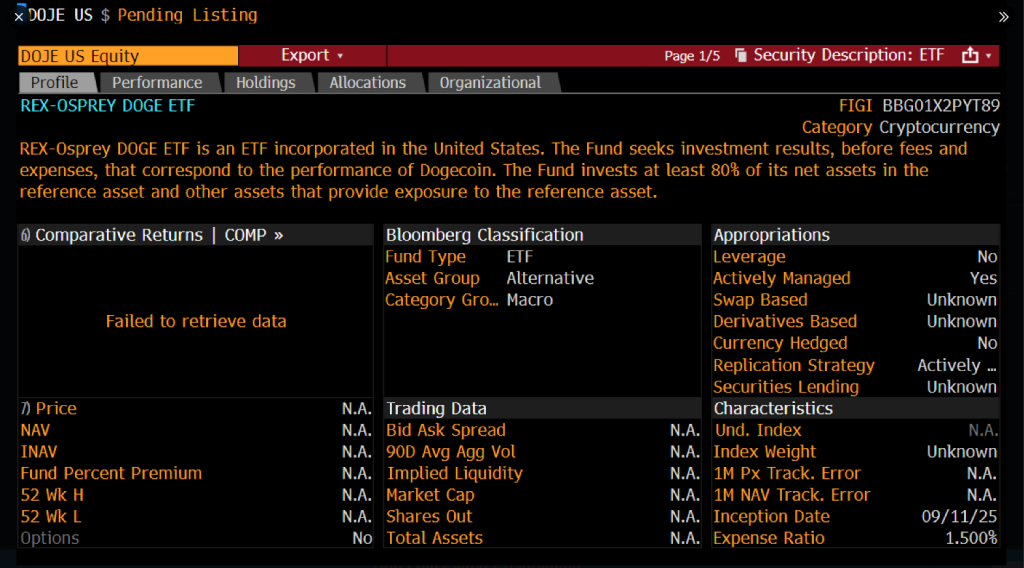
Some in the Dogecoin community pointed to limited payment tests and merchant experiments, while others emphasized the coin’s long history of publicity and social attention.

Reports also note the fund is being structured under the Investment Company Act of 1940 instead of the Securities Act of 1933, a choice that has drawn extra scrutiny.

Why Utility Matters For Investors

Investors typically seek ways to value an asset beyond pure sentiment. Utility can mean things like payment rails, governance roles, or fuel for smart contracts — uses that create sustained demand.

When those uses are limited, price moves can be driven mainly by headlines and momentum. That makes risk evaluation harder for portfolios that require steady, predictable exposures.

Some market participants counter that brand recognition, liquidity, and culture can still produce buyer interest, at least while markets are favorable.

Less Common Legal Route

Based on reports, the legal route chosen for DOJE is unusual for a crypto-linked spot fund. Filing under the 1940 Act instead of the 1933 Act carries different compliance and custody implications.

Few ETFs have taken this exact path for a memecoin-style asset, and observers say they will watch how custody and regulatory reviews play out once trading begins.

Traders and institutions may treat the fund differently because of the structure and the questions raised over utility.

Featured image from Unsplash, chart from TradingView

Market Opportunity
Threshold Logo
Threshold Price(T)
$0.009515
$0.009515$0.009515
-5.27%
USD
Threshold (T) Live Price Chart
Disclaimer: The articles reposted on this site are sourced from public platforms and are provided for informational purposes only. They do not necessarily reflect the views of MEXC. All rights remain with the original authors. If you believe any content infringes on third-party rights, please contact service@support.mexc.com for removal. MEXC makes no guarantees regarding the accuracy, completeness, or timeliness of the content and is not responsible for any actions taken based on the information provided. The content does not constitute financial, legal, or other professional advice, nor should it be considered a recommendation or endorsement by MEXC.

You May Also Like

Gold Hits $3,700 as Sprott’s Wong Says Dollar’s Store-of-Value Crown May Slip

Gold Hits $3,700 as Sprott’s Wong Says Dollar’s Store-of-Value Crown May Slip

The post Gold Hits $3,700 as Sprott’s Wong Says Dollar’s Store-of-Value Crown May Slip appeared on BitcoinEthereumNews.com. Gold is strutting its way into record territory, smashing through $3,700 an ounce Wednesday morning, as Sprott Asset Management strategist Paul Wong says the yellow metal may finally snatch the dollar’s most coveted role: store of value. Wong Warns: Fiscal Dominance Puts U.S. Dollar on Notice, Gold on Top Gold prices eased slightly to $3,678.9 […] Source: https://news.bitcoin.com/gold-hits-3700-as-sprotts-wong-says-dollars-store-of-value-crown-may-slip/
Share
BitcoinEthereumNews2025/09/18 00:33
China Launches Cross-Border QR Code Payment Trial

China Launches Cross-Border QR Code Payment Trial

The post China Launches Cross-Border QR Code Payment Trial appeared on BitcoinEthereumNews.com. Key Points: Main event involves China initiating a cross-border QR code payment trial. Alipay and Ant International are key participants. Impact on financial security and regulatory focus on illicit finance. China’s central bank, led by Deputy Governor Lu Lei, initiated a trial of a unified cross-border QR code payment gateway with Alipay and Ant International as participants. This pilot addresses cross-border fund risks, aiming to enhance financial security amid rising money laundering through digital channels, despite muted crypto market reactions. China’s Cross-Border Payment Gateway Trial with Alipay The trial operation of a unified cross-border QR code payment gateway marks a milestone in China’s financial landscape. Prominent entities such as Alipay and Ant International are at the forefront, participating as the initial institutions in this venture. Lu Lei, Deputy Governor of the People’s Bank of China, highlighted the systemic risks posed by increased cross-border fund flows. Changes are expected in the dynamics of digital transactions, potentially enhancing transaction efficiency while tightening regulations around illicit finance. The initiative underscores China’s commitment to bolstering financial security amidst growing global fund movements. “The scale of cross-border fund flows is expanding, and the frequency is accelerating, providing opportunities for risks such as cross-border money laundering and terrorist financing. Some overseas illegal platforms transfer funds through channels such as virtual currencies and underground banks, creating a ‘resonance’ of risks at home and abroad, posing a challenge to China’s foreign exchange management and financial security.” — Lu Lei, Deputy Governor, People’s Bank of China Bitcoin and Impact of China’s Financial Initiatives Did you know? China’s latest initiative echoes the Payment Connect project of June 2025, furthering real-time cross-boundary remittances and expanding its influence on global financial systems. As of September 17, 2025, Bitcoin (BTC) stands at $115,748.72 with a market cap of $2.31 trillion, showing a 0.97%…
Share
BitcoinEthereumNews2025/09/18 05:28
Zero Knowledge Proof Stage 2 Coin Burns Signal a Possible 7000x Explosion! ETH Slows Down & Pepe Drops

Zero Knowledge Proof Stage 2 Coin Burns Signal a Possible 7000x Explosion! ETH Slows Down & Pepe Drops

Explore how experts are pointing to a possible 7000x rise for Zero Knowledge Proof (ZKP) while ETH slows and Pepe moves sideways, driven by ongoing coin burns and
Share
CoinLive2026/01/19 07:00