Bitcoin ETFs Near YTD Gains as XRP Recovery Lifts Flows
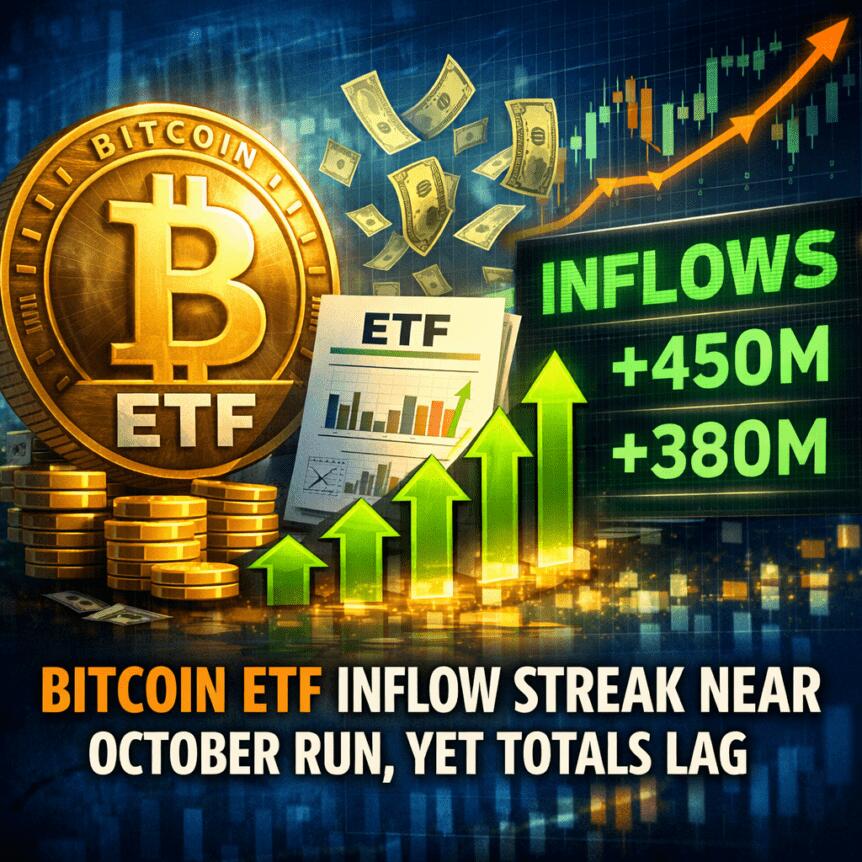
US spot Bitcoin ETFs are closing in on a year-to-date turnaround after extending their current inflow streak to seven trading days. According to SoSoValue, the products added $199.4 million on Tuesday, lifting cumulative inflows over the past seven sessions to roughly $1.2 billion.
The latest move does not match the scale of the powerful run seen in October 2025, when spot Bitcoin ETFs absorbed about $6 billion over nine days, but it does signal a meaningful improvement in demand after a period of pressure earlier this year. The rebound is also showing up across other crypto exchange-traded products. Ether funds posted their strongest daily intake since March 4, Solana products added their biggest inflows in the same period, and XRP ETFs returned to positive territory after an extended stretch of losses.
Key takeaways
- US spot Bitcoin ETFs brought in $199.4 million on Tuesday, extending their inflow streak to seven straight days.
- SoSoValue data shows the current seven-day run has attracted about $1.2 billion, still well below the roughly $6 billion recorded during a nine-day streak in October 2025.
- Bitcoin ETF trading volume fell to $2.6 billion on Tuesday, while assets under management rose to $96.7 billion.
- XRP ETFs recorded $4.64 million in inflows, their first positive day since March 4, after posting $56.8 million in outflows from March 5 to March 16.
- Despite renewed demand in March, Ether ETFs remain negative year to date, while Solana leads crypto ETFs this year with $223 million in net inflows.
Bitcoin ETF demand improves, but the recovery is still incomplete
The headline figure for Bitcoin is not just the single-day inflow, but the persistence behind it. Seven consecutive days of net additions mark the longest positive stretch for US spot Bitcoin ETFs since October 2025. That matters because ETF flow trends are often used as a proxy for institutional conviction, especially when price action alone can be distorted by short-term volatility.
Still, the comparison with last year’s October rally provides useful perspective. The current run has attracted about $1.2 billion, which is substantial on its own, but it remains far smaller than the roughly $6 billion accumulated during the earlier nine-day streak, as previously noted in earlier coverage. In other words, Bitcoin ETF sentiment has improved, but the scale of demand has not yet returned to the strongest levels seen in the prior cycle.
Other parts of the SoSoValue data reinforce that mixed picture. Daily trading volumes for Bitcoin ETFs dropped to $2.6 billion on Tuesday, suggesting that participation remains more measured than during peak enthusiasm phases. At the same time, total assets under management climbed to $96.7 billion, showing that sustained inflows are still rebuilding the asset base even without exceptional turnover.
Year-to-date flows also have not fully healed. The source data cited in the original report shows Bitcoin ETFs are still slightly negative for the year after $1.8 billion in cumulative monthly outflows versus $1.7 billion in cumulative inflows. That gap is narrow enough that continued buying could soon push the category back into positive territory, but it also highlights how recent inflows are still offsetting earlier weakness rather than establishing an entirely new trend.
Why the broader crypto ETP backdrop matters
The recent improvement in Bitcoin ETF demand is not happening in isolation. The source article notes that crypto investment products more broadly drew about $2.7 billion over three consecutive weeks, lifting year-to-date inflows to roughly $1.2 billion, according to CoinShares. That wider context matters because it suggests the rebound is not limited to one asset or one product structure.
For investors, that distinction is important. A recovery driven only by Bitcoin could reflect a temporary rotation into the most liquid and institutionally familiar crypto asset. A broader pickup across listed crypto products is a stronger sign that risk appetite is returning across the sector, even if selectively. It does not confirm a full market reset, but it does suggest that recent inflows are part of a wider reassessment of crypto exposure rather than a single-product anomaly.
That said, the numbers also show that the market remains uneven beneath the surface. Some products are stabilizing quickly, while others are still digging out from earlier drawdowns. This split is especially visible when comparing XRP, Solana and Ether.
XRP turns positive again after a rough stretch
XRP ETFs posted $4.64 million in inflows, their first positive day since March 4. That ended an eight-day losing streak that had seen the products shed $56.8 million between March 5 and March 16, based on SoSoValue figures cited in the source material.
The reversal is notable not because the daily total was especially large, but because it interrupted a clear run of negative sentiment. After several sessions of outflows, even a modest return to net inflows can indicate that selling pressure is cooling. It may also suggest that some investors are becoming more willing to re-enter the product after a near-term reset.
XRP’s year-to-date position remains stronger than its recent March performance might imply. Despite $33.5 million in outflows so far this month, XRP ETFs are still positive for the year, supported by $73.7 million in inflows recorded in January and February. That contrast tells an important story. Early-year demand created enough cushion that March weakness has not erased the broader trend yet.
For market participants, the key question now is whether the latest inflow marks the start of a steadier recovery or merely a pause in a choppier stretch. One positive day does not settle that question. But it does matter that XRP funds stopped bleeding at a time when broader crypto ETF sentiment has also improved.
Solana leads, while Ether still trails
The strongest year-to-date performance among crypto ETFs belongs to Solana, which the source says has attracted $223 million in net inflows so far this year. On Tuesday alone, Solana funds brought in $17.8 million, their biggest daily intake since March 4. That combination of solid recent demand and the strongest yearly total suggests Solana has been one of the clearest winners in the current ETF landscape.
Ether also saw a meaningful daily rebound, with $138.3 million in inflows, the largest since March 4. On the surface, that points to renewed investor appetite. But the bigger picture remains more difficult. Ether ETFs are still down $364.5 million on a year-to-date basis, according to the figures cited in the source. That comes after $358.5 million in inflows in March were outweighed by $723 million in outflows during the first two months of the year.
This is one of the clearest asymmetries in the current market. Bitcoin is close to repairing its year-to-date balance. XRP has managed to stay positive for the year despite a rough patch. Solana is leading the field on net inflows. Ether, however, remains underwater even after a notable daily bounce.
That divergence matters because it shows that investors are not treating all large-cap crypto assets equally. The recent rebound in listed products appears real, but it is not broad enough to erase differences in positioning, conviction and risk tolerance across the sector.
What to watch from here
The next few sessions will matter more than any single daily print. If Bitcoin ETFs continue attracting capital, they could move back into positive territory for the year and strengthen the case that institutional demand is rebuilding. XRP’s first positive day since March 4 will need follow-through to count as a durable shift, while Ether’s rebound still has to overcome a deeper year-to-date deficit. For now, the clearest takeaway is that crypto ETF sentiment has improved, but the recovery remains selective, uneven and still dependent on whether these inflows can persist.
This article was originally published as Bitcoin ETFs Near YTD Gains as XRP Recovery Lifts Flows on Crypto Breaking News – your trusted source for crypto news, Bitcoin news, and blockchain updates.


You May Also Like
Republicans deploy ground troops in the states to execute 'the plan'
GOP Senate hopeful under fire over ties to church rocked by child sex abuse scandal