Polymarket targets a $10B valuation with its US relaunch, while rival Kalshi nears $5B amid surging trading volume and funding.   Polymarket is preparing for a United States comeback that could value the platform as high as $10 billion, according to Business Insider.  The blockchain-powered prediction market has already attracted new funding interest, with some […] The post Polymarket Prepares $10B Valuation as It Plans US Relaunch appeared first on Live Bitcoin News.Polymarket targets a $10B valuation with its US relaunch, while rival Kalshi nears $5B amid surging trading volume and funding.   Polymarket is preparing for a United States comeback that could value the platform as high as $10 billion, according to Business Insider.  The blockchain-powered prediction market has already attracted new funding interest, with some […] The post Polymarket Prepares $10B Valuation as It Plans US Relaunch appeared first on Live Bitcoin News.

Polymarket Prepares $10B Valuation as It Plans US Relaunch

2025/09/14 00:30
3 min read
For feedback or concerns regarding this content, please contact us at crypto.news@mexc.com

Polymarket targets a $10B valuation with its US relaunch, while rival Kalshi nears $5B amid surging trading volume and funding.


Polymarket is preparing for a United States comeback that could value the platform as high as $10 billion, according to Business Insider. 

The blockchain-powered prediction market has already attracted new funding interest, with some investors offering term sheets above the $9 billion mark.

This would represent a sharp leap from its $1 billion valuation in June when it raised $200 million in a round led by Peter Thiel’s Founders Fund.

Kalshi Nears $5B Valuation Amid Growth

Polymarket is not the only prediction platform attracting investor interest. Kalshi, which already operates under CFTC oversight, is reportedly close to finalising a round that would value it at $5 billion.

That valuation is more than double its $2 billion figure from just a few months ago, when Paradigm led a $185 million raise. So far, Kalshi has gained traction thanks to a court ruling from last year that allowed it to list political event contracts. 

The CFTC had appealed the decision but dropped its challenge earlier this year. This meant that Kalshi became free to continue expanding its offerings.
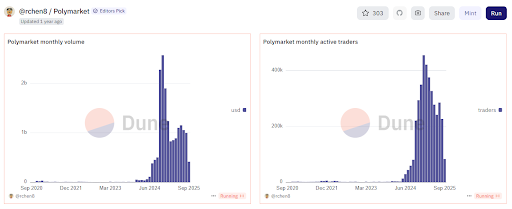
Prediction markets like Polymarket are enjoying strong user engagement | source: Dune Analytics

Trading volume supports this move. In August, Kalshi processed $875 million in activity, which is close to Polymarket’s $1 billion. 

During the first week of the National Football League season alone, Kalshi cleared $441 million, which is another sign of strong user engagement.

How Polymarket and Kalshi Differ

Despite their competition, the two companies follow very different models.

Kalshi runs as a regulated US exchange that requires customers to deposit dollars and complete traditional KYC. This makes it accessible to American traders while maintaining a clear compliance framework.

Polymarket, on the other hand, operates on the Polygon blockchain. 

It settles trades in USDC and allows semi-anonymous participation. This has fueled adoption outside the US, and its model appeals to a global user base even though it has faced regulatory pressure inside the country.

Both approaches show contrasting philosophies in terms of regulation and user experience. Yet both are attracting high valuations from major investors.

Prediction Markets Attract Big Capital

Investor enthusiasm shows the rise of prediction markets as a legitimate trading sector. Polymarket’s backers include Founders Fund, while Kalshi counts Paradigm and Sequoia Capital among its supporters.

The Block Data reports that this year has already become the strongest year for prediction market funding. 

More than $216 million has been raised across 11 deals, compared with $80 million last year. 

Crypto-native companies are also entering the space. Crypto.com and Underdog are launching sports prediction markets across 16 states. On the other hand, Coinbase is exploring its own platform, while X named Polymarket its official prediction partner. 

Kalshi has even teamed up with Robinhood and is further blurring the line between prediction trading and traditional finance.

Challenges Facing Prediction Markets

While the valuations of these platforms are climbing, both Polymarket and Kalshi are facing challenges. User engagement tends to fluctuate outside of major events like elections or sports seasons. 

This means that sustaining consistent activity may require new categories of prediction contracts.

Another issue is regulatory uncertainty. While Kalshi currently enjoys a favourable position, future changes in policy could tighten restrictions. 

Despite the risks, however, investors see strong upside. The ongoing rise in valuations for both Polymarket and Kalshi shows confidence that prediction markets will move beyond niche audiences quickly.


Disclaimer: The articles reposted on this site are sourced from public platforms and are provided for informational purposes only. They do not necessarily reflect the views of MEXC. All rights remain with the original authors. If you believe any content infringes on third-party rights, please contact crypto.news@mexc.com for removal. MEXC makes no guarantees regarding the accuracy, completeness, or timeliness of the content and is not responsible for any actions taken based on the information provided. The content does not constitute financial, legal, or other professional advice, nor should it be considered a recommendation or endorsement by MEXC.

You May Also Like

The Channel Factories We’ve Been Waiting For

The Channel Factories We’ve Been Waiting For

The post The Channel Factories We’ve Been Waiting For appeared on BitcoinEthereumNews.com. Visions of future technology are often prescient about the broad strokes while flubbing the details. The tablets in “2001: A Space Odyssey” do indeed look like iPads, but you never see the astronauts paying for subscriptions or wasting hours on Candy Crush.  Channel factories are one vision that arose early in the history of the Lightning Network to address some challenges that Lightning has faced from the beginning. Despite having grown to become Bitcoin’s most successful layer-2 scaling solution, with instant and low-fee payments, Lightning’s scale is limited by its reliance on payment channels. Although Lightning shifts most transactions off-chain, each payment channel still requires an on-chain transaction to open and (usually) another to close. As adoption grows, pressure on the blockchain grows with it. The need for a more scalable approach to managing channels is clear. Channel factories were supposed to meet this need, but where are they? In 2025, subnetworks are emerging that revive the impetus of channel factories with some new details that vastly increase their potential. They are natively interoperable with Lightning and achieve greater scale by allowing a group of participants to open a shared multisig UTXO and create multiple bilateral channels, which reduces the number of on-chain transactions and improves capital efficiency. Achieving greater scale by reducing complexity, Ark and Spark perform the same function as traditional channel factories with new designs and additional capabilities based on shared UTXOs.  Channel Factories 101 Channel factories have been around since the inception of Lightning. A factory is a multiparty contract where multiple users (not just two, as in a Dryja-Poon channel) cooperatively lock funds in a single multisig UTXO. They can open, close and update channels off-chain without updating the blockchain for each operation. Only when participants leave or the factory dissolves is an on-chain transaction…
Share
BitcoinEthereumNews2025/09/18 00:09
Nibiru – The Next Era of Money

Nibiru – The Next Era of Money

Unique is a co-founder of Nibiru, the Web3 hub ushering in the next era of money. Nibiru is a blockchain and smart contract hub with DeFi, RWAs, and more.
Share
Brave Newcoin2025/09/19 02:37
Nvidia (NVDA) vs AMD: The Ultimate AI Stock Showdown for 2025

Nvidia (NVDA) vs AMD: The Ultimate AI Stock Showdown for 2025

Nvidia (NVDA) dominates AI chips with superior margins and ecosystem. AMD challenges but trails. Compare both stocks to determine your best AI investment. The post
Share
Blockonomi2026/03/15 19:42