

Revealed: Steve Bannon used Epstein as middleman as he sought to meet survivors group
Jeffrey Epstein, the financier and convicted sex trafficker, attempted to arrange a meeting between Steve Bannon, the right-wing strategist who helped bring Donald Trump to power, and leaders of the MeToo-inspired group Time’s Up, Raw Story has learned.
Phone texts exchanged between Epstein and Bannon in March 2018 show Epstein telling Bannon that an intermediary, Joichi “Joi” Ito — then the director of the Massachusetts Institute of Technology Media Lab — had agreed to set up the meeting.
“Joi will organize a meeting with the powers behind Time’s up,” Epstein told Bannon on March 26, 2018, according to the text, which was included in the massive trove of files released by the U.S. Justice Department in response to the Epstein Files Transparency Act.
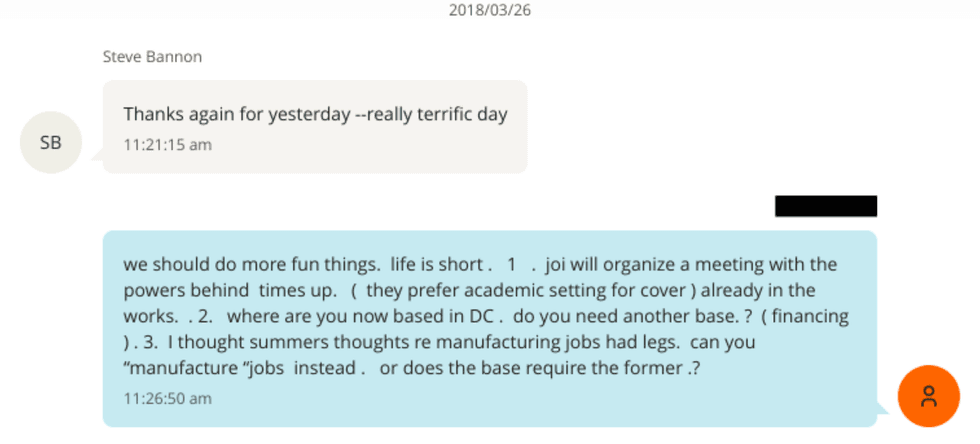 Text from Jeffrey Epstein to Steve Bannon discussing plans for a meeting between Bannon and the leadership of Time's Up.U.S. Department of Justice
Time’s Up launched in January 2018 by 300 prominent women in the entertainment industry to raise awareness about sexual misconduct and push for gender parity in Hollywood, in the wake of revelations about movie mogul Harvey Weinstein’s pattern of rape and harassment.
Bannon, who had served as chairman of Trump’s 2016 campaign and as White House strategist, represented an opposing current in the shifting cultural tides of the first Trump administration.
Before joining the Trump campaign, Bannon had led Breitbart News. Under Bannon’s watch, the outlet promoted Gamergate, a digital mob that harassed women in the video-game industry while giving expression to a right-wing backlash against feminism and racial diversity that would become a potent political force. Known as the “alt-right” at the time, the movement helped propel Trump to power.
The effort to broker a meeting between Bannon and the Time’s Up leadership — two entities at seemingly opposing poles — has not been previously reported.
Epstein added in parentheses after the text to Bannon about the proposed meeting that “they prefer academic setting for cover,” suggesting that he had at least discussed the idea with someone at Time’s Up.
The texts do not identify Epstein’s contact at the organization. But two years earlier, Michelle Kydd, who would go on to become a founding member of Time’s Up, had recommended two public relations professionals to Epstein, as first reported by Page Six Hollywood.
At the time of Kydd’s 2016 email, Epstein had pleaded guilty to child prostitution and had served jail time.
Ito initially put Kydd, a member of his advisory council at MIT Media Lab, in touch with Epstein in 2014. Ito described Kydd, who is the chief innovation officer at Creative Artists Agency, to Epstein as “sort of the ‘mother’ of Hollywood,” who “famous people under the protection of CAA go to when they get in trouble.”
A request for comment left by Raw Story for Kydd at Creative Artists Agency went unreturned.
The texts exchanged between Epstein and Bannon in 2018 show that Bannon was interested in meeting with the Time’s Up leaders.
Three days after initially broaching the idea of a meeting, Epstein raised the topic again.
“We should probably figure out your first meeting with the Time’s Up powers,” Epstein texted. “Academic setting to give them cover. Probably MIT.”
“Yes,” Bannon replied.
“Joi agreed,” Epstein said.
“Wow,” Bannon responded.
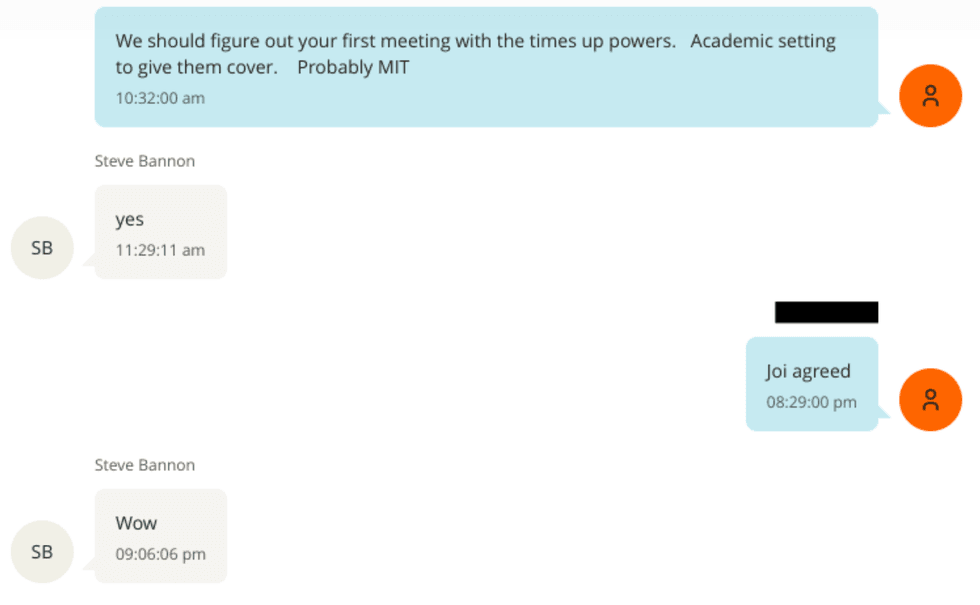 Texts exchanged between Jeffrey Epstein and Steve Bannon discussing plans for a meeting with Time's Up.U.S. Department of Justice
It is unclear whether the meeting between Bannon and Time’s Up ever took place, but emails show that Epstein and Ito had planned to meet in Cambridge, Mass. on March 25 — the day before Epstein suggested the idea to Bannon — and that Epstein and Ito had attempted to schedule a phone call two days before that.
Bannon also spent the day with Epstein in Cambridge on March 25, although it’s unclear whether Bannon and Ito met directly.
“I have all day Sunday. Harvard MIT, [former Harvard President] Larry Summers etc.,” Epstein texted Bannon on March 23. “You are always welcome to join.”
“Pulling up,” Bannon wrote to Epstein on March 25 at 12:09 p.m.
The next day Bannon texted Epstein: “Thanks for yesterday — really terrific day.”
Ito could not be reached for comment.
Ito resigned from his position at MIT following Epstein’s 2019 arrest. He later received appointment as president of the Chiba Institute of Technology in Japan.
Following the latest round of revelations about Ito’s association with Epstein following the recent release of files by the U.S. Justice Department, Ito announced he was stepping away from a Japanese government technology initiative known as the Global Startup Campus Initiative.
A statement from the Chiba Institute of Technology said Ito “reaffirmed he was never aware of the existence of any illegal or improper conduct” with regard to Epstein, “and has never been involved in any illegal or improper conduct.”
Raw Story was not able to reach Bannon for comment. But the right-wing nationalist avatar’s interest in Time’s Up has been well-publicized.
At the time of the proposed meeting, Bannon had become estranged from Trump, having been fired from his position as White House strategist six months earlier. Shortly after leaving the Trump administration, Bannon backed Republican Roy Moore in the special election to fill a vacant U.S. Senate seat in Alabama in the fall of 2017, even after accusations by several women that Moore had sexually assaulted them when they were girls caused his candidacy to implode.
In 2018 and 2019, Bannon embarked on a global campaign to promote a right-wing populist movement and far-right nationalist candidates, including Marine LePen in France, Mario Salvini in Italy and Jair Bolsonaro in Brazil.
In February 2018, Bannon publicly expressed admiration for Time’s Up, telling GQ that he had “never seen such potential power in something,” adding that he considered Time’s Up “a reaction to this populist movement, this nationalist movement.”
During an event in Zurich, Switzerland about a week later, Bannon reportedly praised Time’s Up as representing “an empowered grassroots on the left” that “focused on power dynamics in society and asks deep and searching questions that are going to have to be answered.”
Bannon contrasted Time’s Up with the nationalist movement that he had helped build in the United States and abroad, while predicting “these two forces are going to collide, and we’re going to see who wins and who loses.”
While Bannon characterized Time’s Up as “anti-patriarchy,” he had previously recognized the latent power of teenage gamers, whom he typified as “rootless white males” to biographer Joshua Green. Bannon described his appreciation for Milo Yiannopoulos, an editor who was forced to resign from Breitbart in 2017 following the revelation of comments that appeared to condone pedophilia.
“I realized Milo could connect with these [gamers] right away,” Bannon told Green. “You can activate that army. They come in through Gamergate or whatever and then get turned onto politics and Trump.”
Texts exchanged between Epstein and Bannon during the Senate Judiciary hearings to confirm Supreme Court Justice Brett Kavanaugh in September 2018 reveal that while the two men may have publicly praised Time’s Up, their private views were far less favorable.
“Your Times Up movement strength,” Epstein texted to Bannon. “Prophetic in Kavanaugh.”
“Scary,” Bannon responded.
“Every guy can visualize himself sitting in that chair, being harangued by [Sen. Kamala] Harris, [Sen. Dianne] Feinstein] etc.,” Epstein continued. “Did you grab, grope. How many drinks. How often. Can you categorically deny it didn’t happen. Yikes.”
“The victim must be heard and must believed,” Bannon said.
A couple days later, Epstein told Bannon he believed Time’s Up was behind the scrutiny of Kavanaugh for alleged sexual misconduct, adding that “they want a woman on the court.”
Whatever benefit Bannon and Epstein may have seen in forging a relationship with Time’s Up, a scandal involving leaders of the organization maneuvering behind the scenes to protect one powerful man led to its eventual downfall.
Following revelations that Time’s Up CEO Tina Tchen discouraged public comments about sexual harassment allegations against former New York Gov. Andrew Cuomo, a Democrat, and that Tchen and board chair Roberta Kaplan offered advice to Cuomo, the organization ceased operations in 2023.


You May Also Like

Policy, Protocols, and Pressure: Is crypto setting up for a big move?

Zcash (ZEC) 2026: A Rare Altcoin Thesis That Still Holds Up




