

Bitcoin Price Stuck in a Trap? Data Signals $66K Sweep Before $72K Breakout

The post Bitcoin Price Stuck in a Trap? Data Signals $66K Sweep Before $72K Breakout appeared first on Coinpedia Fintech News
The Bitcoin price is once again approaching a critical zone, but the current setup suggests traders may be walking into a trap. Despite strong liquidity clusters building above the $70,000 level, key derivatives data show weak conviction, rising leverage dominance, and a lack of real spot demand. This combination often precedes sharp, unexpected moves in the opposite direction.
With Bitcoin consolidating near $68,000 inside a rising channel, the big question is: Will BTC break toward $72K or drop to sweep liquidity near $66K first?
Bitcoin Liquidation Heatmap Shows $72K Target — But a Short-Term Dip Could Come First
Recent shifts in open interest, funding rates, and volume ratios indicate that the market is not trending—it’s positioning for a liquidity-driven move. And historically, in such conditions, Bitcoin tends to move where it hurts the most traders before choosing a direction.
The latest Bitcoin liquidation heatmap (48-hour) highlights a clear liquidity imbalance, with major clusters forming above the current price. Data indicates that the $70,000 to $72,000 range holds a dense concentration of leveraged short positions, making it a key target for any upward move. This zone acts as a liquidity magnet for the BTC price, as a move into this region could trigger a short squeeze.
Historically, Bitcoin tends to test such high-liquidity levels.
While the upside target remains clear, the heatmap also reveals nearby liquidity below the current price, particularly around $66K–$68K. These levels contain long liquidation clusters, with the price often moving toward closer liquidity zones first as weak momentum increases the chances of a downside sweep. This suggests that Bitcoin could drop in the short term before attempting a move toward $72K.
The liquidation heatmap suggests that while Bitcoin price could target $72K, traders should prepare for short-term volatility and potential downside risk first.
Bitcoin Derivatives Data Hints at Volatility as Leverage Dominates Market
Bitcoin’s current price action suggests consolidation, but underlying derivatives data tells a more important story—the market lacks strong conviction and is increasingly driven by leveraged trading rather than spot demand.
Aggregate open interest remains largely flat near the $21 billion level after a recent decline, indicating that traders are not aggressively building new positions. This lack of participation typically signals uncertainty and often precedes a sharp move once liquidity is triggered.
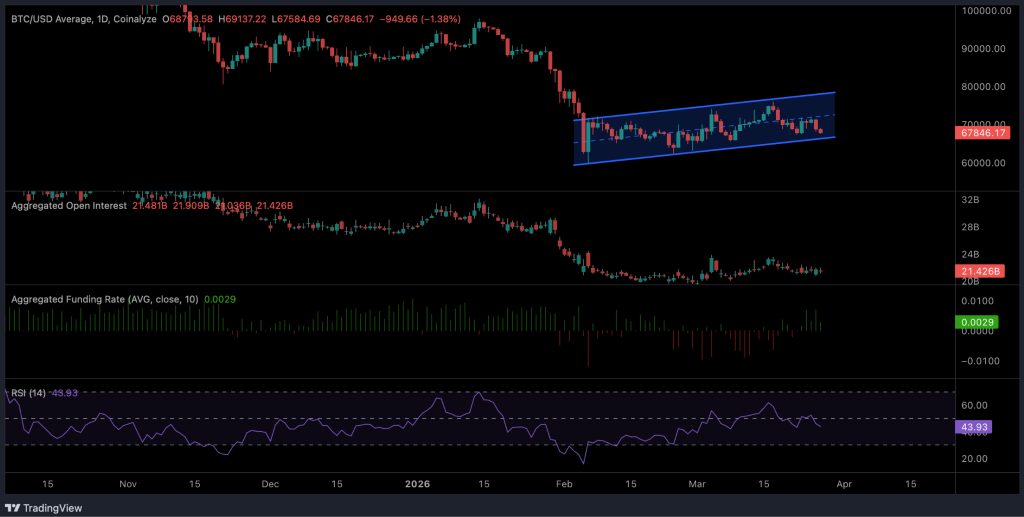
At the same time, the funding rate has turned slightly positive, reflecting a mild long bias in the market. However, the absence of extreme funding levels suggests that bullish sentiment is not strong enough to sustain a breakout on its own. This aligns with the Relative Strength Index (RSI), which continues to hover in the neutral zone near 44, highlighting the absence of clear momentum in either direction.
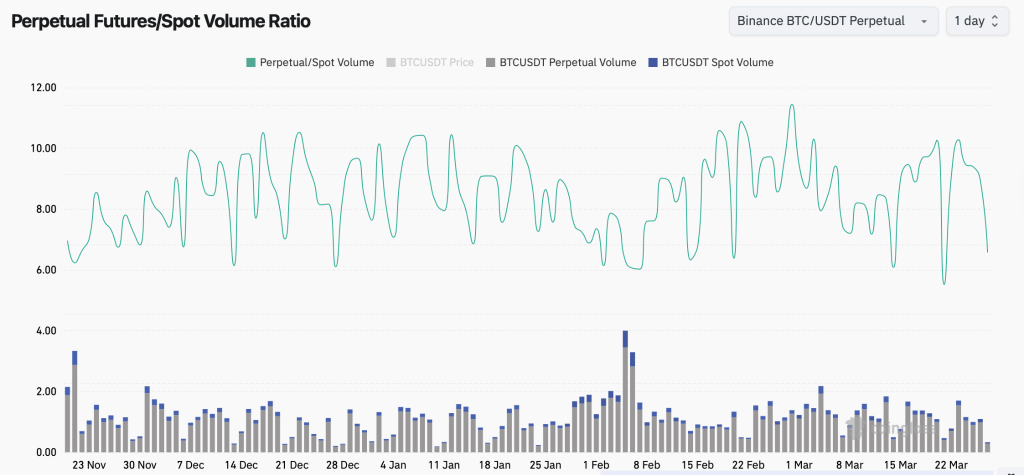
Adding to this, the perpetual futures-to-spot volume ratio remains elevated, showing that most of the trading activity is concentrated in derivatives rather than actual buying in the spot market. Historically, such conditions lead to liquidity-driven price action, where Bitcoin moves sharply to liquidate overleveraged positions rather than follow a steady trend.
Taken together, these indicators suggest that Bitcoin is currently in a low-conviction environment, where price is more likely to experience sudden volatility than a sustained directional move. This reinforces the possibility of a liquidity sweep before any meaningful breakout, aligning with the broader market structure seen in recent sessions.
Bitcoin Outlook for Traders: Key Levels and Month-End Target
Bitcoin price remains in a low-conviction, liquidity-driven phase, where price is more likely to move sharply toward key liquidation zones rather than follow a steady trend. Current structure and derivatives data suggest that traders should prepare for volatility and fakeouts rather than a clean directional breakout.
In the near term, the $66,000–$67,000 zone acts as critical support, where a cluster of long liquidations could be triggered if the BTC price dips further. On the upside, the $70,000 level remains immediate resistance, while the broader $71,500–$72,500 range stands out as the primary liquidity target, supported by dense short positions visible on the heatmap.
Given the lack of strong participation in open interest and the dominance of leveraged trading, Bitcoin is unlikely to break out cleanly without first clearing nearby liquidity. This increases the probability of a short-term downside sweep below $67K, followed by a reversal toward the $70K–$72K range by the end of the month


You May Also Like

US Dollar Gains Ground as Retail Sales Hold Up, Yields Rise

Data focus shifts to payrolls – Societe Generale




