Morgan Stanley Sees Key Indicators Signaling End to S&P 500 Downturn
TLDR
- Morgan Stanley downgraded global equities to “equal weight” and raised cash and U.S. Treasuries to “overweight”
- Brent crude jumped over 59% this month, passing $116 a barrel, its biggest monthly gain ever
- More than 50% of Russell 3000 stocks are down at least 20% from their 52-week highs
- Morgan Stanley’s equity team says the S&P 500 correction is entering its final stages
- The firm kept its year-end S&P 500 target at 7,800, assuming no recession
Morgan Stanley has adopted a more defensive stance on international equities while simultaneously indicating that the recent U.S. market decline could be approaching its conclusion.
The prominent investment bank shifted its global equity rating from “overweight” to “equal weight” last Friday. Concurrently, the firm elevated both U.S. Treasuries and cash positions to “overweight” status, reflecting a flight to safer assets.
This strategic adjustment follows an extraordinary surge in Brent crude prices, which skyrocketed more than 59% within a single month—marking the largest monthly increase ever recorded, surpassing even the dramatic gains witnessed during the 1990 Gulf War. On Monday, futures contracts exceeded $116 per barrel.
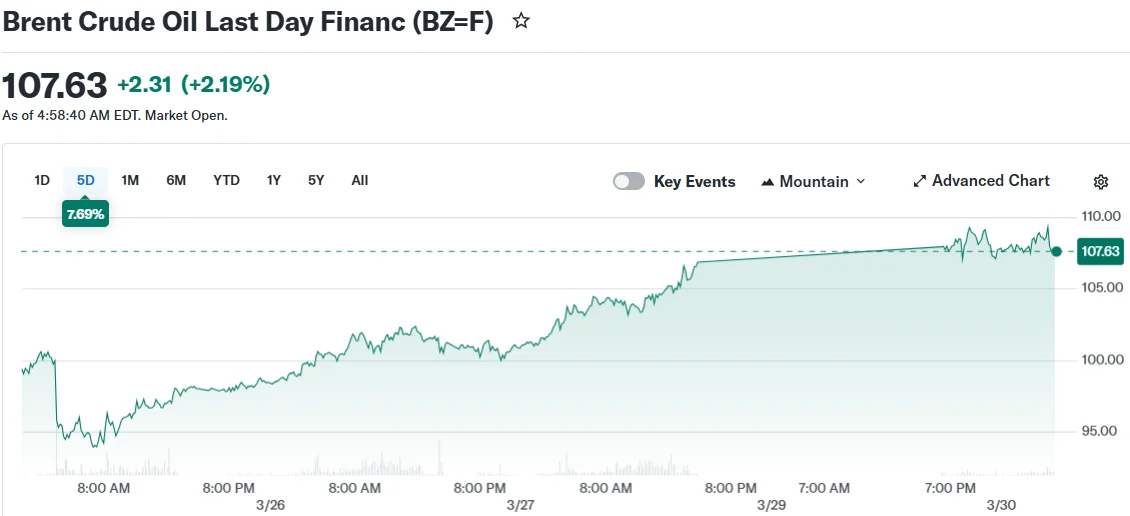 Brent Crude Oil Last Day Financ (BZ=F)
The oil spike stems from escalating tensions in the Middle East, particularly anxieties surrounding the Strait of Hormuz, a critical chokepoint for worldwide petroleum shipments. Morgan Stanley cautioned that sustained oil prices ranging between $150 and $180 per barrel could trigger a valuation contraction of approximately 25% across global equity markets.
The investment firm downgraded both American and Japanese equities to “equal weight” from their previous “overweight” designations. Japan faces heightened vulnerability to supply chain interruptions and a possible global economic downturn should the Strait remain blocked.
Nevertheless, Morgan Stanley expressed a preference for U.S. equities relative to other geographical markets, citing superior earnings-per-share expansion.
Signs the U.S. Stock Correction May Be Ending
Despite adopting a more cautious posture, Morgan Stanley’s equity strategy division, headed by Michael Wilson, identified increasing evidence that the S&P 500’s downturn is approaching its conclusion.
Over half of the companies comprising the Russell 3000 index have declined by no less than 20% from their 52-week peak values. Additionally, the S&P 500’s forward price-to-earnings multiple has contracted by 17%, consistent with previous growth concerns that ultimately didn’t culminate in economic recession.
Wilson emphasized that present circumstances differ markedly from earlier oil-induced market declines. Current earnings expansion stands at 14% year-over-year and continues to accelerate, whereas previous downturns witnessed earnings already in negative territory.
The annual percentage increase in crude prices is also roughly half the magnitude observed during those earlier crisis periods.
Defensive market segments such as Consumer Staples have surprisingly lagged behind the broader market since hostilities began, which Morgan Stanley interprets as evidence that investors have already incorporated most of the oil shock into current valuations.
Rate Risk and the AI Trade
According to Wilson’s assessment, the more immediate threat comes from climbing interest rates. The 10-year Treasury yield is nearing 4.50%, a threshold that historically precipitates equity market strain.
The correlation between stock prices and bond yields has shifted dramatically negative, indicating heightened stock market sensitivity to interest rate fluctuations.
Current market pricing suggests a partial rate increase this year, which contradicts projections from Morgan Stanley’s own economics team, who continue to anticipate rate reductions.
Regarding artificial intelligence-related equities, Wilson observed that semiconductor memory stocks remain heavily concentrated in investor portfolios while hyperscaler positioning remains relatively light. He pointed to Google’s recent memory compression announcement as a potential catalyst for unwinding overcrowded positions.
The Magnificent 7 technology stocks currently command price-to-earnings valuations comparable to Consumer Staples companies, despite delivering earnings growth exceeding three times that of the defensive sector.
Morgan Stanley preserved its year-end S&P 500 price objective of 7,800, predicated on the United States successfully avoiding a recessionary scenario.
The post Morgan Stanley Sees Key Indicators Signaling End to S&P 500 Downturn appeared first on Blockonomi.


You May Also Like

Japanese Tech Giant’s Ambitious Bitcoin Accumulation

Trump says he and China’s Xi agree Iran cannot have nuclear weapons