Loud is an experimental project centered around the $LOUD token, exploring whether attention can be directly converted into value.Loud is an experimental project centered around the $LOUD token, exploring whether attention can be directly converted into value.

A quick look at Loud: An experiment in a decentralized attention market that rewards voices with transaction fees

2025/05/28 13:19

Original author: @0x_ultra

Compiled by: Zen, PANews

TL;DR

Loud is an experiment in the relationship between attention and value. $LOUD tokens have no intrinsic value, and every transaction generates a fee, which is used as a marketing budget every week to reward the top 25 users who can increase Loud's mindshare the most. The allocation is done using @KaitoAI's mindshare data, which is one of the most efficient incentive mechanisms currently available.

This is not a revolutionary paper on attention mechanisms in neural networks; it is an experiment in the purest form of attention market, one that will run forever, without human intervention.

Inspiration

We often talk about the attention economy in Web3, and the platform built by Kaito AI is essentially a system that allows everyone to participate in the attention transaction, thereby accelerating the development of the entire industry. In the process, it also created one of the best proof-of-work incentive mechanisms in history: a reward mechanism based on "mindshare". This Web3 primitive allows project parties to get the highest output possible for every dollar invested: creating a reward pool that is fought over by those who are willing to work. This is the first piece of the puzzle.

The second part is inspired by the successful practice of Believe, a Web3 startup platform: through transaction volume and fees, a long-term model of binding the interests of speculators and creators is established, thereby feeding back to the creators' continued creation. In fact, the attention of a project is completely dependent on the output and maintenance of the creators, so the creators are the key driving force to maintain attention.

So what would happen if we could combine the best of both models and create a new incentive mechanism that aligned the motivations of all participants around the goal of maximizing mind share?

What is Loud?

Loud is an experiment in distilling cryptographic primitives to their purest form, removing the intermediate product forms.

It's time for the "3,3 game theory" to return.

(3,3) Game theory is a concept proposed by Olympus DAO. It originates from the collaborative thinking in game theory and expresses that a "win-win" situation can be achieved when participants cooperate with each other. Its essence is an optimized version of the prisoner's dilemma. Combined with the token economic model of Web3, it conveys the concept of "we win together" to the community in an easy-to-understand way.
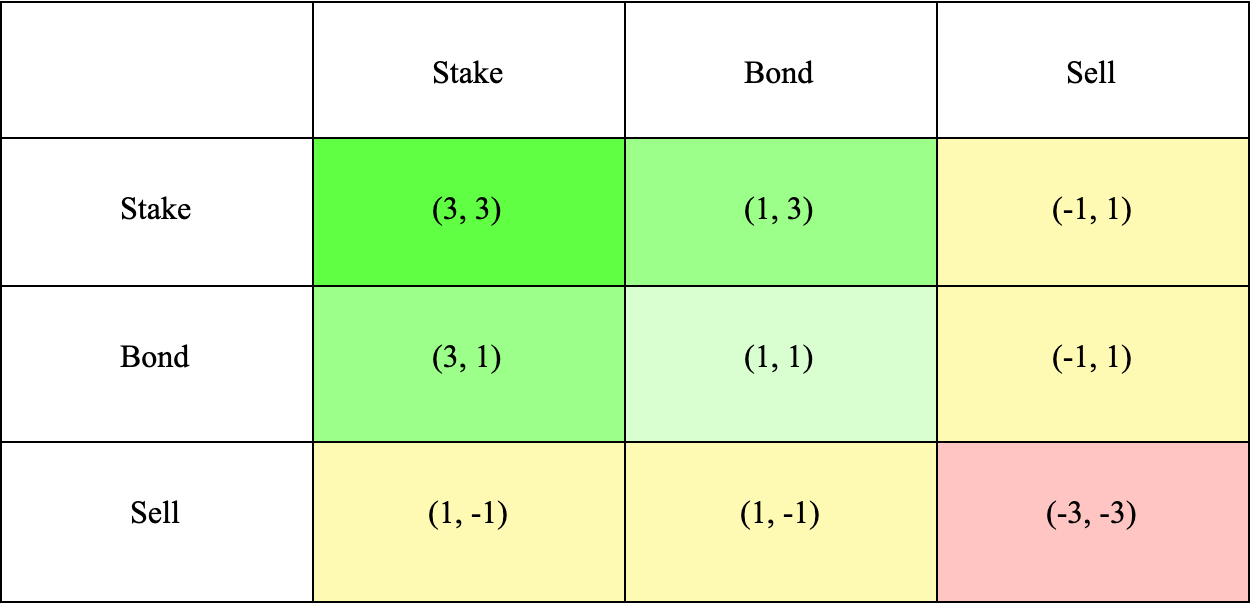
A quick look at Loud: An experiment in a decentralized attention market that rewards voices with transaction fees

In the game matrix, "3" means that the operation has a positive effect on both the protocol and the participants; "-3" means it is harmful. Therefore:

  • (3,3): You stake, I stake, we all support the protocol, the protocol grows, and we all benefit the most → win-win

  • (-3,-3): You sell, I sell too, the agreement collapses, we all lose → lose together

  • (3,-1): You pledge, I sell, you take the risk and I profit → One-sided game

Experimental setup

We combine the best of the “attention proof of work” model with a mechanism that allows creators to earn long-term commissions. What would happen if we provided continuous rewards for those who spread a topic?

We will get the purest "3,3": a direct link between speculators and opinion leaders (KOLs) - no need for intermediaries at all. A continuous attention engine subsidized by speculators and driven by KOLs.

The fees paid by traders will be directly transferred to a bonus pool, which will be divided among the "topic makers" who rank at the top of the attention rankings, incentivizing them to continue to create greater publicity and trading volume. You should have seen the prototype of this flywheel mechanism.

  • The goal of a topic maker: to stimulate higher trading volume

  • Trader’s goal: Buy attention through fee subsidies

This is an experiment in whether attention is enough to confer value. If something gets enough attention, does its price go up? Or vice versa?

Actual operating mechanism

  • $LOUD tokens will be traded on the Solana chain through the liquidity pool of the liquidity platform Meteora. A handling fee will be charged for each exchange, denominated in SOL.

  • Users can gain "mind share" by posting content about Loud

  • The mindshare ranking mechanism provided by Kaito AI will objectively quantify contributions

  • Users can go to stayloud.io to view the leaderboard and register their wallet to receive rewards

  • Once a week, the transaction fee (in SOL) will be distributed to the top 25 users in the leaderboard according to their mindshare contribution ratio.

  • 20% of the handling fee will be awarded to $KAITO stakers to promote the ecological flywheel and achieve interest binding

  • The flywheel mechanism will continue forever without intervention

Loud is the purest symbiotic model of speculators subsidizing KOLs.

About the Top 25 ranking mechanism

Why set the top 25 limit? Because as mentioned above, every fee paid by traders is essentially to "buy attention". Setting a smaller reward pool can motivate participants to work harder to gain voice for token holders and traders. Even if you enter the top 25, you can't rest easy - the reward distribution will be entirely based on the mindshare contribution ratio, and participants must continue to maximize their communication efficiency and influence.

Note: Loud is an experimental project. The mechanism will be continuously optimized and adjusted based on community feedback, but it will always adhere to the principle of minimal intervention. It aims to conduct the first large-scale experiment of "decentralized attention-value system".

What happens next?

$LOUD tokens will be launched soon, and the specific release time and distribution method will be announced in subsequent announcements. The experiment is about to begin, with technical support provided by Holoworld AI.

This is an experimental project that belongs entirely to the community: no team reserves tokens, no hidden interests, a completely fair launch, and 100% transparency. How it will develop next depends entirely on the community.

Market Opportunity
TokenFi Logo
TokenFi Price(TOKEN)
$0.002446
$0.002446$0.002446
+0.28%
USD
TokenFi (TOKEN) Live Price Chart
Disclaimer: The articles reposted on this site are sourced from public platforms and are provided for informational purposes only. They do not necessarily reflect the views of MEXC. All rights remain with the original authors. If you believe any content infringes on third-party rights, please contact service@support.mexc.com for removal. MEXC makes no guarantees regarding the accuracy, completeness, or timeliness of the content and is not responsible for any actions taken based on the information provided. The content does not constitute financial, legal, or other professional advice, nor should it be considered a recommendation or endorsement by MEXC.

You May Also Like

Building a DEXScreener Clone: A Step-by-Step Guide

Building a DEXScreener Clone: A Step-by-Step Guide

DEX Screener is used by crypto traders who need access to on-chain data like trading volumes, liquidity, and token prices. This information allows them to analyze trends, monitor new listings, and make informed investment decisions. In this tutorial, I will build a DEXScreener clone from scratch, covering everything from the initial design to a functional app. We will use Streamlit, a Python framework for building full-stack apps.
Share
Hackernoon2025/09/18 15:05
Which DOGE? Musk's Cryptic Post Explodes Confusion

Which DOGE? Musk's Cryptic Post Explodes Confusion

A viral chart documenting a sharp decline in U.S. federal employment during President Trump's second term has sparked unexpected confusion in cryptocurrency markets
Share
Coinstats2025/12/20 01:13
Google's AP2 protocol has been released. Does encrypted AI still have a chance?

Google's AP2 protocol has been released. Does encrypted AI still have a chance?

Following the MCP and A2A protocols, the AI Agent market has seen another blockbuster arrival: the Agent Payments Protocol (AP2), developed by Google. This will clearly further enhance AI Agents' autonomous multi-tasking capabilities, but the unfortunate reality is that it has little to do with web3AI. Let's take a closer look: What problem does AP2 solve? Simply put, the MCP protocol is like a universal hook, enabling AI agents to connect to various external tools and data sources; A2A is a team collaboration communication protocol that allows multiple AI agents to cooperate with each other to complete complex tasks; AP2 completes the last piece of the puzzle - payment capability. In other words, MCP opens up connectivity, A2A promotes collaboration efficiency, and AP2 achieves value exchange. The arrival of AP2 truly injects "soul" into the autonomous collaboration and task execution of Multi-Agents. Imagine AI Agents connecting Qunar, Meituan, and Didi to complete the booking of flights, hotels, and car rentals, but then getting stuck at the point of "self-payment." What's the point of all that multitasking? So, remember this: AP2 is an extension of MCP+A2A, solving the last mile problem of AI Agent automated execution. What are the technical highlights of AP2? The core innovation of AP2 is the Mandates mechanism, which is divided into real-time authorization mode and delegated authorization mode. Real-time authorization is easy to understand. The AI Agent finds the product and shows it to you. The operation can only be performed after the user signs. Delegated authorization requires the user to set rules in advance, such as only buying the iPhone 17 when the price drops to 5,000. The AI Agent monitors the trigger conditions and executes automatically. The implementation logic is cryptographically signed using Verifiable Credentials (VCs). Users can set complex commission conditions, including price ranges, time limits, and payment method priorities, forming a tamper-proof digital contract. Once signed, the AI Agent executes according to the conditions, with VCs ensuring auditability and security at every step. Of particular note is the "A2A x402" extension, a technical component developed by Google specifically for crypto payments, developed in collaboration with Coinbase and the Ethereum Foundation. This extension enables AI Agents to seamlessly process stablecoins, ETH, and other blockchain assets, supporting native payment scenarios within the Web3 ecosystem. What kind of imagination space can AP2 bring? After analyzing the technical principles, do you think that's it? Yes, in fact, the AP2 is boring when it is disassembled alone. Its real charm lies in connecting and opening up the "MCP+A2A+AP2" technology stack, completely opening up the complete link of AI Agent's autonomous analysis+execution+payment. From now on, AI Agents can open up many application scenarios. For example, AI Agents for stock investment and financial management can help us monitor the market 24/7 and conduct independent transactions. Enterprise procurement AI Agents can automatically replenish and renew without human intervention. AP2's complementary payment capabilities will further expand the penetration of the Agent-to-Agent economy into more scenarios. Google obviously understands that after the technical framework is established, the ecological implementation must be relied upon, so it has brought in more than 60 partners to develop it, almost covering the entire payment and business ecosystem. Interestingly, it also involves major Crypto players such as Ethereum, Coinbase, MetaMask, and Sui. Combined with the current trend of currency and stock integration, the imagination space has been doubled. Is web3 AI really dead? Not entirely. Google's AP2 looks complete, but it only achieves technical compatibility with Crypto payments. It can only be regarded as an extension of the traditional authorization framework and belongs to the category of automated execution. There is a "paradigm" difference between it and the autonomous asset management pursued by pure Crypto native solutions. The Crypto-native solutions under exploration are taking the "decentralized custody + on-chain verification" route, including AI Agent autonomous asset management, AI Agent autonomous transactions (DeFAI), AI Agent digital identity and on-chain reputation system (ERC-8004...), AI Agent on-chain governance DAO framework, AI Agent NPC and digital avatars, and many other interesting and fun directions. Ultimately, once users get used to AI Agent payments in traditional fields, their acceptance of AI Agents autonomously owning digital assets will also increase. And for those scenarios that AP2 cannot reach, such as anonymous transactions, censorship-resistant payments, and decentralized asset management, there will always be a time for crypto-native solutions to show their strength? The two are more likely to be complementary rather than competitive, but to be honest, the key technological advancements behind AI Agents currently all come from web2AI, and web3AI still needs to keep up the good work!
Share
PANews2025/09/18 07:00