ACX, the native token of Across Protocol, has dropped sharply following serious allegations of insider self-dealing involving $23 million in decentralized autonomous organization funds. The token is trading at $0.1342, down 10% in the past 24 hours and over 40%…ACX, the native token of Across Protocol, has dropped sharply following serious allegations of insider self-dealing involving $23 million in decentralized autonomous organization funds. The token is trading at $0.1342, down 10% in the past 24 hours and over 40%…

Across Protocol token plunges amid allegations of $23M misappropriation by team

ACX, the native token of Across Protocol, has dropped sharply following serious allegations of insider self-dealing involving $23 million in decentralized autonomous organization funds.

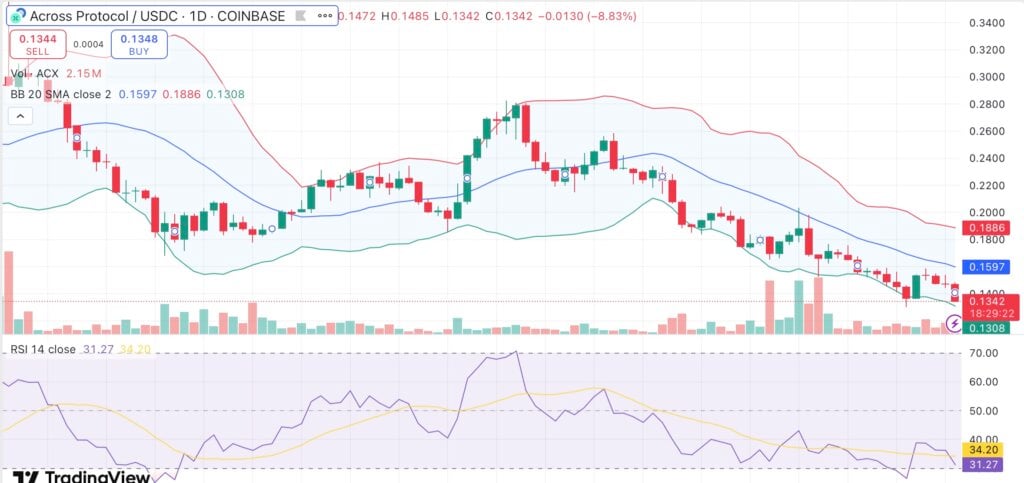
The token is trading at $0.1342, down 10% in the past 24 hours and over 40% in the past month. It’s now 91% below its all-time high of $1.69 set in December 2024.

The allegations were made public on June 27 by Ogle, the pseudonymous founder of Layer 1 project Glue and advisor to World Liberty Financial. In a detailed post on X, Ogle accused the Across Protocol team, particularly project lead Kevin Chan and chief executive officer Hart Lambur, of orchestrating two secretive proposals that directly benefited their own company using undisclosed wallets.

These proposals, made to appear as having community support, transferred 150 million ACX tokens worth about $23 million at current prices to Risk Labs over two separate governance votes. The first vote in October 2023 granted 100 million ACX under the pretense of future development support, with claims that the tokens would not be sold for two years.

But soon after, Risk Labs allegedly began selling token option agreements to external investors  A second vote, for “retroactive funding” of 50 million ACX, passed primarily due to insider-controlled wallets. Without those votes, it would not have reached quorum.

The report argues that such actions run counter to DAO governance principles and create significant future sell pressure, especially harmful to ACX holders unaware of the conflicts of interest behind these decisions. Across Protocol has not publicly responded to the allegations at the time of writing.

Looking at the technical picture, the chart shows clear downward pressure. The token is currently hugging the lower Bollinger Band at $0.1308 and trading below its 20-day simple moving average of $0.1597. At 31.27, the relative streghth index, which is trending downwards, is close to oversold territory.
Across Protocol token plunges amid allegations of $23M misappropriation by team - 1

More declines may occur if the price breaks through the $0.13 support zone. Some investors may watching for a bounce move back toward the mid-Bollinger band despite the sell-off. However, in the short term, upward momentum might be limited due to deteriorating sentiment and eroded trust in the team.

Market Opportunity
TokenFi Logo
TokenFi Price(TOKEN)
$0.002362
$0.002362$0.002362
-2.95%
USD
TokenFi (TOKEN) Live Price Chart
Disclaimer: The articles reposted on this site are sourced from public platforms and are provided for informational purposes only. They do not necessarily reflect the views of MEXC. All rights remain with the original authors. If you believe any content infringes on third-party rights, please contact service@support.mexc.com for removal. MEXC makes no guarantees regarding the accuracy, completeness, or timeliness of the content and is not responsible for any actions taken based on the information provided. The content does not constitute financial, legal, or other professional advice, nor should it be considered a recommendation or endorsement by MEXC.

You May Also Like

Trust Wallet’s Decisive Move: Full Compensation for $7M Hack Victims

Trust Wallet’s Decisive Move: Full Compensation for $7M Hack Victims

BitcoinWorld Trust Wallet’s Decisive Move: Full Compensation for $7M Hack Victims In a significant move for cryptocurrency security, Trust Wallet has committed
Share
bitcoinworld2025/12/26 17:40
Cashing In On University Patents Means Giving Up On Our Innovation Future

Cashing In On University Patents Means Giving Up On Our Innovation Future

The post Cashing In On University Patents Means Giving Up On Our Innovation Future appeared on BitcoinEthereumNews.com. “It’s a raid on American innovation that would deliver pennies to the Treasury while kneecapping the very engine of our economic and medical progress,” writes Pipes. Getty Images Washington is addicted to taxing success. Now, Commerce Secretary Howard Lutnick is floating a plan to skim half the patent earnings from inventions developed at universities with federal funding. It’s being sold as a way to shore up programs like Social Security. In reality, it’s a raid on American innovation that would deliver pennies to the Treasury while kneecapping the very engine of our economic and medical progress. Yes, taxpayer dollars support early-stage research. But the real payoff comes later—in the jobs created, cures discovered, and industries launched when universities and private industry turn those discoveries into real products. By comparison, the sums at stake in patent licensing are trivial. Universities collectively earn only about $3.6 billion annually in patent income—less than the federal government spends on Social Security in a single day. Even confiscating half would barely register against a $6 trillion federal budget. And yet the damage from such a policy would be anything but trivial. The true return on taxpayer investment isn’t in licensing checks sent to Washington, but in the downstream economic activity that federally supported research unleashes. Thanks to the bipartisan Bayh-Dole Act of 1980, universities and private industry have powerful incentives to translate early-stage discoveries into real-world products. Before Bayh-Dole, the government hoarded patents from federally funded research, and fewer than 5% were ever licensed. Once universities could own and license their own inventions, innovation exploded. The result has been one of the best returns on investment in government history. Since 1996, university research has added nearly $2 trillion to U.S. industrial output, supported 6.5 million jobs, and launched more than 19,000 startups. Those companies pay…
Share
BitcoinEthereumNews2025/09/18 03:26
Trust Wallet Hack Hits $7M: CZ Hints at Possible Insider Role

Trust Wallet Hack Hits $7M: CZ Hints at Possible Insider Role

CZ hinted at possible insider involvement in the Trust Wallet incident while assuring users that their funds would be reimbursed.
Share
CryptoPotato2025/12/26 16:48