

Bitcoin and Ethereum just had their best Q2 since 2020 — can Q3 keep it going?
Can the strongest Q2 since 2020 for Bitcoin and Ethereum reset market confidence or are we simply watching another temporary rally before macro headwinds catch up?
Table of Contents
- BTC and ETH post best Q2 since 2020
- Spot ETF volumes bounce back
- Crypto’s institutional reframing
- Macro will decide the next move
BTC and ETH post best Q2 since 2020
Bitcoin (BTC) and Ethereum (ETH) are ending the second quarter of 2025 with strong momentum, recording quarterly gains of 30% and 36% respectively, according to CoinGlass data. These are the best Q2 returns for both assets since the post-COVID rally in 2020.
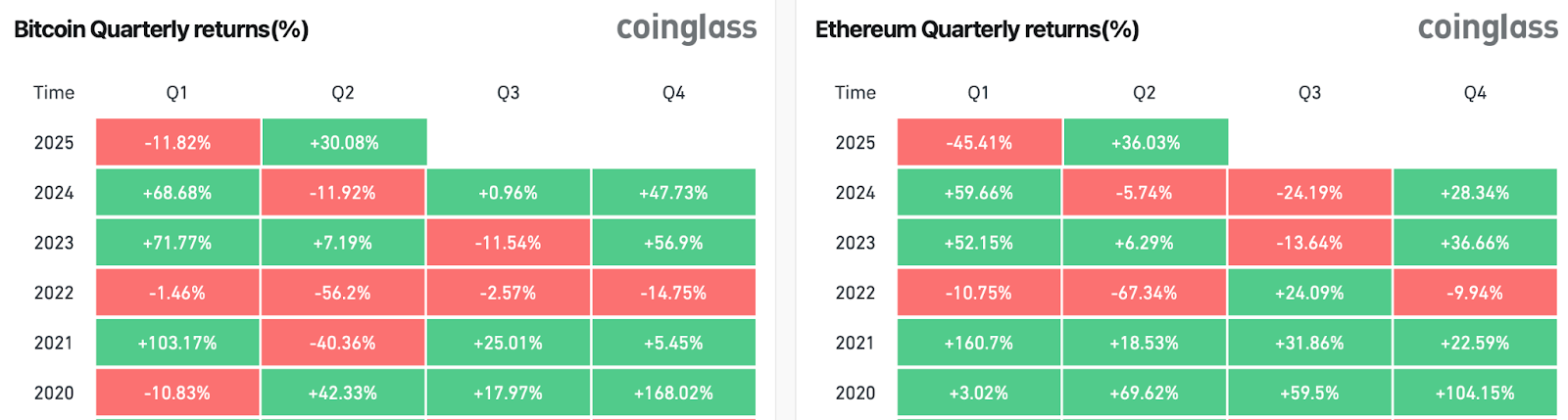
As of Jun. 30, Bitcoin is trading near $107,500 and Ethereum is holding around $2,450. On a weekly basis, they are up 6% and 9%, underpinning the broader upward trend that has taken shape over the past few weeks.
The first quarter of 2025 had started on a much weaker note. Bitcoin fell 11.82% in Q1, giving back part of its massive 47.73% rally in the final quarter of 2024.
Ethereum dropped even more sharply, ending Q1 with a 45.41% loss, marking its worst quarterly performance since the 2022 bear market.
Trade tensions under the Trump administration, along with renewed geopolitical instability in Europe and the Middle East, created a risk-off environment that pulled capital away from speculative assets, including crypto.
The turnaround in Q2 is notable. Ethereum has recovered nearly 80% of its first-quarter losses. Bitcoin, while not yet at its all-time highs, is now trading within reach of that level.
Historically, Q4 and Q1 have delivered stronger results for Bitcoin and Ethereum, often tied to end-of-year positioning and early-cycle optimism. Q2 tends to be more volatile, with outcomes often shaped by policy developments and regulatory activity.
In 2022, Bitcoin posted a Q2 loss of 56.2%, while Ethereum dropped 67.34%. The following year saw modest Q2 gains of 7.19% and 6.29% for BTC and ETH respectively.
Against that backdrop, the performance in Q2 2025 stands out not just for its scale, but for reversing a sharp downtrend from earlier in the year.
Spot ETF volumes bounce back
One of the defining features of Q2’s crypto recovery has been the steady rise in institutional participation, particularly through spot ETFs.
Bitcoin ETFs, led by BlackRock’s IBIT, saw a notable resurgence in investor interest through June, effectively ending a brief period of declining activity.
According to data, over 210 million IBIT shares were traded in the week ending Jun. 27, reflecting a 22.2% increase from the previous week and reversing a four-week downtrend in trading volume.
That volume recovery has been accompanied by consistent capital inflows. BlackRock’s IBIT alone attracted $1.31 billion in net inflows last week, slightly ahead of the $1.23 billion it pulled in the week prior.
Over the month of June, the fund has drawn in $3.74 billion, reflecting its dominant role in channeling large-scale investment into Bitcoin.
Cumulatively, all 11 spot Bitcoin ETFs listed in the U.S. have attracted over $4 billion in net inflows this month, marking their third straight month of positive flows.
Moreover, since Jun. 9, the segment has not recorded a single net outflow day, a sign that institutional demand is holding steady despite broader market uncertainties.
As of this writing on Jun. 30, all the spot BTC ETFs have a combined assets under management exceeding $135 billion.
Meanwhile, Ethereum ETFs have shown a similar course, albeit on a smaller base. Inflows into spot ETH ETFs climbed to $283 million last week, a sharp rise from the $40 million added the week before.
That jump has helped June surpass May and April’s figures, with a total of $1.13 billion entering Ethereum ETFs this month.
In comparison, May saw $564 million in inflows, and April had $66.2 million. Over the past seven weeks, ETH ETFs have now recorded uninterrupted weekly inflows, the longest streak since their inception.
Total cumulative inflows into Ethereum ETFs have exceeded $4.1 billion since September, bringing total AUM to $9.88 billion.
BlackRock’s ETHA fund currently holds the largest share, with $4.25 billion in assets. While this is still smaller than Bitcoin’s footprint in the ETF space, the pace of growth over the past two months indicates growing confidence in Ethereum’s investment thesis.
Crypto’s institutional reframing
Recent moves by institutional leaders and policymakers suggest a shift in how Bitcoin and Ethereum are perceived in modern portfolios.
Ric Edelman, founder of the $300 billion advisory firm Edelman Financial Engines, has laid out a new investment framework that places crypto in every category of investor allocation.
Edelman’s recommendation proposes that even conservative investors allocate 10% to crypto, with moderate clients going up to 25% and aggressive ones as high as 40%.
His outlook challenges the long-standing 60-40 stock-bond model and positions crypto not as a speculative add-on but as an essential component of diversified exposure.
Edelman’s reasoning is rooted in historical data. Over the past 15 years, Bitcoin has outperformed all other asset classes.
Portfolios that included Bitcoin have shown stronger returns and lower drawdowns, while also scoring higher on traditional portfolio metrics such as the Sharpe and Sortino ratios.
The market appears to be following through on this logic. MicroStrategy, on Jun. 29, acquired another 4,980 BTC at an average price of $106,801 per coin, bringing its total holdings to 597,325 BTC, purchased at an average of just under $71,000. The firm’s Bitcoin yield year-to-date is nearly 20%.
Wall Street strategist Tom Lee is also placing a bold bet on crypto. Now serving as chairman of BitMine, a small Bitcoin mining firm, Lee is backing a $250 million capital raise aimed at transforming the company into the largest public holder of Ethereum.
The plan involves building an Ether-first treasury strategy modeled on Strategy’s Bitcoin approach, confriming growing institutional interest in Ethereum as a core reserve asset.
Meanwhile, Kazakhstan’s central bank is studying the creation of a national crypto reserve. The proposal includes using assets sourced from government-run mining and confiscations, with the goal of placing them under regulated central control.
Authorities have acknowledged the risks of volatility but argue that structured oversight can offer better integration into national financial frameworks.
If implemented, Kazakhstan would be one of the earliest nations to formally hold crypto at the central bank level, following El Salvador and the U.S.
Amid this, macroeconomic policy remains a wildcard. The Federal Reserve has kept interest rates steady at 4.25% to 4.50%, but Minneapolis Fed President Neel Kashkari has reaffirmed expectations of two rate cuts before the end of the year.
The first could come as early as September, depending on incoming inflation and employment data. President Trump has also renewed calls for a sharper cut, targeting a 1% policy rate in the upcoming July meeting.
If the Federal Reserve proceeds with rate cuts while institutions continue to scale up exposure, capital could keep flowing into risk assets, especially crypto. Bitcoin may remain the primary beneficiary as a macro hedge, while Ethereum could gain from capital trickle-down effects.
Macro will decide the next move
Heading into Q3, all eyes will be on the Fed’s July meeting and its response to cooling inflation data. A confirmed rate cut could reinforce risk-on sentiment across markets, with crypto likely to benefit from renewed capital inflows.
Traders will also be watching for updates on the U.S. crypto tax bill, enforcement actions, and spot ETF expansion, especially around Ethereum. If ETH ETFs continue attracting steady inflows, Ethereum may begin to close the gap with Bitcoin in institutional portfolios.
In the background, macro events remain unpredictable. Any escalation in global trade tensions, especially involving China and the U.S., could revive volatility.
Meanwhile, on-chain data suggests leverage in derivatives markets is climbing again, which could amplify both rallies and corrections in the weeks ahead.
For now, the market is holding its Q2 gains, but sustained momentum will likely depend on a clear rate cut signal and continued institutional positioning.
Without either, the rally could stall. But if both align, Q3 could extend the uptrend, with Ethereum potentially leading the next leg.
However, nothing is ever guaranteed in the crypto world. Trade wisely and never invest more than you can afford to lose.
Disclosure: This article does not represent investment advice. The content and materials featured on this page are for educational purposes only.
You May Also Like

Trading time: Tonight, the US GDP and the upcoming non-farm data will become the market focus. Institutions are bullish on BTC to $120,000 in the second quarter.

‘Love Island Games’ Season 2 Release Schedule—When Do New Episodes Come Out?
