Bitcoin's dominance is dropping, while Ethereum is on the rise, showing potential early signs of an altcoin season.Bitcoin's dominance is dropping, while Ethereum is on the rise, showing potential early signs of an altcoin season.

Bitcoin dominance hits 3-month low as Ethereum breaks $3,600

Bitcoin’s rally has finally trickled down to the rest of the crypto markets, with its dominance falling sharply in favor of altcoins.

Signs that the altcoin season may be starting are finally here, and Ethereum (ETH) is leading the way. On Friday, July 18, Bitcoin’s (BTC) dominance fell by 3.35% to a three-month low of 60.8%. The biggest crypto asset saw moderate losses of 0.59% while falling below $118,000, while altcoins surged.
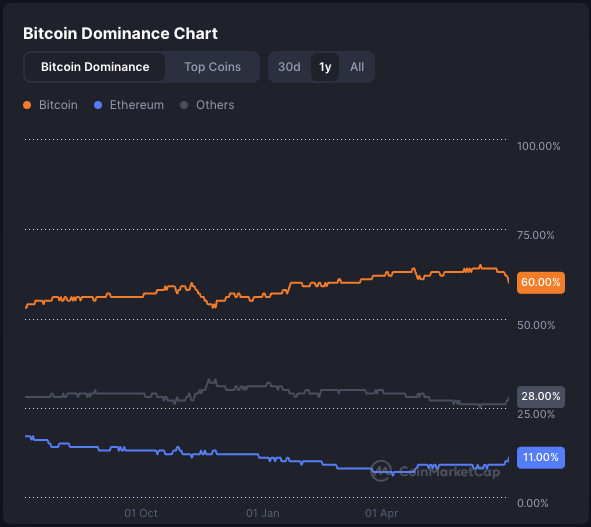
Bitcoin and Ethereum dominance over a yearly period

At the same time, Ethereum was one of the standout performers today, rising 5.56%, amid significant ETF inflows. Its dominance rose 1.87%, just as the ETH price briefly broke $3,600 for the first time since January.

What is more, Ethereum attracted significant ETF inflows, with $727 million on July 16 alone. BlackRock’s ETHA accounted for about $499 million of that figure. Moreover, monthly inflows rose 36%, outpacing Bitcoin ETFs, which saw their inflows grow by 10%.

Regulatory tailwinds boost Ethereum and altcoins

Most other altcoins registered strong gains, as traders converted their Bitcoin profits into tokens with more potential upside. The likely reason for the market’s appetite for risk is the passage of three crypto-related bills, which will significantly reshape the industry.

Notably, the recently passed Clarity Act delineates the jurisdiction between the SEC and the CFTC. This is particularly important for altcoins, including Ethereum. Virtually all altcoins were previously considered securities, which meant that they had to adhere to stringent securities laws.

For Ethereum, the passage of crypto legislations opens an opportunity for more institutional investment and participation. Due to its position as the largest and oldest blockchain that enables smart contracts, it is attracting significant institutional capital. What is more, legislation will likely attract even some conservative investors to look beyond Bitcoin for opportunities in the crypto arena.

Disclaimer: The articles reposted on this site are sourced from public platforms and are provided for informational purposes only. They do not necessarily reflect the views of MEXC. All rights remain with the original authors. If you believe any content infringes on third-party rights, please contact service@support.mexc.com for removal. MEXC makes no guarantees regarding the accuracy, completeness, or timeliness of the content and is not responsible for any actions taken based on the information provided. The content does not constitute financial, legal, or other professional advice, nor should it be considered a recommendation or endorsement by MEXC.

You May Also Like

Trump’s Crypto Gains Risk Backlash Post-Presidency, Ethereum Veteran Advises Urgency

Trump’s Crypto Gains Risk Backlash Post-Presidency, Ethereum Veteran Advises Urgency

The post Trump’s Crypto Gains Risk Backlash Post-Presidency, Ethereum Veteran Advises Urgency appeared on BitcoinEthereumNews.com. President Trump’s administration
Share
BitcoinEthereumNews2025/12/21 01:29
China Blocks Nvidia’s RTX Pro 6000D as Local Chips Rise

China Blocks Nvidia’s RTX Pro 6000D as Local Chips Rise

The post China Blocks Nvidia’s RTX Pro 6000D as Local Chips Rise appeared on BitcoinEthereumNews.com. China Blocks Nvidia’s RTX Pro 6000D as Local Chips Rise China’s internet regulator has ordered the country’s biggest technology firms, including Alibaba and ByteDance, to stop purchasing Nvidia’s RTX Pro 6000D GPUs. According to the Financial Times, the move shuts down the last major channel for mass supplies of American chips to the Chinese market. Why Beijing Halted Nvidia Purchases Chinese companies had planned to buy tens of thousands of RTX Pro 6000D accelerators and had already begun testing them in servers. But regulators intervened, halting the purchases and signaling stricter controls than earlier measures placed on Nvidia’s H20 chip. Image: Nvidia An audit compared Huawei and Cambricon processors, along with chips developed by Alibaba and Baidu, against Nvidia’s export-approved products. Regulators concluded that Chinese chips had reached performance levels comparable to the restricted U.S. models. This assessment pushed authorities to advise firms to rely more heavily on domestic processors, further tightening Nvidia’s already limited position in China. China’s Drive Toward Tech Independence The decision highlights Beijing’s focus on import substitution — developing self-sufficient chip production to reduce reliance on U.S. supplies. “The signal is now clear: all attention is focused on building a domestic ecosystem,” said a representative of a leading Chinese tech company. Nvidia had unveiled the RTX Pro 6000D in July 2025 during CEO Jensen Huang’s visit to Beijing, in an attempt to keep a foothold in China after Washington restricted exports of its most advanced chips. But momentum is shifting. Industry sources told the Financial Times that Chinese manufacturers plan to triple AI chip production next year to meet growing demand. They believe “domestic supply will now be sufficient without Nvidia.” What It Means for the Future With Huawei, Cambricon, Alibaba, and Baidu stepping up, China is positioning itself for long-term technological independence. Nvidia, meanwhile, faces…
Share
BitcoinEthereumNews2025/09/18 01:37
Academic Publishing and Fairness: A Game-Theoretic Model of Peer-Review Bias

Academic Publishing and Fairness: A Game-Theoretic Model of Peer-Review Bias

Exploring how biases in the peer-review system impact researchers' choices, showing how principles of fairness relate to the production of scientific knowledge based on topic importance and hardness.
Share
Hackernoon2025/09/17 23:15