Cardano and Ethereum are back in the spotlight as Q4 opens with firmer technicals and a wave of headlines from […] The post Cardano vs Ethereum Price Prediction — Which Layer-1 Hits $5 First While DOT Pushes Stablecoin Vote? appeared first on Coindoo.Cardano and Ethereum are back in the spotlight as Q4 opens with firmer technicals and a wave of headlines from […] The post Cardano vs Ethereum Price Prediction — Which Layer-1 Hits $5 First While DOT Pushes Stablecoin Vote? appeared first on Coindoo.

Cardano vs Ethereum Price Prediction — Which Layer-1 Hits $5 First While DOT Pushes Stablecoin Vote?

2025/10/06 05:30

Cardano and Ethereum are back in the spotlight as Q4 opens with firmer technicals and a wave of headlines from top crypto desks. Fresh price notes key ADA levels to flip for a sustained rebound, while technicians keep ETH on a glide path toward fresh highs. 

Polkadot is also moving a native, DOT-collateralized stablecoin proposal through an on-chain vote—an upgrade that could reshape its DeFi liquidity stack and at the same time, MAGACOIN FINANCE is steadily gaining traction to become the outsider favourite amid shifting sentiment and growing attention on next-gen altcoins. 
Cardano (ADA) — Price Prediction & Q4 Catalysts

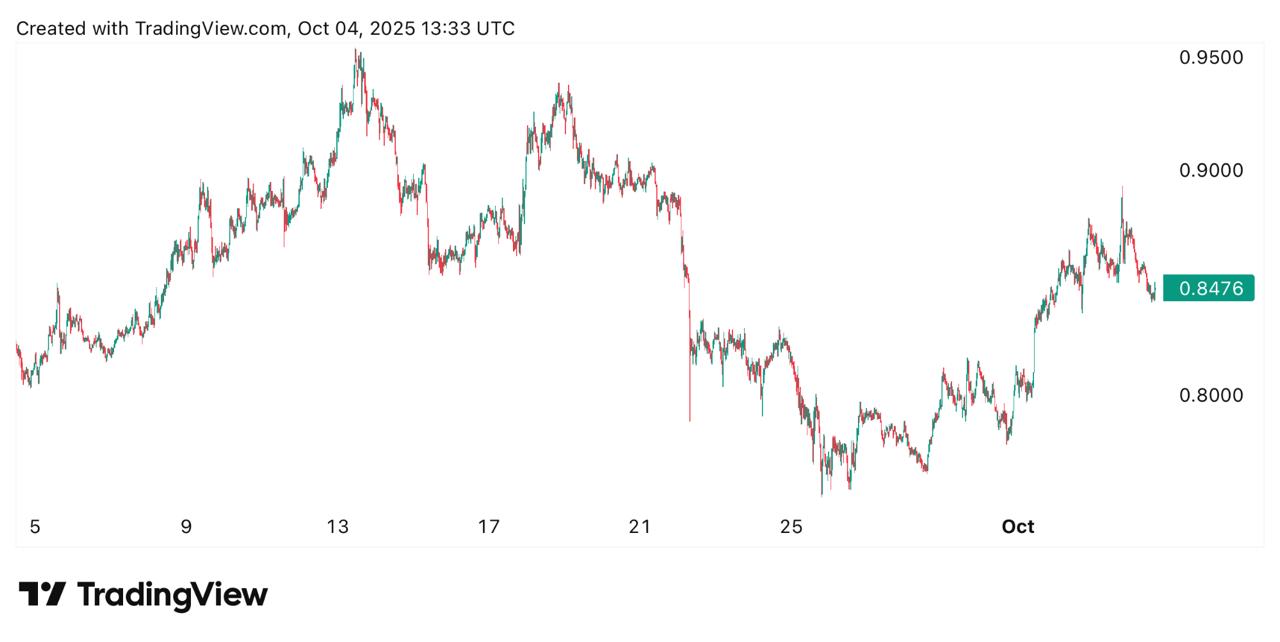
Cardano has been grinding in the $0.80–$0.85 bracket, with short-term sentiment hinging on whether bulls can reclaim nearby resistance. Today’s desk notes point to $0.94–$1.02 as a decision zone; failure to hold the 20-day EMA (~$0.84) risks a slide toward $0.75, while a clean break higher opens room for a multi-week recovery.
ADA TradingView

Intraday trackers show ADA roughly $0.85–$0.87, consistent with its recent consolidation band as traders wait for a catalyst. A near-term push above resistance would validate momentum plays into the $1 handle; lose $0.75 and the market could retest deeper supports before attempting another leg up.

Structurally, the bull case leans on Cardano’s methodical scaling roadmap (e.g., Hydra) and improving participation across its dApp stack. 
Ethereum (ETH) — Price Prediction & Narrative

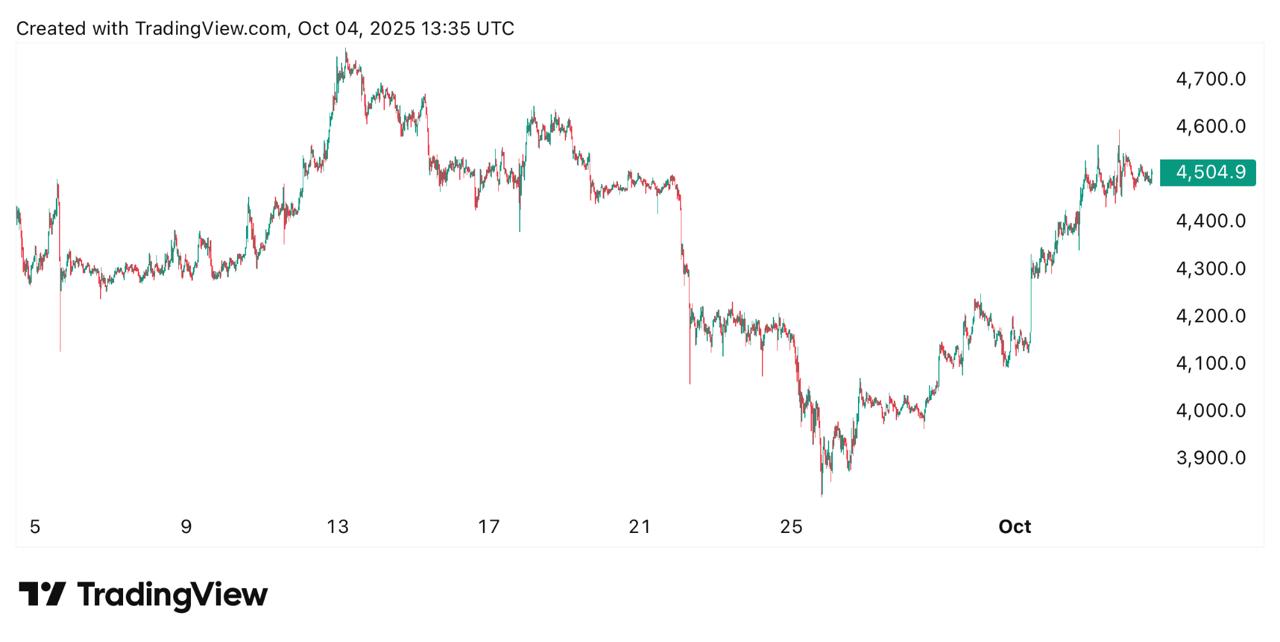
ETH continues to range in the low-to-mid $4K area with robust dev activity and steady DeFi volumes. Fundstrat’s Mark Newton recently reiterated a $5,500 objective on favorable momentum and buy-the-dip zones near $4,418–$4,375, framing ETH as the leading large-cap into mid-October if flows persist.
ETH TradingView

Across research desks, Ethereum’s rollup-first roadmap plus the drumbeat of ETF chatter keep it top of mind for allocators, with several market wraps through September emphasizing ETH as the higher-conviction L1 relative to peers. 

In practical terms, it shows ETH is still the favorite to tap $5K before ADA reaches $5, even if ADA’s percentage upside could be larger from current levels.

Polkadot (DOT) — Stablecoin Vote & DeFi Innovation

Polkadot’s headline driver: a community proposal for pUSD, a native DOT-backed algorithmic stablecoin designed to deepen on-chain liquidity and reduce reliance on third-party stables. 

Early support has been strong, with the measure framed as a pivotal step for Polkadot DeFi if it clears final checks and goes live across key parachains. Price watchers say a confirmed greenlight could reinforce DOT’s improving structure into the $4+ zone.
MAGACOIN FINANCE Gains Ground as the outsider favourite

Alongside the big caps, MAGACOIN FINANCE continues to show up in watchlists as a secured, externally-audited asset riding broader market flows rather than hype cycles. 

For investors, the emerging strategy pairs ETH’s institutional track with ADA’s asymmetry—and sprinkles measured exposure to a smaller-cap project that’s building steadily, increasing wallet activity on X/Telegram, and tracking liquidity conditions without overextending.

Smart investors now have access to a milestone celebration offer: a 50% EXTRA bonus, available for a limited time only when redeeming the code PATRIOT100X.

Bottom Line

ETH remains the statistical favorite to cross its big round figure first, powered by stronger volume expansion and institutional participation. ADA retains a credible pathway to higher prices if the market cooperates and technicals flip cleanly. DOT could rewrite its DeFi story if the pUSD vote finalizes as expected—an underappreciated catalyst for Q4.

Within that mix, MAGACOIN FINANCE has been gaining quiet traction as the outsider favourite in diversified baskets: smaller allocation, clear audits, security top-of-mind, and disciplined communication—designed to complement, not compete with, the L1 heavyweights.

To learn more about MAGACOIN FINANCE, visit:
Website: https://magacoinfinance.com
Access: https://magacoinfinance.com/access
Twitter/X: https://x.com/magacoinfinance
Telegram: https://t.me/magacoinfinance


This publication is sponsored. Coindoo does not endorse or assume responsibility for the content, accuracy, quality, advertising, products, or any other materials on this page. Readers are encouraged to conduct their own research before engaging in any cryptocurrency-related actions. Coindoo will not be liable, directly or indirectly, for any damages or losses resulting from the use of or reliance on any content, goods, or services mentioned. Always do your own research.

The post Cardano vs Ethereum Price Prediction — Which Layer-1 Hits $5 First While DOT Pushes Stablecoin Vote? appeared first on Coindoo.

Market Opportunity
Solayer Logo
Solayer Price(LAYER)
$0.1826
$0.1826$0.1826
-0.86%
USD
Solayer (LAYER) Live Price Chart
Disclaimer: The articles reposted on this site are sourced from public platforms and are provided for informational purposes only. They do not necessarily reflect the views of MEXC. All rights remain with the original authors. If you believe any content infringes on third-party rights, please contact service@support.mexc.com for removal. MEXC makes no guarantees regarding the accuracy, completeness, or timeliness of the content and is not responsible for any actions taken based on the information provided. The content does not constitute financial, legal, or other professional advice, nor should it be considered a recommendation or endorsement by MEXC.

You May Also Like

Volante Technologies Customers Successfully Navigate Critical Regulatory Deadlines for EU SEPA Instant and Global SWIFT Cross-Border Payments

Volante Technologies Customers Successfully Navigate Critical Regulatory Deadlines for EU SEPA Instant and Global SWIFT Cross-Border Payments

PaaS leader ensures seamless migrations and uninterrupted payment operations LONDON–(BUSINESS WIRE)–Volante Technologies, the global leader in Payments as a Service
Share
AI Journal2025/12/16 17:16
Fed Acts on Economic Signals with Rate Cut

Fed Acts on Economic Signals with Rate Cut

In a significant pivot, the Federal Reserve reduced its benchmark interest rate following a prolonged ten-month hiatus. This decision, reflecting a strategic response to the current economic climate, has captured attention across financial sectors, with both market participants and policymakers keenly evaluating its potential impact.Continue Reading:Fed Acts on Economic Signals with Rate Cut
Share
Coinstats2025/09/18 02:28
Google's AP2 protocol has been released. Does encrypted AI still have a chance?

Google's AP2 protocol has been released. Does encrypted AI still have a chance?

Following the MCP and A2A protocols, the AI Agent market has seen another blockbuster arrival: the Agent Payments Protocol (AP2), developed by Google. This will clearly further enhance AI Agents' autonomous multi-tasking capabilities, but the unfortunate reality is that it has little to do with web3AI. Let's take a closer look: What problem does AP2 solve? Simply put, the MCP protocol is like a universal hook, enabling AI agents to connect to various external tools and data sources; A2A is a team collaboration communication protocol that allows multiple AI agents to cooperate with each other to complete complex tasks; AP2 completes the last piece of the puzzle - payment capability. In other words, MCP opens up connectivity, A2A promotes collaboration efficiency, and AP2 achieves value exchange. The arrival of AP2 truly injects "soul" into the autonomous collaboration and task execution of Multi-Agents. Imagine AI Agents connecting Qunar, Meituan, and Didi to complete the booking of flights, hotels, and car rentals, but then getting stuck at the point of "self-payment." What's the point of all that multitasking? So, remember this: AP2 is an extension of MCP+A2A, solving the last mile problem of AI Agent automated execution. What are the technical highlights of AP2? The core innovation of AP2 is the Mandates mechanism, which is divided into real-time authorization mode and delegated authorization mode. Real-time authorization is easy to understand. The AI Agent finds the product and shows it to you. The operation can only be performed after the user signs. Delegated authorization requires the user to set rules in advance, such as only buying the iPhone 17 when the price drops to 5,000. The AI Agent monitors the trigger conditions and executes automatically. The implementation logic is cryptographically signed using Verifiable Credentials (VCs). Users can set complex commission conditions, including price ranges, time limits, and payment method priorities, forming a tamper-proof digital contract. Once signed, the AI Agent executes according to the conditions, with VCs ensuring auditability and security at every step. Of particular note is the "A2A x402" extension, a technical component developed by Google specifically for crypto payments, developed in collaboration with Coinbase and the Ethereum Foundation. This extension enables AI Agents to seamlessly process stablecoins, ETH, and other blockchain assets, supporting native payment scenarios within the Web3 ecosystem. What kind of imagination space can AP2 bring? After analyzing the technical principles, do you think that's it? Yes, in fact, the AP2 is boring when it is disassembled alone. Its real charm lies in connecting and opening up the "MCP+A2A+AP2" technology stack, completely opening up the complete link of AI Agent's autonomous analysis+execution+payment. From now on, AI Agents can open up many application scenarios. For example, AI Agents for stock investment and financial management can help us monitor the market 24/7 and conduct independent transactions. Enterprise procurement AI Agents can automatically replenish and renew without human intervention. AP2's complementary payment capabilities will further expand the penetration of the Agent-to-Agent economy into more scenarios. Google obviously understands that after the technical framework is established, the ecological implementation must be relied upon, so it has brought in more than 60 partners to develop it, almost covering the entire payment and business ecosystem. Interestingly, it also involves major Crypto players such as Ethereum, Coinbase, MetaMask, and Sui. Combined with the current trend of currency and stock integration, the imagination space has been doubled. Is web3 AI really dead? Not entirely. Google's AP2 looks complete, but it only achieves technical compatibility with Crypto payments. It can only be regarded as an extension of the traditional authorization framework and belongs to the category of automated execution. There is a "paradigm" difference between it and the autonomous asset management pursued by pure Crypto native solutions. The Crypto-native solutions under exploration are taking the "decentralized custody + on-chain verification" route, including AI Agent autonomous asset management, AI Agent autonomous transactions (DeFAI), AI Agent digital identity and on-chain reputation system (ERC-8004...), AI Agent on-chain governance DAO framework, AI Agent NPC and digital avatars, and many other interesting and fun directions. Ultimately, once users get used to AI Agent payments in traditional fields, their acceptance of AI Agents autonomously owning digital assets will also increase. And for those scenarios that AP2 cannot reach, such as anonymous transactions, censorship-resistant payments, and decentralized asset management, there will always be a time for crypto-native solutions to show their strength? The two are more likely to be complementary rather than competitive, but to be honest, the key technological advancements behind AI Agents currently all come from web2AI, and web3AI still needs to keep up the good work!
Share
PANews2025/09/18 07:00