The pre-confirmation mechanism can improve the user experience, but it requires users to temporarily believe that the block producer is honest and reliable.The pre-confirmation mechanism can improve the user experience, but it requires users to temporarily believe that the block producer is honest and reliable.

Comparison of Base, MegaETH and Solana pre-confirmation mechanisms: How to balance speed and security?

2025/03/20 19:28

Author: Shiva

Compiled by: Tim, PANews

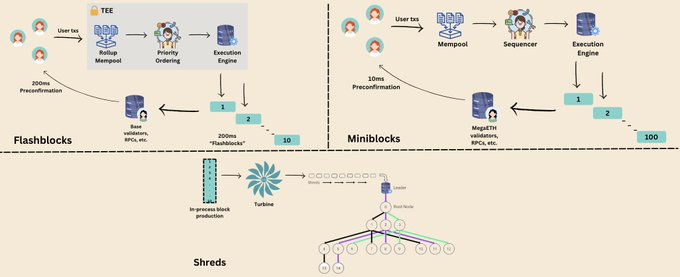
The pre-confirmation mechanisms of Base, MegaETH and Solana are Flashblocks, Miniblocks and Shreds respectively.

Who is the fastest?

Who is the safest?

Who will win?

Here’s everything you need to know:
Comparison of Base, MegaETH and Solana pre-confirmation mechanisms: How to balance speed and security?

TLDR:

  • Flashblocks, miniblocks and shreds are the "pre-confirmation" mechanisms on the Base, MegaETH and Solana chains respectively.
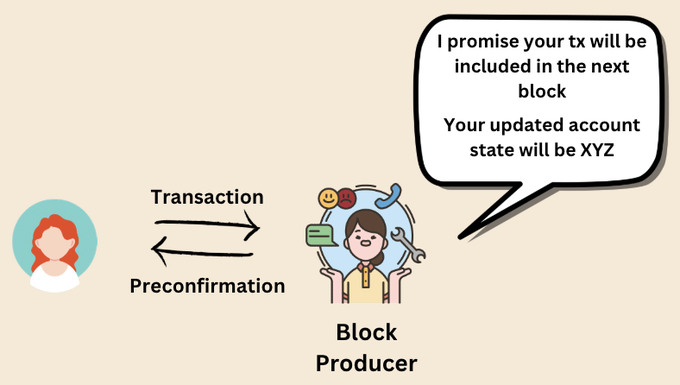
  • The pre-confirmation mechanism provides users with an "inclusion guarantee" that their transaction will be included in the next block.
  • The pre-confirmation mechanism can improve the user experience, but it requires users to temporarily believe that the block producer is honest and reliable.
Comparison of Base, MegaETH and Solana pre-confirmation mechanisms: How to balance speed and security?

Base Flashblocks

The current block confirmation time on Base is 2 seconds.

Every 2 seconds, all tools such as block browsers, RPC, wallets, etc. will obtain status updates of blocks and databases and share them with users.

The above state updates lack "finality" (immutability), but are "pre-confirmed" by the sorter.

A 2 second update delay does not provide a good user experience because users are accustomed to higher speeds.

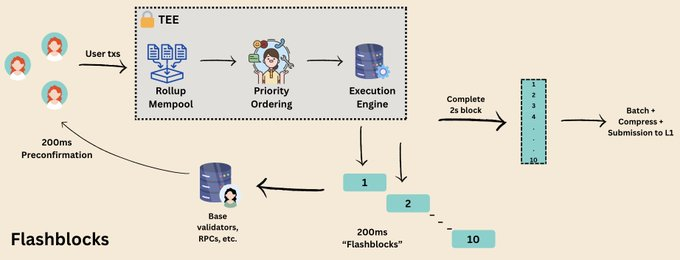
Flashblocks directly addresses this user experience problem by reducing the pre-confirmation time to 200 milliseconds:

  • The sorter runs in a Trusted Execution Environment (TEE) and sorts transactions based on priority fees.
  • Every 200 milliseconds, the sorter creates a child block (Flashblock) and broadcasts it to the L2 nodes.
  • L2 nodes verify the TEE signature and issue pre-confirmations to the user, they also apply Flashblocks to the local state.
  • After 2 seconds, the sorter compiles a complete block, generating a Merkle digest for submission to L1.
  • Once L1 is finalized, L2 nodes update their hard state to finalize the block.

Although it still takes 2 seconds for the entire block to be confirmed, users can see the updated status within 200 milliseconds, which significantly improves the user experience.
Comparison of Base, MegaETH and Solana pre-confirmation mechanisms: How to balance speed and security?

MegaETH Miniblocks

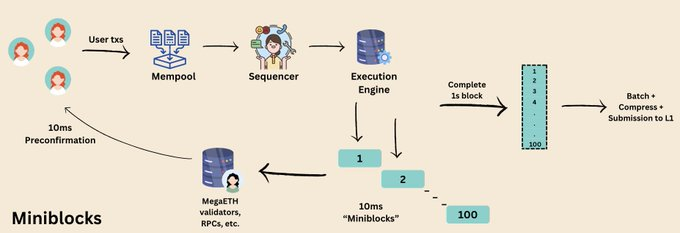
MegaETH currently plans to set the block time to 1 second.

However, they will adopt a pre-confirmation mechanism similar to Flashblocks to improve the user experience.

The MegaETH sequencer will output transactions as blocks are constructed (in an arbitrary order of transactions).

MegaETH plans to perform pre-confirmation every 10 milliseconds, and they call this format "Miniblocks".

Similar to Flashblocks, Miniblocks can significantly improve the user experience without increasing trust in the 1-second block.

(Note that when using Flashblocks, users also need to trust the TEE (Trusted Execution Environment) to run the prioritization correctly.)
Comparison of Base, MegaETH and Solana pre-confirmation mechanisms: How to balance speed and security?

Solana Shreds

Solana is a blockchain pioneer with good user experience and high-speed transactions.

Solana’s normal block time is 400 milliseconds.

However, during the block generation process, Solana block producers split blocks into smaller parts, called “Shreds”, and submit them to the Proof of History (PoH), which are then propagated to the rest of the network.

Other validators can start replicating transactions once they receive the shreds and send transactions immediately after validating the shreds (in less than 400 milliseconds).
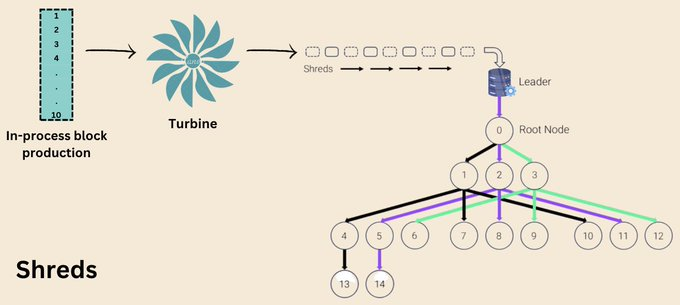
Comparison of Base, MegaETH and Solana pre-confirmation mechanisms: How to balance speed and security?

Now two problems arise:

  1. In each case, how secure are these “pre-confirmations”?
  2. What does “block time” actually mean for a rollup when transactions are not finalized until they are batched and sent to L1?

Pre-confirmed safety

a) Solana

Assume a Solana validator receives 2 Shreds from a block producer, but these Shreds do not become part of the final block. This could be due to two reasons:

  1. Block producer is offline: no final block is produced and the slot is skipped. In this case, the next block producer will take over these shreds and include them in their own blocks (copying on the longest fork).
  2. Malicious behavior by block producers: Block producers propagate different shreds to different validators with the intention of splitting the network.

So, inclusion guarantees simply mean trusting that block producers are not malicious or corrupt.

b) MegaETH

There is only one collator. Therefore, the inclusive guarantee is to trust that the collator is not malicious.

Two other risks are:

i) The sorter is offline: In this case, when it comes back online, it will contain the pre-confirmed transactions.

ii) Ethereum L1 reorganization occurs: any unfinalized L2 transactions will be replicated by the sorter on the new fork.

c) Base

Similar inclusion guarantees as MegaETH.

The inclusive guarantee here is to trust that the sorter is not malicious and that the TEE (Trusted Execution Environment) is secure.

However, even if the TEE is hacked, the only thing that can be changed is the priority order of transactions.

In all cases, users get faster pre-confirmations, but at the risk of corrupt block producers.

Since a single block producer has a monopoly on the construction of a block at any given time, it is reasonable to assume that corrupt behavior has the same probability in each block construction.

What does L2 block time mean?

L1 blockchains have a consensus mechanism, while most L2 blockchains do not.

In the L1 public chain, fixed block time can improve consensus efficiency because the voting behavior of validators is concentrated at the key time nodes of block generation. Validators will confirm the correctness of all transactions in the entire block through voting.

Do L2 block times make sense?

The answer is yes.

Although L2 block times are freely set and represent only "pre-confirmation" rather than finality, fixed block times still have the following key values:

  • When implementing a fee mechanism similar to EIP1559, operating at the block level will significantly improve execution efficiency compared to the frequent miniblock/flashblock level.
  • If L2 plans to implement a decentralized sorting and verification process, setting clear block boundaries can significantly improve efficiency because voting and verification activities can be completed in a specific time window.

As blockchain performance improves, faster sub-second pre-confirmations will become the norm.

The main chain that ultimately wins will also ensure that the probability of corruption is effectively resisted.

Disclaimer: The articles reposted on this site are sourced from public platforms and are provided for informational purposes only. They do not necessarily reflect the views of MEXC. All rights remain with the original authors. If you believe any content infringes on third-party rights, please contact service@support.mexc.com for removal. MEXC makes no guarantees regarding the accuracy, completeness, or timeliness of the content and is not responsible for any actions taken based on the information provided. The content does not constitute financial, legal, or other professional advice, nor should it be considered a recommendation or endorsement by MEXC.

You May Also Like

SEC urges caution on crypto wallets in latest investor guide

SEC urges caution on crypto wallets in latest investor guide

The SEC’s Office of Investor Education and Assistance issued a bulletin warning retail investors about crypto asset custody risks. The guidance covers how investors
Share
Crypto.news2025/12/15 01:45
Crucial Fed Rate Cut: October Probability Surges to 94%

Crucial Fed Rate Cut: October Probability Surges to 94%

BitcoinWorld Crucial Fed Rate Cut: October Probability Surges to 94% The financial world is buzzing with a significant development: the probability of a Fed rate cut in October has just seen a dramatic increase. This isn’t just a minor shift; it’s a monumental change that could ripple through global markets, including the dynamic cryptocurrency space. For anyone tracking economic indicators and their impact on investments, this update from the U.S. interest rate futures market is absolutely crucial. What Just Happened? Unpacking the FOMC Statement’s Impact Following the latest Federal Open Market Committee (FOMC) statement, market sentiment has decisively shifted. Before the announcement, the U.S. interest rate futures market had priced in a 71.6% chance of an October rate cut. However, after the statement, this figure surged to an astounding 94%. This jump indicates that traders and analysts are now overwhelmingly confident that the Federal Reserve will lower interest rates next month. Such a high probability suggests a strong consensus emerging from the Fed’s latest communications and economic outlook. A Fed rate cut typically means cheaper borrowing costs for businesses and consumers, which can stimulate economic activity. But what does this really signify for investors, especially those in the digital asset realm? Why is a Fed Rate Cut So Significant for Markets? When the Federal Reserve adjusts interest rates, it sends powerful signals across the entire financial ecosystem. A rate cut generally implies a more accommodative monetary policy, often enacted to boost economic growth or combat deflationary pressures. Impact on Traditional Markets: Stocks: Lower interest rates can make borrowing cheaper for companies, potentially boosting earnings and making stocks more attractive compared to bonds. Bonds: Existing bonds with higher yields might become more valuable, but new bonds will likely offer lower returns. Dollar Strength: A rate cut can weaken the U.S. dollar, making exports cheaper and potentially benefiting multinational corporations. Potential for Cryptocurrency Markets: The cryptocurrency market, while often seen as uncorrelated, can still react significantly to macro-economic shifts. A Fed rate cut could be interpreted as: Increased Risk Appetite: With traditional investments offering lower returns, investors might seek higher-yielding or more volatile assets like cryptocurrencies. Inflation Hedge Narrative: If rate cuts are perceived as a precursor to inflation, assets like Bitcoin, often dubbed “digital gold,” could gain traction as an inflation hedge. Liquidity Influx: A more accommodative monetary environment generally means more liquidity in the financial system, some of which could flow into digital assets. Looking Ahead: What Could This Mean for Your Portfolio? While the 94% probability for a Fed rate cut in October is compelling, it’s essential to consider the nuances. Market probabilities can shift, and the Fed’s ultimate decision will depend on incoming economic data. Actionable Insights: Stay Informed: Continue to monitor economic reports, inflation data, and future Fed statements. Diversify: A diversified portfolio can help mitigate risks associated with sudden market shifts. Assess Risk Tolerance: Understand how a potential rate cut might affect your specific investments and adjust your strategy accordingly. This increased likelihood of a Fed rate cut presents both opportunities and challenges. It underscores the interconnectedness of traditional finance and the emerging digital asset space. Investors should remain vigilant and prepared for potential volatility. The financial landscape is always evolving, and the significant surge in the probability of an October Fed rate cut is a clear signal of impending change. From stimulating economic growth to potentially fueling interest in digital assets, the implications are vast. Staying informed and strategically positioned will be key as we approach this crucial decision point. The market is now almost certain of a rate cut, and understanding its potential ripple effects is paramount for every investor. Frequently Asked Questions (FAQs) Q1: What is the Federal Open Market Committee (FOMC)? A1: The FOMC is the monetary policymaking body of the Federal Reserve System. It sets the federal funds rate, which influences other interest rates and economic conditions. Q2: How does a Fed rate cut impact the U.S. dollar? A2: A rate cut typically makes the U.S. dollar less attractive to foreign investors seeking higher returns, potentially leading to a weakening of the dollar against other currencies. Q3: Why might a Fed rate cut be good for cryptocurrency? A3: Lower interest rates can reduce the appeal of traditional investments, encouraging investors to seek higher returns in alternative assets like cryptocurrencies. It can also be seen as a sign of increased liquidity or potential inflation, benefiting assets like Bitcoin. Q4: Is a 94% probability a guarantee of a rate cut? A4: While a 94% probability is very high, it is not a guarantee. Market probabilities reflect current sentiment and data, but the Federal Reserve’s final decision will depend on all available economic information leading up to their meeting. Q5: What should investors do in response to this news? A5: Investors should stay informed about economic developments, review their portfolio diversification, and assess their risk tolerance. Consider how potential changes in interest rates might affect different asset classes and adjust strategies as needed. Did you find this analysis helpful? Share this article with your network to keep others informed about the potential impact of the upcoming Fed rate cut and its implications for the financial markets! To learn more about the latest crypto market trends, explore our article on key developments shaping Bitcoin price action. This post Crucial Fed Rate Cut: October Probability Surges to 94% first appeared on BitcoinWorld.
Share
Coinstats2025/09/18 02:25
Bitcoin’s Battle with Market Pressures Sparks Concerns

Bitcoin’s Battle with Market Pressures Sparks Concerns

Throughout the weekend, Bitcoin exhibited a degree of stability. Yet, it is once again challenging the critical support level of $88,000.Continue Reading:Bitcoin
Share
Coinstats2025/12/15 01:35

