

Dust or Gas? The Data That Could Rewrite Planet Formation Theory
Table of Links
Abstract and 1 Introduction
-
Sample selection and properties
-
Results
-
Discussion
-
Concluding remarks and References
Appendix A: Sample selection
Appendix B: Properties of the TOIs in this work
Appendix C: Pre-MS estimates
2. Sample selection and properties
This work is based on sources with exoplanet candidates identified from TESS light curves or "TESS objects of interest" (TOIs; Guerrero et al. 2021). The list of TOIs was filtered and cross-matched with Gaia DR3 data to select the sample. Details of the selection process are included in Appendix A, but we offer a brief summary below.
\ Essentially, we selected the most reliable TOIs with short-period planets (P < 10 days) and Gaia DR3 stellar characterization, including the evolutionary state, luminosity, mass, and radius (L∗, M∗, R∗). The Gaia parameters allowed us to disentangle the MS, intermediate-mass host stars from the rest. A careful filtering process was carried out to prevent contamination of the light curves by additional stars within the TESS apertures. Although the TOIs rejected could include planets that may be validated or confirmed in the future (e.g., Lillo-Box et al. in prep), the strict filtering criteria applied led to a robust sample of 47 intermediate-mass, MS stars. In particular, 25 such stars host confirmed planets and 22 have planet candidates with minimal chances of turning out to be false positives.
\ Appendix B summarizes the properties of this sample. The stellar masses range from 1.5 to 3 M⊙ and the planetary sizes extend from Neptune to a few Jupiter radii. The parameter space covered by the 25 confirmed and 22 candidate planets is similar and the general results from this work do not change when considering each sub-sample separately. All 47 sources are studied to increase the statistical significance and the term "planet" or "candidate planet" is used interchangeably in the rest of the manuscript.
\ We also consider 298 low-mass, MS stars (0.5 < M∗/M⊙ ≤ 1.5) included both in the TOIs and Gaia DR3 catalogs. All of them host confirmed, short-period giant planets similar to those around the intermediate-mass sample. This control sample of low-mass stars is used mainly for comparison purposes, maintaining the homogeneity of the analysis based on TESS and Gaia data. Although other samples of low-mass stars with hot Jupiters have been studied in the past, the distributions of orbital periods and radii presented here are similar to previous works. Details on the low-mass sample selection and its properties are also given in Appendices A and B. In addition, Appendix B provides support to the underlying assumption that potential observational biases similarly affect the intermediate- and low-mass samples, for the range of orbital periods and planet sizes analyzed. Thus, such biases are not expected to drive the trends presented in this work.
\
3. Results
We are interested on the relative positions of the planets with respect to the protoplanetary disk dust and gas barriers, which are defined as a function of pre-MS stellar luminosities and radii. Appendix C details how the pre-MS values for L∗ and R∗ have been inferred for the stars in the sample. In short, the luminosities and radii exhibited by the stars throughout the pre-MS were derived from the crossing points between the evolutionary tracks for each stellar mass and the 3 Myr theoretical isochrone in Siess et al. (2000). Such a young age is the typical timescale when most protoplanetary disks dissipate (e.g., Mendigutía et al. 2022, and references therein). As discussed in Appendix C, our general results and conclusions are not significantly affected by the use of different disk dissipation timescales, theoretical evolutionary tracks, or isochrones.
\ 
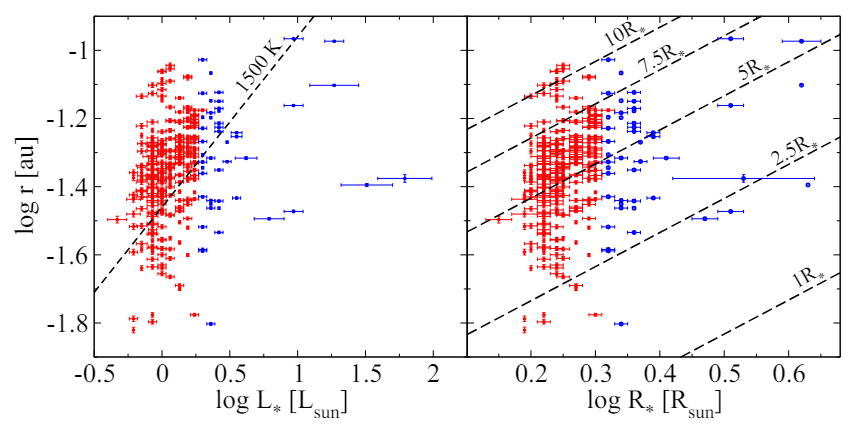
\ Figure 2 (right) shows the planetary orbital radii versus the pre-MS stellar radii. The dashed lines indicate the orbits at 10, 7.5, 5, 2.5, and 1R∗. The location of ∼ 60% of the planets around intermediate-mass stars is consistent with the small magnetospheres typical of Herbig stars (< 5R∗), being the rest orbiting at larger distances.
\ Concerning the sample of low-mass stars, Fig. 2 shows that almost 80% of such sources host planets in orbits equal or larger than the dust-destruction radius, and ∼ 65% have orbits > 5R∗. This illustrates the notion noted in Sect. 1: the dust and gas barriers roughly coincide in low-mass stars, with the majority of their planets located in orbits that are consistent both with the dust-destruction radius and with the large magnetospheric gastruncation radii typical for T Tauri stars.
\ Figure 3 shows the above-mentioned statistical differences between the distributions of planetary orbits, which are expressed as a function of pre-MS stellar radii. The orbits
\ 
\ \ 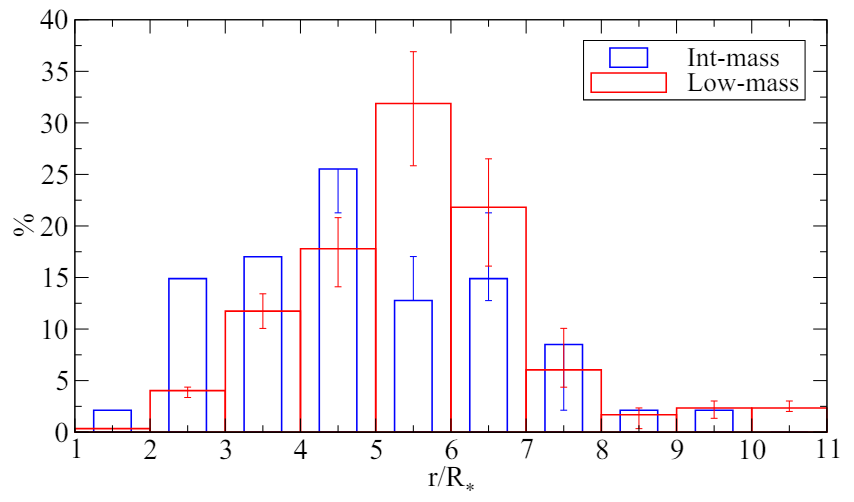
\ around intermediate- and low-mass stars dominate below and above 5R∗, respectively, which is the rough limit dividing between small and large magnetosphere sizes. A two-sample Kolmogorov-Smirnov (K-S) test provides a 0.53% probability that the previous samples are drawn from the same parent distribution.
\
:::info Authors:
(1) I. Mendigutía, Centro de Astrobiología (CAB), CSIC-INTA, Camino Bajo del Castillo s/n, 28692, Villanueva de la Cañada, Madrid, Spain;
(2) J. Lillo-Box, Centro de Astrobiología (CAB), CSIC-INTA, Camino Bajo del Castillo s/n, 28692, Villanueva de la Cañada, Madrid, Spain;
(3) M. Vioque, European Southern Observatory, Karl-Schwarzschild-Strasse 2, D-85748 Garching bei München, Germany and Joint ALMA Observatory, Alonso de Córdova 3107, Vitacura, Santiago 763-0355, Chile;
(4) J. Maldonado, INAF – Osservatorio Astronomico di Palermo, Piazza del Parlamento 1, I-90134 Palermo, Italy;
(8) B. Montesinos, Centro de Astrobiología (CAB), CSIC-INTA, Camino Bajo del Castillo s/n, 28692, Villanueva de la Cañada, Madrid, Spain;
(6) N. Huélamo, Centro de Astrobiología (CAB), CSIC-INTA, Camino Bajo del Castillo s/n, 28692, Villanueva de la Cañada, Madrid, Spain;
(7) J. Wang, Departamento de Física Teórica, Módulo 15, Facultad de Ciencias, Universidad Autónoma de Madrid, 28049 Madrid, Spain.
:::
:::info This paper is available on arxiv under CC BY-SA 4.0 DEED license.
:::
\
You May Also Like

Cashing In On University Patents Means Giving Up On Our Innovation Future

Trump Reviews Candidates to Succeed Fed Chair Powell
