In the combination of real life and blockchain technology, what is the next potential opportunity for the C-end consumer track? As a platform that promotes the development of PayFi and RWA tracks, Umy is committed to providing Web3 users with a more diversified travel and consumption experience.In the combination of real life and blockchain technology, what is the next potential opportunity for the C-end consumer track? As a platform that promotes the development of PayFi and RWA tracks, Umy is committed to providing Web3 users with a more diversified travel and consumption experience.

Exploring opportunities in the next consumer track, Web3 platform Umy will create diversified travel and consumption experiences
2025/01/02 15:00

Exploring opportunities in the next consumer track, Web3 platform Umy will create diversified travel and consumption experiences

Author: Weilin, PANews

In this round of bull market, the prediction market has ignited the enthusiasm of C-end users, and meme coins have boosted the growth of the crypto market. With the total market value of stablecoins hitting a record high, the large-scale adoption of Web3 has also entered a new stage of development. In the combination of real life and blockchain technology, what are the next potential opportunities for C-end consumer tracks?

Web3 travel platform Umy has brought new possibilities to the consumer goods track. Designed specifically for Web3 users, Umy uses blockchain technology to solve the problems of high costs and weak privacy protection in the traditional travel industry. It not only helps the industry increase basic traffic and promote industrial growth, but also accelerates the application of encrypted payments in daily life. As a platform that promotes the development of PayFi (payment finance) and RWA (real world assets) tracks, Umy is committed to providing Web3 users with a more diversified travel and consumption experience.

Connecting encrypted payments with the off-chain world

Large-scale applications and entry into the mainstream have always been the direction of the crypto market's efforts, and RWA and PayFi have become important entry points.

RWA, which brings real-world assets onto the chain, is a hot track in this cycle. As of December 4, according to rwa.xyz data, the total asset size of the RWA track (excluding stablecoins) reached US$13.21 billion. Ondo Finance, which brings US debt onto the chain, and Propy, which puts real estate on the chain, have both achieved good market performance this year.

The concept of PayFi was not proposed until July last year. According to SoSoValue data, as of December 4, the top four projects in RWA market value have exceeded US$1 billion, representing a new way to build financial markets, creating financial primitives and product experiences around the time value of money, achieving more efficient and low-cost transactions, and applicable to Web3 transactions, off-chain consumption scenarios, retail environments, creator monetization, accounts receivable, payment processing, private credit pools and other scenarios. At present, representatives in the field of PayFi include Ripple, a long-established payment settlement public chain that has recently led the secondary market, COTI, a B-side payment solution, and Safe, a multi-signature wallet provider.

RWA and PayFi are both flourishing. With the improvement of infrastructure and the increase of users on the chain, the two tracks can be organically combined. Umy, as a Web3 travel and consumption platform, is exploring this. Umy focuses on encrypted payments, improves the time value of money (TVM) in PayFi, and supports cross-border payments. With its product matrix, it is expected to bring about a wave of Web3 consumer applications.

Four core products: Reshaping travel and consumption experience

Umy has launched four core products focusing on housing, transportation, e-commerce and innovative consumer products: Umy Beds , Umy Flights , Umy Shop and Umy X.
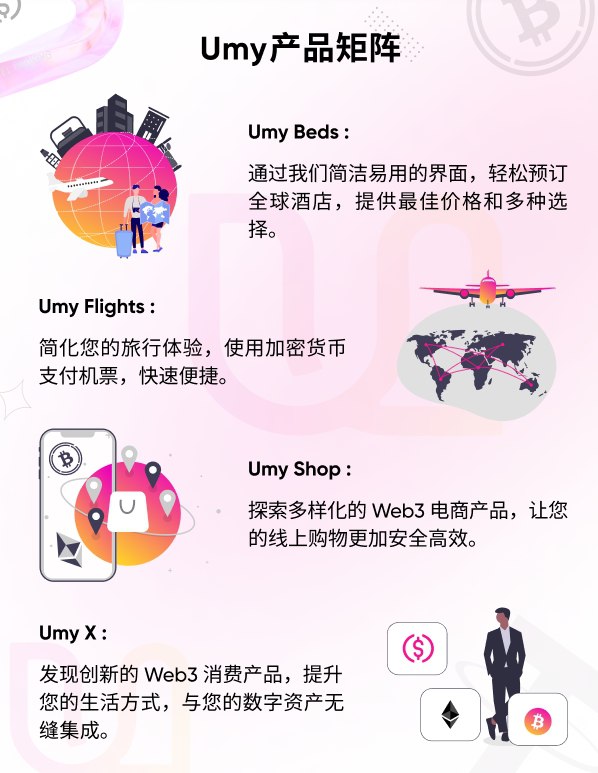
Exploring opportunities in the next consumer track, Web3 platform Umy will create diversified travel and consumption experiences

First of all, Umy Beds is a decentralized global hotel booking platform that connects hotels with consumers, reduces intermediary fees, improves transparency, and helps the industry increase basic traffic. For example, there are currently some platforms on the market that support paying hotel fees with USDT. However, the prices on these platforms are usually much higher than those of traditional online travel agencies such as Ctrip, Qunar.com or Fliggy. In contrast, the Umy platform cooperates with HashKey to provide hotel room rates that are basically the same as the over-the-counter (OTC) price of USDT, and in some cases are even more favorable than the OTC price. This price advantage makes Umy a better choice for users to pay hotel fees with USDT.

Another product, Umy Flights , is a platform that supports cryptocurrency payments for air tickets, breaking down traditional payment barriers, simplifying global payment processes, and further expanding market potential.

In addition, Umy Shop is a diversified Web3 e-commerce platform that provides travelers with the convenience and discounts of online shopping.

Umy X is an innovative Web3 consumer product that supports tokenized transactions of real-world assets (RWA), enhances the overall lifestyle of travelers, fully integrates digital assets and consumer products, drives real industry growth, and is expected to drive the growth of the RWA track.

From the perspective of the pain points of traditional travel, traditional platforms can no longer meet the needs of Web3 users. Privacy risks are high, personal data is easily leaked and abused, and the fees are high and the hidden fees of cross-border payments are a headache. In addition, traditional platforms currently have encryption payment barriers, and most platforms cannot seamlessly support cryptocurrency payments.

By adopting Web3 technology, Umy aims to promote privacy first and use blockchain technology to ensure data security. Its cryptocurrency payment achieves no exchange rate conversion fees and fast transactions. Its innovative travel experience focuses on meeting the needs of Web3 users.

Multiple new features launched, working with HashKey to open up new Web3 business travel scenarios

The Umy team completed two homepage iterations in just four months and basically perfected the hotel booking function. At the same time, the air ticket booking function will also be launched soon to provide users with more comprehensive travel services.

Currently, Umy has reached cooperation with ImToken, HashKey and TON ecology, and will support more ecological assets in the future to continuously expand the platform's compatibility and user selection space.

On November 22, Umy announced a partnership with HashKey HSK to jointly promote new Web3 business travel and consumption scenarios. The two parties will work together to promote the implementation of Web3 consumer experience and PayFi, bringing users a more convenient and innovative payment experience. They also plan to conduct in-depth cooperation in Web3 consumer experience in the future. Through resource sharing and technical complementarity, Umy will bring customized business travel services and convenient payment experience in PayFi scenarios to Hashkey users.

In the future development roadmap, Umy plans to have four stages:

  • Phase 1: Global hotel and air ticket reservations, solving the most basic pain points in the travel industry.
  • Phase 2: Blockchain conference support will improve the efficiency of information exchange within the industry and help the industry attract more traffic.
  • Phase 3: Personalize travel and shopping services to enhance user experience and drive long-term user growth on the platform.
  • Phase 4: Integrate e-commerce and commodity payment, open up the global consumer payment chain, and promote seamless connection between the platform and consumer goods track.

In general, Umy is an e-commerce platform that supports crypto payments and is committed to providing a one-stop digital life experience for crypto natives. Before large e-commerce platforms have fully integrated crypto payment tools, Umy has a valuable market window. As the scale of crypto native users expands and the meme wave attracts more and more Gen Z to enter Web3, Umy has great potential to compete with traditional giants of Web2.

Market Opportunity
Chainbase Logo
Chainbase Price(C)
$0.08736
$0.08736$0.08736
+3.97%
USD
Chainbase (C) Live Price Chart
Disclaimer: The articles reposted on this site are sourced from public platforms and are provided for informational purposes only. They do not necessarily reflect the views of MEXC. All rights remain with the original authors. If you believe any content infringes on third-party rights, please contact service@support.mexc.com for removal. MEXC makes no guarantees regarding the accuracy, completeness, or timeliness of the content and is not responsible for any actions taken based on the information provided. The content does not constitute financial, legal, or other professional advice, nor should it be considered a recommendation or endorsement by MEXC.

You May Also Like

Bitcoin ETF Investors React to Fed’s Decision

Bitcoin ETF Investors React to Fed’s Decision

The post Bitcoin ETF Investors React to Fed’s Decision appeared on BitcoinEthereumNews.com. In a surprise move, spot Bitcoin ETFs experienced their first significant daily outflows in over a week, following the Federal Reserve’s adjusted policy outlook. This shift reflects the market’s readiness to respond to any hint of change on the regulatory landscape, as well as its sensitivity to central bank cues. Continue Reading:Bitcoin ETF Investors React to Fed’s Decision Source: https://en.bitcoinhaber.net/bitcoin-etf-investors-react-to-feds-decision
Share
BitcoinEthereumNews2025/09/18 18:51
US Senators Introduce SAFE Crypto Act to Target Rising Crypto Scams
US Senators Introduce SAFE Crypto Act to Target Rising Crypto Scams

The post US Senators Introduce SAFE Crypto Act to Target Rising Crypto Scams appeared first on Coinpedia Fintech News Crypto scams are getting faster, smarter and
Share
CoinPedia2025/12/17 18:33
From Idea to App Store: The Complete Guide to Mobile App Development in Saudi Arabia

From Idea to App Store: The Complete Guide to Mobile App Development in Saudi Arabia

Saudi Arabia is at the forefront of digital transformation. With Vision 2030 driving innovation and a rapidly growing population of tech-savvy users, mobile apps have become a core driver of business growth in the Kingdom. From e-commerce and fintech to healthcare, logistics, and on-demand services, Saudi businesses are embracing mobile apps to connect with customers and scale faster. But how do you take a mobile app idea and turn it into a successful launch on the App Store or Google Play? This guide breaks down the complete mobile app development process in Saudi Arabia — step by step. Step 1: Validate Your App Idea for the Saudi Market Before you start building, ask: What problem does my app solve for Saudi users? Is there a cultural or market gap my app can fill? How do local competitors approach the same challenge? For example, apps related to digital payments, e-learning, delivery services, and healthcare are in high demand across Saudi Arabia. Conducting market research and aligning your app idea with local user behavior is critical. Step 2: Plan Features with Local Needs in Mind Your app should start with an MVP (Minimum Viable Product) — a core version that solves the main problem. Later, you can scale with advanced features. In Saudi Arabia, consider adding: Arabic language support (essential for user adoption) Integration with local payment gateways like STC Pay, Mada, or Apple Pay Regulatory compliance (especially for fintech and health apps) Localization for user preferences (Hijri calendar, cultural UI elements) Step 3: Select the Right Development Approach You can choose: Native Apps (Swift for iOS, Kotlin for Android) — Great for scalability and performance. Cross-Platform Apps (Flutter, React Native) — Cost-effective for startups targeting both iOS and Android simultaneously. Hybrid Apps — Suitable for simpler apps with limited features. For Saudi startups and enterprises, cross-platform development is often preferred to reach a wider audience quickly and efficiently. Step 4: Design With a Local Touch The design must balance global usability standards with local cultural relevance. UI (User Interface): Clean, modern visuals that align with Saudi branding. UX (User Experience): Simple navigation, clear Arabic text support, and intuitive flows. Wireframing & Prototyping: Test early with Saudi users to ensure adoption. A user-friendly design is one of the top reasons apps succeed in the Kingdom’s competitive market. Step 5: Develop Your Mobile App Once the design is ready, the coding begins. Saudi app development companies often follow Agile methodology, ensuring flexibility and faster delivery. Front-End Development: Interface and user interactions. Back-End Development: Databases, servers, and APIs. Integration: Secure connections between front-end and back-end. Strong collaboration between developers, designers, and business analysts ensures your app aligns with Saudi market needs. Step 6: Testing Across Devices and Networks Saudi users rely on different devices and network speeds. That’s why rigorous testing is critical: Functionality Testing: Features work as expected. Performance Testing: The app runs smoothly on both 4G and 5G networks. Localization Testing: Arabic text displays correctly, without alignment issues. Security Testing: Data protection compliance with Saudi cybersecurity standards. Step 7: App Store & Google Play Launch in Saudi Arabia To publish your app: Apple App Store (iOS): Requires an Apple Developer account and strict guideline compliance. Google Play Store (Android): Faster approval but still requires detailed app info. You’ll also need metadata in both English and Arabic — titles, descriptions, and screenshots — to maximize visibility among Saudi users. Step 8: Market Your App in Saudi Arabia Launching an app is only the beginning. You need a marketing strategy tailored to the Kingdom: App Store Optimization (ASO): Use Arabic and English keywords. Social Media Campaigns: Leverage platforms like Snapchat, Twitter (X), and Instagram, which are highly popular in Saudi Arabia. Influencer Marketing: Collaborate with Saudi influencers for early traction. Paid Ads: Google Ads and Saudi-focused Facebook/Instagram ads. Partnerships: Collaborate with local businesses to reach a wider audience. Step 9: Gather Feedback and Optimize Once your app is live, monitor: User reviews on app stores Analytics on engagement, retention, and churn rates Suggestions from Saudi users for culturally relevant features Continuous updates and improvements are vital to stay competitive. Step 10: Scale With Advanced Features Once your MVP gains traction, you can expand with advanced features such as: AI and machine learning for personalization Blockchain-based payments for fintech apps AR/VR features for retail and gaming apps IoT integration for smart home and mobility solutions Saudi Arabia’s digital ecosystem is growing rapidly — apps that adapt quickly will thrive. Conclusion Mobile app development in Saudi Arabia is not just about building an app — it’s about aligning with Vision 2030, cultural needs, and user expectations. By following a clear process — from idea validation to launch and beyond — you can transform your concept into a profitable digital product. Whether you’re a startup or an enterprise in Saudi Arabia, the opportunity is massive. With the right strategy, you can move from idea to App Store and create an app that truly resonates with Saudi users. From Idea to App Store: The Complete Guide to Mobile App Development in Saudi Arabia was originally published in Coinmonks on Medium, where people are continuing the conversation by highlighting and responding to this story
Share
Medium2025/09/18 14:46