Institutional Bitcoin demand now revolves around ETF flows, with EFIS offering a clear view of how capital impacts market behavior.]]>Institutional Bitcoin demand now revolves around ETF flows, with EFIS offering a clear view of how capital impacts market behavior.]]>

How ETF Flows Became the New Driving Force for Bitcoin

  • Institutional Bitcoin flows through ETFs now dominate price movements, with normalized data offering consistent insights into market sentiment and positioning.
  • EFIS reveals how sustained ETF inflows or outflows forecast accumulation or distribution phases among large institutional investors.

Since early 2024, capital flows from spot Bitcoin ETFs in the United States have taken over the market. This isn’t just a new story in the crypto industry, but a reality that’s increasingly difficult to ignore.

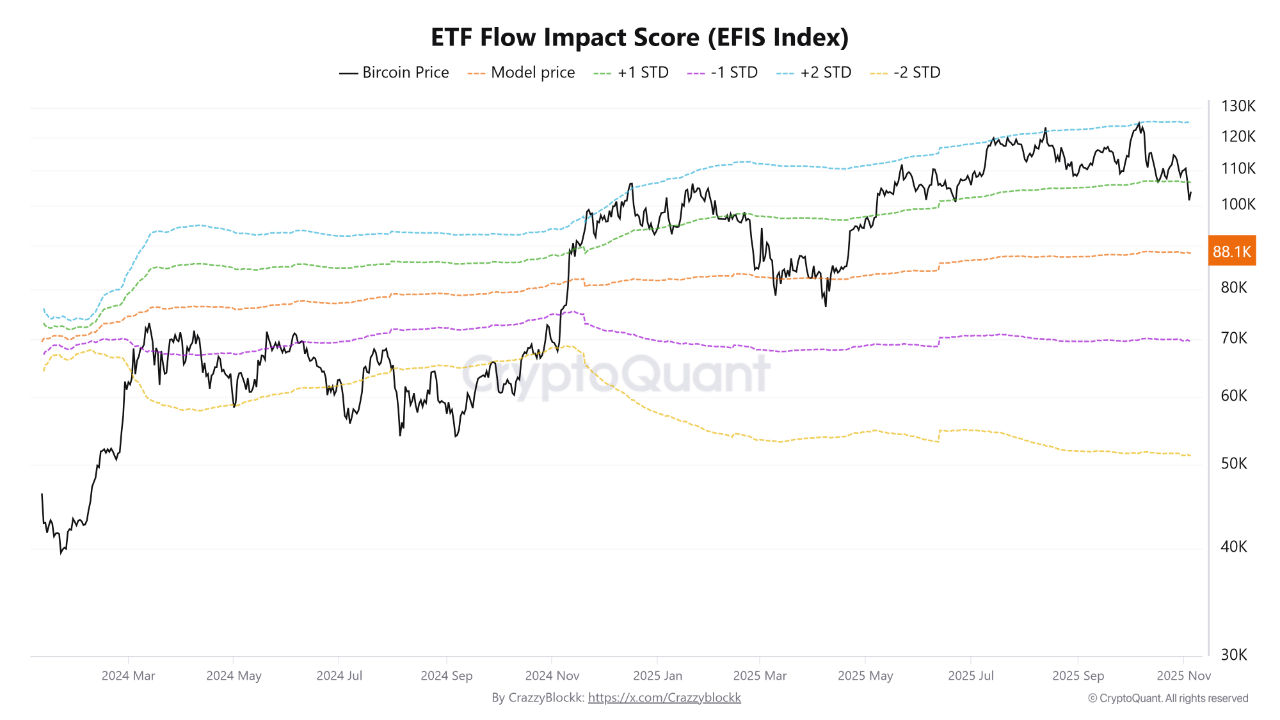
Observing this trend, on-chain analyst Crazzyblockk on CryptoQuant highlighted a particularly interesting metric: the ETF Flow Impact Score (EFIS).

This model is designed to measure the extent to which institutional funds from ETFs can move the Bitcoin price, with surprisingly high accuracy.
Source: CryptoQuant

The EFIS is built from 663 days of inflow and outflow data on 11 active spot Bitcoin ETFs in the US. However, Crazzyblockk doesn’t simply count dollar inflows and outflows. He realized one crucial thing: a $200 million investment might have had a significant impact earlier in the year when AUM was still small, but now its impact is much smaller.

Therefore, the EFIS normalizes fund flows based on total assets under management (AUM), creating a consistent measure over time. This is where an interesting correlation arises: if fund flows exceed 1% of daily AUM, Bitcoin can move up 2% to 3% within a week.

EFIS Model Points to $88K, But Market Seems Unconvinced

Now, let’s look at some more alarming numbers. Total ETF holdings currently stand at 1,047,000 BTC. Based on current inflow patterns, EFIS estimates Bitcoin’s fair price should be around $88,000.

But the reality? It’s still far above that. This gap raises an intriguing question: is the market still unaware, or are ETFs simply being too aggressive?

Not only that, EFIS also has another feature that makes investors more alert. It can detect correction signals quite accurately. Whenever a daily outflow exceeds 0.5% of AUM, a major correction soon follows.

Conversely, if for five consecutive days there are positive inflows but the price is still 10% behind the model’s prediction, it’s a sign that institutions are secretly buying.

On the other hand, a previous report from CNF indicated increasingly tense conditions in the on-chain space. Market liquidity is under pressure due to political uncertainty in the US—especially as the looming government shutdown slows capital flows.

Bitcoin reserves on exchanges are rising again, while miners’ balances continue to shrink. This could be interpreted as a defensive move, not an offensive one.

Bitcoin’s Active Addresses Plunge, Signaling Institutional Control

Furthermore, in early November, we highlighted that the number of active Bitcoin addresses had dropped by 26% in a year. This reflects a decline in real activity on the Bitcoin network.

Retail investors are starting to withdraw, leaving institutions and long-term holders in the spotlight.

This situation further underscores the role of EFIS as a tool to detect invisible institutional flows. Because, as Crazzyblockk revealed, the only way to directly measure institutional positions is through ETF data.

Meanwhile, as of the writing time, BTC is changing hands at about $102,889. up 1.04% over the last 24 hours, with $7.19 billion in daily trading volume.

]]>


Market Opportunity
Nowchain Logo
Nowchain Price(NOW)
$0.000942
$0.000942$0.000942
-7.92%
USD
Nowchain (NOW) Live Price Chart
Disclaimer: The articles reposted on this site are sourced from public platforms and are provided for informational purposes only. They do not necessarily reflect the views of MEXC. All rights remain with the original authors. If you believe any content infringes on third-party rights, please contact service@support.mexc.com for removal. MEXC makes no guarantees regarding the accuracy, completeness, or timeliness of the content and is not responsible for any actions taken based on the information provided. The content does not constitute financial, legal, or other professional advice, nor should it be considered a recommendation or endorsement by MEXC.

You May Also Like

Hadron Labs Launches Bitcoin Summer on Neutron, Offering 5–10% BTC Yield

Hadron Labs Launches Bitcoin Summer on Neutron, Offering 5–10% BTC Yield

Hadron Labs launches 'Bitcoin Summer' on Neutron, BTC vaults for WBTC, eBTC, solvBTC, uniBTC and USDC. Earn 5–10% BTC via maxBTC, with up to 10x looping.
Share
Blockchainreporter2025/09/18 02:00
South Korea Launches First Won-Backed Stablecoin KRW1 on Avalanche

South Korea Launches First Won-Backed Stablecoin KRW1 on Avalanche

South Korea made history this week by launching its first Korean won-backed stablecoin.
Share
Brave Newcoin2025/09/19 03:15
Curve Finance votes on revenue-sharing model for CRV holders

Curve Finance votes on revenue-sharing model for CRV holders

The post Curve Finance votes on revenue-sharing model for CRV holders appeared on BitcoinEthereumNews.com. Curve Finance has proposed a new protocol called Yield Basis that would share revenue directly with CRV holders, marking a shift from one-off incentives to sustainable income. Summary Curve Finance has put forward a revenue-sharing protocol to give CRV holders sustainable income beyond emissions and fees. The plan would mint $60M in crvUSD to seed three Bitcoin liquidity pools (WBTC, cbBTC, tBTC), with 35–65% of revenue distributed to veCRV stakers. The DAO vote runs from up to Sept. 24, with the proposal seen as a major step to strengthen CRV tokenomics after past liquidity and governance challenges. Curve Finance founder Michael Egorov has introduced a proposal to give CRV token holders a more direct way to earn income, launching a system called Yield Basis that aims to turn the governance token into a sustainable, yield-bearing asset.  The proposal has been published on the Curve DAO (CRV) governance forum, with voting open until Sept. 24. A new model for CRV rewards Yield Basis is designed to distribute transparent and consistent returns to CRV holders who lock their tokens for veCRV governance rights. Unlike past incentive programs, which relied heavily on airdrops and emissions, the protocol channels income from Bitcoin-focused liquidity pools directly back to token holders. To start, Curve would mint $60 million worth of crvUSD, its over-collateralized stablecoin, with proceeds allocated across three pools — WBTC, cbBTC, and tBTC — each capped at $10 million. 25% of Yield Basis tokens would be reserved for the Curve ecosystem, and between 35% and 65% of Yield Basis’s revenue would be given to veCRV holders. By emphasizing Bitcoin (BTC) liquidity and offering yields without the short-term loss risks associated with automated market makers, the protocol hopes to draw in professional traders and institutions. Context and potential impact on Curve Finance The proposal comes as Curve continues to modify…
Share
BitcoinEthereumNews2025/09/18 14:37