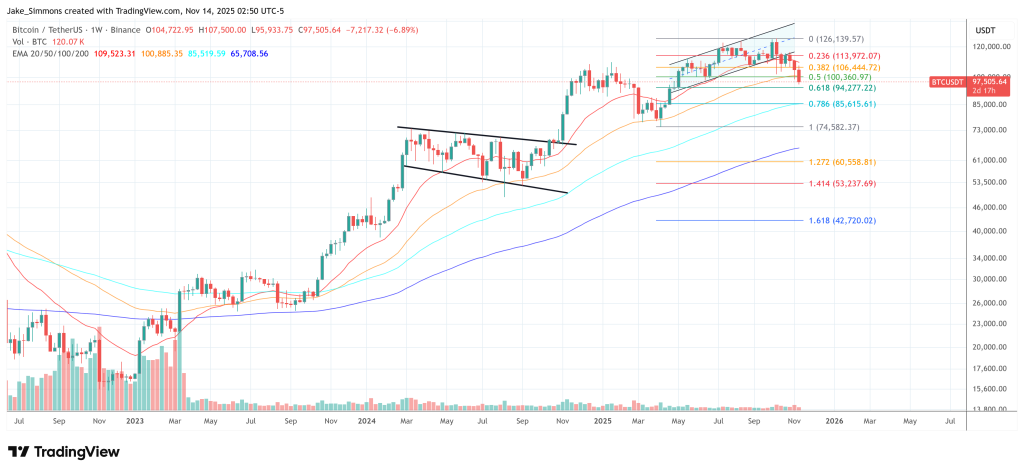
JPMorgan has put a numerical marker under this Bitcoin cycle, telling clients that the market’s “pain threshold” now sits near $94,000 — a level the bank frames as both a mining-economics floor and an answer to the question of how low spot can realistically trade before fundamentals start to bite. According to reporting by The Block, the analyst team led by Nikolaos Panigirtzoglou argues that “Bitcoin’s downside from current levels appears to be ‘very limited,’” because they “see its support price at around $94,000.” How Low Can Bitcoin Go? The core of the call is JPMorgan’s updated estimate of Bitcoin’s production cost. In their latest note, cited by The Block, the analysts say the all-in cost to mine one bitcoin has risen from about $92,000 to roughly $94,000 as network difficulty has surged over recent months. That jump in difficulty forces miners to deploy more hashpower per block, lifting the marginal cost per coin. The team reiterates a framework they have used in prior cycles, stressing that “the bitcoin production cost has empirically acted as a floor for bitcoin,” so a higher cost mechanically pulls the support zone higher as well. Related Reading: Bitcoin Death Cross Is Coming: Don’t Be Fooled By The Name On JPMorgan’s numbers, the ratio of spot price to production cost now sits just above 1.0, close to the lower end of its historical range. That implies miners’ operating margin is thin and that there is limited room for an extended move far below the modeled cost without triggering stress in the mining sector. From that perspective, the bank’s $94,000 level is not presented as a precise line in the sand, but as a statistically grounded region where downside risk becomes compressed because miners’ incentives to keep selling into weakness deteriorate. The same note keeps a much more optimistic medium-term scenario in place. JPMorgan reiterates a 6–12 month upside case around $170,000 per bitcoin, derived from a volatility-adjusted comparison with gold. As summarized by The Block, the analysts estimate that Bitcoin currently “consumes” around 1.8 times more risk capital than gold, yet still has a smaller market capitalization — roughly $2.1 trillion versus about $6.2 trillion in private-sector gold investment via ETFs, bars and coins. To close that gap on a volatility-adjusted basis, they calculate Bitcoin’s market cap would need to rise by about 67%, “implying a theoretical bitcoin price of close to $170,000.” Related Reading: Bitcoin Crashes To $98,000 As HODLer Selling Accelerates The Block also highlights how this view fits into JPMorgan’s recent track record of calls. In an earlier note last month, the same team argued that Bitcoin looked significantly undervalued relative to gold, implying upside toward about $165,000 by year-end. Panigirtzoglou has since dialed back the timing, telling The Block that, “it would not be realistic to expect this price target by year’s end,” given recent liquidations and very weak sentiment, and reframing $170,000 as a 6–12 month scenario rather than a near-term objective. The note further recalls an August projection around $126,000 by year-end; Bitcoin later printed an all-time high above $126,200 on Oct. 6 before a record liquidation event on Oct. 10 abruptly reset positioning. Those earlier pieces of research are consistent with a broader framework JPMorgan has been articulating publicly. In a separate analysis earlier this month, also led by Panigirtzoglou and reported by MarketWatch, the bank argued that post-October deleveraging left Bitcoin “very cheap to gold” on a volatility-adjusted basis and concluded that “this mechanical exercise thus implies significant upside for bitcoin over the next 6–12 months,” with fair value again clustering near $170,000. What the new note, as relayed by The Block, adds is a more explicit downside anchor: as long as network difficulty and energy-input assumptions keep the estimated production cost around $94,000, JPMorgan sees that level as the effective floor that answers how low Bitcoin can go before mining economics force the market to confront its constraints. At press time, BTC traded at $97,505. Featured image created with DALL.E, chart from TradingView.comJPMorgan has put a numerical marker under this Bitcoin cycle, telling clients that the market’s “pain threshold” now sits near $94,000 — a level the bank frames as both a mining-economics floor and an answer to the question of how low spot can realistically trade before fundamentals start to bite. According to reporting by The Block, the analyst team led by Nikolaos Panigirtzoglou argues that “Bitcoin’s downside from current levels appears to be ‘very limited,’” because they “see its support price at around $94,000.” How Low Can Bitcoin Go? The core of the call is JPMorgan’s updated estimate of Bitcoin’s production cost. In their latest note, cited by The Block, the analysts say the all-in cost to mine one bitcoin has risen from about $92,000 to roughly $94,000 as network difficulty has surged over recent months. That jump in difficulty forces miners to deploy more hashpower per block, lifting the marginal cost per coin. The team reiterates a framework they have used in prior cycles, stressing that “the bitcoin production cost has empirically acted as a floor for bitcoin,” so a higher cost mechanically pulls the support zone higher as well. Related Reading: Bitcoin Death Cross Is Coming: Don’t Be Fooled By The Name On JPMorgan’s numbers, the ratio of spot price to production cost now sits just above 1.0, close to the lower end of its historical range. That implies miners’ operating margin is thin and that there is limited room for an extended move far below the modeled cost without triggering stress in the mining sector. From that perspective, the bank’s $94,000 level is not presented as a precise line in the sand, but as a statistically grounded region where downside risk becomes compressed because miners’ incentives to keep selling into weakness deteriorate. The same note keeps a much more optimistic medium-term scenario in place. JPMorgan reiterates a 6–12 month upside case around $170,000 per bitcoin, derived from a volatility-adjusted comparison with gold. As summarized by The Block, the analysts estimate that Bitcoin currently “consumes” around 1.8 times more risk capital than gold, yet still has a smaller market capitalization — roughly $2.1 trillion versus about $6.2 trillion in private-sector gold investment via ETFs, bars and coins. To close that gap on a volatility-adjusted basis, they calculate Bitcoin’s market cap would need to rise by about 67%, “implying a theoretical bitcoin price of close to $170,000.” Related Reading: Bitcoin Crashes To $98,000 As HODLer Selling Accelerates The Block also highlights how this view fits into JPMorgan’s recent track record of calls. In an earlier note last month, the same team argued that Bitcoin looked significantly undervalued relative to gold, implying upside toward about $165,000 by year-end. Panigirtzoglou has since dialed back the timing, telling The Block that, “it would not be realistic to expect this price target by year’s end,” given recent liquidations and very weak sentiment, and reframing $170,000 as a 6–12 month scenario rather than a near-term objective. The note further recalls an August projection around $126,000 by year-end; Bitcoin later printed an all-time high above $126,200 on Oct. 6 before a record liquidation event on Oct. 10 abruptly reset positioning. Those earlier pieces of research are consistent with a broader framework JPMorgan has been articulating publicly. In a separate analysis earlier this month, also led by Panigirtzoglou and reported by MarketWatch, the bank argued that post-October deleveraging left Bitcoin “very cheap to gold” on a volatility-adjusted basis and concluded that “this mechanical exercise thus implies significant upside for bitcoin over the next 6–12 months,” with fair value again clustering near $170,000. What the new note, as relayed by The Block, adds is a more explicit downside anchor: as long as network difficulty and energy-input assumptions keep the estimated production cost around $94,000, JPMorgan sees that level as the effective floor that answers how low Bitcoin can go before mining economics force the market to confront its constraints. At press time, BTC traded at $97,505. Featured image created with DALL.E, chart from TradingView.com

How Low Can Bitcoin Price Go? JPMorgan Points To A Key Threshold

2025/11/14 18:00

JPMorgan has put a numerical marker under this Bitcoin cycle, telling clients that the market’s “pain threshold” now sits near $94,000 — a level the bank frames as both a mining-economics floor and an answer to the question of how low spot can realistically trade before fundamentals start to bite. According to reporting by The Block, the analyst team led by Nikolaos Panigirtzoglou argues that “Bitcoin’s downside from current levels appears to be ‘very limited,’” because they “see its support price at around $94,000.”

How Low Can Bitcoin Go?

The core of the call is JPMorgan’s updated estimate of Bitcoin’s production cost. In their latest note, cited by The Block, the analysts say the all-in cost to mine one bitcoin has risen from about $92,000 to roughly $94,000 as network difficulty has surged over recent months. That jump in difficulty forces miners to deploy more hashpower per block, lifting the marginal cost per coin. The team reiterates a framework they have used in prior cycles, stressing that “the bitcoin production cost has empirically acted as a floor for bitcoin,” so a higher cost mechanically pulls the support zone higher as well.

On JPMorgan’s numbers, the ratio of spot price to production cost now sits just above 1.0, close to the lower end of its historical range. That implies miners’ operating margin is thin and that there is limited room for an extended move far below the modeled cost without triggering stress in the mining sector. From that perspective, the bank’s $94,000 level is not presented as a precise line in the sand, but as a statistically grounded region where downside risk becomes compressed because miners’ incentives to keep selling into weakness deteriorate.

The same note keeps a much more optimistic medium-term scenario in place. JPMorgan reiterates a 6–12 month upside case around $170,000 per bitcoin, derived from a volatility-adjusted comparison with gold. As summarized by The Block, the analysts estimate that Bitcoin currently “consumes” around 1.8 times more risk capital than gold, yet still has a smaller market capitalization — roughly $2.1 trillion versus about $6.2 trillion in private-sector gold investment via ETFs, bars and coins. To close that gap on a volatility-adjusted basis, they calculate Bitcoin’s market cap would need to rise by about 67%, “implying a theoretical bitcoin price of close to $170,000.”

The Block also highlights how this view fits into JPMorgan’s recent track record of calls. In an earlier note last month, the same team argued that Bitcoin looked significantly undervalued relative to gold, implying upside toward about $165,000 by year-end. Panigirtzoglou has since dialed back the timing, telling The Block that, “it would not be realistic to expect this price target by year’s end,” given recent liquidations and very weak sentiment, and reframing $170,000 as a 6–12 month scenario rather than a near-term objective. The note further recalls an August projection around $126,000 by year-end; Bitcoin later printed an all-time high above $126,200 on Oct. 6 before a record liquidation event on Oct. 10 abruptly reset positioning.

Those earlier pieces of research are consistent with a broader framework JPMorgan has been articulating publicly. In a separate analysis earlier this month, also led by Panigirtzoglou and reported by MarketWatch, the bank argued that post-October deleveraging left Bitcoin “very cheap to gold” on a volatility-adjusted basis and concluded that “this mechanical exercise thus implies significant upside for bitcoin over the next 6–12 months,” with fair value again clustering near $170,000.

What the new note, as relayed by The Block, adds is a more explicit downside anchor: as long as network difficulty and energy-input assumptions keep the estimated production cost around $94,000, JPMorgan sees that level as the effective floor that answers how low Bitcoin can go before mining economics force the market to confront its constraints.

At press time, BTC traded at $97,505.

Bitcoin price
Market Opportunity
Nowchain Logo
Nowchain Price(NOW)
$0.00212
$0.00212$0.00212
-9.78%
USD
Nowchain (NOW) Live Price Chart
Disclaimer: The articles reposted on this site are sourced from public platforms and are provided for informational purposes only. They do not necessarily reflect the views of MEXC. All rights remain with the original authors. If you believe any content infringes on third-party rights, please contact service@support.mexc.com for removal. MEXC makes no guarantees regarding the accuracy, completeness, or timeliness of the content and is not responsible for any actions taken based on the information provided. The content does not constitute financial, legal, or other professional advice, nor should it be considered a recommendation or endorsement by MEXC.

You May Also Like

Wormhole launches reserve tying protocol revenue to token

Wormhole launches reserve tying protocol revenue to token

The post Wormhole launches reserve tying protocol revenue to token appeared on BitcoinEthereumNews.com. Wormhole is changing how its W token works by creating a new reserve designed to hold value for the long term. Announced on Wednesday, the Wormhole Reserve will collect onchain and offchain revenues and other value generated across the protocol and its applications (including Portal) and accumulate them into W, locking the tokens within the reserve. The reserve is part of a broader update called W 2.0. Other changes include a 4% targeted base yield for tokenholders who stake and take part in governance. While staking rewards will vary, Wormhole said active users of ecosystem apps can earn boosted yields through features like Portal Earn. The team stressed that no new tokens are being minted; rewards come from existing supply and protocol revenues, keeping the cap fixed at 10 billion. Wormhole is also overhauling its token release schedule. Instead of releasing large amounts of W at once under the old “cliff” model, the network will shift to steady, bi-weekly unlocks starting October 3, 2025. The aim is to avoid sharp periods of selling pressure and create a more predictable environment for investors. Lockups for some groups, including validators and investors, will extend an additional six months, until October 2028. Core contributor tokens remain under longer contractual time locks. Wormhole launched in 2020 as a cross-chain bridge and now connects more than 40 blockchains. The W token powers governance and staking, with a capped supply of 10 billion. By redirecting fees and revenues into the new reserve, Wormhole is betting that its token can maintain value as demand for moving assets and data between chains grows. This is a developing story. This article was generated with the assistance of AI and reviewed by editor Jeffrey Albus before publication. Get the news in your inbox. Explore Blockworks newsletters: Source: https://blockworks.co/news/wormhole-launches-reserve
Share
BitcoinEthereumNews2025/09/18 01:55
Fed forecasts only one rate cut in 2026, a more conservative outlook than expected

Fed forecasts only one rate cut in 2026, a more conservative outlook than expected

The post Fed forecasts only one rate cut in 2026, a more conservative outlook than expected appeared on BitcoinEthereumNews.com. Federal Reserve Chairman Jerome Powell talks to reporters following the regular Federal Open Market Committee meetings at the Fed on July 30, 2025 in Washington, DC. Chip Somodevilla | Getty Images The Federal Reserve is projecting only one rate cut in 2026, fewer than expected, according to its median projection. The central bank’s so-called dot plot, which shows 19 individual members’ expectations anonymously, indicated a median estimate of 3.4% for the federal funds rate at the end of 2026. That compares to a median estimate of 3.6% for the end of this year following two expected cuts on top of Wednesday’s reduction. A single quarter-point reduction next year is significantly more conservative than current market pricing. Traders are currently pricing in at two to three more rate cuts next year, according to the CME Group’s FedWatch tool, updated shortly after the decision. The gauge uses prices on 30-day fed funds futures contracts to determine market-implied odds for rate moves. Here are the Fed’s latest targets from 19 FOMC members, both voters and nonvoters: Zoom In IconArrows pointing outwards The forecasts, however, showed a large difference of opinion with two voting members seeing as many as four cuts. Three officials penciled in three rate reductions next year. “Next year’s dot plot is a mosaic of different perspectives and is an accurate reflection of a confusing economic outlook, muddied by labor supply shifts, data measurement concerns, and government policy upheaval and uncertainty,” said Seema Shah, chief global strategist at Principal Asset Management. The central bank has two policy meetings left for the year, one in October and one in December. Economic projections from the Fed saw slightly faster economic growth in 2026 than was projected in June, while the outlook for inflation was updated modestly higher for next year. There’s a lot of uncertainty…
Share
BitcoinEthereumNews2025/09/18 02:59
Best Crypto to Buy as Saylor & Crypto Execs Meet in US Treasury Council

Best Crypto to Buy as Saylor & Crypto Execs Meet in US Treasury Council

The post Best Crypto to Buy as Saylor & Crypto Execs Meet in US Treasury Council appeared on BitcoinEthereumNews.com. Michael Saylor and a group of crypto executives met in Washington, D.C. yesterday to push for the Strategic Bitcoin Reserve Bill (the BITCOIN Act), which would see the U.S. acquire up to 1M $BTC over five years. With Bitcoin being positioned yet again as a cornerstone of national monetary policy, many investors are turning their eyes to projects that lean into this narrative – altcoins, meme coins, and presales that could ride on the same wave. Read on for three of the best crypto projects that seem especially well‐suited to benefit from this macro shift:  Bitcoin Hyper, Best Wallet Token, and Remittix. These projects stand out for having a strong use case and high adoption potential, especially given the push for a U.S. Bitcoin reserve.   Why the Bitcoin Reserve Bill Matters for Crypto Markets The strategic Bitcoin Reserve Bill could mark a turning point for the U.S. approach to digital assets. The proposal would see America build a long-term Bitcoin reserve by acquiring up to one million $BTC over five years. To make this happen, lawmakers are exploring creative funding methods such as revaluing old gold certificates. The plan also leans on confiscated Bitcoin already held by the government, worth an estimated $15–20B. This isn’t just a headline for policy wonks. It signals that Bitcoin is moving from the margins into the core of financial strategy. Industry figures like Michael Saylor, Senator Cynthia Lummis, and Marathon Digital’s Fred Thiel are all backing the bill. They see Bitcoin not just as an investment, but as a hedge against systemic risks. For the wider crypto market, this opens the door for projects tied to Bitcoin and the infrastructure that supports it. 1. Bitcoin Hyper ($HYPER) – Turning Bitcoin Into More Than Just Digital Gold The U.S. may soon treat Bitcoin as…
Share
BitcoinEthereumNews2025/09/18 00:27