Authors: Yanz, June, TechFlow When people talk about the protagonists of the crypto world, they always think of Silicon Valley geeks, Wall Street capital, investment institutions in Singapore and Hong Kong, and mainland developers, but few people turn their attention to Malaysian Chinese. They didn’t appear on the cover of Fortune like SBF, nor were they labeled as the “richest Chinese” like Changpeng Zhao. They rarely accept spotlight interviews and are often even "invisible" on Twitter. However, when you really dismantle the landscape of the encryption industry, you will be surprised to find that: Coingecko, the world's largest encrypted data platform, was born in Kuala Lumpur; Etherscan, an indispensable component of the Ethereum ecosystem, was built by Malaysian Chinese; Virtuals Protocol, which is the hottest narrative in the bull market, "AI+Crypto", also comes from a Malaysian Chinese team. Solana Ecosystem Liquidity Center Jupiter, from Malaysia. These projects are not scraps that can be replaced at any time, but have become the infrastructure of the crypto industry and the spark of new narratives. Without the Chinese in Malaysia, today's crypto industry would lose a pair of "eyes", a "map", and even a future "road of exploration". Central China Real Estate In 2014, Mt. Gox collapsed, plunging the crypto world into darkness. Amidst the market's turmoil, Bobby Ong and TM Lee founded Coingecko with $100 in seed capital. Source: Fintechnews One studied economics, the other was a programmer. Their chance encounter led them to a shared vision: the market desperately needed a transparent, reliable data platform. Thus, Coingecko was born amidst a market crisis. "We want to be a company that serves everyone in the world," they summed up their original aspirations years later. This direction has proven to be correct. With its Trust Score algorithm and coverage of marginal markets, Coingecko quickly became a daily must-have for investors. Ten years later, it now tracks over 17,000 tokens, and its API is widely used by platforms like Trezor and Metamask. Around the same time, another young Malaysian, Matthew Tan, was also interested in Ethereum. He previously ran a blockchain search engine called Blockscan. When Ethereum smart contracts emerged, he keenly identified a key issue that had been largely overlooked: block explorers at the time could only handle simple peer-to-peer transactions and were completely unable to cope with the complexities of smart contracts. So, he almost took a gamble and reshaped Blockscan into Etherscan. “It’s no longer about transferring value from point A to point B. There’s so much more that needs to be surfaced by search engines.” He decisively transformed and upgraded Blockscan, an early blockchain search engine that had been in operation for two years, into Etherscan, and redesigned the underlying architecture specifically to address the complexity of smart contracts. Today, Etherscan has evolved from a simple tool into the de facto standard in the Ethereum ecosystem, indispensable to nearly every Ethereum user. With the advent of the multi-chain era, the successive launch of products like BscScan, PolygonScan, and ArbiScan has further solidified this Malaysian-Chinese company's dominance in the blockchain explorer space. It’s 2021. As the heat of DeFi’s summer lingers, a young man named TN Lee sets his sights on a more complex problem: how to make yields more predictable and tradable? With a background in computer science and a deep understanding of the logic of financial derivatives, he proposed a seemingly crazy concept at the time: tokenized returns. He separated future returns into principal tokens (PT) and return tokens (YT), allowing users to trade these two components independently. The seemingly simple innovation actually took several years. In 2021, Pendle Protocol was born. Also in 2021, young developer Siong set his sights on Solana. He saw the potential for high performance, but also the challenges of fragmented liquidity and excessive slippage. So, he and his team created Jupiter, a transaction aggregator that automatically finds the optimal path using an intelligent routing algorithm. From humble beginnings, by 2024, both Pendle and Jupiter had achieved significant success in their respective ecosystems. Pendle became the leading DeFi protocol with over $10 billion in total value locked (TVL), while Jupiter became a liquidity hub within the Solana ecosystem, with daily trading volume regularly exceeding $1 billion and a total token market capitalization exceeding $10 billion. The entrepreneurial story doesn't end there. In 2024, Weekee Tiew, formerly of Boston Consulting Group, set his sights on AI. He previously founded the gaming guild PathDAO, which was valued at $600 million. However, the company hit rock bottom during the bear market, leaving him struggling to find a way forward. In 2024, he pivoted and launched Virtuals Protocol, focusing on the creation and distribution of AI agents. Source: LinkedIn Virtuals Protocol's token $VIRTUAL hit a new high of over $4.5 billion in market capitalization in January 2025, becoming one of the most representative projects in the field of AI and Crypto integration. It was not until Weekee Tiew became a hit and appeared on many podcasts that people were surprised to find out that it was actually a Malaysian project. Not only that, Pendle, Jupiter, Aevo, and Drift are also from Malaysia. On Twitter, everyone seems to have reached a consensus that this cycle is a bull market for Malaysian entrepreneurship. Bridge Builder "I still have many Malaysian friends who don't talk much on social media." Compared with well-known entrepreneurs, more Malaysian Chinese in the crypto industry are scattered in the industry like tendons and veins, stringing together flexible limbs, and their roles are like meridians, stringing together markets with different cultural backgrounds. Malaysian Chinese are natural bridge builders. Cova, a Malaysian Chinese, has been involved in the crypto industry for five years. As she communicated more with practitioners from all over the world, she truly realized the unique advantages of Malaysian Chinese in the industry. "I think Malaysian Chinese are natural customer service professionals. Normally, a Malaysian Chinese person speaks at least three languages, not including dialects - Chinese, Malay, and English. Some even speak Japanese and Korean." Since kindergarten, they have lived in an environment where Chinese, English and Malay are intertwined. In addition to their different backgrounds, they also speak Cantonese, Teochew, Hakka... This "multi-threaded" language ability allows them to thrive in the team - they can follow hot trends in Europe and the United States, take care of the Southeast Asian market, cooperate with international teams, and connect with customers from all over the world. This linguistic talent is particularly valuable in the crypto world. Virtuals Protocol founder Weekee Tiew can demonstrate to European and American listeners in his English podcast how Virtuals truly integrates AI and crypto, and he can also directly explain Virtuals' grand vision to Chinese audiences at offline events. This multilingual ability allows him to simultaneously serve developer communities from diverse cultural backgrounds. At the intersection of cultures, Cova also believes that Malaysian Chinese and Singaporeans will integrate faster. "For example, Malaysian Chinese and Singaporeans are quick to assimilate and understand American projects, meme culture, and cultures from lesser-known countries." The cultural DNA of Malaysian Chinese is like a master key, opening the door to multiple international markets. However, this unique multilingual advantage also brings an unexpected side effect: the blurring of identity. Whenever Malaysian Chinese start their own Twitter accounts or create crypto projects, they face a crucial decision: should they use English or Chinese as the primary medium of communication? This choice often determines the audience and market scope they can reach. A typical example is that if you didn’t specify, you might be hard to guess that the well-known Chinese KOL @Wolfy_XBT is actually Malaysian Chinese. Similarly, well-known English KOLs @ahboyash and @sandraaleow are also from Malaysia. More importantly, in order to gain wider recognition and acceptance in the global market, many Malaysian Chinese entrepreneurs will intentionally or unintentionally downplay their regional identity. They hope that their products will be seen as "international" solutions rather than projects from a specific country. This strategy is often smart business-wise, but it also leads to an unfortunate consequence: most users have no idea that these world-changing products actually come from Malaysia. When you use Etherscan to query Ethereum transactions, you may not think that this is the work of a Malaysian Chinese team; when you trade tokens on Jupiter, when you study Pendle's profit strategy, you may be more likely to think that this is the masterpiece of an elite European and American team. Their "invisible" identity precisely illustrates the adaptability of Malaysian Chinese in the context of globalization, but it also reflects their complex situation in identity recognition and market positioning. Behind this blurred identity lies a deeper problem: brain drain. Many Malaysian Chinese have chosen to leave their homeland to pursue careers. This fertile land continues to cultivate batches of talent, but due to various practical factors, whether it is the policy environment, market size, or the degree of internationalization, these talents are often forced to flow to overseas markets. They shine brightly on the global stage, yet few know their true origins. This "invisible success" illustrates the adaptability of Malaysian Chinese in the context of globalization, but also the price this group has paid for globalization. They are the best bridge builders, but also the builders whose identities are most easily forgotten. Changemaker Seriousness, practicality, and contentment are the common traits of most Malaysian Chinese. They rarely publicize their achievements on social media, preferring to let their solid work speak for itself. This low-key personality trait is deeply connected to their historical experiences. During the "Southeast Asia" migration of the late Qing Dynasty, Chinese people migrated from China's southeastern coastal areas to the Malay Peninsula. Faced with a completely unfamiliar environment and culture, they relied on diligence and ingenuity to find a place to survive within the British colonial economy. However, even though they achieved commercial success through their efforts, the colonial government's "divide and rule" policy consistently excluded Chinese people from political power. After Malaysia's independence in 1957, the political ideology of "Malay supremacy" and the subsequent implementation of the New Economic Policy further restricted opportunities for Chinese in education, employment, and business through a quota system. University admissions were limited, government jobs were restricted, and even starting a business faced various policy barriers. This long-term institutional pressure has shaped the unique survival philosophy of the Chinese in Malaysia: since they cannot change the broader environment, they focus on doing well in the things they can control. They have learned to survive in the cracks, to prove their worth through their own strength, and to remain resilient in the face of adversity. “Malaysian Chinese have always been oppressed by policies, so most of them just keep their heads down and work hard, just to make money.” This resilience, fostered by these past experiences, has become a distinct advantage in the challenging crypto industry. When the market plummets, they don't panic; when projects encounter difficulties, they find solutions rather than complain; and when opportunities arise, they quietly seize them rather than hype them up. However, the process of focusing on work, making profits from pursuing dreams, proving strength through successful projects, and changing the outside world's inherent impression of the Malaysian Chinese community is not smooth sailing. Early on, Malaysian crypto projects had a less than favorable reputation, with many suspected of market manipulation and pyramid schemes. Cova noted that Malaysian Chinese were easily perceived by partners as "sponsors" of the project, a bias that created an additional cost of trust when establishing a business. The formation of this negative impression has historical roots. Malaysia's lack of early fintech regulation created numerous gray areas, allowing some criminals to exploit these gaps to engage in illegal fundraising and fraud. Many projects touted as "blockchain innovation" profited from repeated losses, harming investors and casting a shadow over Malaysia's tech startup ecosystem. Worse still, these negative stories often spread faster and more widely than positive ones. When people hear the term "Malaysian project," their first reaction might not be technological innovation but rather "beware of being ripped off." This stereotype has become an invisible obstacle that all Chinese Malaysian entrepreneurs must face. But times are changing. The global success of projects like CoinGecko, Etherscan, Pendle, Jupiter, and Virtuals Protocol is putting high-quality Malaysian projects in the spotlight on the international stage, gradually improving global users' perception of Malaysian tech projects. "I think these down-to-earth builders have also proved in the past two or three bull markets that they are not the stereotypical project parties who play the pyramid game, but that they are big international projects at the first try." said a Malaysian Chinese practitioner. Across cycles, this shadow army has been doing its thing in the industry, building businesses, building bridges, and realizing dreams... until they are seen, until they are recognized, or "just make money."Authors: Yanz, June, TechFlow When people talk about the protagonists of the crypto world, they always think of Silicon Valley geeks, Wall Street capital, investment institutions in Singapore and Hong Kong, and mainland developers, but few people turn their attention to Malaysian Chinese. They didn’t appear on the cover of Fortune like SBF, nor were they labeled as the “richest Chinese” like Changpeng Zhao. They rarely accept spotlight interviews and are often even "invisible" on Twitter. However, when you really dismantle the landscape of the encryption industry, you will be surprised to find that: Coingecko, the world's largest encrypted data platform, was born in Kuala Lumpur; Etherscan, an indispensable component of the Ethereum ecosystem, was built by Malaysian Chinese; Virtuals Protocol, which is the hottest narrative in the bull market, "AI+Crypto", also comes from a Malaysian Chinese team. Solana Ecosystem Liquidity Center Jupiter, from Malaysia. These projects are not scraps that can be replaced at any time, but have become the infrastructure of the crypto industry and the spark of new narratives. Without the Chinese in Malaysia, today's crypto industry would lose a pair of "eyes", a "map", and even a future "road of exploration". Central China Real Estate In 2014, Mt. Gox collapsed, plunging the crypto world into darkness. Amidst the market's turmoil, Bobby Ong and TM Lee founded Coingecko with $100 in seed capital. Source: Fintechnews One studied economics, the other was a programmer. Their chance encounter led them to a shared vision: the market desperately needed a transparent, reliable data platform. Thus, Coingecko was born amidst a market crisis. "We want to be a company that serves everyone in the world," they summed up their original aspirations years later. This direction has proven to be correct. With its Trust Score algorithm and coverage of marginal markets, Coingecko quickly became a daily must-have for investors. Ten years later, it now tracks over 17,000 tokens, and its API is widely used by platforms like Trezor and Metamask. Around the same time, another young Malaysian, Matthew Tan, was also interested in Ethereum. He previously ran a blockchain search engine called Blockscan. When Ethereum smart contracts emerged, he keenly identified a key issue that had been largely overlooked: block explorers at the time could only handle simple peer-to-peer transactions and were completely unable to cope with the complexities of smart contracts. So, he almost took a gamble and reshaped Blockscan into Etherscan. “It’s no longer about transferring value from point A to point B. There’s so much more that needs to be surfaced by search engines.” He decisively transformed and upgraded Blockscan, an early blockchain search engine that had been in operation for two years, into Etherscan, and redesigned the underlying architecture specifically to address the complexity of smart contracts. Today, Etherscan has evolved from a simple tool into the de facto standard in the Ethereum ecosystem, indispensable to nearly every Ethereum user. With the advent of the multi-chain era, the successive launch of products like BscScan, PolygonScan, and ArbiScan has further solidified this Malaysian-Chinese company's dominance in the blockchain explorer space. It’s 2021. As the heat of DeFi’s summer lingers, a young man named TN Lee sets his sights on a more complex problem: how to make yields more predictable and tradable? With a background in computer science and a deep understanding of the logic of financial derivatives, he proposed a seemingly crazy concept at the time: tokenized returns. He separated future returns into principal tokens (PT) and return tokens (YT), allowing users to trade these two components independently. The seemingly simple innovation actually took several years. In 2021, Pendle Protocol was born. Also in 2021, young developer Siong set his sights on Solana. He saw the potential for high performance, but also the challenges of fragmented liquidity and excessive slippage. So, he and his team created Jupiter, a transaction aggregator that automatically finds the optimal path using an intelligent routing algorithm. From humble beginnings, by 2024, both Pendle and Jupiter had achieved significant success in their respective ecosystems. Pendle became the leading DeFi protocol with over $10 billion in total value locked (TVL), while Jupiter became a liquidity hub within the Solana ecosystem, with daily trading volume regularly exceeding $1 billion and a total token market capitalization exceeding $10 billion. The entrepreneurial story doesn't end there. In 2024, Weekee Tiew, formerly of Boston Consulting Group, set his sights on AI. He previously founded the gaming guild PathDAO, which was valued at $600 million. However, the company hit rock bottom during the bear market, leaving him struggling to find a way forward. In 2024, he pivoted and launched Virtuals Protocol, focusing on the creation and distribution of AI agents. Source: LinkedIn Virtuals Protocol's token $VIRTUAL hit a new high of over $4.5 billion in market capitalization in January 2025, becoming one of the most representative projects in the field of AI and Crypto integration. It was not until Weekee Tiew became a hit and appeared on many podcasts that people were surprised to find out that it was actually a Malaysian project. Not only that, Pendle, Jupiter, Aevo, and Drift are also from Malaysia. On Twitter, everyone seems to have reached a consensus that this cycle is a bull market for Malaysian entrepreneurship. Bridge Builder "I still have many Malaysian friends who don't talk much on social media." Compared with well-known entrepreneurs, more Malaysian Chinese in the crypto industry are scattered in the industry like tendons and veins, stringing together flexible limbs, and their roles are like meridians, stringing together markets with different cultural backgrounds. Malaysian Chinese are natural bridge builders. Cova, a Malaysian Chinese, has been involved in the crypto industry for five years. As she communicated more with practitioners from all over the world, she truly realized the unique advantages of Malaysian Chinese in the industry. "I think Malaysian Chinese are natural customer service professionals. Normally, a Malaysian Chinese person speaks at least three languages, not including dialects - Chinese, Malay, and English. Some even speak Japanese and Korean." Since kindergarten, they have lived in an environment where Chinese, English and Malay are intertwined. In addition to their different backgrounds, they also speak Cantonese, Teochew, Hakka... This "multi-threaded" language ability allows them to thrive in the team - they can follow hot trends in Europe and the United States, take care of the Southeast Asian market, cooperate with international teams, and connect with customers from all over the world. This linguistic talent is particularly valuable in the crypto world. Virtuals Protocol founder Weekee Tiew can demonstrate to European and American listeners in his English podcast how Virtuals truly integrates AI and crypto, and he can also directly explain Virtuals' grand vision to Chinese audiences at offline events. This multilingual ability allows him to simultaneously serve developer communities from diverse cultural backgrounds. At the intersection of cultures, Cova also believes that Malaysian Chinese and Singaporeans will integrate faster. "For example, Malaysian Chinese and Singaporeans are quick to assimilate and understand American projects, meme culture, and cultures from lesser-known countries." The cultural DNA of Malaysian Chinese is like a master key, opening the door to multiple international markets. However, this unique multilingual advantage also brings an unexpected side effect: the blurring of identity. Whenever Malaysian Chinese start their own Twitter accounts or create crypto projects, they face a crucial decision: should they use English or Chinese as the primary medium of communication? This choice often determines the audience and market scope they can reach. A typical example is that if you didn’t specify, you might be hard to guess that the well-known Chinese KOL @Wolfy_XBT is actually Malaysian Chinese. Similarly, well-known English KOLs @ahboyash and @sandraaleow are also from Malaysia. More importantly, in order to gain wider recognition and acceptance in the global market, many Malaysian Chinese entrepreneurs will intentionally or unintentionally downplay their regional identity. They hope that their products will be seen as "international" solutions rather than projects from a specific country. This strategy is often smart business-wise, but it also leads to an unfortunate consequence: most users have no idea that these world-changing products actually come from Malaysia. When you use Etherscan to query Ethereum transactions, you may not think that this is the work of a Malaysian Chinese team; when you trade tokens on Jupiter, when you study Pendle's profit strategy, you may be more likely to think that this is the masterpiece of an elite European and American team. Their "invisible" identity precisely illustrates the adaptability of Malaysian Chinese in the context of globalization, but it also reflects their complex situation in identity recognition and market positioning. Behind this blurred identity lies a deeper problem: brain drain. Many Malaysian Chinese have chosen to leave their homeland to pursue careers. This fertile land continues to cultivate batches of talent, but due to various practical factors, whether it is the policy environment, market size, or the degree of internationalization, these talents are often forced to flow to overseas markets. They shine brightly on the global stage, yet few know their true origins. This "invisible success" illustrates the adaptability of Malaysian Chinese in the context of globalization, but also the price this group has paid for globalization. They are the best bridge builders, but also the builders whose identities are most easily forgotten. Changemaker Seriousness, practicality, and contentment are the common traits of most Malaysian Chinese. They rarely publicize their achievements on social media, preferring to let their solid work speak for itself. This low-key personality trait is deeply connected to their historical experiences. During the "Southeast Asia" migration of the late Qing Dynasty, Chinese people migrated from China's southeastern coastal areas to the Malay Peninsula. Faced with a completely unfamiliar environment and culture, they relied on diligence and ingenuity to find a place to survive within the British colonial economy. However, even though they achieved commercial success through their efforts, the colonial government's "divide and rule" policy consistently excluded Chinese people from political power. After Malaysia's independence in 1957, the political ideology of "Malay supremacy" and the subsequent implementation of the New Economic Policy further restricted opportunities for Chinese in education, employment, and business through a quota system. University admissions were limited, government jobs were restricted, and even starting a business faced various policy barriers. This long-term institutional pressure has shaped the unique survival philosophy of the Chinese in Malaysia: since they cannot change the broader environment, they focus on doing well in the things they can control. They have learned to survive in the cracks, to prove their worth through their own strength, and to remain resilient in the face of adversity. “Malaysian Chinese have always been oppressed by policies, so most of them just keep their heads down and work hard, just to make money.” This resilience, fostered by these past experiences, has become a distinct advantage in the challenging crypto industry. When the market plummets, they don't panic; when projects encounter difficulties, they find solutions rather than complain; and when opportunities arise, they quietly seize them rather than hype them up. However, the process of focusing on work, making profits from pursuing dreams, proving strength through successful projects, and changing the outside world's inherent impression of the Malaysian Chinese community is not smooth sailing. Early on, Malaysian crypto projects had a less than favorable reputation, with many suspected of market manipulation and pyramid schemes. Cova noted that Malaysian Chinese were easily perceived by partners as "sponsors" of the project, a bias that created an additional cost of trust when establishing a business. The formation of this negative impression has historical roots. Malaysia's lack of early fintech regulation created numerous gray areas, allowing some criminals to exploit these gaps to engage in illegal fundraising and fraud. Many projects touted as "blockchain innovation" profited from repeated losses, harming investors and casting a shadow over Malaysia's tech startup ecosystem. Worse still, these negative stories often spread faster and more widely than positive ones. When people hear the term "Malaysian project," their first reaction might not be technological innovation but rather "beware of being ripped off." This stereotype has become an invisible obstacle that all Chinese Malaysian entrepreneurs must face. But times are changing. The global success of projects like CoinGecko, Etherscan, Pendle, Jupiter, and Virtuals Protocol is putting high-quality Malaysian projects in the spotlight on the international stage, gradually improving global users' perception of Malaysian tech projects. "I think these down-to-earth builders have also proved in the past two or three bull markets that they are not the stereotypical project parties who play the pyramid game, but that they are big international projects at the first try." said a Malaysian Chinese practitioner. Across cycles, this shadow army has been doing its thing in the industry, building businesses, building bridges, and realizing dreams... until they are seen, until they are recognized, or "just make money."

Malaysian Chinese, the shadow army of the crypto world

2025/09/02 18:00

Authors: Yanz, June, TechFlow

When people talk about the protagonists of the crypto world, they always think of Silicon Valley geeks, Wall Street capital, investment institutions in Singapore and Hong Kong, and mainland developers, but few people turn their attention to Malaysian Chinese.

They didn’t appear on the cover of Fortune like SBF, nor were they labeled as the “richest Chinese” like Changpeng Zhao.

They rarely accept spotlight interviews and are often even "invisible" on Twitter.

However, when you really dismantle the landscape of the encryption industry, you will be surprised to find that:

  • Coingecko, the world's largest encrypted data platform, was born in Kuala Lumpur;
  • Etherscan, an indispensable component of the Ethereum ecosystem, was built by Malaysian Chinese;
  • Virtuals Protocol, which is the hottest narrative in the bull market, "AI+Crypto", also comes from a Malaysian Chinese team.
  • Solana Ecosystem Liquidity Center Jupiter, from Malaysia.

These projects are not scraps that can be replaced at any time, but have become the infrastructure of the crypto industry and the spark of new narratives.

Without the Chinese in Malaysia, today's crypto industry would lose a pair of "eyes", a "map", and even a future "road of exploration".

Central China Real Estate

In 2014, Mt. Gox collapsed, plunging the crypto world into darkness. Amidst the market's turmoil, Bobby Ong and TM Lee founded Coingecko with $100 in seed capital.

 Source: Fintechnews

One studied economics, the other was a programmer. Their chance encounter led them to a shared vision: the market desperately needed a transparent, reliable data platform. Thus, Coingecko was born amidst a market crisis.

"We want to be a company that serves everyone in the world," they summed up their original aspirations years later. This direction has proven to be correct. With its Trust Score algorithm and coverage of marginal markets, Coingecko quickly became a daily must-have for investors. Ten years later, it now tracks over 17,000 tokens, and its API is widely used by platforms like Trezor and Metamask.

Around the same time, another young Malaysian, Matthew Tan, was also interested in Ethereum. He previously ran a blockchain search engine called Blockscan. When Ethereum smart contracts emerged, he keenly identified a key issue that had been largely overlooked: block explorers at the time could only handle simple peer-to-peer transactions and were completely unable to cope with the complexities of smart contracts.

So, he almost took a gamble and reshaped Blockscan into Etherscan.

“It’s no longer about transferring value from point A to point B. There’s so much more that needs to be surfaced by search engines.”

He decisively transformed and upgraded Blockscan, an early blockchain search engine that had been in operation for two years, into Etherscan, and redesigned the underlying architecture specifically to address the complexity of smart contracts.

Today, Etherscan has evolved from a simple tool into the de facto standard in the Ethereum ecosystem, indispensable to nearly every Ethereum user. With the advent of the multi-chain era, the successive launch of products like BscScan, PolygonScan, and ArbiScan has further solidified this Malaysian-Chinese company's dominance in the blockchain explorer space.

It’s 2021. As the heat of DeFi’s summer lingers, a young man named TN Lee sets his sights on a more complex problem: how to make yields more predictable and tradable?

With a background in computer science and a deep understanding of the logic of financial derivatives, he proposed a seemingly crazy concept at the time: tokenized returns. He separated future returns into principal tokens (PT) and return tokens (YT), allowing users to trade these two components independently.

The seemingly simple innovation actually took several years. In 2021, Pendle Protocol was born.

Also in 2021, young developer Siong set his sights on Solana. He saw the potential for high performance, but also the challenges of fragmented liquidity and excessive slippage. So, he and his team created Jupiter, a transaction aggregator that automatically finds the optimal path using an intelligent routing algorithm.

From humble beginnings, by 2024, both Pendle and Jupiter had achieved significant success in their respective ecosystems. Pendle became the leading DeFi protocol with over $10 billion in total value locked (TVL), while Jupiter became a liquidity hub within the Solana ecosystem, with daily trading volume regularly exceeding $1 billion and a total token market capitalization exceeding $10 billion.

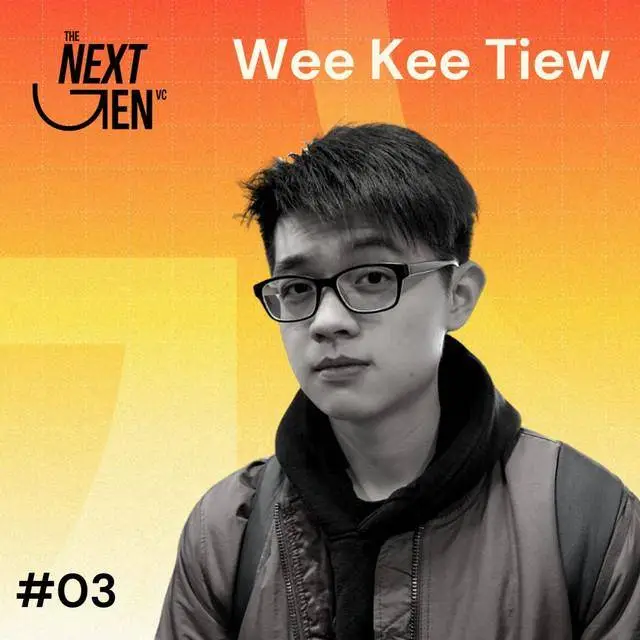
The entrepreneurial story doesn't end there. In 2024, Weekee Tiew, formerly of Boston Consulting Group, set his sights on AI. He previously founded the gaming guild PathDAO, which was valued at $600 million. However, the company hit rock bottom during the bear market, leaving him struggling to find a way forward. In 2024, he pivoted and launched Virtuals Protocol, focusing on the creation and distribution of AI agents.
 Source: LinkedIn

Virtuals Protocol's token $VIRTUAL hit a new high of over $4.5 billion in market capitalization in January 2025, becoming one of the most representative projects in the field of AI and Crypto integration.

It was not until Weekee Tiew became a hit and appeared on many podcasts that people were surprised to find out that it was actually a Malaysian project.

Not only that, Pendle, Jupiter, Aevo, and Drift are also from Malaysia.
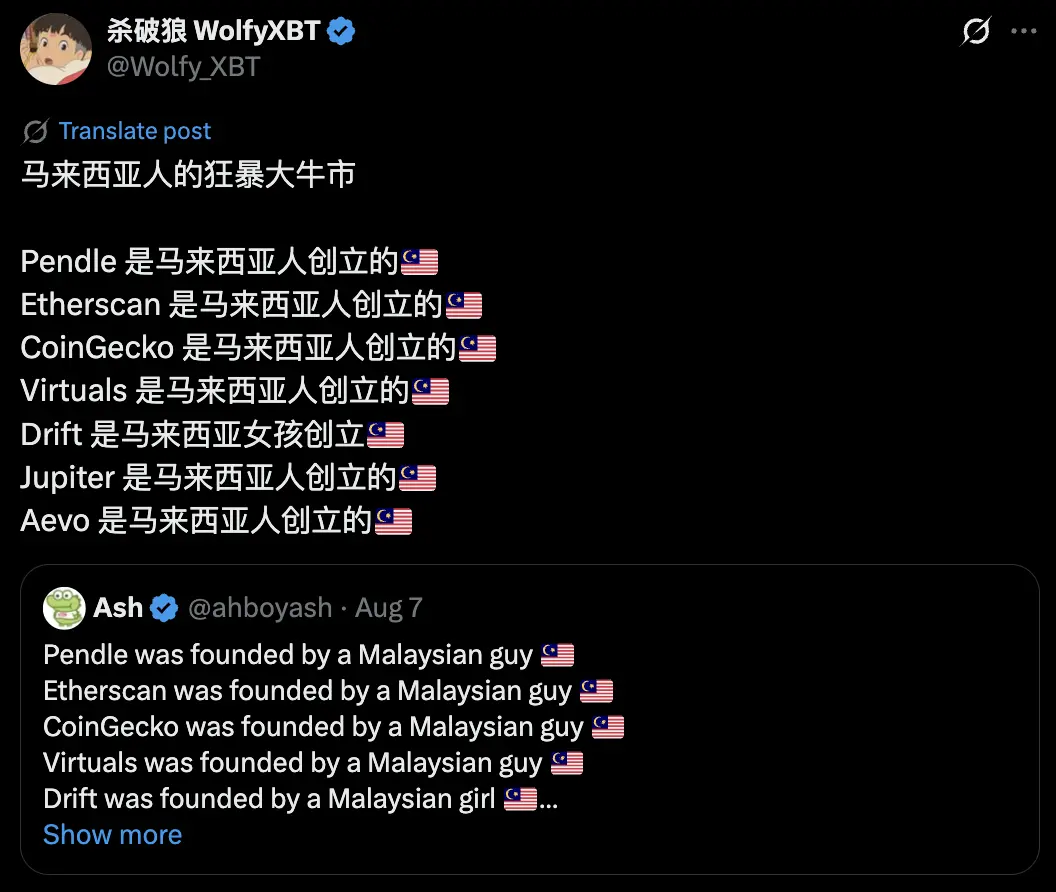
On Twitter, everyone seems to have reached a consensus that this cycle is a bull market for Malaysian entrepreneurship.

Bridge Builder

"I still have many Malaysian friends who don't talk much on social media."

Compared with well-known entrepreneurs, more Malaysian Chinese in the crypto industry are scattered in the industry like tendons and veins, stringing together flexible limbs, and their roles are like meridians, stringing together markets with different cultural backgrounds.

Malaysian Chinese are natural bridge builders.

Cova, a Malaysian Chinese, has been involved in the crypto industry for five years. As she communicated more with practitioners from all over the world, she truly realized the unique advantages of Malaysian Chinese in the industry.

"I think Malaysian Chinese are natural customer service professionals. Normally, a Malaysian Chinese person speaks at least three languages, not including dialects - Chinese, Malay, and English. Some even speak Japanese and Korean."

Since kindergarten, they have lived in an environment where Chinese, English and Malay are intertwined. In addition to their different backgrounds, they also speak Cantonese, Teochew, Hakka... This "multi-threaded" language ability allows them to thrive in the team - they can follow hot trends in Europe and the United States, take care of the Southeast Asian market, cooperate with international teams, and connect with customers from all over the world.

This linguistic talent is particularly valuable in the crypto world. Virtuals Protocol founder Weekee Tiew can demonstrate to European and American listeners in his English podcast how Virtuals truly integrates AI and crypto, and he can also directly explain Virtuals' grand vision to Chinese audiences at offline events. This multilingual ability allows him to simultaneously serve developer communities from diverse cultural backgrounds.

At the intersection of cultures, Cova also believes that Malaysian Chinese and Singaporeans will integrate faster.

"For example, Malaysian Chinese and Singaporeans are quick to assimilate and understand American projects, meme culture, and cultures from lesser-known countries."

The cultural DNA of Malaysian Chinese is like a master key, opening the door to multiple international markets.

However, this unique multilingual advantage also brings an unexpected side effect: the blurring of identity.

Whenever Malaysian Chinese start their own Twitter accounts or create crypto projects, they face a crucial decision: should they use English or Chinese as the primary medium of communication? This choice often determines the audience and market scope they can reach.

A typical example is that if you didn’t specify, you might be hard to guess that the well-known Chinese KOL @Wolfy_XBT is actually Malaysian Chinese. Similarly, well-known English KOLs @ahboyash and @sandraaleow are also from Malaysia.

More importantly, in order to gain wider recognition and acceptance in the global market, many Malaysian Chinese entrepreneurs will intentionally or unintentionally downplay their regional identity. They hope that their products will be seen as "international" solutions rather than projects from a specific country.

This strategy is often smart business-wise, but it also leads to an unfortunate consequence: most users have no idea that these world-changing products actually come from Malaysia.

When you use Etherscan to query Ethereum transactions, you may not think that this is the work of a Malaysian Chinese team; when you trade tokens on Jupiter, when you study Pendle's profit strategy, you may be more likely to think that this is the masterpiece of an elite European and American team.

Their "invisible" identity precisely illustrates the adaptability of Malaysian Chinese in the context of globalization, but it also reflects their complex situation in identity recognition and market positioning.

Behind this blurred identity lies a deeper problem: brain drain.

Many Malaysian Chinese have chosen to leave their homeland to pursue careers. This fertile land continues to cultivate batches of talent, but due to various practical factors, whether it is the policy environment, market size, or the degree of internationalization, these talents are often forced to flow to overseas markets.

They shine brightly on the global stage, yet few know their true origins. This "invisible success" illustrates the adaptability of Malaysian Chinese in the context of globalization, but also the price this group has paid for globalization.

They are the best bridge builders, but also the builders whose identities are most easily forgotten.

Changemaker

Seriousness, practicality, and contentment are the common traits of most Malaysian Chinese. They rarely publicize their achievements on social media, preferring to let their solid work speak for itself.

This low-key personality trait is deeply connected to their historical experiences.

During the "Southeast Asia" migration of the late Qing Dynasty, Chinese people migrated from China's southeastern coastal areas to the Malay Peninsula. Faced with a completely unfamiliar environment and culture, they relied on diligence and ingenuity to find a place to survive within the British colonial economy. However, even though they achieved commercial success through their efforts, the colonial government's "divide and rule" policy consistently excluded Chinese people from political power.

After Malaysia's independence in 1957, the political ideology of "Malay supremacy" and the subsequent implementation of the New Economic Policy further restricted opportunities for Chinese in education, employment, and business through a quota system. University admissions were limited, government jobs were restricted, and even starting a business faced various policy barriers.

This long-term institutional pressure has shaped the unique survival philosophy of the Chinese in Malaysia: since they cannot change the broader environment, they focus on doing well in the things they can control. They have learned to survive in the cracks, to prove their worth through their own strength, and to remain resilient in the face of adversity.

“Malaysian Chinese have always been oppressed by policies, so most of them just keep their heads down and work hard, just to make money.”

This resilience, fostered by these past experiences, has become a distinct advantage in the challenging crypto industry. When the market plummets, they don't panic; when projects encounter difficulties, they find solutions rather than complain; and when opportunities arise, they quietly seize them rather than hype them up.

However, the process of focusing on work, making profits from pursuing dreams, proving strength through successful projects, and changing the outside world's inherent impression of the Malaysian Chinese community is not smooth sailing.

Early on, Malaysian crypto projects had a less than favorable reputation, with many suspected of market manipulation and pyramid schemes. Cova noted that Malaysian Chinese were easily perceived by partners as "sponsors" of the project, a bias that created an additional cost of trust when establishing a business.

The formation of this negative impression has historical roots.

Malaysia's lack of early fintech regulation created numerous gray areas, allowing some criminals to exploit these gaps to engage in illegal fundraising and fraud. Many projects touted as "blockchain innovation" profited from repeated losses, harming investors and casting a shadow over Malaysia's tech startup ecosystem.

Worse still, these negative stories often spread faster and more widely than positive ones. When people hear the term "Malaysian project," their first reaction might not be technological innovation but rather "beware of being ripped off." This stereotype has become an invisible obstacle that all Chinese Malaysian entrepreneurs must face.

But times are changing. The global success of projects like CoinGecko, Etherscan, Pendle, Jupiter, and Virtuals Protocol is putting high-quality Malaysian projects in the spotlight on the international stage, gradually improving global users' perception of Malaysian tech projects.

"I think these down-to-earth builders have also proved in the past two or three bull markets that they are not the stereotypical project parties who play the pyramid game, but that they are big international projects at the first try." said a Malaysian Chinese practitioner.

Across cycles, this shadow army has been doing its thing in the industry, building businesses, building bridges, and realizing dreams... until they are seen, until they are recognized, or "just make money."

Market Opportunity
B Logo
B Price(B)
$0.21069
$0.21069$0.21069
+2.51%
USD
B (B) Live Price Chart
Disclaimer: The articles reposted on this site are sourced from public platforms and are provided for informational purposes only. They do not necessarily reflect the views of MEXC. All rights remain with the original authors. If you believe any content infringes on third-party rights, please contact service@support.mexc.com for removal. MEXC makes no guarantees regarding the accuracy, completeness, or timeliness of the content and is not responsible for any actions taken based on the information provided. The content does not constitute financial, legal, or other professional advice, nor should it be considered a recommendation or endorsement by MEXC.

You May Also Like

Gold Hits $3,700 as Sprott’s Wong Says Dollar’s Store-of-Value Crown May Slip

Gold Hits $3,700 as Sprott’s Wong Says Dollar’s Store-of-Value Crown May Slip

The post Gold Hits $3,700 as Sprott’s Wong Says Dollar’s Store-of-Value Crown May Slip appeared on BitcoinEthereumNews.com. Gold is strutting its way into record territory, smashing through $3,700 an ounce Wednesday morning, as Sprott Asset Management strategist Paul Wong says the yellow metal may finally snatch the dollar’s most coveted role: store of value. Wong Warns: Fiscal Dominance Puts U.S. Dollar on Notice, Gold on Top Gold prices eased slightly to $3,678.9 […] Source: https://news.bitcoin.com/gold-hits-3700-as-sprotts-wong-says-dollars-store-of-value-crown-may-slip/
Share
BitcoinEthereumNews2025/09/18 00:33
ZKP’s Proof Generation Edge: The $100M Privacy Layer DOGE and XRP Don’t Have

ZKP’s Proof Generation Edge: The $100M Privacy Layer DOGE and XRP Don’t Have

Dogecoin, XRP, and ZKP represent three very different bets for the next cycle,  and the market is already separating speculation from structure. The Dogecoin price
Share
Blockonomi2026/01/22 01:00
Why The Green Bay Packers Must Take The Cleveland Browns Seriously — As Hard As That Might Be

Why The Green Bay Packers Must Take The Cleveland Browns Seriously — As Hard As That Might Be

The post Why The Green Bay Packers Must Take The Cleveland Browns Seriously — As Hard As That Might Be appeared on BitcoinEthereumNews.com. Jordan Love and the Green Bay Packers are off to a 2-0 start. Getty Images The Green Bay Packers are, once again, one of the NFL’s better teams. The Cleveland Browns are, once again, one of the league’s doormats. It’s why unbeaten Green Bay (2-0) is a 8-point favorite at winless Cleveland (0-2) Sunday according to betmgm.com. The money line is also Green Bay -500. Most expect this to be a Packers’ rout, and it very well could be. But Green Bay knows taking anyone in this league for granted can prove costly. “I think if you look at their roster, the paper, who they have on that team, what they can do, they got a lot of talent and things can turn around quickly for them,” Packers safety Xavier McKinney said. “We just got to kind of keep that in mind and know we not just walking into something and they just going to lay down. That’s not what they going to do.” The Browns certainly haven’t laid down on defense. Far from. Cleveland is allowing an NFL-best 191.5 yards per game. The Browns gave up 141 yards to Cincinnati in Week 1, including just seven in the second half, but still lost, 17-16. Cleveland has given up an NFL-best 45.5 rushing yards per game and just 2.1 rushing yards per attempt. “The biggest thing is our defensive line is much, much improved over last year and I think we’ve got back to our personality,” defensive coordinator Jim Schwartz said recently. “When we play our best, our D-line leads us there as our engine.” The Browns rank third in the league in passing defense, allowing just 146.0 yards per game. Cleveland has also gone 30 straight games without allowing a 300-yard passer, the longest active streak in the NFL.…
Share
BitcoinEthereumNews2025/09/18 00:41