The post Market mood sours as investors reassess Fed rate outlook appeared on BitcoinEthereumNews.com. Here is what you need to know on Tuesday, November 18: Safe-haven flows dominate the financial markets early Tuesday as investors adopt a cautious stance amid the uncertainty created by the US data backlog and easing bets of a Federal Reserve (Fed) rate cut in December. The economic calendar will feature weekly ADP Employment Change data and several Fed policymakers will be delivering speeches during the American trading hours. The risk-averse market atmosphere, as reflected by the bearish action seen in Wall Street’s main indexes, helped the US Dollar (USD) gather strength against its rivals on Monday. The USD Index rose nearly 0.3%, while the S&P 500 and the Nasdaq Composite lost 0.9% and 0.8%, respectively. Early Tuesday, the USD Index stays in a consolidation phase near 99.50 and US stock index futures are down between 0.3% and 0.6%. US Dollar Price This week The table below shows the percentage change of US Dollar (USD) against listed major currencies this week. US Dollar was the strongest against the Australian Dollar. USD EUR GBP JPY CAD AUD NZD CHF USD 0.20% 0.00% 0.20% 0.19% 0.86% 0.44% -0.02% EUR -0.20% -0.09% 0.36% 0.00% 0.65% 0.25% -0.21% GBP -0.00% 0.09% 0.20% 0.10% 0.74% 0.34% -0.11% JPY -0.20% -0.36% -0.20% 0.01% 0.67% 0.24% -0.24% CAD -0.19% -0.01% -0.10% -0.01% 0.67% 0.23% -0.21% AUD -0.86% -0.65% -0.74% -0.67% -0.67% -0.39% -0.83% NZD -0.44% -0.25% -0.34% -0.24% -0.23% 0.39% -0.45% CHF 0.02% 0.21% 0.11% 0.24% 0.21% 0.83% 0.45% The heat map shows percentage changes of major currencies against each other. The base currency is picked from the left column, while the quote currency is picked from the top row. For example, if you pick the US Dollar from the left column and move along the horizontal line to the Japanese Yen, the percentage change displayed in… The post Market mood sours as investors reassess Fed rate outlook appeared on BitcoinEthereumNews.com. Here is what you need to know on Tuesday, November 18: Safe-haven flows dominate the financial markets early Tuesday as investors adopt a cautious stance amid the uncertainty created by the US data backlog and easing bets of a Federal Reserve (Fed) rate cut in December. The economic calendar will feature weekly ADP Employment Change data and several Fed policymakers will be delivering speeches during the American trading hours. The risk-averse market atmosphere, as reflected by the bearish action seen in Wall Street’s main indexes, helped the US Dollar (USD) gather strength against its rivals on Monday. The USD Index rose nearly 0.3%, while the S&P 500 and the Nasdaq Composite lost 0.9% and 0.8%, respectively. Early Tuesday, the USD Index stays in a consolidation phase near 99.50 and US stock index futures are down between 0.3% and 0.6%. US Dollar Price This week The table below shows the percentage change of US Dollar (USD) against listed major currencies this week. US Dollar was the strongest against the Australian Dollar. USD EUR GBP JPY CAD AUD NZD CHF USD 0.20% 0.00% 0.20% 0.19% 0.86% 0.44% -0.02% EUR -0.20% -0.09% 0.36% 0.00% 0.65% 0.25% -0.21% GBP -0.00% 0.09% 0.20% 0.10% 0.74% 0.34% -0.11% JPY -0.20% -0.36% -0.20% 0.01% 0.67% 0.24% -0.24% CAD -0.19% -0.01% -0.10% -0.01% 0.67% 0.23% -0.21% AUD -0.86% -0.65% -0.74% -0.67% -0.67% -0.39% -0.83% NZD -0.44% -0.25% -0.34% -0.24% -0.23% 0.39% -0.45% CHF 0.02% 0.21% 0.11% 0.24% 0.21% 0.83% 0.45% The heat map shows percentage changes of major currencies against each other. The base currency is picked from the left column, while the quote currency is picked from the top row. For example, if you pick the US Dollar from the left column and move along the horizontal line to the Japanese Yen, the percentage change displayed in…

Market mood sours as investors reassess Fed rate outlook

Here is what you need to know on Tuesday, November 18:

Safe-haven flows dominate the financial markets early Tuesday as investors adopt a cautious stance amid the uncertainty created by the US data backlog and easing bets of a Federal Reserve (Fed) rate cut in December. The economic calendar will feature weekly ADP Employment Change data and several Fed policymakers will be delivering speeches during the American trading hours.

The risk-averse market atmosphere, as reflected by the bearish action seen in Wall Street’s main indexes, helped the US Dollar (USD) gather strength against its rivals on Monday. The USD Index rose nearly 0.3%, while the S&P 500 and the Nasdaq Composite lost 0.9% and 0.8%, respectively. Early Tuesday, the USD Index stays in a consolidation phase near 99.50 and US stock index futures are down between 0.3% and 0.6%.

US Dollar Price This week

The table below shows the percentage change of US Dollar (USD) against listed major currencies this week. US Dollar was the strongest against the Australian Dollar.

USDEURGBPJPYCADAUDNZDCHF
USD0.20%0.00%0.20%0.19%0.86%0.44%-0.02%
EUR-0.20%-0.09%0.36%0.00%0.65%0.25%-0.21%
GBP-0.00%0.09%0.20%0.10%0.74%0.34%-0.11%
JPY-0.20%-0.36%-0.20%0.01%0.67%0.24%-0.24%
CAD-0.19%-0.01%-0.10%-0.01%0.67%0.23%-0.21%
AUD-0.86%-0.65%-0.74%-0.67%-0.67%-0.39%-0.83%
NZD-0.44%-0.25%-0.34%-0.24%-0.23%0.39%-0.45%
CHF0.02%0.21%0.11%0.24%0.21%0.83%0.45%

The heat map shows percentage changes of major currencies against each other. The base currency is picked from the left column, while the quote currency is picked from the top row. For example, if you pick the US Dollar from the left column and move along the horizontal line to the Japanese Yen, the percentage change displayed in the box will represent USD (base)/JPY (quote).

The minutes of the Reserve Bank of Australia’s (RBA) November monetary policy meeting showed on Tuesday that policymakers would be comfortable keeping the policy rate unchanged for longer if incoming data prove to be stronger than expected. However, policymakers could also consider easing the policy further is growth weakens, according to the publication. After losing more than 0.6% on Monday, AUD/USD stays on the back foot and trades in negative territory below 0.6500 in the European morning on Tuesday.

Japan’s Finance Minister Satsuki Katayama said on Tuesday that the government’s upcoming economic stimulus package has become “sizable,” but declined to disclose its exact scale. USD/JPY holds steady at around 155.00 after touching its highest level since February near 155.40 earlier in the Asian session.

The data from Canada showed on Monday that the annual inflation, as measured by the change in the Consumer Price Index (CPI), softened to 2.2% in October from 2.4% in September. USD/CAD trades in a tight range at around 1.4050 in the European session on Tuesday.

EUR/USD fell about 0.3% on Monday and closed the second consecutive day in negative territory. The pair moves sideways at around 1.1600 in the European morning.

Gold declined for the third consecutive trading day on Monday and closed below $4,100. XAU/USD remains under bearish pressure and falls toward $4,000.

Fed FAQs

Monetary policy in the US is shaped by the Federal Reserve (Fed). The Fed has two mandates: to achieve price stability and foster full employment. Its primary tool to achieve these goals is by adjusting interest rates.
When prices are rising too quickly and inflation is above the Fed’s 2% target, it raises interest rates, increasing borrowing costs throughout the economy. This results in a stronger US Dollar (USD) as it makes the US a more attractive place for international investors to park their money.
When inflation falls below 2% or the Unemployment Rate is too high, the Fed may lower interest rates to encourage borrowing, which weighs on the Greenback.

The Federal Reserve (Fed) holds eight policy meetings a year, where the Federal Open Market Committee (FOMC) assesses economic conditions and makes monetary policy decisions.
The FOMC is attended by twelve Fed officials – the seven members of the Board of Governors, the president of the Federal Reserve Bank of New York, and four of the remaining eleven regional Reserve Bank presidents, who serve one-year terms on a rotating basis.

In extreme situations, the Federal Reserve may resort to a policy named Quantitative Easing (QE). QE is the process by which the Fed substantially increases the flow of credit in a stuck financial system.
It is a non-standard policy measure used during crises or when inflation is extremely low. It was the Fed’s weapon of choice during the Great Financial Crisis in 2008. It involves the Fed printing more Dollars and using them to buy high grade bonds from financial institutions. QE usually weakens the US Dollar.

Quantitative tightening (QT) is the reverse process of QE, whereby the Federal Reserve stops buying bonds from financial institutions and does not reinvest the principal from the bonds it holds maturing, to purchase new bonds. It is usually positive for the value of the US Dollar.

Source: https://www.fxstreet.com/news/forex-today-market-mood-sours-as-investors-reassess-fed-rate-outlook-202511180639

Market Opportunity
Safe Token Logo
Safe Token Price(SAFE)
$0.1062
$0.1062$0.1062
-0.09%
USD
Safe Token (SAFE) Live Price Chart
Disclaimer: The articles reposted on this site are sourced from public platforms and are provided for informational purposes only. They do not necessarily reflect the views of MEXC. All rights remain with the original authors. If you believe any content infringes on third-party rights, please contact service@support.mexc.com for removal. MEXC makes no guarantees regarding the accuracy, completeness, or timeliness of the content and is not responsible for any actions taken based on the information provided. The content does not constitute financial, legal, or other professional advice, nor should it be considered a recommendation or endorsement by MEXC.

You May Also Like

Tom Lee’s BitMine approaches 50% of goal to hold 5% Ethereum supply

Tom Lee’s BitMine approaches 50% of goal to hold 5% Ethereum supply

The post Tom Lee’s BitMine approaches 50% of goal to hold 5% Ethereum supply appeared on BitcoinEthereumNews.com. Key Takeaways Tom Lee’s Bitmine Immersion (BMNR) have reached nearly 50% of their goal to hold 5% of Ethereum’s total supply. BMNR has been steadily increasing its Ethereum holdings by buying during market dips, reflecting an institutional acquisition strategy. Tom Lee-led Bitmine Immersion (BMNR) is approaching 50% of its goal to hold 5% of Ethereum’s total supply. BMNR has been methodically increasing its Ethereum holdings through targeted purchases during market dips, aligning with Lee’s vision of positioning the company as a major institutional holder of the asset. Lee’s approach with BMNR mirrors strategies seen in other crypto-focused firms, emphasizing Ethereum as a key reserve asset amid growing regulatory clarity in the US. Ethereum remains a dominant blockchain network increasingly adopted by institutions for its smart contract capabilities and layer 2 scaling solutions. Source: https://cryptobriefing.com/tom-lee-bmnr-ethereum-treasury-strategy/
Share
BitcoinEthereumNews2025/10/03 08:46
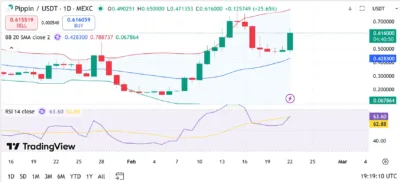
Pippin (PIPPIN) Price Prediction 2026–2030: Can PIPPIN Hit $0.70 Soon?

Pippin (PIPPIN) Price Prediction 2026–2030: Can PIPPIN Hit $0.70 Soon?

PIPPIN has surged sharply on the daily timeframe, printing a powerful bullish candle with over 25% gains. RSI is holding above 60, signaling strengthening momentum
Share
Coinstats2026/02/23 04:29
‘Love Island Games’ Season 2 Release Schedule—When Do New Episodes Come Out?

‘Love Island Games’ Season 2 Release Schedule—When Do New Episodes Come Out?

The post ‘Love Island Games’ Season 2 Release Schedule—When Do New Episodes Come Out? appeared on BitcoinEthereumNews.com. LOVE ISLAND GAMES — Episode 201 — Pictured: Ariana Madix — (Photo by: Ben Symons/PEACOCK via Getty Images) Ben Symons/PEACOCK via Getty Images We’ve got a text! It’s time for another season of Love Island Games. With fan-favorites returning in hopes of winning the $250,000 cash prize, read on to learn more about Love Island Games Season 2, including the release schedule so you don’t miss a second of drama. Love Island Games is a spinoff in the Love Island franchise that first premiered in 2023. The show follows a similar format to the original series, but with one major twist: all contestants are returning Islanders from previous seasons of Love Island from around the world, including the USA, UK, Australia and more. Another big difference is that games take on much more importance in Love Island Games than the mothership version, with the results “determining advantages, risks, and even who stays and who goes,” according to Peacock. Vanderpump Rules star Ariana Madix is taking over hosting duties for Love Island Games Season 2, replacing Love Island UK star Maya Jama who hosted the first season. Iain Stirling returns as the show’s narrator, while UK alum Maura Higgins will continue to host the Saturday show Love Island: Aftersun. ForbesWho’s In The ‘Love Island Games’ Season 2 Cast? Meet The IslandersBy Monica Mercuri Jack Fowler and Justine Ndiba were named the first-ever winners of Love Island Games in 2023. Justine had previously won Love Island USA Season 2 with Caleb Corprew, while Jack was a contestant on Love Island UK Season 4. In March 2024, Fowler announced on his Instagram story that he and Justine decided to remain “just friends.” The Season 2 premiere revealed the first couples of the season: Andrea Carmona and Charlie Georgios, Andreina Santos-Marte and Tyrique Hyde,…
Share
BitcoinEthereumNews2025/09/18 04:50