A new pricing model from Diana, a crypto analyst on X, projects that XRP could climb into the $7–$24 range within 60 days of the ETF launch, driven strictly by inflow pressure and the asset’s constrained liquid supply. The model reportedly relies on supply-absorption math, revealing how ETF-driven demand could shift XRP’s market pricing once XRP ETFs go live. New XRP ETF Inflow Model Maps A Direct Route To $24 Diana’s newly released “XRP ETF Launch Impact Model” outlines a clear, data-driven view on how ETF inflows alone could reprice XRP. Her framework tests multiple launch scenarios involving five to twenty ETFs, each seeded with $10 million to $45 million. Depending on the scale, total inflows range from $50 million to $900 million, absorbing between 0.08% and 1.50% of XRP’s estimated 60-billion-unit liquid supply. Related Reading: Here’s Why The Ethereum Price Is Crashing Again, Can It Breach $3,000? According to Diana’s projections, this level of liquidity absorption pushes XRP into a thirty-day range of $3.00 to $15.00, with the sixty-day window stretching from $3.80 up to $24.00. The top end of the model—where XRP approaches $24—emerges when twenty ETFs launch with maximum seed capital and nearly a billion dollars in early inflows. Diana argues that as issuers acquire XRP to build underlying exposure, the available float tightens, and the resulting supply squeeze forces a natural repricing cycle. However, XRP’s real-time price action tells a different story. Despite the successful debut of the Canary XRP ETF, XRP has failed to respond positively. The latest market data shows the asset trading near $2.14, posting a 13.5% decline over the week. Even so, Diana maintains that early price weakness is typical during ETF rollout phases and believes the projected inflow dynamics still position XRP for a sharp upward revaluation once institutional allocations begin to materialize. The Market Structure Delaying XRP’s Next Major Rally In a separate post, Diana outlined the market pattern she believes has been driving XRP’s recent price behavior. According to her, traders typically buy ahead of an ETF launch to front-run expected demand, creating a pre-launch rally driven by speculation rather than institutional activity. Once the ETF goes live, those early buyers take profit, producing the sharp launch-day dip that often surprises retail investors. Related Reading: What Will Trigger The XRP 1,300% Break To $36 This Bull Cycle? Diana noted that institutional inflows never arrive on day one. Wealth managers move through compliance checks, committee approvals, and allocation cycles, meaning real capital enters the market weeks later. She pointed to Bitcoin’s January 2024 ETF rollout as the clearest example, where the asset fell at launch but later surged to new highs as regulated inflows matured. She argues that XRP is showing the same early-stage pattern now: a weak market following the Canary ETF launch, profit-taking, and a temporary cooling phase. When these delayed inflows eventually begin to accumulate, Diana maintains that they will reinforce an upward pricing dynamic for XRP’s next major climb. Featured image created with Dall.E, chart from Tradingview.comA new pricing model from Diana, a crypto analyst on X, projects that XRP could climb into the $7–$24 range within 60 days of the ETF launch, driven strictly by inflow pressure and the asset’s constrained liquid supply. The model reportedly relies on supply-absorption math, revealing how ETF-driven demand could shift XRP’s market pricing once XRP ETFs go live. New XRP ETF Inflow Model Maps A Direct Route To $24 Diana’s newly released “XRP ETF Launch Impact Model” outlines a clear, data-driven view on how ETF inflows alone could reprice XRP. Her framework tests multiple launch scenarios involving five to twenty ETFs, each seeded with $10 million to $45 million. Depending on the scale, total inflows range from $50 million to $900 million, absorbing between 0.08% and 1.50% of XRP’s estimated 60-billion-unit liquid supply. Related Reading: Here’s Why The Ethereum Price Is Crashing Again, Can It Breach $3,000? According to Diana’s projections, this level of liquidity absorption pushes XRP into a thirty-day range of $3.00 to $15.00, with the sixty-day window stretching from $3.80 up to $24.00. The top end of the model—where XRP approaches $24—emerges when twenty ETFs launch with maximum seed capital and nearly a billion dollars in early inflows. Diana argues that as issuers acquire XRP to build underlying exposure, the available float tightens, and the resulting supply squeeze forces a natural repricing cycle. However, XRP’s real-time price action tells a different story. Despite the successful debut of the Canary XRP ETF, XRP has failed to respond positively. The latest market data shows the asset trading near $2.14, posting a 13.5% decline over the week. Even so, Diana maintains that early price weakness is typical during ETF rollout phases and believes the projected inflow dynamics still position XRP for a sharp upward revaluation once institutional allocations begin to materialize. The Market Structure Delaying XRP’s Next Major Rally In a separate post, Diana outlined the market pattern she believes has been driving XRP’s recent price behavior. According to her, traders typically buy ahead of an ETF launch to front-run expected demand, creating a pre-launch rally driven by speculation rather than institutional activity. Once the ETF goes live, those early buyers take profit, producing the sharp launch-day dip that often surprises retail investors. Related Reading: What Will Trigger The XRP 1,300% Break To $36 This Bull Cycle? Diana noted that institutional inflows never arrive on day one. Wealth managers move through compliance checks, committee approvals, and allocation cycles, meaning real capital enters the market weeks later. She pointed to Bitcoin’s January 2024 ETF rollout as the clearest example, where the asset fell at launch but later surged to new highs as regulated inflows matured. She argues that XRP is showing the same early-stage pattern now: a weak market following the Canary ETF launch, profit-taking, and a temporary cooling phase. When these delayed inflows eventually begin to accumulate, Diana maintains that they will reinforce an upward pricing dynamic for XRP’s next major climb. Featured image created with Dall.E, chart from Tradingview.com

Model Shows How XRP Could Hit $24 After ETFs Go Live

2025/11/19 01:30

A new pricing model from Diana, a crypto analyst on X, projects that XRP could climb into the $7–$24 range within 60 days of the ETF launch, driven strictly by inflow pressure and the asset’s constrained liquid supply. The model reportedly relies on supply-absorption math, revealing how ETF-driven demand could shift XRP’s market pricing once XRP ETFs go live.

New XRP ETF Inflow Model Maps A Direct Route To $24

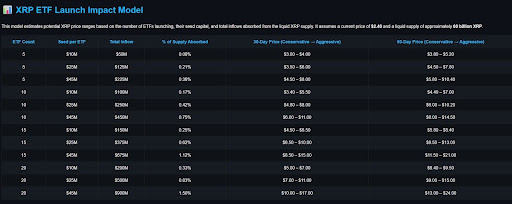
Diana’s newly released “XRP ETF Launch Impact Model” outlines a clear, data-driven view on how ETF inflows alone could reprice XRP. Her framework tests multiple launch scenarios involving five to twenty ETFs, each seeded with $10 million to $45 million. Depending on the scale, total inflows range from $50 million to $900 million, absorbing between 0.08% and 1.50% of XRP’s estimated 60-billion-unit liquid supply.
XRP ETFs

According to Diana’s projections, this level of liquidity absorption pushes XRP into a thirty-day range of $3.00 to $15.00, with the sixty-day window stretching from $3.80 up to $24.00. The top end of the model—where XRP approaches $24—emerges when twenty ETFs launch with maximum seed capital and nearly a billion dollars in early inflows. Diana argues that as issuers acquire XRP to build underlying exposure, the available float tightens, and the resulting supply squeeze forces a natural repricing cycle.

However, XRP’s real-time price action tells a different story. Despite the successful debut of the Canary XRP ETF, XRP has failed to respond positively. The latest market data shows the asset trading near $2.14, posting a 13.5% decline over the week. Even so, Diana maintains that early price weakness is typical during ETF rollout phases and believes the projected inflow dynamics still position XRP for a sharp upward revaluation once institutional allocations begin to materialize.

The Market Structure Delaying XRP’s Next Major Rally

In a separate post, Diana outlined the market pattern she believes has been driving XRP’s recent price behavior. According to her, traders typically buy ahead of an ETF launch to front-run expected demand, creating a pre-launch rally driven by speculation rather than institutional activity. Once the ETF goes live, those early buyers take profit, producing the sharp launch-day dip that often surprises retail investors.

Diana noted that institutional inflows never arrive on day one. Wealth managers move through compliance checks, committee approvals, and allocation cycles, meaning real capital enters the market weeks later. She pointed to Bitcoin’s January 2024 ETF rollout as the clearest example, where the asset fell at launch but later surged to new highs as regulated inflows matured.

She argues that XRP is showing the same early-stage pattern now: a weak market following the Canary ETF launch, profit-taking, and a temporary cooling phase. When these delayed inflows eventually begin to accumulate, Diana maintains that they will reinforce an upward pricing dynamic for XRP’s next major climb.

XRP price chart from Tradingview.com
Market Opportunity
XRP Logo
XRP Price(XRP)
$1.846
$1.846$1.846
-0.19%
USD
XRP (XRP) Live Price Chart
Disclaimer: The articles reposted on this site are sourced from public platforms and are provided for informational purposes only. They do not necessarily reflect the views of MEXC. All rights remain with the original authors. If you believe any content infringes on third-party rights, please contact service@support.mexc.com for removal. MEXC makes no guarantees regarding the accuracy, completeness, or timeliness of the content and is not responsible for any actions taken based on the information provided. The content does not constitute financial, legal, or other professional advice, nor should it be considered a recommendation or endorsement by MEXC.

You May Also Like

Will US Banks Soon Accept Stablecoin Interest?

Will US Banks Soon Accept Stablecoin Interest?

The post Will US Banks Soon Accept Stablecoin Interest? appeared on BitcoinEthereumNews.com. Coinbase CEO Brian Armstrong predicts US banks will reverse their stance
Share
BitcoinEthereumNews2025/12/27 22:36
ArtGis Finance Partners with MetaXR to Expand its DeFi Offerings in the Metaverse

ArtGis Finance Partners with MetaXR to Expand its DeFi Offerings in the Metaverse

By using this collaboration, ArtGis utilizes MetaXR’s infrastructure to widen access to its assets and enable its customers to interact with the metaverse.
Share
Blockchainreporter2025/09/18 00:07
BlackRock boosts AI and US equity exposure in $185 billion models

BlackRock boosts AI and US equity exposure in $185 billion models

The post BlackRock boosts AI and US equity exposure in $185 billion models appeared on BitcoinEthereumNews.com. BlackRock is steering $185 billion worth of model portfolios deeper into US stocks and artificial intelligence. The decision came this week as the asset manager adjusted its entire model suite, increasing its equity allocation and dumping exposure to international developed markets. The firm now sits 2% overweight on stocks, after money moved between several of its biggest exchange-traded funds. This wasn’t a slow shuffle. Billions flowed across multiple ETFs on Tuesday as BlackRock executed the realignment. The iShares S&P 100 ETF (OEF) alone brought in $3.4 billion, the largest single-day haul in its history. The iShares Core S&P 500 ETF (IVV) collected $2.3 billion, while the iShares US Equity Factor Rotation Active ETF (DYNF) added nearly $2 billion. The rebalancing triggered swift inflows and outflows that realigned investor exposure on the back of performance data and macroeconomic outlooks. BlackRock raises equities on strong US earnings The model updates come as BlackRock backs the rally in American stocks, fueled by strong earnings and optimism around rate cuts. In an investment letter obtained by Bloomberg, the firm said US companies have delivered 11% earnings growth since the third quarter of 2024. Meanwhile, earnings across other developed markets barely touched 2%. That gap helped push the decision to drop international holdings in favor of American ones. Michael Gates, lead portfolio manager for BlackRock’s Target Allocation ETF model portfolio suite, said the US market is the only one showing consistency in sales growth, profit delivery, and revisions in analyst forecasts. “The US equity market continues to stand alone in terms of earnings delivery, sales growth and sustainable trends in analyst estimates and revisions,” Michael wrote. He added that non-US developed markets lagged far behind, especially when it came to sales. This week’s changes reflect that position. The move was made ahead of the Federal…
Share
BitcoinEthereumNews2025/09/18 01:44