An exchange on X between Polygon’s CTO Mudit Gupta and Zcash founder Zooko Wilcox reignited a long-simmering debate over whether privacy-preserving shielded pools can be perfectly audited — and, by extension, whether ZEC’s 21 million cap can be trusted under all conceivable failure modes. The dispute hinged on a familiar fault line in privacy-coin design: […]An exchange on X between Polygon’s CTO Mudit Gupta and Zcash founder Zooko Wilcox reignited a long-simmering debate over whether privacy-preserving shielded pools can be perfectly audited — and, by extension, whether ZEC’s 21 million cap can be trusted under all conceivable failure modes. The dispute hinged on a familiar fault line in privacy-coin design: […]

Polygon CTO Vs. Zcash: Clash Erupts Over 21 Million Coin Integrity

An exchange on X between Polygon’s CTO Mudit Gupta and Zcash founder Zooko Wilcox reignited a long-simmering debate over whether privacy-preserving shielded pools can be perfectly audited — and, by extension, whether ZEC’s 21 million cap can be trusted under all conceivable failure modes. The dispute hinged on a familiar fault line in privacy-coin design: zero-knowledge protocols can obfuscate individual balances and flows, but they still must preserve a hard monetary base.

Polygon CTO Attacks Zcash

Gupta opened with a stark framing: “Nobody knows how many Zcash tokens actually exist. Shielded assets like Zcash are hard to audit. In March 2019, an infinite mint bug was detected in Zcash shielded assets. It was fixed in October 2019 but there is no guaranteed way to tell if the bug was ever exploited.”

He later softened the immediate risk assessment — “Based on heuristic, it’s unlikely the bug was exploited so no reason to panic” — while stressing what he called an enduring category risk: “I’m just highlighting an attack vector with Zcash and similar privacy pools… I’m not claiming any bug was exploited, just mentioning the possibility and risk.”

Wilcox pushed back, calling the initial post “not accurate,” and pointed Gupta to “publicly-verifiable on-chain audits” that track the monetary base. “They show the integrity of the Zcash monetary base. A straightforward game-theoretic analysis further shows zero counterfeiting,” he wrote, linking to community dashboards and documentation.

In a follow-on, Wilcox encapsulated the ZEC position with a thought experiment about the legacy Sprout pool: “Suppose someone counterfeited ZEC in the Sprout pool before October 28, 2018. Then there is a ‘race to the exits’ between the counterfeiter and his victims. Whoever moves their ZEC out of the Sprout pool first gets to keep all the money. Conclusion: there was no counterfeiting.” He added that “even if there was counterfeiting… there would still be only 16,355,911 ZEC in existence, and still only 21 M ever. Thanks, turnstiles!”

Stripped to its essentials, the technical disagreement is less about Zcash’s intended monetary policy and more about the edge-case guarantees when privacy meets auditability. Zcash’s published economics mirror Bitcoin’s: a fixed 21 million upper bound and a halving-style issuance schedule. That cap is unambiguous in official materials.

The Backstory

The controversy traces back to the counterfeiting vulnerability affecting ZEC’s earliest shielded pool, Sprout. According to the Electric Coin Company (ECC) and the Zcash Foundation, the flaw was discovered privately in 2018 and publicly disclosed on February 5, 2019; critically, the Sapling upgrade that activated on October 28, 2018 removed the vulnerable construction, and Zcash introduced “turnstile” accounting to constrain exits from shielded pools to, at most, the amount verifiably entered.

ECC reported at disclosure that it had seen “no evidence that counterfeiting has occurred,” a stance it has reiterated, and it described turnstile enforcement as a defense to preserve the monetary base even under hypothetical counterfeiting.

This is the heart of Wilcox’s argument. Because ZEC can only enter or leave a shielded pool via transfers that reveal values at the boundary, the chain can compute an expected pool balance. If more value tries to exit than has ever entered, the discrepancy becomes observable at the turnstile.

The “race to the exits” intuition — while informal — captures the idea that any attacker who minted bogus ZEC inside Sprout would be competing against legitimate holders to withdraw before the turnstile constraint bites; absent an unexplained drain to zero or a negative reconciliation, long-lived counterfeiting is inconsistent with observed pool totals. Zcash’s documentation describes these value-pool turnstiles and their role in monitoring pool integrity, and community discussions dating back years have treated them as the canonical mitigation.

Gupta’s rejoinder is about epistemic certainty, not policy intent. “Perhaps I should have been clearer,” he wrote. “Due to [the] possibility of bugs, there’s no guarantee that the shielded pools have the same amount of Zcash circulating inside them as transparent Zcash that went in. Therefore, you can’t be 100% sure of the actual total supply… [though] the likelihood of a bug like this being exploited is essentially 0.”

At press time, ZEC traded at $325.
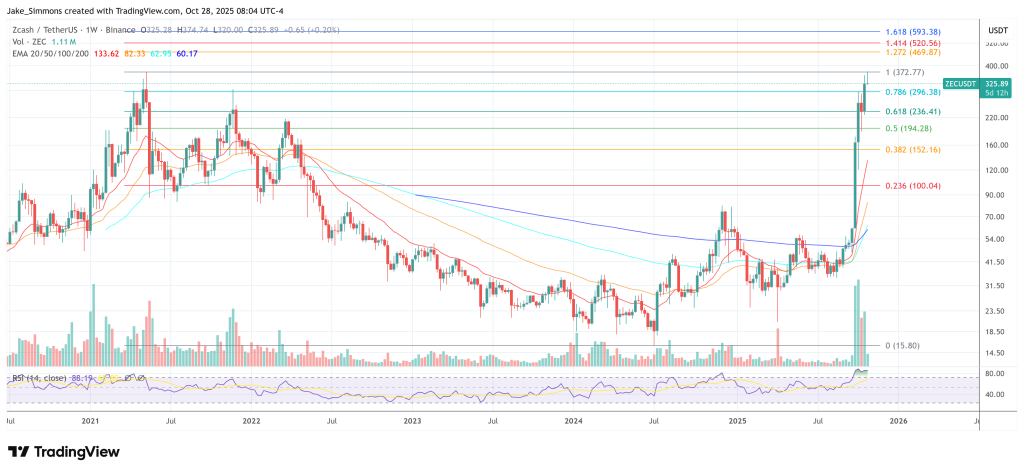
Zcash price
Market Opportunity
Clash Logo
Clash Price(CLASH)
$0.041295
$0.041295$0.041295
+1.19%
USD
Clash (CLASH) Live Price Chart
Disclaimer: The articles reposted on this site are sourced from public platforms and are provided for informational purposes only. They do not necessarily reflect the views of MEXC. All rights remain with the original authors. If you believe any content infringes on third-party rights, please contact service@support.mexc.com for removal. MEXC makes no guarantees regarding the accuracy, completeness, or timeliness of the content and is not responsible for any actions taken based on the information provided. The content does not constitute financial, legal, or other professional advice, nor should it be considered a recommendation or endorsement by MEXC.

You May Also Like

Is Doge Losing Steam As Traders Choose Pepeto For The Best Crypto Investment?

Is Doge Losing Steam As Traders Choose Pepeto For The Best Crypto Investment?

The post Is Doge Losing Steam As Traders Choose Pepeto For The Best Crypto Investment? appeared on BitcoinEthereumNews.com. Crypto News 17 September 2025 | 17:39 Is dogecoin really fading? As traders hunt the best crypto to buy now and weigh 2025 picks, Dogecoin (DOGE) still owns the meme coin spotlight, yet upside looks capped, today’s Dogecoin price prediction says as much. Attention is shifting to projects that blend culture with real on-chain tools. Buyers searching “best crypto to buy now” want shipped products, audits, and transparent tokenomics. That frames the true matchup: dogecoin vs. Pepeto. Enter Pepeto (PEPETO), an Ethereum-based memecoin with working rails: PepetoSwap, a zero-fee DEX, plus Pepeto Bridge for smooth cross-chain moves. By fusing story with tools people can use now, and speaking directly to crypto presale 2025 demand, Pepeto puts utility, clarity, and distribution in front. In a market where legacy meme coin leaders risk drifting on sentiment, Pepeto’s execution gives it a real seat in the “best crypto to buy now” debate. First, a quick look at why dogecoin may be losing altitude. Dogecoin Price Prediction: Is Doge Really Fading? Remember when dogecoin made crypto feel simple? In 2013, DOGE turned a meme into money and a loose forum into a movement. A decade on, the nonstop momentum has cooled; the backdrop is different, and the market is far more selective. With DOGE circling ~$0.268, the tape reads bearish-to-neutral for the next few weeks: hold the $0.26 shelf on daily closes and expect choppy range-trading toward $0.29–$0.30 where rallies keep stalling; lose $0.26 decisively and momentum often bleeds into $0.245 with risk of a deeper probe toward $0.22–$0.21; reclaim $0.30 on a clean daily close and the downside bias is likely neutralized, opening room for a squeeze into the low-$0.30s. Source: CoinMarketcap / TradingView Beyond the dogecoin price prediction, DOGE still centers on payments and lacks native smart contracts; ZK-proof verification is proposed,…
Share
BitcoinEthereumNews2025/09/18 00:14
Fed Decides On Interest Rates Today—Here’s What To Watch For

Fed Decides On Interest Rates Today—Here’s What To Watch For

The post Fed Decides On Interest Rates Today—Here’s What To Watch For appeared on BitcoinEthereumNews.com. Topline The Federal Reserve on Wednesday will conclude a two-day policymaking meeting and release a decision on whether to lower interest rates—following months of pressure and criticism from President Donald Trump—and potentially signal whether additional cuts are on the way. President Donald Trump has urged the central bank to “CUT INTEREST RATES, NOW, AND BIGGER” than they might plan to. Getty Images Key Facts The central bank is poised to cut interest rates by at least a quarter-point, down from the 4.25% to 4.5% range where they have been held since December to between 4% and 4.25%, as Wall Street has placed 100% odds of a rate cut, according to CME’s FedWatch, with higher odds (94%) on a quarter-point cut than a half-point (6%) reduction. Fed governors Christopher Waller and Michelle Bowman, both Trump appointees, voted in July for a quarter-point reduction to rates, and they may dissent again in favor of a large cut alongside Stephen Miran, Trump’s Council of Economic Advisers’ chair, who was sworn in at the meeting’s start on Tuesday. It’s unclear whether other policymakers, including Kansas City Fed President Jeffrey Schmid and St. Louis Fed President Alberto Musalem, will favor larger cuts or opt for no reduction. Fed Chair Jerome Powell said in his Jackson Hole, Wyoming, address last month the central bank would likely consider a looser monetary policy, noting the “shifting balance of risks” on the U.S. economy “may warrant adjusting our policy stance.” David Mericle, an economist for Goldman Sachs, wrote in a note the “key question” for the Fed’s meeting is whether policymakers signal “this is likely the first in a series of consecutive cuts” as the central bank is anticipated to “acknowledge the softening in the labor market,” though they may not “nod to an October cut.” Mericle said he…
Share
BitcoinEthereumNews2025/09/18 00:23
Stronger capital, bigger loans: Africa’s banking outlook for 2026

Stronger capital, bigger loans: Africa’s banking outlook for 2026

African banks spent 2025 consolidating, shoring up capital, tightening risk controls, and investing in digital infrastructure, following years of macroeconomic
Share
Techcabal2026/01/14 23:06