This article outlines the OW‑VISCap framework, which jointly detects, segments, and captions both seen and unseen objects within a video.This article outlines the OW‑VISCap framework, which jointly detects, segments, and captions both seen and unseen objects within a video.

Teaching AI to See and Speak: Inside the OW‑VISCap Approach

Abstract and 1. Introduction

  1. Related Work

    2.1 Open-world Video Instance Segmentation

    2.2 Dense Video Object Captioning and 2.3 Contrastive Loss for Object Queries

    2.4 Generalized Video Understanding and 2.5 Closed-World Video Instance Segmentation

  2. Approach

    3.1 Overview

    3.2 Open-World Object Queries

    3.3 Captioning Head

    3.4 Inter-Query Contrastive Loss and 3.5 Training

  3. Experiments and 4.1 Datasets and Evaluation Metrics

    4.2 Main Results

    4.3 Ablation Studies and 4.4 Qualitative Results

  4. Conclusion, Acknowledgements, and References

\ Supplementary Material

A. Additional Analysis

B. Implementation Details

C. Limitations

3 Approach

Given a video, our goal is to jointly detect, segment and caption object instances present in the video. Importantly, note that object instance categories may not be part of the training set (e.g., the parachutes shown in Fig. 3 (top row)), placing our goal in an open-world setting. To achieve this goal, a given video is first broken into short clips, each consisting of T frames. Each clip is processed using our approach OW-VISCap. We discuss merging of the results of each clip in Sec. 4.

\ We provide an overview of OW-VISCap to process each clip in Sec. 3.1. We then discuss our contributions: (a) introduction of open-world object queries in Sec. 3.2, (b) use of masked attention for object-centric captioning in Sec. 3.3, and (c) use of inter-query contrastive loss to ensure that the object qeries are different from each other in Sec. 3.4. In Sec. 3.5, we discuss the final training objective.

3.1 Overview

\ Both open- and closed-world object queries are processed by our specifically designed captioning head which yields an object-centric caption, a classification head which yields a category label, and a detection head which yields either a segmentation mask or a bounding-box.

\
\ We introduce an inter-query contrastive loss to ensure that the object queries are encouraged to differ from each other. We provide details in Sec. 3.4. For closed world objects, this loss helps in removing highly overlapping false positives. For open-world objects, it helps in the discovery of new objects.

\ Finally, we provide the full training objective in Sec. 3.5.

\

3.2 Open-World Object Queries

\
\

\ We first match the ground truth objects with the open-world predictions by minimizing a matching cost using the Hungarian algorithm [34]. The optimal matching is then used to calculate the final open-world loss.

\
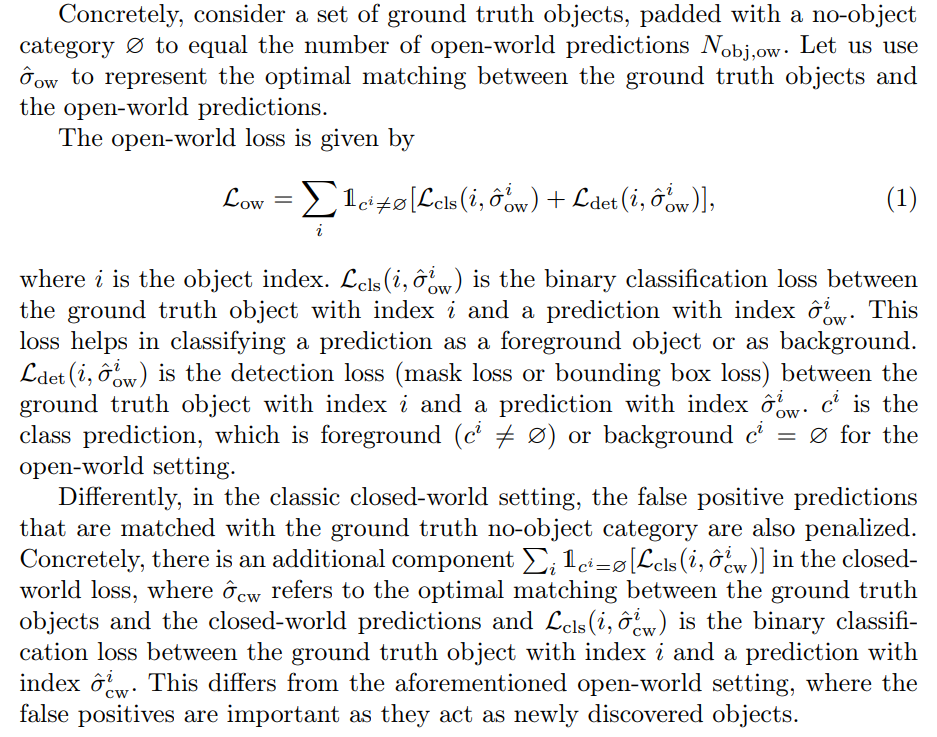
\

3.3 Captioning Head

\
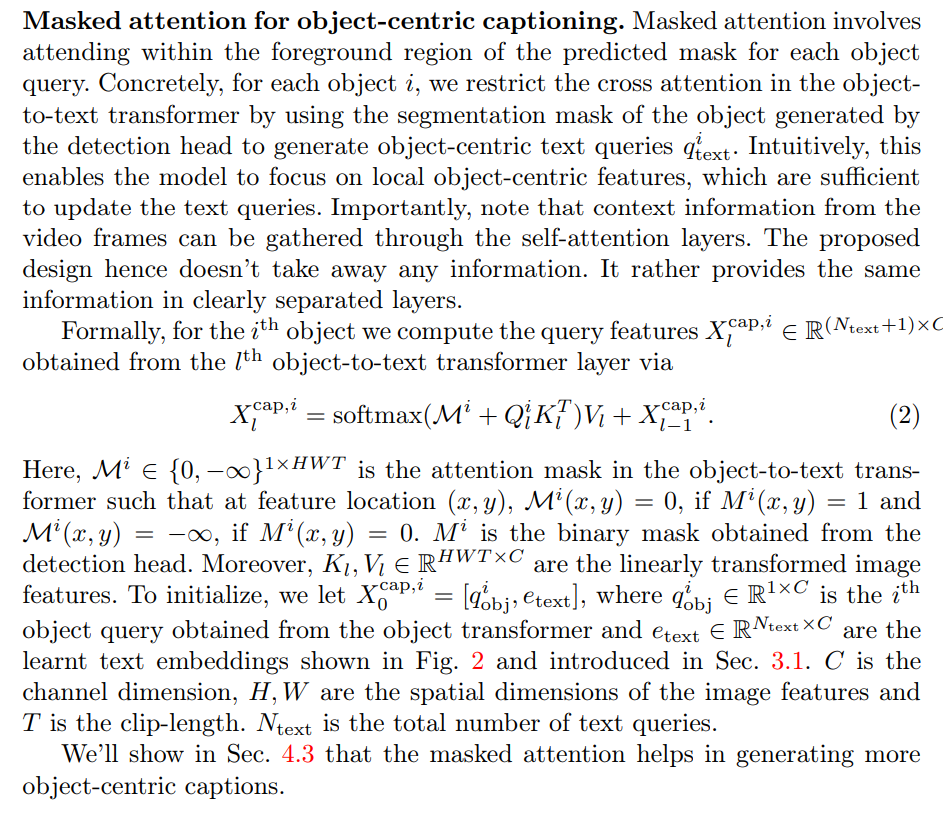
\

3.4 Inter-Query Contrastive Loss

\
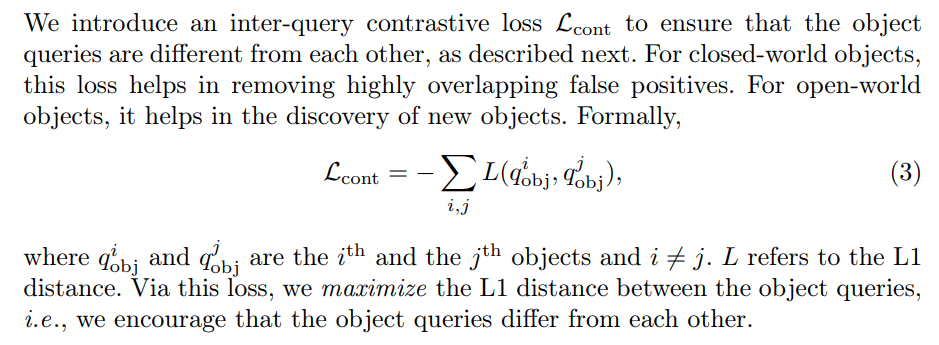
\

3.5 Training

Our total training loss is

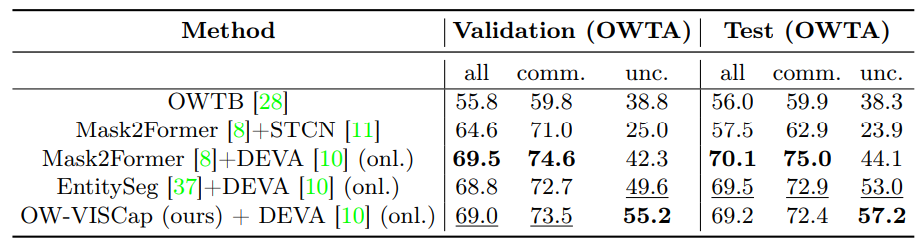
\ Table 1: Open-world tracking accuracy (OWTA) on the BURST validation and test sets for all, common (comm.) and uncommon (unc.) categories of objects. Onl. refers to online frame-by-frame processing. The best scores are highlighted in bold font, and the second-best scores are underlined.
\ Table 2: Dense video object captioning results on the VidSTG [57] dataset. Off. indicates offline methods and onl. refers to online methods.

\

:::info Authors:

(1) Anwesa Choudhuri, University of Illinois at Urbana-Champaign (anwesac2@illinois.edu);

(2) Girish Chowdhary, University of Illinois at Urbana-Champaign (girishc@illinois.edu);

(3) Alexander G. Schwing, University of Illinois at Urbana-Champaign (aschwing@illinois.edu).

:::


:::info This paper is available on arxiv under CC by 4.0 Deed (Attribution 4.0 International) license.

:::

\

Market Opportunity
Sleepless AI Logo
Sleepless AI Price(AI)
$0.03776
$0.03776$0.03776
+6.15%
USD
Sleepless AI (AI) Live Price Chart
Disclaimer: The articles reposted on this site are sourced from public platforms and are provided for informational purposes only. They do not necessarily reflect the views of MEXC. All rights remain with the original authors. If you believe any content infringes on third-party rights, please contact service@support.mexc.com for removal. MEXC makes no guarantees regarding the accuracy, completeness, or timeliness of the content and is not responsible for any actions taken based on the information provided. The content does not constitute financial, legal, or other professional advice, nor should it be considered a recommendation or endorsement by MEXC.

You May Also Like

Russia’s Central Bank Prepares Crackdown on Crypto in New 2026–2028 Strategy

Russia’s Central Bank Prepares Crackdown on Crypto in New 2026–2028 Strategy

The Central Bank of Russia’s long-term strategy for 2026 to 2028 paints a picture of growing concern. The document, prepared […] The post Russia’s Central Bank Prepares Crackdown on Crypto in New 2026–2028 Strategy appeared first on Coindoo.
Share
Coindoo2025/09/18 02:30
Japanese Yen rises on safe-haven demand and intervention concerns

Japanese Yen rises on safe-haven demand and intervention concerns

The post Japanese Yen rises on safe-haven demand and intervention concerns appeared on BitcoinEthereumNews.com. The Japanese Yen (JPY) attracts some buyers at the
Share
BitcoinEthereumNews2025/12/22 11:49
Cryptos Signal Divergence Ahead of Fed Rate Decision

Cryptos Signal Divergence Ahead of Fed Rate Decision

The post Cryptos Signal Divergence Ahead of Fed Rate Decision appeared on BitcoinEthereumNews.com. Crypto assets send conflicting signals ahead of the Federal Reserve’s September rate decision. On-chain data reveals a clear decrease in Bitcoin and Ethereum flowing into centralized exchanges, but a sharp increase in altcoin inflows. The findings come from a Tuesday report by CryptoQuant, an on-chain data platform. The firm’s data shows a stark divergence in coin volume, which has been observed in movements onto centralized exchanges over the past few weeks. Bitcoin and Ethereum Inflows Drop to Multi-Month Lows Sponsored Sponsored Bitcoin has seen a dramatic drop in exchange inflows, with the 7-day moving average plummeting to 25,000 BTC, its lowest level in over a year. The average deposit per transaction has fallen to 0.57 BTC as of September. This suggests that smaller retail investors, rather than large-scale whales, are responsible for the recent cash-outs. Ethereum is showing a similar trend, with its daily exchange inflows decreasing to a two-month low. CryptoQuant reported that the 7-day moving average for ETH deposits on exchanges is around 783,000 ETH, the lowest in two months. Other Altcoins See Renewed Selling Pressure In contrast, other altcoin deposit activity on exchanges has surged. The number of altcoin deposit transactions on centralized exchanges was quite steady in May and June of this year, maintaining a 7-day moving average of about 20,000 to 30,000. Recently, however, that figure has jumped to 55,000 transactions. Altcoins: Exchange Inflow Transaction Count. Source: CryptoQuant CryptoQuant projects that altcoins, given their increased inflow activity, could face relatively higher selling pressure compared to BTC and ETH. Meanwhile, the balance of stablecoins on exchanges—a key indicator of potential buying pressure—has increased significantly. The report notes that the exchange USDT balance, around $273 million in April, grew to $379 million by August 31, marking a new yearly high. CryptoQuant interprets this surge as a reflection of…
Share
BitcoinEthereumNews2025/09/18 01:01