Crypto Insight UK used the first post-cut trading day to reframe the XRP narrative around what he calls the difference between utility and speculation, arguing that the latest burst of institutional developments does not automatically validate “$100 dreams.” While welcoming macro and regulatory tailwinds, he cautioned that euphoria often front-runs fundamentals and urged disciplined profit-taking if XRP reaches what he considers this cycle’s plausible range. “Don’t get caught in the trap of thinking when it starts to send that it’s going to go to $100 or $200 or $50 straight away,” he said, adding that, should XRP push into double digits, “I’m going to be taking a significant amount—probably towards 80%—of my portfolio off the table.” Massive Tailwinds For XRP The macro backdrop he keyed on was the Federal Reserve’s 25-basis-point rate cut on Sept. 17 and Chair Jerome Powell’s guidance that more easing is possible this year. Risk assets whipsawed on the headlines before settling, with markets now handicapping further cuts into year-end. For the analyst, the decision was “pretty much a nothing burger” in isolation, but it sharpened the focus on micro drivers inside crypto—namely flows and policy. Related Reading: Next XRP ‘Monster Leg’ Will Start No Earlier Than 2026: Analyst On policy, he highlighted what may prove the most consequential regulatory pivot since US spot Bitcoin and Ether ETFs: the SEC’s approval of generic listing standards for spot commodity ETPs across major exchanges, a change that streamlines the path for crypto ETFs beyond BTC and ETH. In the same sweep, the agency cleared Grayscale’s Digital Large Cap product—a multi-asset ETP holding Bitcoin, Ether, XRP, Solana and Cardano—signaling a new phase for regulated crypto baskets. “ He also pointed to deepening derivatives infrastructure. CME Group announced it will list options on Solana and XRP futures, extending regulated hedging tools beyond the BTC/ETH duopoly and potentially drawing new institutional basis and vol sellers into those order books. Yet it was Ripple’s new institutional initiative that the analyst treated as the week’s sleeper story. Ripple, DBS and Franklin Templeton unveiled a plan to enable accredited and institutional clients to toggle between Ripple’s dollar stablecoin (RLUSD) and Franklin Templeton’s tokenized money-market fund (sgBENJI) on DBS Digital Exchange—with the bank exploring the use of sgBENJI as repo collateral and Ripple’s stablecoin as transactional grease. Franklin Templeton will issue the sgBENJI token on the XRP Ledger. In his view, the significance is two-fold: a credible on-chain cash-and-collateral market and a concrete, regulated venue for RLUSD utility. Related Reading: Facts Vs. Hype: Analyst Examines XRP Supply Shock Theory To underscore the potential scale, he cited RLUSD executive Jack McDonald’s estimate that “repo transaction volume is well into the 10s of trillions globally (nearly $12T in the US in 2024 itself).” The analyst did not claim that flow will migrate wholesale to the XRP Ledger; rather, he framed it as an addressable ceiling for tokenized collateral markets if custody, compliance and counterparty rails mature around them. Why XRP Won’t Reach $100 This Cycle The technicals in his rundown served more as risk-management context than price calls. He flagged Bitcoin dominance’s recent weakness as the tell for an early-stage altcoin rotation while noting that short-term structures remain choppy. The analyst referenced BNB’s push toward a 1.618 Fibonacci extension and observed that XRP, by his drawings, remains below a comparable extension level—thereby allowing for catch-up dynamics should capital rotate. He reiterated that speculation typically “moves price further than utility does, at least initially,” and cautioned that traders should not confuse institutional news with a settled valuation model for base-layer settlement tokens. Where does that leave XRP? His thesis is deliberately conservative relative to social-media targets. He said he still believes utility “is going to come,” especially as US market-structure language evolves and institutional rails—ETFs, CME derivatives, tokenized cash and collateral—proliferate. However, the analyst continues to uphold his long-stated thesis that the $12 region will mark the cycle top for XRP. Until there is a widely accepted framework to price “base utility” for throughput, he intends to sell into strength if XRP hits his personal range for this cycle, keep a 10% “moon bag” above that, and reassess. The discipline, he argued, is psychological as much as mathematical: “If you were afraid of losing $1,000 … and it’s now worth $20,000, you should be 20 times more afraid of losing $20,000.” At press time, XRP traded at $3.03. Featured image created with DALL.E, chart from TradingView.comCrypto Insight UK used the first post-cut trading day to reframe the XRP narrative around what he calls the difference between utility and speculation, arguing that the latest burst of institutional developments does not automatically validate “$100 dreams.” While welcoming macro and regulatory tailwinds, he cautioned that euphoria often front-runs fundamentals and urged disciplined profit-taking if XRP reaches what he considers this cycle’s plausible range. “Don’t get caught in the trap of thinking when it starts to send that it’s going to go to $100 or $200 or $50 straight away,” he said, adding that, should XRP push into double digits, “I’m going to be taking a significant amount—probably towards 80%—of my portfolio off the table.” Massive Tailwinds For XRP The macro backdrop he keyed on was the Federal Reserve’s 25-basis-point rate cut on Sept. 17 and Chair Jerome Powell’s guidance that more easing is possible this year. Risk assets whipsawed on the headlines before settling, with markets now handicapping further cuts into year-end. For the analyst, the decision was “pretty much a nothing burger” in isolation, but it sharpened the focus on micro drivers inside crypto—namely flows and policy. Related Reading: Next XRP ‘Monster Leg’ Will Start No Earlier Than 2026: Analyst On policy, he highlighted what may prove the most consequential regulatory pivot since US spot Bitcoin and Ether ETFs: the SEC’s approval of generic listing standards for spot commodity ETPs across major exchanges, a change that streamlines the path for crypto ETFs beyond BTC and ETH. In the same sweep, the agency cleared Grayscale’s Digital Large Cap product—a multi-asset ETP holding Bitcoin, Ether, XRP, Solana and Cardano—signaling a new phase for regulated crypto baskets. “ He also pointed to deepening derivatives infrastructure. CME Group announced it will list options on Solana and XRP futures, extending regulated hedging tools beyond the BTC/ETH duopoly and potentially drawing new institutional basis and vol sellers into those order books. Yet it was Ripple’s new institutional initiative that the analyst treated as the week’s sleeper story. Ripple, DBS and Franklin Templeton unveiled a plan to enable accredited and institutional clients to toggle between Ripple’s dollar stablecoin (RLUSD) and Franklin Templeton’s tokenized money-market fund (sgBENJI) on DBS Digital Exchange—with the bank exploring the use of sgBENJI as repo collateral and Ripple’s stablecoin as transactional grease. Franklin Templeton will issue the sgBENJI token on the XRP Ledger. In his view, the significance is two-fold: a credible on-chain cash-and-collateral market and a concrete, regulated venue for RLUSD utility. Related Reading: Facts Vs. Hype: Analyst Examines XRP Supply Shock Theory To underscore the potential scale, he cited RLUSD executive Jack McDonald’s estimate that “repo transaction volume is well into the 10s of trillions globally (nearly $12T in the US in 2024 itself).” The analyst did not claim that flow will migrate wholesale to the XRP Ledger; rather, he framed it as an addressable ceiling for tokenized collateral markets if custody, compliance and counterparty rails mature around them. Why XRP Won’t Reach $100 This Cycle The technicals in his rundown served more as risk-management context than price calls. He flagged Bitcoin dominance’s recent weakness as the tell for an early-stage altcoin rotation while noting that short-term structures remain choppy. The analyst referenced BNB’s push toward a 1.618 Fibonacci extension and observed that XRP, by his drawings, remains below a comparable extension level—thereby allowing for catch-up dynamics should capital rotate. He reiterated that speculation typically “moves price further than utility does, at least initially,” and cautioned that traders should not confuse institutional news with a settled valuation model for base-layer settlement tokens. Where does that leave XRP? His thesis is deliberately conservative relative to social-media targets. He said he still believes utility “is going to come,” especially as US market-structure language evolves and institutional rails—ETFs, CME derivatives, tokenized cash and collateral—proliferate. However, the analyst continues to uphold his long-stated thesis that the $12 region will mark the cycle top for XRP. Until there is a widely accepted framework to price “base utility” for throughput, he intends to sell into strength if XRP hits his personal range for this cycle, keep a 10% “moon bag” above that, and reassess. The discipline, he argued, is psychological as much as mathematical: “If you were afraid of losing $1,000 … and it’s now worth $20,000, you should be 20 times more afraid of losing $20,000.” At press time, XRP traded at $3.03. Featured image created with DALL.E, chart from TradingView.com
The $100 XRP Dream: Analyst Explains Why It’s A Fantasy

2025/09/19 16:00

Crypto Insight UK used the first post-cut trading day to reframe the XRP narrative around what he calls the difference between utility and speculation, arguing that the latest burst of institutional developments does not automatically validate “$100 dreams.” While welcoming macro and regulatory tailwinds, he cautioned that euphoria often front-runs fundamentals and urged disciplined profit-taking if XRP reaches what he considers this cycle’s plausible range.

“Don’t get caught in the trap of thinking when it starts to send that it’s going to go to $100 or $200 or $50 straight away,” he said, adding that, should XRP push into double digits, “I’m going to be taking a significant amount—probably towards 80%—of my portfolio off the table.”

Massive Tailwinds For XRP

The macro backdrop he keyed on was the Federal Reserve’s 25-basis-point rate cut on Sept. 17 and Chair Jerome Powell’s guidance that more easing is possible this year. Risk assets whipsawed on the headlines before settling, with markets now handicapping further cuts into year-end. For the analyst, the decision was “pretty much a nothing burger” in isolation, but it sharpened the focus on micro drivers inside crypto—namely flows and policy.

On policy, he highlighted what may prove the most consequential regulatory pivot since US spot Bitcoin and Ether ETFs: the SEC’s approval of generic listing standards for spot commodity ETPs across major exchanges, a change that streamlines the path for crypto ETFs beyond BTC and ETH.

In the same sweep, the agency cleared Grayscale’s Digital Large Cap product—a multi-asset ETP holding Bitcoin, Ether, XRP, Solana and Cardano—signaling a new phase for regulated crypto baskets. “

He also pointed to deepening derivatives infrastructure. CME Group announced it will list options on Solana and XRP futures, extending regulated hedging tools beyond the BTC/ETH duopoly and potentially drawing new institutional basis and vol sellers into those order books.

Yet it was Ripple’s new institutional initiative that the analyst treated as the week’s sleeper story. Ripple, DBS and Franklin Templeton unveiled a plan to enable accredited and institutional clients to toggle between Ripple’s dollar stablecoin (RLUSD) and Franklin Templeton’s tokenized money-market fund (sgBENJI) on DBS Digital Exchange—with the bank exploring the use of sgBENJI as repo collateral and Ripple’s stablecoin as transactional grease.

Franklin Templeton will issue the sgBENJI token on the XRP Ledger. In his view, the significance is two-fold: a credible on-chain cash-and-collateral market and a concrete, regulated venue for RLUSD utility.

To underscore the potential scale, he cited RLUSD executive Jack McDonald’s estimate that “repo transaction volume is well into the 10s of trillions globally (nearly $12T in the US in 2024 itself).” The analyst did not claim that flow will migrate wholesale to the XRP Ledger; rather, he framed it as an addressable ceiling for tokenized collateral markets if custody, compliance and counterparty rails mature around them.

Why XRP Won’t Reach $100 This Cycle

The technicals in his rundown served more as risk-management context than price calls. He flagged Bitcoin dominance’s recent weakness as the tell for an early-stage altcoin rotation while noting that short-term structures remain choppy.

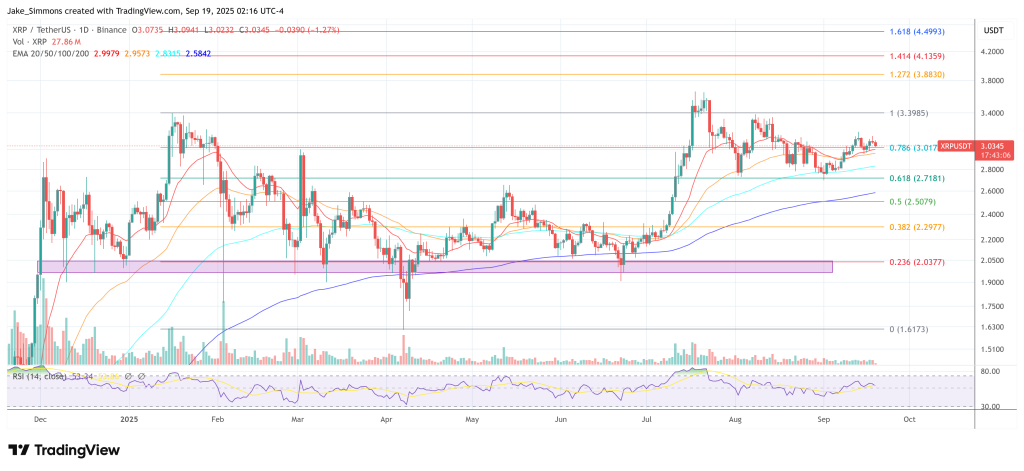
The analyst referenced BNB’s push toward a 1.618 Fibonacci extension and observed that XRP, by his drawings, remains below a comparable extension level—thereby allowing for catch-up dynamics should capital rotate. He reiterated that speculation typically “moves price further than utility does, at least initially,” and cautioned that traders should not confuse institutional news with a settled valuation model for base-layer settlement tokens.

Where does that leave XRP? His thesis is deliberately conservative relative to social-media targets. He said he still believes utility “is going to come,” especially as US market-structure language evolves and institutional rails—ETFs, CME derivatives, tokenized cash and collateral—proliferate. However, the analyst continues to uphold his long-stated thesis that the $12 region will mark the cycle top for XRP.

Until there is a widely accepted framework to price “base utility” for throughput, he intends to sell into strength if XRP hits his personal range for this cycle, keep a 10% “moon bag” above that, and reassess. The discipline, he argued, is psychological as much as mathematical: “If you were afraid of losing $1,000 … and it’s now worth $20,000, you should be 20 times more afraid of losing $20,000.”

At press time, XRP traded at $3.03.

XRP price
Market Opportunity
MemeCore Logo
MemeCore Price(M)
$1.61568
$1.61568$1.61568
-1.61%
USD
MemeCore (M) Live Price Chart
Disclaimer: The articles reposted on this site are sourced from public platforms and are provided for informational purposes only. They do not necessarily reflect the views of MEXC. All rights remain with the original authors. If you believe any content infringes on third-party rights, please contact service@support.mexc.com for removal. MEXC makes no guarantees regarding the accuracy, completeness, or timeliness of the content and is not responsible for any actions taken based on the information provided. The content does not constitute financial, legal, or other professional advice, nor should it be considered a recommendation or endorsement by MEXC.

You May Also Like

CME Group to Launch Solana and XRP Futures Options

CME Group to Launch Solana and XRP Futures Options

The post CME Group to Launch Solana and XRP Futures Options appeared on BitcoinEthereumNews.com. An announcement was made by CME Group, the largest derivatives exchanger worldwide, revealed that it would introduce options for Solana and XRP futures. It is the latest addition to CME crypto derivatives as institutions and retail investors increase their demand for Solana and XRP. CME Expands Crypto Offerings With Solana and XRP Options Launch According to a press release, the launch is scheduled for October 13, 2025, pending regulatory approval. The new products will allow traders to access options on Solana, Micro Solana, XRP, and Micro XRP futures. Expiries will be offered on business days on a monthly, and quarterly basis to provide more flexibility to market players. CME Group said the contracts are designed to meet demand from institutions, hedge funds, and active retail traders. According to Giovanni Vicioso, the launch reflects high liquidity in Solana and XRP futures. Vicioso is the Global Head of Cryptocurrency Products for the CME Group. He noted that the new contracts will provide additional tools for risk management and exposure strategies. Recently, CME XRP futures registered record open interest amid ETF approval optimism, reinforcing confidence in contract demand. Cumberland, one of the leading liquidity providers, welcomed the development and said it highlights the shift beyond Bitcoin and Ethereum. FalconX, another trading firm, added that rising digital asset treasuries are increasing the need for hedging tools on alternative tokens like Solana and XRP. High Record Trading Volumes Demand Solana and XRP Futures Solana futures and XRP continue to gain popularity since their launch earlier this year. According to CME official records, many have bought and sold more than 540,000 Solana futures contracts since March. A value that amounts to over $22 billion dollars. Solana contracts hit a record 9,000 contracts in August, worth $437 million. Open interest also set a record at 12,500 contracts.…
Share
BitcoinEthereumNews2025/09/18 01:39
Vitalik Buterin Warns Crypto Lost Its Way, But Ethereum Is Ready to Fix It

Vitalik Buterin Warns Crypto Lost Its Way, But Ethereum Is Ready to Fix It

The post Vitalik Buterin Warns Crypto Lost Its Way, But Ethereum Is Ready to Fix It appeared first on Coinpedia Fintech News Ethereum co-founder Vitalik Buterin
Share
CoinPedia2026/01/14 18:13
Top 3 Reasons Why XRP Price Is Surging Today

Top 3 Reasons Why XRP Price Is Surging Today

The post Top 3 Reasons Why XRP Price Is Surging Today appeared on BitcoinEthereumNews.com. The XRP price is back in the spotlight today, becoming one of the top
Share
BitcoinEthereumNews2026/01/14 17:55
