Tether has reached an all-time high in supply, largely driven by Ethereum and Tron.Tether has reached an all-time high in supply, largely driven by Ethereum and Tron.

USDT supply hits $156.1b all-time high, 90% on Tron and Ethereum

2025/06/24 22:27
2 min read
For feedback or concerns regarding this content, please contact us at crypto.news@mexc.com

Tether’s USDT reached an all-time high in supply at $156.1 billion, with most of the stablecoin circulating on Tron and Ethereum.

Despite renewed hype around Circle, Tether continues to dominate the stablecoin market. On Tuesday, June 24, USDT’s outstanding supply hit an all-time high of $156.1 billion. Notably, 90% of that supply is concentrated on just two networks: Ethereum and Tron.
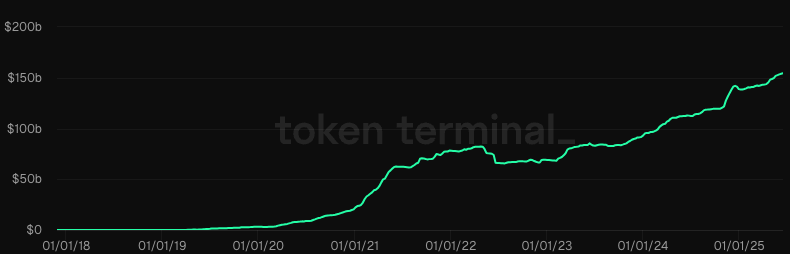
USDT outstanding supply

Over half of USDT stablecoins, or 50.47%, are now on Tron (TRX), while almost 40% are on Ethereum (ETH). Less than 10% of USDT supply is distributed across other blockchains, including BNB Chain, Solana, Cosmos, Avalanche, and others.

Circle’s USDC has gained more traction on many of these smaller chains. For instance, Solana hosts nearly $7.5 billion worth of USDC compared to just $2.3 billion of USDT. Still, despite USDC’s growing popularity, USDT’s dominance has remained largely stable.
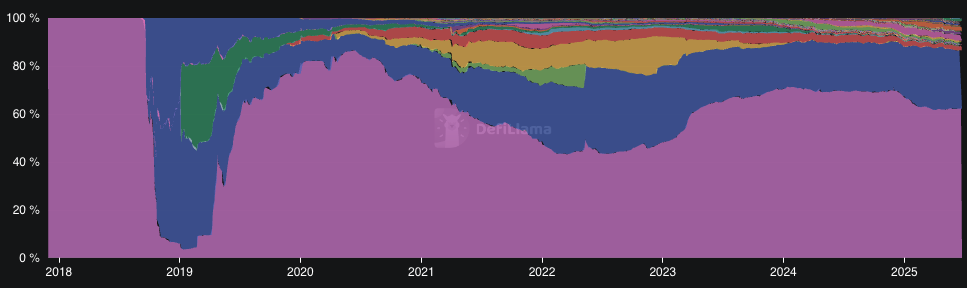
Stablecoin dominance, with USDT and USDC in the lead

Currently, USDT accounts for 62.10% of stablecoin supply across all chains, while USDC holds around 24%. However, USDT saw a dip in dominance near the end of 2024, coinciding with the implementation of the European Union’s MiCA stablecoin regulations.

What’s the future for USDT?

Instead of trying to comply with MiCA regulation, Tether chose to withdraw from the market completely. It had discontinued its EURT stablecoin, as well as faced delisting on several major exchanges. Still, Tether’s leadership would not relent, declining to enact full reserve transparency.

Still, the passage of the U.S. GENIUS Act could pose new problems for Tether, where it controls a dominant market share. However, experts are not convinced that the GENIUS Act would force the Tether out of the U.S. market.

For now, Tether’s strategic focus remains on Asia, where it continues to be a preferred option for crypto payments—particularly on the Tron network.

Disclaimer: The articles reposted on this site are sourced from public platforms and are provided for informational purposes only. They do not necessarily reflect the views of MEXC. All rights remain with the original authors. If you believe any content infringes on third-party rights, please contact crypto.news@mexc.com for removal. MEXC makes no guarantees regarding the accuracy, completeness, or timeliness of the content and is not responsible for any actions taken based on the information provided. The content does not constitute financial, legal, or other professional advice, nor should it be considered a recommendation or endorsement by MEXC.

You May Also Like

When the Middle East burns, the Filipino nanay feels the heat

When the Middle East burns, the Filipino nanay feels the heat

(Part 1 of 2) On Feb. 28, the world watched as the US-Israel coalition launched coordinated airstrikes on Iranian nuclear and military infrastructure, which also
Share
Bworldonline2026/03/16 00:03
The Hidden Costs of a Smart Home: How to Calculate Your Real Electricity Usage

The Hidden Costs of a Smart Home: How to Calculate Your Real Electricity Usage

You just finished setting up your smart home. The lights respond to your voice. The thermostat adjusts itself. The security cameras check in every few minutes.
Share
Techbullion2026/03/16 02:35
Michael Saylor Pushes Digital Capital Narrative At Bitcoin Treasuries Unconference

Michael Saylor Pushes Digital Capital Narrative At Bitcoin Treasuries Unconference

The post Michael Saylor Pushes Digital Capital Narrative At Bitcoin Treasuries Unconference appeared on BitcoinEthereumNews.com. The suitcoiners are in town.  From a low-key, circular podium in the middle of a lavish New York City event hall, Strategy executive chairman Michael Saylor took the mic and opened the Bitcoin Treasuries Unconference event. He joked awkwardly about the orange ties, dresses, caps and other merch to the (mostly male) audience of who’s-who in the bitcoin treasury company world.  Once he got onto the regular beat, it was much of the same: calm and relaxed, speaking freely and with confidence, his keynote was heavy on the metaphors and larger historical stories. Treasury companies are like Rockefeller’s Standard Oil in its early years, Michael Saylor said: We’ve just discovered crude oil and now we’re making sense of the myriad ways in which we can use it — the automobile revolution and jet fuel is still well ahead of us.  Established, trillion-dollar companies not using AI because of “security concerns” make them slow and stupid — just like companies and individuals rejecting digital assets now make them poor and weak.  “I’d like to think that we understood our business five years ago; we didn’t.”  We went from a defensive investment into bitcoin, Saylor said, to opportunistic, to strategic, and finally transformational; “only then did we realize that we were different.” Michael Saylor: You Come Into My Financial History House?! Jokes aside, Michael Saylor is very welcome to the warm waters of our financial past. He acquitted himself honorably by invoking the British Consol — though mispronouncing it, and misdating it to the 1780s; Pelham’s consolidation of debts happened in the 1750s and perpetual government debt existed well before then — and comparing it to the gold standard and the future of bitcoin. He’s right that Strategy’s STRC product in many ways imitates the consols; irredeemable, perpetual debt, issued at par, with…
Share
BitcoinEthereumNews2025/09/18 02:12