The usage of AI, especially in the software industry, has increased a lot lately, but everything has a downside — and that, is, excess. Excess of anything is bad, and that includes the use of AI. With that in mind, in this post, I explore the downsides of vibe coding and how to balance it.The usage of AI, especially in the software industry, has increased a lot lately, but everything has a downside — and that, is, excess. Excess of anything is bad, and that includes the use of AI. With that in mind, in this post, I explore the downsides of vibe coding and how to balance it.

When AI Becomes a Crutch, Not a Tool

The usage of AI, especially in the software industry, has increased a lot lately, but everything has a downside — and that, is, excess. Excess of anything is bad, and that includes the use of AI. With that in mind, in this post, I explore the downsides of vibe coding and how to balance it.

Recently, Zen van Riel - a senior software engineer at GitHub, shared a linkedin post about the dark side of vibe coding. He describes a developer constantly trying to fix "simple things" using an AI model but, unfortunately, the AI model fails to do so every time. It's not only a waste of time, but a waste of money (credits) as well. Zen wonderfully describes this through an analogy of fast food (hence, the title of this post).

\
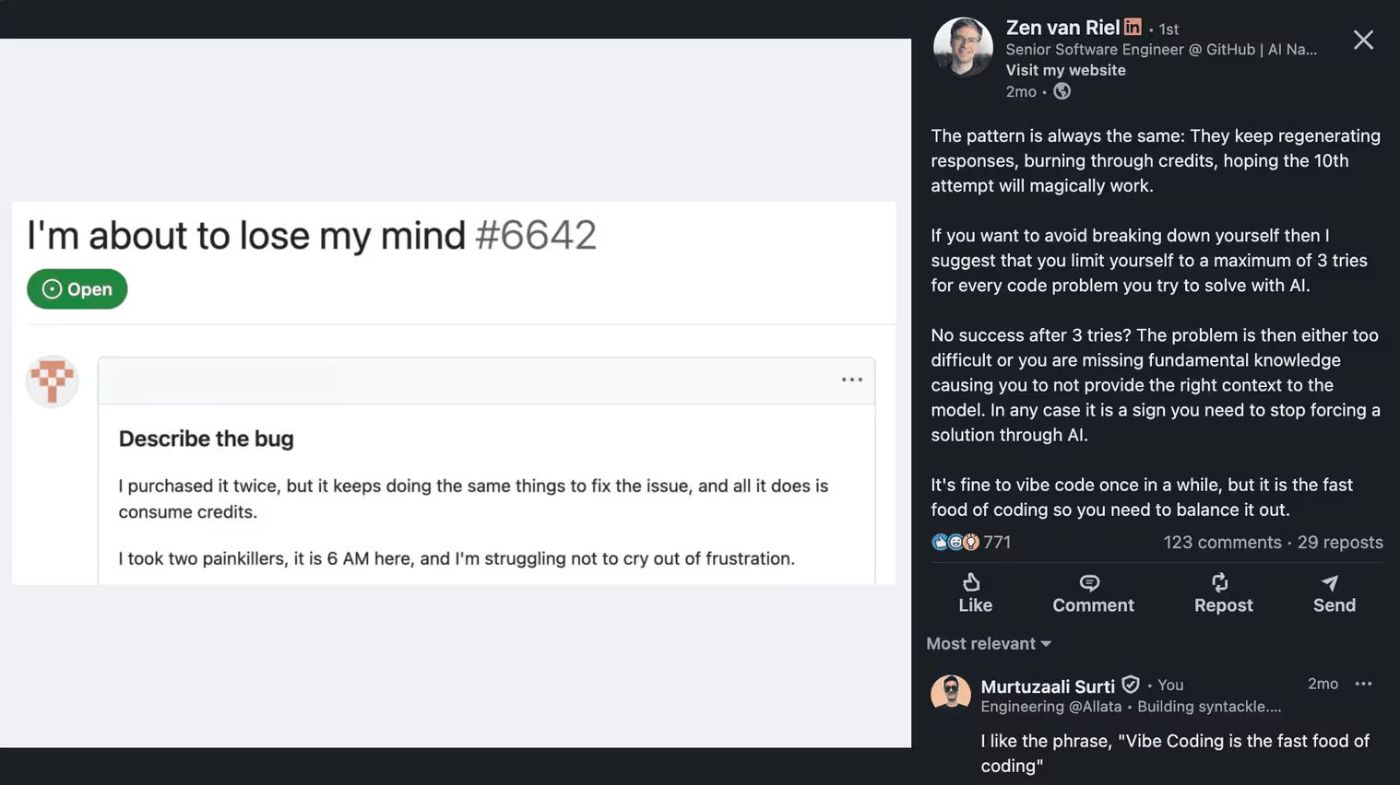
In my opinion, that's a brilliant analogy because it talks about balance. Let me draw some parallels between fast food and vibe coding.

Vibe Coding & Fast Food

1. Instant Gratification

When you send a prompt and see output in a matter of seconds, you feel good. It gives you a dopamine hit, a sense of accomplishment, but it's only a matter of time when it all fades away.

When the AI model starts making mistakes and no matter which prompt you give, it still doesn't work, that's when you start feeling I could have done it myself.

It starts becoming messy if you look at the bigger picture.

2. Opinionated Ingredients

If you don't know what you are building, AI model can use whatever it thinks is good to build your application and sometimes it's not the best for your application and use case. And, it can be very hard to refactor later.

For you to be able to give enough context of what you are building and why, you need to be aware of the available tools and techniques needed to make that happen.

3. Lacks Nutritional Value

Once you get the taste of it, you stop asking the "why"/"how" question. Questioning what the AI model does almost feels like a second thought. And you know what it does? It drains your ability to learn and grasp new things.

That's the reason I never recommend beginners to rely solely on AI tools for coding/programming. Always questions things and ask the model why it did what it did.

4. Looks Good on the Outside

AI tools might get you the exact thing you want, but if you look closely at the code, (if you have decent knowledge about programming) you start seeing inconsistencies and tech debt.

5. Forms Bad Habit in the Long Term

If you only vibe code, you never get to focus on the grilling part of programming, which is to sit patiently and think about the problem at hand. You never really learn how to dissect a problem and solve it incrementally.

Some of the best solutions to software engineering problems I had occurred to me when I was asleep, walking or just wandering around with an open mind. Sometimes, all it takes is to take a step back and relax.

Correct Usage of AI tools for Coding

  • Don't solely rely on AI of you are a beginner. Read in-depth articles, watch YouTube videos explaining how stuff really works and practice, build something. Building something on your own is key and it will get you out of tutorial hell.
  • Familiarize yourself with what you are building and why. It's easy to get lost in whatever the AI model generates, so it's necessary to have decent knowledge about technologies you want to use to build your project.
  • Use AI model in an incremental way. Prompt the AI model to do small changes instead of giving it a complex task. Break down the problem yourself, or even better, prompt the AI model to generate a plan first, study the plan, and then tell it to implement. It will help you learn and break down the problem.
  • Ask the AI model why it did what it did. AI models are great at explaining things, so use it to your own advantage.

\

Market Opportunity
League of Traders Logo
League of Traders Price(LOT)
$0.0105
$0.0105$0.0105
+1.15%
USD
League of Traders (LOT) Live Price Chart
Disclaimer: The articles reposted on this site are sourced from public platforms and are provided for informational purposes only. They do not necessarily reflect the views of MEXC. All rights remain with the original authors. If you believe any content infringes on third-party rights, please contact service@support.mexc.com for removal. MEXC makes no guarantees regarding the accuracy, completeness, or timeliness of the content and is not responsible for any actions taken based on the information provided. The content does not constitute financial, legal, or other professional advice, nor should it be considered a recommendation or endorsement by MEXC.

You May Also Like

The Channel Factories We’ve Been Waiting For

The Channel Factories We’ve Been Waiting For

The post The Channel Factories We’ve Been Waiting For appeared on BitcoinEthereumNews.com. Visions of future technology are often prescient about the broad strokes while flubbing the details. The tablets in “2001: A Space Odyssey” do indeed look like iPads, but you never see the astronauts paying for subscriptions or wasting hours on Candy Crush.  Channel factories are one vision that arose early in the history of the Lightning Network to address some challenges that Lightning has faced from the beginning. Despite having grown to become Bitcoin’s most successful layer-2 scaling solution, with instant and low-fee payments, Lightning’s scale is limited by its reliance on payment channels. Although Lightning shifts most transactions off-chain, each payment channel still requires an on-chain transaction to open and (usually) another to close. As adoption grows, pressure on the blockchain grows with it. The need for a more scalable approach to managing channels is clear. Channel factories were supposed to meet this need, but where are they? In 2025, subnetworks are emerging that revive the impetus of channel factories with some new details that vastly increase their potential. They are natively interoperable with Lightning and achieve greater scale by allowing a group of participants to open a shared multisig UTXO and create multiple bilateral channels, which reduces the number of on-chain transactions and improves capital efficiency. Achieving greater scale by reducing complexity, Ark and Spark perform the same function as traditional channel factories with new designs and additional capabilities based on shared UTXOs.  Channel Factories 101 Channel factories have been around since the inception of Lightning. A factory is a multiparty contract where multiple users (not just two, as in a Dryja-Poon channel) cooperatively lock funds in a single multisig UTXO. They can open, close and update channels off-chain without updating the blockchain for each operation. Only when participants leave or the factory dissolves is an on-chain transaction…
Share
BitcoinEthereumNews2025/09/18 00:09
Elon Musk and Netanyahu Discuss AI and Tesla Plans In Joint Conference

Elon Musk and Netanyahu Discuss AI and Tesla Plans In Joint Conference

TLDR Elon Musk joined a virtual meeting with Israeli PM Netanyahu to talk AI and transportation technology. Israel aims to lead in AI, using strategies from its
Share
Coincentral2025/12/30 03:05
Elon Musk discusses AI development with Israeli Prime Minister Netanyahu

Elon Musk discusses AI development with Israeli Prime Minister Netanyahu

The post Elon Musk discusses AI development with Israeli Prime Minister Netanyahu appeared on BitcoinEthereumNews.com. Key Takeaways Musk and Netanyahu discussed
Share
BitcoinEthereumNews2025/12/30 03:00