This article explores the implementation of gradient descent algorithms for minimizing global loss functions in neural networks, particularly in problems governed by Rankine-Hugoniot conditions. While gradient descent reliably converges, scalability issues arise when handling large domains with many coupled networks. To address this, a domain decomposition method (DDM) is introduced, enabling parallel optimization of local loss functions. The result is faster convergence, improved scalability, and a more efficient framework for training complex AI models.This article explores the implementation of gradient descent algorithms for minimizing global loss functions in neural networks, particularly in problems governed by Rankine-Hugoniot conditions. While gradient descent reliably converges, scalability issues arise when handling large domains with many coupled networks. To address this, a domain decomposition method (DDM) is introduced, enabling parallel optimization of local loss functions. The result is faster convergence, improved scalability, and a more efficient framework for training complex AI models.

Why Gradient Descent Converges (and Sometimes Doesn’t) in Neural Networks

2025/09/19 18:38

Abstract and 1. Introduction

1.1. Introductory remarks

1.2. Basics of neural networks

1.3. About the entropy of direct PINN methods

1.4. Organization of the paper

  1. Non-diffusive neural network solver for one dimensional scalar HCLs

    2.1. One shock wave

    2.2. Arbitrary number of shock waves

    2.3. Shock wave generation

    2.4. Shock wave interaction

    2.5. Non-diffusive neural network solver for one dimensional systems of CLs

    2.6. Efficient initial wave decomposition

  2. Gradient descent algorithm and efficient implementation

    3.1. Classical gradient descent algorithm for HCLs

    3.2. Gradient descent and domain decomposition methods

  3. Numerics

    4.1. Practical implementations

    4.2. Basic tests and convergence for 1 and 2 shock wave problems

    4.3. Shock wave generation

    4.4. Shock-Shock interaction

    4.5. Entropy solution

    4.6. Domain decomposition

    4.7. Nonlinear systems

  4. Conclusion and References

3. Gradient descent algorithm and efficient implementation

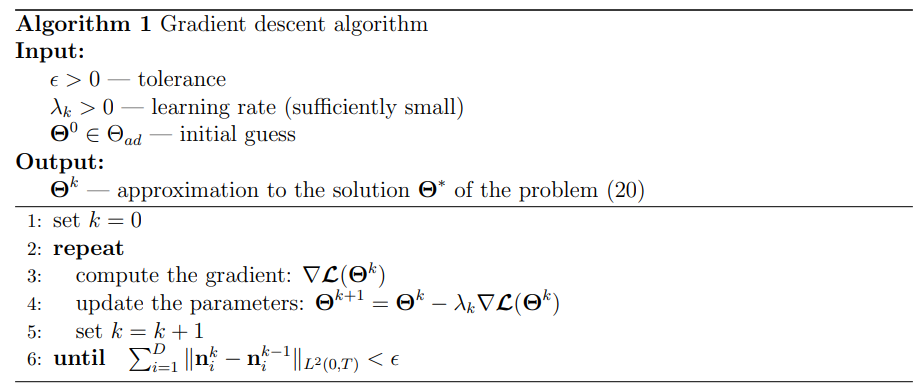
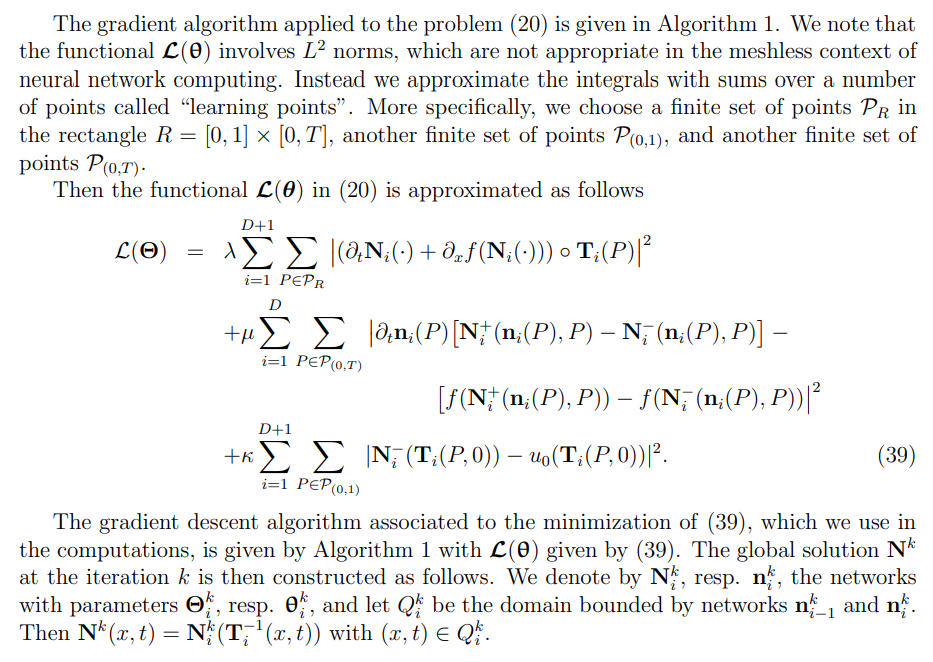
In this section we discuss the implementation of gradient descent algorithms for solving the minimization problems (11), (20) and (35). We note that these problems involve a global loss functional measuring the residue of HCL in the whole domain, as well Rankine-Hugoniot conditions, which results in training of a number of neural networks. In all the tests we have done, the gradient descent method converges and provides accurate results. We note also, that in problems with a large number of DLs, the global loss functional couples a large number of networks and the gradient descent algorithm may converge slowly. For these problems we present a domain decomposition method (DDM).

3.1. Classical gradient descent algorithm for HCLs

All the problems (11), (20) and (35) being similar, we will demonstrate in details the algorithm for the problem (20). We assume that the solution is initially constituted by i) D ∈ {1, 2, . . . , } entropic shock waves emanating from x1, . . . , xD, ii) an arbitrary number of rarefaction waves, and that iii) there is no shock generation for t ∈ [0, T].

\
\
3.2. Gradient descent and domain decomposition methods

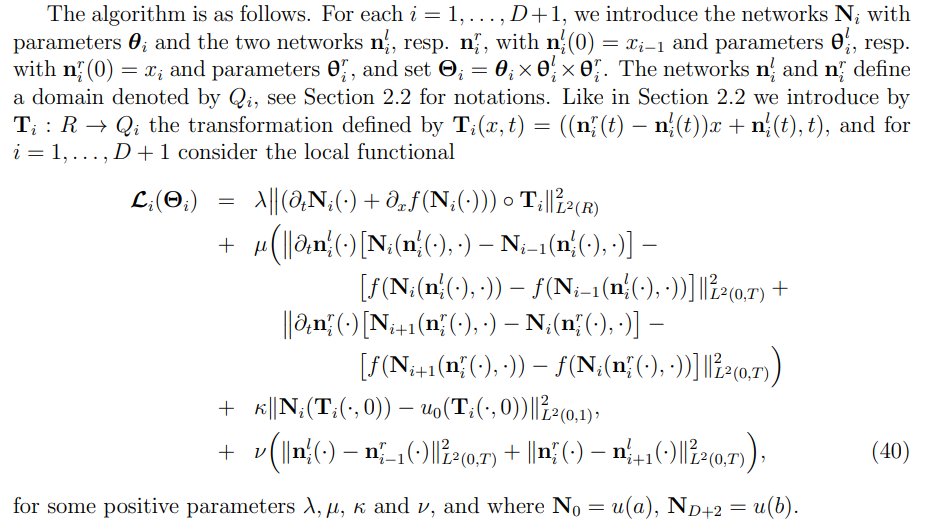
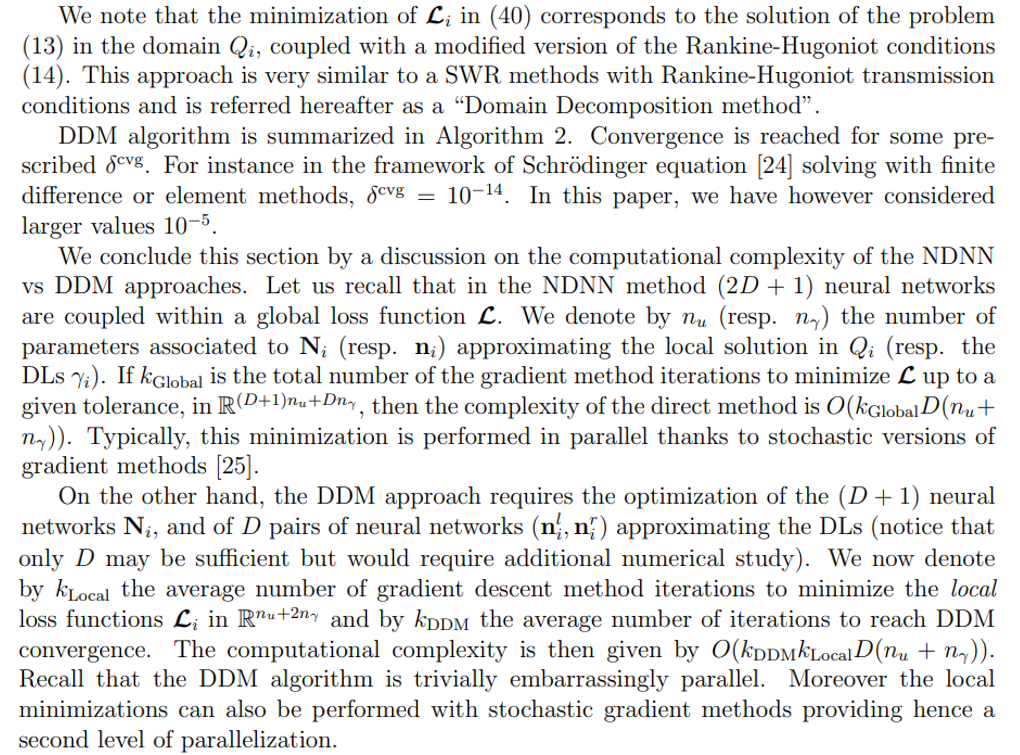
Rather than minimizing the global loss function (21) (or (12), (36)), we here propose to decouple the optimization of the neural networks, and make it scalable. The approach is closely connected to domain decomposition methods (DDMs) Schwarz Waveform Relaxation (SWR) methods [21, 22, 23]. The resulting algorithm allows for embarrassingly parallel computation of minimization of local loss functions.

\ \
\ \ \
\ \ \
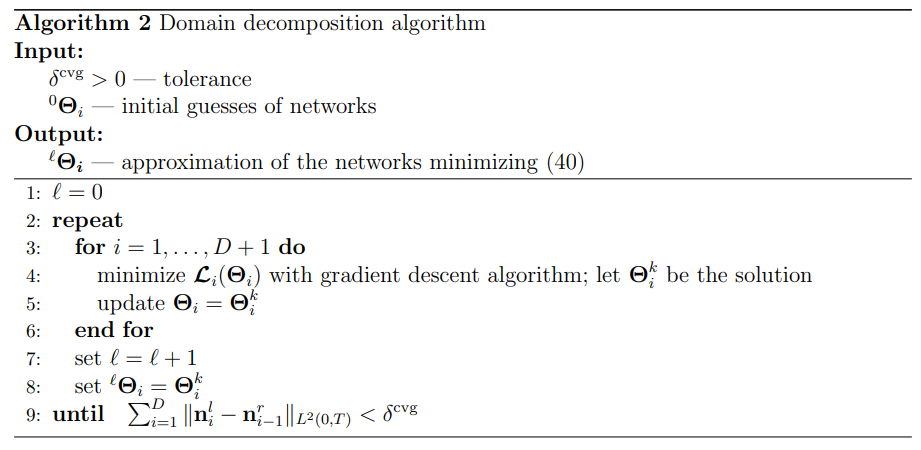
\ \ In conclusion, the DDM becomes relevant thanks to its scalability and for kDDMkLocal < kGlobal, which is expected for D large.

\

:::info Authors:

(1) Emmanuel LORIN, School of Mathematics and Statistics, Carleton University, Ottawa, Canada, K1S 5B6 and Centre de Recherches Mathematiques, Universit´e de Montr´eal, Montreal, Canada, H3T 1J4 (elorin@math.carleton.ca);

(2) Arian NOVRUZI, a Corresponding Author from Department of Mathematics and Statistics, University of Ottawa, Ottawa, ON K1N 6N5, Canada (novruzi@uottawa.ca).

:::


:::info This paper is available on arxiv under CC by 4.0 Deed (Attribution 4.0 International) license.

:::

\

Disclaimer: The articles reposted on this site are sourced from public platforms and are provided for informational purposes only. They do not necessarily reflect the views of MEXC. All rights remain with the original authors. If you believe any content infringes on third-party rights, please contact service@support.mexc.com for removal. MEXC makes no guarantees regarding the accuracy, completeness, or timeliness of the content and is not responsible for any actions taken based on the information provided. The content does not constitute financial, legal, or other professional advice, nor should it be considered a recommendation or endorsement by MEXC.

You May Also Like

CME Group to launch options on XRP and SOL futures

CME Group to launch options on XRP and SOL futures

The post CME Group to launch options on XRP and SOL futures appeared on BitcoinEthereumNews.com. CME Group will offer options based on the derivative markets on Solana (SOL) and XRP. The new markets will open on October 13, after regulatory approval.  CME Group will expand its crypto products with options on the futures markets of Solana (SOL) and XRP. The futures market will start on October 13, after regulatory review and approval.  The options will allow the trading of MicroSol, XRP, and MicroXRP futures, with expiry dates available every business day, monthly, and quarterly. The new products will be added to the existing BTC and ETH options markets. ‘The launch of these options contracts builds on the significant growth and increasing liquidity we have seen across our suite of Solana and XRP futures,’ said Giovanni Vicioso, CME Group Global Head of Cryptocurrency Products. The options contracts will have two main sizes, tracking the futures contracts. The new market will be suitable for sophisticated institutional traders, as well as active individual traders. The addition of options markets singles out XRP and SOL as liquid enough to offer the potential to bet on a market direction.  The options on futures arrive a few months after the launch of SOL futures. Both SOL and XRP had peak volumes in August, though XRP activity has slowed down in September. XRP and SOL options to tap both institutions and active traders Crypto options are one of the indicators of market attitudes, with XRP and SOL receiving a new way to gauge sentiment. The contracts will be supported by the Cumberland team.  ‘As one of the biggest liquidity providers in the ecosystem, the Cumberland team is excited to support CME Group’s continued expansion of crypto offerings,’ said Roman Makarov, Head of Cumberland Options Trading at DRW. ‘The launch of options on Solana and XRP futures is the latest example of the…
Share
BitcoinEthereumNews2025/09/18 00:56