Buy Crypto
Markets
Spot
FuturesBTC
Earn
Event Center
Rewards Hub
More
Common Questions About One-Way Mode and Hedge ModeCommon Questions About One-Way Mode and Hedge Mode
Category List
Cancel

Common Questions About One-Way Mode and Hedge Mode

1. What Are One-Way Mode and Hedge Mode?


In crypto futures trading, One-Way Mode means you can only hold a position in one direction per contract. You cannot hold both long and short positions at the same time for the same trading pair.
Hedge Mode allows you to hold both long and short positions simultaneously on the same contract. The system records each position separately, and profit and loss (PNL) is calculated independently for each direction.

2. What Are the Characteristics of One-Way Mode?


Single-direction positions only: You can hold only one directional position at a time. If you place an order in the opposite direction, the system will offset your existing position.
Simplified trading strategy: Focusing on a single market view makes strategies clearer and more straightforward.
Faster entry and exit: Orders can be executed quickly without managing opposing positions, improving trading efficiency.

3. What Are the Characteristics of Hedge Mode?


Simultaneous long and short positions: You can hold both long and short positions on the same trading pair.
Flexible strategy execution: Allows you to balance exposure or adjust long and short positions based on market conditions.
Risk hedging: Maintaining positions in both directions helps manage uncertainty and volatility, reducing overall exposure to sudden price swings.

4. What Are the Key Differences Between One-Way Mode and Hedge Mode?


Position direction
  • One-Way Mode: only long or short, not both.
  • Hedge Mode: long and short simultaneously.
Strategy complexity
  • One-Way Mode is simpler and easier to manage.
  • Hedge Mode requires managing two separate positions, margins, and risks.
Flexibility
  • One-Way Mode offers limited flexibility and does not support hedging strategies that require both directions.
  • Hedge Mode supports advanced strategies such as hedging and profit locking.
Execution speed
  • One-Way Mode generally enables faster entry and exit.
  • Hedge Mode may require additional steps for complex strategies.
Risk characteristics
  • One-Way Mode concentrates risk and returns in a single direction.
  • Hedge Mode can diversify risk but requires more advanced capital management.

5. When Should I Use One-Way Mode or Hedge Mode?


One-Way Mode is suitable for: Beginner traders, trend-following strategies, and those who prefer simple position management. It works best when you have a clear directional market view.
Hedge Mode is suitable for: Experienced traders, arbitrage strategies, and long-term risk management. It is useful when market direction is uncertain or volatility is high.

6. How Do I Set One-Way Mode or Hedge Mode on MEXC?


Web:
MEXC website → Futures Trading → ⚙ Settings → Position Mode → select Hedge Mode or One-Way Mode
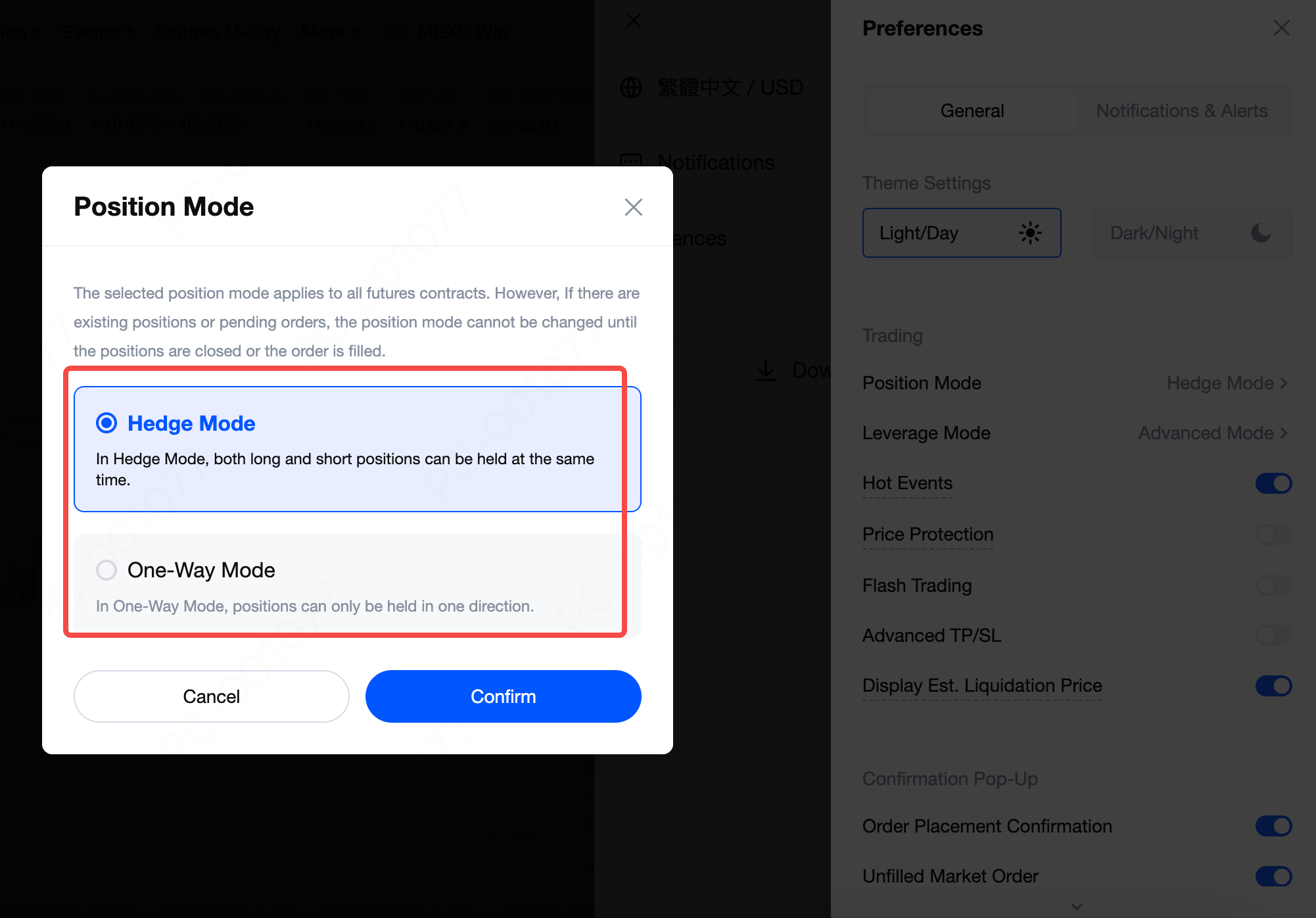


App: MEXC App → Futures → ... → Preferences → Position Mode → select Hedge Mode or One-Way Mode


Important: If you currently have open orders or positions, you cannot change the position mode. You must cancel all orders or close all positions first.

7. Which Is Better: One-Way Mode or Hedge Mode?


Both modes are designed for different trading strategies and risk preferences. The best choice depends on your trading experience, strategy requirements, and risk tolerance.

8. What Happens If I Place an Opposite Order in One-Way Mode?


If you hold a long position and place a short order, the system will offset your long position automatically.
If the short order size exceeds the existing long position, the long position will be fully closed and a new short position will be opened for the remaining amount.

9. Can Hedge Mode Be Used for Risk Hedging?


Yes. One of the main advantages of Hedge Mode is risk hedging. By holding both long and short positions, traders can reduce overall exposure during uncertain market conditions.

10. Are There Restrictions When Switching Position Modes?


Yes. If you have open orders or active positions, you cannot switch position modes. All orders must be canceled and all positions must be closed before changing modes.

11. Does Hedge Mode Require More Margin?


Yes. Since you hold two positions simultaneously, margin is required for both directions. This may increase margin requirements and capital usage.

12. Which Position Mode Should Beginners Choose?


Beginners are generally recommended to start with One-Way Mode. It is simpler, easier to manage, and helps traders focus on market direction.

13. Is Hedge Mode Better for Short-Term or Long-Term Trading?


Hedge Mode can be used in multiple scenarios, including short-term arbitrage and long-term risk management. It is particularly useful in volatile or sideways markets, or when hedging is required.


Common Questions About One-Way Mode and Hedge Mode

1. What Are One-Way Mode and Hedge Mode?


In crypto futures trading, One-Way Mode means you can only hold a position in one direction per contract. You cannot hold both long and short positions at the same time for the same trading pair.
Hedge Mode allows you to hold both long and short positions simultaneously on the same contract. The system records each position separately, and profit and loss (PNL) is calculated independently for each direction.

2. What Are the Characteristics of One-Way Mode?


Single-direction positions only: You can hold only one directional position at a time. If you place an order in the opposite direction, the system will offset your existing position.
Simplified trading strategy: Focusing on a single market view makes strategies clearer and more straightforward.
Faster entry and exit: Orders can be executed quickly without managing opposing positions, improving trading efficiency.

3. What Are the Characteristics of Hedge Mode?


Simultaneous long and short positions: You can hold both long and short positions on the same trading pair.
Flexible strategy execution: Allows you to balance exposure or adjust long and short positions based on market conditions.
Risk hedging: Maintaining positions in both directions helps manage uncertainty and volatility, reducing overall exposure to sudden price swings.

4. What Are the Key Differences Between One-Way Mode and Hedge Mode?


Position direction
  • One-Way Mode: only long or short, not both.
  • Hedge Mode: long and short simultaneously.
Strategy complexity
  • One-Way Mode is simpler and easier to manage.
  • Hedge Mode requires managing two separate positions, margins, and risks.
Flexibility
  • One-Way Mode offers limited flexibility and does not support hedging strategies that require both directions.
  • Hedge Mode supports advanced strategies such as hedging and profit locking.
Execution speed
  • One-Way Mode generally enables faster entry and exit.
  • Hedge Mode may require additional steps for complex strategies.
Risk characteristics
  • One-Way Mode concentrates risk and returns in a single direction.
  • Hedge Mode can diversify risk but requires more advanced capital management.

5. When Should I Use One-Way Mode or Hedge Mode?


One-Way Mode is suitable for: Beginner traders, trend-following strategies, and those who prefer simple position management. It works best when you have a clear directional market view.
Hedge Mode is suitable for: Experienced traders, arbitrage strategies, and long-term risk management. It is useful when market direction is uncertain or volatility is high.

6. How Do I Set One-Way Mode or Hedge Mode on MEXC?


Web:
MEXC website → Futures Trading → ⚙ Settings → Position Mode → select Hedge Mode or One-Way Mode


App: MEXC App → Futures → ... → Preferences → Position Mode → select Hedge Mode or One-Way Mode


Important: If you currently have open orders or positions, you cannot change the position mode. You must cancel all orders or close all positions first.

7. Which Is Better: One-Way Mode or Hedge Mode?


Both modes are designed for different trading strategies and risk preferences. The best choice depends on your trading experience, strategy requirements, and risk tolerance.

8. What Happens If I Place an Opposite Order in One-Way Mode?


If you hold a long position and place a short order, the system will offset your long position automatically.
If the short order size exceeds the existing long position, the long position will be fully closed and a new short position will be opened for the remaining amount.

9. Can Hedge Mode Be Used for Risk Hedging?


Yes. One of the main advantages of Hedge Mode is risk hedging. By holding both long and short positions, traders can reduce overall exposure during uncertain market conditions.

10. Are There Restrictions When Switching Position Modes?


Yes. If you have open orders or active positions, you cannot switch position modes. All orders must be canceled and all positions must be closed before changing modes.

11. Does Hedge Mode Require More Margin?


Yes. Since you hold two positions simultaneously, margin is required for both directions. This may increase margin requirements and capital usage.

12. Which Position Mode Should Beginners Choose?


Beginners are generally recommended to start with One-Way Mode. It is simpler, easier to manage, and helps traders focus on market direction.

13. Is Hedge Mode Better for Short-Term or Long-Term Trading?


Hedge Mode can be used in multiple scenarios, including short-term arbitrage and long-term risk management. It is particularly useful in volatile or sideways markets, or when hedging is required.