
Bitcoin fell below $70,000 on Friday, Asia time, for the first time since August, and well below its September high of $87,400.
The first push came from outside crypto: a tech sell-off, US data that made a December rate hike the base case, and the midterms. But when stocks bounced on Wednesday, Bitcoin didn't. And when Nvidia's CEO resigned on Thursday, the Nasdaq slipped 0.39% while Bitcoin fell about 3.5%. The selling has become crypto's own.
It has pushed Bitcoin below what its newest buyers paid. The test now is whether it can get back above it.
Bitcoin's Breakeven Test
How It Started
Tech went first. The Nasdaq fell 5.3% in October, and Nvidia shares dropped on November 9 after its board opened an independent investigation into reports that CEO Jensen Huang had been the target of a foreign intelligence effort. Three days later, Huang resigned after 33 years, with CFO Colette Kress named interim CEO. The company gave no reason. Nvidia shares fell as much as 13% at the open before closing down 4.34%.
Then the data. The US added 165,000 jobs in October against forecasts near 65,000, and October CPI rose 0.4% on the month against 0.3% expected, with core at 0.3% against 0.2%. Futures now price a Fed hike on December 9 as close to certain.
And the midterms put the crypto market structure bill on a short clock. With a new Congress taking over on January 3, it has weeks, not months, to pass before it has to start over.
Stocks Held Up. Bitcoin Didn't.
On November 11, the S&P 500 rose 1.31% and the Nasdaq 1.60%. Bitcoin stayed stuck near $73,000. A day later, as Huang stepped down, the Nasdaq slipped just 0.39% and the S&P 500 0.35%, while Bitcoin fell about 3.5% and broke below $72,000.
The money is leaving on several fronts. US spot Bitcoin ETFs posted five straight days of outflows through Wednesday, about $1.44 billion in total, and their net flows for 2026 have turned negative. Ether ETFs lost about $1.6 billion in October, their worst month of the year. Stablecoin supply, the cash that usually waits on the sidelines to buy crypto, shrank by $14.2 billion in 30 days, its fastest drop since June 2022.
Leverage added to it. More than $600 million in crypto positions were liquidated on CPI day, and about $730 million more in the 24 hours after Huang's exit.
The $75K Line
Coins bought in the past five months have an average cost of about $75,600, according to Glassnode. Bitfinex estimates that about 1.6 million BTC bought between $75,000 and $80,000 is now held at a loss.
Strategy is in the same spot. It bought another 1,036 bitcoin last week, bringing its average cost to $75,456, now above the market price. MSCI also said it will remove Strategy from its global indexes at the November 30 close. Estimates of the passive selling range from about $1.3 billion to $2.8 billion of Strategy shares, which fell about 7% at Thursday's open.
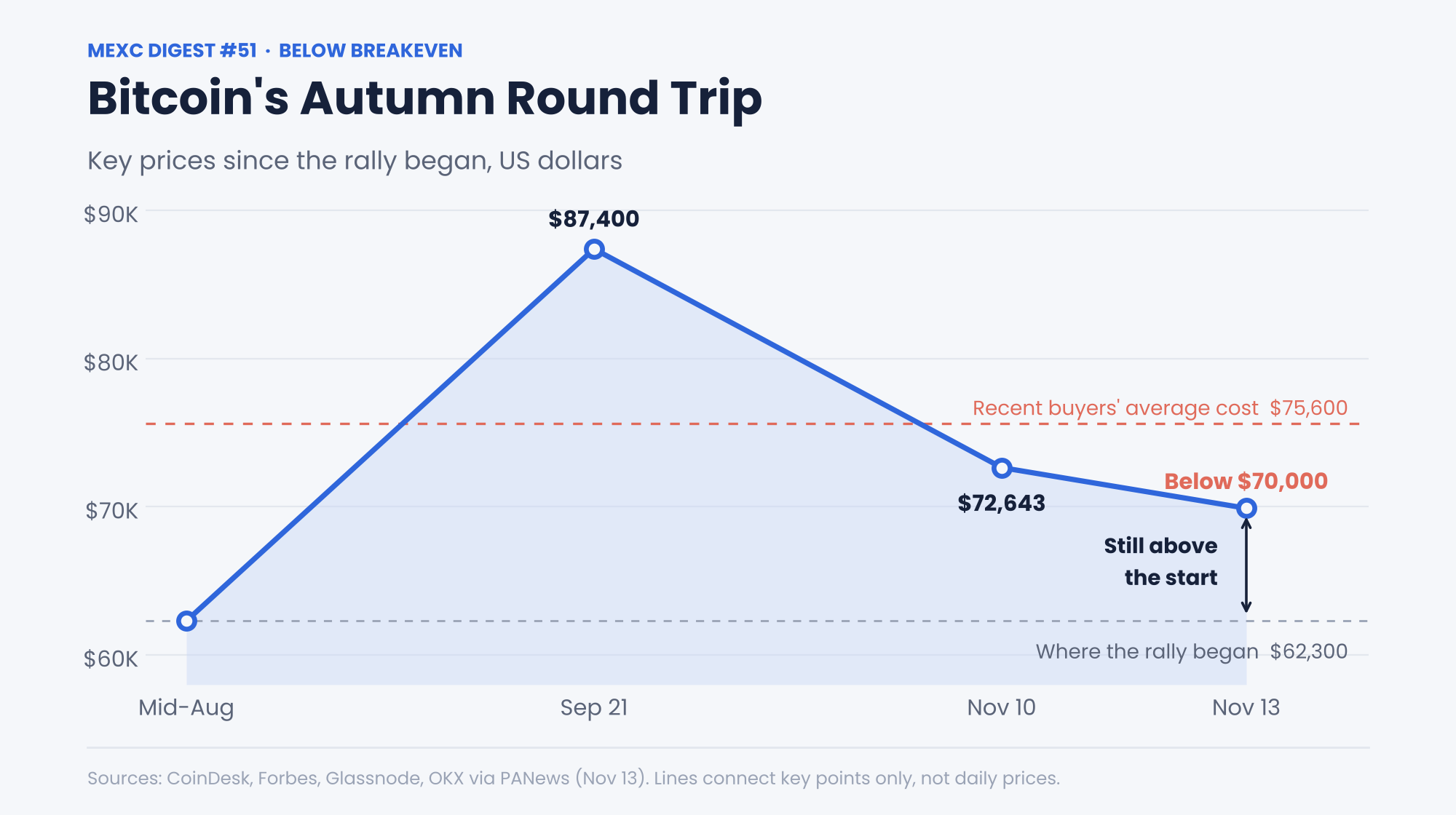
Being underwater changes behavior. Some holders sell to cut their losses. Some wait to sell once they're back to even, which can cap a bounce. Others buy more at a price they already liked. Which group wins usually decides the next move.
Not a Panic, Yet
There are reasons to think this is a reset rather than a breakdown. The autumn rally started from about $62,300 in mid-August, so even under $70,000, Bitcoin is still above where the run began. Open interest on Binance's main Bitcoin pair fell from $9.4 billion to $7.2 billion between mid-October and November 11, but only about 12% of positions actually closed, so most traders are still in.
History offers some comfort too. After each of the last three midterms, Bitcoin bottomed within about ten weeks: 71 days after the 2014 vote, 39 days after 2018 and 13 days after 2022. That's a pattern, not a promise.
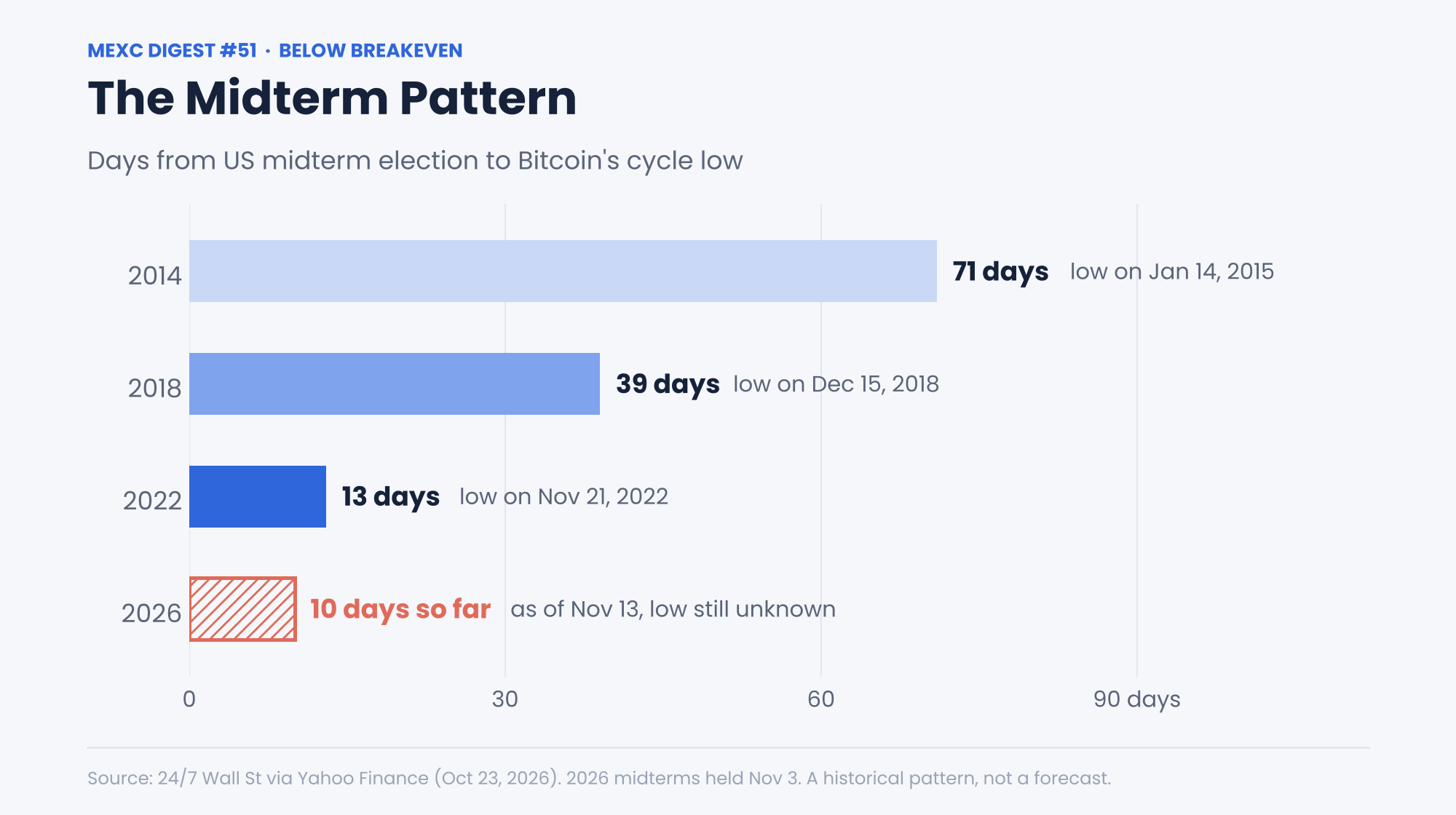
What would confirm it is visible from here: daily ETF inflows above $100 million, a December Fed statement suggesting the next hike will be the last, and a weekly close back above $70,000. That last one is already under pressure heading into the weekend.
The price has slipped below where the newest buyers got in. What they do next matters more than any headline.
Quick Hits
The NYSE picked a blockchain. The New York Stock Exchange chose Avalanche technology to settle its planned 24/7 market for tokenized stocks, running on its own Avalanche-based chain rather than the public network. AVAX rose about 8% on the news.
A first for tokenized stocks. On November 4, the first tokenized US stock trades under the SEC's new innovation exemption settled on the Canton Network.
New and Noteworthy
Canton, zero fees. Canton (CC), the network behind this month's first exempt tokenized stock trade, has a 0-Fee Carnival on MEXC with $1,000,000 up for grabs.
Matrix in the Innovation Zone. Matrix (MTX) is now listed, with 80,000 USDT in Airdrop+ rewards.
Translation
"In that case, I believe a 50 basis point hike in the policy rate should be considered at the December meeting."
Christopher Waller, Federal Reserve Governor, speaking in London, November 10, 2026
Waller set his bar for a bigger hike at core inflation of 0.3% or more. Later that day, October's core CPI came in at exactly 0.3%. A half-point hike is now on the table. The more cash pays, the harder Bitcoin has to work to compete for it.
Before You Go
Two dates to watch: Nvidia reports on November 17, its first results without Huang in charge, and MSCI's changes take effect on November 30. If this week has you picking sides between stocks and crypto, MEXC's Earnings Season Battle lets you do exactly that: join the U.S. Stocks team or the Crypto team for a share of $100,000 in rewards until December 18.
Not financial advice. We describe, you decide.