The post Google’s ‘Quantum Money’ could render blockchain unnecessary appeared on BitcoinEthereumNews.com. Google AI researchers and academics from the University of Texas at Austin and the Czech Academy of Sciences are working on a system labelled “quantum money,” a form of currency secured by the unalterable laws of physics. Google’s Quantum AI division has revived a decades-old concept that could upend the foundations of digital currency, embedded in ledger-based blockchain technology.  According to the work detailed in a new study titled “Anonymous Quantum Tokens with Classical Verification,” digital money can exist securely without relying on the technology that Bitcoin and most cryptocurrencies currently use. Blockchain’s core principle rivaled by quantum money Since Bitcoin’s whitepaper was released more than ten years ago, blockchain technology has provided the architecture for the global digital currency ecosystem. Its distributed ledger records every transaction permanently and transparently, preventing counterfeiting and double-spending automatically, out of control of any central entity.  However, Google’s new quantum framework could render that complex infrastructure unnecessary. “Quantum money” reportedly solves the same fundamental problem of making sure digital tokens cannot be duplicated or forged, but does so through quantum mechanics.  The concept rests on a quantum theory known as the no-cloning theorem, which states that it is physically impossible to make an exact copy of an unknown quantum state. If a unit of currency were represented as a quantum state, any attempt to duplicate it would fail. “If you had a $1 bill that was actually a quantum state, you could prove, based on the properties of quantum mechanics, that copying such a state is impossible. You could only succeed with very small probability,” said Dar Gilboa, a Google Quantum AI researcher and co-author of the study. Quantum technology revisits a 1960s vision The idea of quantum security was first proposed in 1969 by physicist Stephen Wiesner, who broadly explained a method for… The post Google’s ‘Quantum Money’ could render blockchain unnecessary appeared on BitcoinEthereumNews.com. Google AI researchers and academics from the University of Texas at Austin and the Czech Academy of Sciences are working on a system labelled “quantum money,” a form of currency secured by the unalterable laws of physics. Google’s Quantum AI division has revived a decades-old concept that could upend the foundations of digital currency, embedded in ledger-based blockchain technology.  According to the work detailed in a new study titled “Anonymous Quantum Tokens with Classical Verification,” digital money can exist securely without relying on the technology that Bitcoin and most cryptocurrencies currently use. Blockchain’s core principle rivaled by quantum money Since Bitcoin’s whitepaper was released more than ten years ago, blockchain technology has provided the architecture for the global digital currency ecosystem. Its distributed ledger records every transaction permanently and transparently, preventing counterfeiting and double-spending automatically, out of control of any central entity.  However, Google’s new quantum framework could render that complex infrastructure unnecessary. “Quantum money” reportedly solves the same fundamental problem of making sure digital tokens cannot be duplicated or forged, but does so through quantum mechanics.  The concept rests on a quantum theory known as the no-cloning theorem, which states that it is physically impossible to make an exact copy of an unknown quantum state. If a unit of currency were represented as a quantum state, any attempt to duplicate it would fail. “If you had a $1 bill that was actually a quantum state, you could prove, based on the properties of quantum mechanics, that copying such a state is impossible. You could only succeed with very small probability,” said Dar Gilboa, a Google Quantum AI researcher and co-author of the study. Quantum technology revisits a 1960s vision The idea of quantum security was first proposed in 1969 by physicist Stephen Wiesner, who broadly explained a method for…

Google’s ‘Quantum Money’ could render blockchain unnecessary

2025/11/04 19:37

Google AI researchers and academics from the University of Texas at Austin and the Czech Academy of Sciences are working on a system labelled “quantum money,” a form of currency secured by the unalterable laws of physics.

Google’s Quantum AI division has revived a decades-old concept that could upend the foundations of digital currency, embedded in ledger-based blockchain technology. 

According to the work detailed in a new study titled “Anonymous Quantum Tokens with Classical Verification,” digital money can exist securely without relying on the technology that Bitcoin and most cryptocurrencies currently use.

Blockchain’s core principle rivaled by quantum money

Since Bitcoin’s whitepaper was released more than ten years ago, blockchain technology has provided the architecture for the global digital currency ecosystem. Its distributed ledger records every transaction permanently and transparently, preventing counterfeiting and double-spending automatically, out of control of any central entity. 

However, Google’s new quantum framework could render that complex infrastructure unnecessary. “Quantum money” reportedly solves the same fundamental problem of making sure digital tokens cannot be duplicated or forged, but does so through quantum mechanics. 

The concept rests on a quantum theory known as the no-cloning theorem, which states that it is physically impossible to make an exact copy of an unknown quantum state. If a unit of currency were represented as a quantum state, any attempt to duplicate it would fail.

“If you had a $1 bill that was actually a quantum state, you could prove, based on the properties of quantum mechanics, that copying such a state is impossible. You could only succeed with very small probability,” said Dar Gilboa, a Google Quantum AI researcher and co-author of the study.

Quantum technology revisits a 1960s vision

The idea of quantum security was first proposed in 1969 by physicist Stephen Wiesner, who broadly explained a method for minting “private-key quantum money” that could not be counterfeited. 

Wiesner’s paper, published in 1983, imagined each banknote as a unique quantum state paired with a serial number, which only the issuing mint could verify. He kick-started an interest that led to more developments, which studied the possibility of public-key quantum money, or tokens that anyone could verify without consulting the issuer. 

However, models, including those proposed by theoretical computer scientist Scott Aaronson, were less actionable and largely insecure. Researchers have since diverted to “collision-free” schemes where each quantum bill has a unique serial number that not even the mint could duplicate, preventing over-issuance of currency.

“We’re not solving the same problem,” Gilboa said. “What we’re doing isn’t decentralized, so it’s not really an analog of cryptocurrencies in any strong sense. The no-cloning theorem gives us hope that quantum information could be used as the basis of a better kind of money.

The Google proposal discusses having a trusted central issuer, such as a bank or government institution, responsible for creating and validating quantum tokens. Much different from today’s fiat systems, the issuer would have no ability to track how the money circulates. 

Users can perform a “swap test” on their tokens to detect if the issuer is secretly tagging or tracing them. “If they’re not identical, that means the bank could be tracking you. Any attempt by the bank to secretly tag its money would be instantly revealed,” Gilboa explained.

In late October, Google’s quantum research team announced that its latest quantum computer had achieved a computational breakthrough, executing a task beyond the capabilities of classical machines.

The algorithm computed the structure of a molecule and ran 13,000 times faster than conventional computers, demonstrating what scientists call “quantum advantage.” 

Quantum technology has its promises, but more limitations

According to Winfried Hensinger, professor of quantum technologies at the University of Sussex, the experiment achieved a task that is clearly impossible for classical machines, but it is not quite there yet when it comes to real-world applications.

Even Google admitted that practical quantum computers, capable of performing large-scale computations and supporting technologies like quantum money, are still years away. Fully fault-tolerant machines would need hundreds of thousands of quantum bits, far beyond what the experimental systems can endure.

Get seen where it counts. Advertise in Cryptopolitan Research and reach crypto’s sharpest investors and builders.

Source: https://www.cryptopolitan.com/googles-quantum-money-blockchain-obsolete/

Sorumluluk Reddi: Bu sitede yeniden yayınlanan makaleler, halka açık platformlardan alınmıştır ve yalnızca bilgilendirme amaçlıdır. MEXC'nin görüşlerini yansıtmayabilir. Tüm hakları telif sahiplerine aittir. Herhangi bir içeriğin üçüncü taraf haklarını ihlal ettiğini düşünüyorsanız, kaldırılması için lütfen service@support.mexc.com ile iletişime geçin. MEXC, içeriğin doğruluğu, eksiksizliği veya güncelliği konusunda hiçbir garanti vermez ve sağlanan bilgilere dayalı olarak alınan herhangi bir eylemden sorumlu değildir. İçerik, finansal, yasal veya diğer profesyonel tavsiye niteliğinde değildir ve MEXC tarafından bir tavsiye veya onay olarak değerlendirilmemelidir.

Ayrıca Şunları da Beğenebilirsiniz

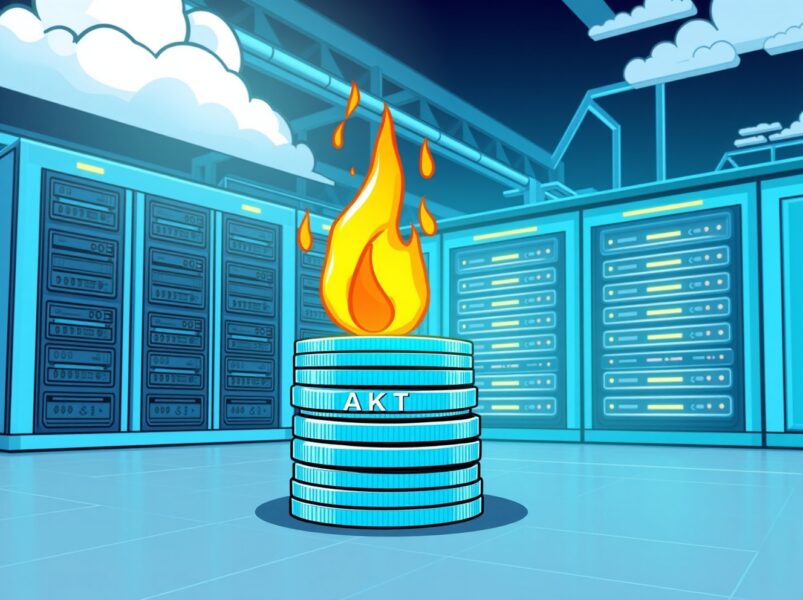
Akash Network’s Strategic Move: A Crucial Burn for AKT’s Future

Akash Network’s Strategic Move: A Crucial Burn for AKT’s Future

BitcoinWorld Akash Network’s Strategic Move: A Crucial Burn for AKT’s Future In the dynamic world of decentralized computing, exciting developments are constantly shaping the future. Today, all eyes are on Akash Network, the innovative supercloud project, as it proposes a significant change to its tokenomics. This move aims to strengthen the value of its native token, AKT, and further solidify its position in the competitive blockchain space. The community is buzzing about a newly submitted governance proposal that could introduce a game-changing Burn Mint Equilibrium (BME) model. What is the Burn Mint Equilibrium (BME) for Akash Network? The core of this proposal revolves around a concept called Burn Mint Equilibrium, or BME. Essentially, this model is designed to create a balance in the token’s circulating supply by systematically removing a portion of tokens from existence. For Akash Network, this means burning an amount of AKT that is equivalent to the U.S. dollar value of fees paid by network users. Fee Conversion: When users pay for cloud services on the Akash Network, these fees are typically collected in various cryptocurrencies or stablecoins. AKT Equivalence: The proposal suggests converting the U.S. dollar value of these collected fees into an equivalent amount of AKT. Token Burn: This calculated amount of AKT would then be permanently removed from circulation, or ‘burned’. This mechanism creates a direct link between network utility and token supply reduction. As more users utilize the decentralized supercloud, more AKT will be burned, potentially impacting the token’s scarcity and value. Why is This Proposal Crucial for AKT Holders? For anyone holding AKT, or considering investing in the Akash Network ecosystem, this proposal carries significant weight. Token burning mechanisms are often viewed as a positive development because they can lead to increased scarcity. When supply decreases while demand remains constant or grows, the price per unit tends to increase. Here are some key benefits: Increased Scarcity: Burning tokens reduces the total circulating supply of AKT. This makes each remaining token potentially more valuable over time. Demand-Supply Dynamics: The BME model directly ties the burning of AKT to network usage. Higher adoption of the Akash Network supercloud translates into more fees, and thus more AKT burned. Long-Term Value Proposition: By creating a deflationary pressure, the proposal aims to enhance AKT’s long-term value, making it a more attractive asset for investors and long-term holders. This strategic move demonstrates a commitment from the Akash Network community to optimize its tokenomics for sustainable growth and value appreciation. How Does BME Impact the Decentralized Supercloud Mission? Beyond token value, the BME proposal aligns perfectly with the broader mission of the Akash Network. As a decentralized supercloud, Akash provides a marketplace for cloud computing resources, allowing users to deploy applications faster, more efficiently, and at a lower cost than traditional providers. The BME model reinforces this utility. Consider these impacts: Network Health: A stronger AKT token can incentivize more validators and providers to secure and contribute resources to the network, improving its overall health and resilience. Ecosystem Growth: Enhanced token value can attract more developers and projects to build on the Akash Network, fostering a vibrant and diverse ecosystem. User Incentive: While users pay fees, the potential appreciation of AKT could indirectly benefit those who hold the token, creating a circular economy within the supercloud. This proposal is not just about burning tokens; it’s about building a more robust, self-sustaining, and economically sound decentralized cloud infrastructure for the future. What Are the Next Steps for the Akash Network Community? As a governance proposal, the BME model will now undergo a period of community discussion and voting. This is a crucial phase where AKT holders and network participants can voice their opinions, debate the merits, and ultimately decide on the future direction of the project. Transparency and community engagement are hallmarks of decentralized projects like Akash Network. Challenges and Considerations: Implementation Complexity: Ensuring the burning mechanism is technically sound and transparent will be vital. Community Consensus: Achieving broad agreement within the diverse Akash Network community is key for successful adoption. The outcome of this vote will significantly shape the tokenomics and economic model of the Akash Network, influencing its trajectory in the rapidly evolving decentralized cloud landscape. The proposal to introduce a Burn Mint Equilibrium model represents a bold and strategic step for Akash Network. By directly linking network usage to token scarcity, the project aims to create a more resilient and valuable AKT token, ultimately strengthening its position as a leading decentralized supercloud provider. This move underscores the project’s commitment to innovative tokenomics and sustainable growth, promising an exciting future for both users and investors in the Akash Network ecosystem. It’s a clear signal that Akash is actively working to enhance its value proposition and maintain its competitive edge in the decentralized future. Frequently Asked Questions (FAQs) 1. What is the main goal of the Burn Mint Equilibrium (BME) proposal for Akash Network? The primary goal is to adjust the circulating supply of AKT tokens by burning a portion of network fees, thereby creating deflationary pressure and potentially enhancing the token’s long-term value and scarcity. 2. How will the amount of AKT to be burned be determined? The proposal suggests burning an amount of AKT equivalent to the U.S. dollar value of fees paid by users on the Akash Network for cloud services. 3. What are the potential benefits for AKT token holders? Token holders could benefit from increased scarcity of AKT, which may lead to higher demand and appreciation in value over time, especially as network usage grows. 4. How does this proposal relate to the overall mission of Akash Network? The BME model reinforces the Akash Network‘s mission by creating a stronger, more economically robust ecosystem. A healthier token incentivizes network participants, fostering growth and stability for the decentralized supercloud. 5. What is the next step for this governance proposal? The proposal will undergo a period of community discussion and voting by AKT token holders. The community’s decision will determine if the BME model is implemented on the Akash Network. If you found this article insightful, consider sharing it with your network! Your support helps us bring more valuable insights into the world of decentralized technology. Stay informed and help spread the word about the exciting developments happening within Akash Network. To learn more about the latest crypto market trends, explore our article on key developments shaping decentralized cloud solutions price action. This post Akash Network’s Strategic Move: A Crucial Burn for AKT’s Future first appeared on BitcoinWorld.
Paylaş
Coinstats2025/09/22 21:35