Polygon launches the Madhugiri Hardfork, boosting throughput, enhancing stability, and enabling seamless future upgrades across its PoS network. Polygon has initiated a major network upgrade designed to strengthen stability and improve performance. The Madhugiri Hardfork increases the throughput by 33%, while making it possible to increase speed further in future without disruptive procedures. Polygon’s Madhugiri […] The post Polygon Improves Stability with New Hardfork Rollout appeared first on Live Bitcoin News.Polygon launches the Madhugiri Hardfork, boosting throughput, enhancing stability, and enabling seamless future upgrades across its PoS network. Polygon has initiated a major network upgrade designed to strengthen stability and improve performance. The Madhugiri Hardfork increases the throughput by 33%, while making it possible to increase speed further in future without disruptive procedures. Polygon’s Madhugiri […] The post Polygon Improves Stability with New Hardfork Rollout appeared first on Live Bitcoin News.

Polygon Improves Stability with New Hardfork Rollout

2025/12/09 19:45

Polygon launches the Madhugiri Hardfork, boosting throughput, enhancing stability, and enabling seamless future upgrades across its PoS network.

Polygon has initiated a major network upgrade designed to strengthen stability and improve performance. The Madhugiri Hardfork increases the throughput by 33%, while making it possible to increase speed further in future without disruptive procedures.

Polygon’s Madhugiri Upgrade Marks Critical Technical Shift

Background work on this upgrade began with previous forks pointing out some structural limitations. Polygon set out to make adjustments to performance easier and make the lives of validators easier. Several previous improvements led to solid foundations and this latest fork improves on those lessons, according to developer statements and technical reports.

Related Reading: BDACS Expands KRW1 Stablecoin to Polygon Network | Live Bitcoin News

The planned deployment time the around 10 a.m. UTC on December 9. The update brings with it faster synchronization of nodes, improved reliability of block production, and stronger characteristics of protecting the execution layer. It also brings support for Fusaka EIPs of Ethereum that reinforce cross-chain security practices.

In addition, some important proposals are present in the hardfork. These include PIP-75 for the one-second time for consensus and PIP-74 for regulated StateSync inclusion. It also includes the cost increases for ModExp (EIP-7883), gas limit caps (EIP-7825), and upper bounds on MODEXP (EIP-7823). These include components that are designed to increase resiliency and protect operations during heavy cycles of use.

Broader Network Enhancements Reshape Polygon PoS Direction

Earlier upgrades paved the way for this development. Heimdall v2, released in early 2025, tried to lower the finality to five seconds and rectify technical limitations that had existed for some time now. Despite one disruption, it progressed the chain faster toward coordination. The Bhilai Hardfork in July increased throughput past one thousand transactions per second and adopted the Pectra EIPs of Ethereum.

Polygon went on to release the Rio upgrade in October. That update introduced the Validator-Elected Block Producer model, which simplified the block-formation process and increased expectations overall. Rio also started to implement stateless validation and modification of incentives to validators. These redesigns help Polygon now with its ambition to be the leader of the global payments infrastructure.

The combination of these upgrades increases the platform reliability. Rio’s design reduces the amount of reorganization that would have to happen and Madhugiri creates better finality and accommodates later throughput extensions. Stateless validation also lowers hardware requirements, which opens up participation and lowers operation barriers.
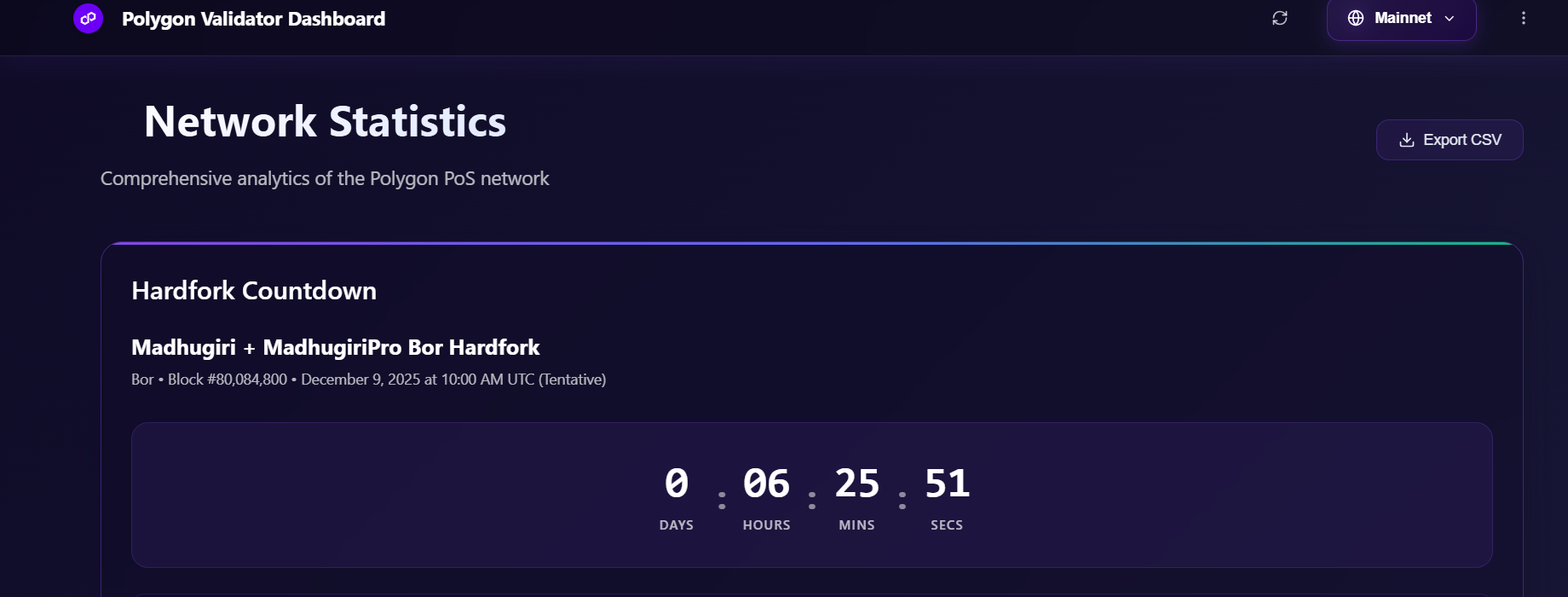
Polygon launches the Madhugiri Hardfork, boosting throughput, enhancing stability, and enabling seamless future upgrades across its PoS network.                                                                    Source: X

Therefore, Polygon puts itself in the position of high-volume payment traffic. Developers emphasize possible speeds in the five thousand transactions/supported by architecture suited to stablecoin transfers and real-world asset systems.

Polygon Hardfork Paves Way for Faster, Scalable Transactions

The current upgrade is also related to the ongoing GigaGas road map. Engineers are shooting for long-term capacity of up to one hundred thousand transactions per second. To achieve that goal, further protocol segmentation and redesigned bridge components are required. Future iterations might separate the consensus from the cross-chain operation to mitigate the risk and increase modularity.

Polygon’s continued evolution shows its attempt at developing a sustainable layer for the world’s settlements. Faster confirmation, steady throughput, as well as decreased validator power, help with business adoption as well as with payment integration. These improvements also come with the ability to carry out orderly liquidation processes when markets are in some measure of stress due to the uniformity of execution and predictable settlement conditions.

With the upgrades, Polygon enhances its capacity to support enterprises with stable performance requirements. This hardfork is continuing that path forward with the ability to increase speed in the future through simple configuration changes, another step on the roadmap for the development of the technical aspects of the platform.

The post Polygon Improves Stability with New Hardfork Rollout appeared first on Live Bitcoin News.

Sorumluluk Reddi: Bu sitede yeniden yayınlanan makaleler, halka açık platformlardan alınmıştır ve yalnızca bilgilendirme amaçlıdır. MEXC'nin görüşlerini yansıtmayabilir. Tüm hakları telif sahiplerine aittir. Herhangi bir içeriğin üçüncü taraf haklarını ihlal ettiğini düşünüyorsanız, kaldırılması için lütfen service@support.mexc.com ile iletişime geçin. MEXC, içeriğin doğruluğu, eksiksizliği veya güncelliği konusunda hiçbir garanti vermez ve sağlanan bilgilere dayalı olarak alınan herhangi bir eylemden sorumlu değildir. İçerik, finansal, yasal veya diğer profesyonel tavsiye niteliğinde değildir ve MEXC tarafından bir tavsiye veya onay olarak değerlendirilmemelidir.

Ayrıca Şunları da Beğenebilirsiniz

The Channel Factories We’ve Been Waiting For

The Channel Factories We’ve Been Waiting For

The post The Channel Factories We’ve Been Waiting For appeared on BitcoinEthereumNews.com. Visions of future technology are often prescient about the broad strokes while flubbing the details. The tablets in “2001: A Space Odyssey” do indeed look like iPads, but you never see the astronauts paying for subscriptions or wasting hours on Candy Crush.  Channel factories are one vision that arose early in the history of the Lightning Network to address some challenges that Lightning has faced from the beginning. Despite having grown to become Bitcoin’s most successful layer-2 scaling solution, with instant and low-fee payments, Lightning’s scale is limited by its reliance on payment channels. Although Lightning shifts most transactions off-chain, each payment channel still requires an on-chain transaction to open and (usually) another to close. As adoption grows, pressure on the blockchain grows with it. The need for a more scalable approach to managing channels is clear. Channel factories were supposed to meet this need, but where are they? In 2025, subnetworks are emerging that revive the impetus of channel factories with some new details that vastly increase their potential. They are natively interoperable with Lightning and achieve greater scale by allowing a group of participants to open a shared multisig UTXO and create multiple bilateral channels, which reduces the number of on-chain transactions and improves capital efficiency. Achieving greater scale by reducing complexity, Ark and Spark perform the same function as traditional channel factories with new designs and additional capabilities based on shared UTXOs.  Channel Factories 101 Channel factories have been around since the inception of Lightning. A factory is a multiparty contract where multiple users (not just two, as in a Dryja-Poon channel) cooperatively lock funds in a single multisig UTXO. They can open, close and update channels off-chain without updating the blockchain for each operation. Only when participants leave or the factory dissolves is an on-chain transaction…
Paylaş
BitcoinEthereumNews2025/09/18 00:09
American Bitcoin’s $5B Nasdaq Debut Puts Trump-Backed Miner in Crypto Spotlight

American Bitcoin’s $5B Nasdaq Debut Puts Trump-Backed Miner in Crypto Spotlight

The post American Bitcoin’s $5B Nasdaq Debut Puts Trump-Backed Miner in Crypto Spotlight appeared on BitcoinEthereumNews.com. Key Takeaways: American Bitcoin (ABTC) surged nearly 85% on its Nasdaq debut, briefly reaching a $5B valuation. The Trump family, alongside Hut 8 Mining, controls 98% of the newly merged crypto-mining entity. Eric Trump called Bitcoin “modern-day gold,” predicting it could reach $1 million per coin. American Bitcoin, a fast-rising crypto mining firm with strong political and institutional backing, has officially entered Wall Street. After merging with Gryphon Digital Mining, the company made its Nasdaq debut under the ticker ABTC, instantly drawing global attention to both its stock performance and its bold vision for Bitcoin’s future. Read More: Trump-Backed Crypto Firm Eyes Asia for Bold Bitcoin Expansion Nasdaq Debut: An Explosive First Day ABTC’s first day of trading proved as dramatic as expected. Shares surged almost 85% at the open, touching a peak of $14 before settling at lower levels by the close. That initial spike valued the company around $5 billion, positioning it as one of 2025’s most-watched listings. At the last session, ABTC has been trading at $7.28 per share, which is a small positive 2.97% per day. Although the price has decelerated since opening highs, analysts note that the company has been off to a strong start and early investor activity is a hard-to-find feat in a newly-launched crypto mining business. According to market watchers, the listing comes at a time of new momentum in the digital asset markets. With Bitcoin trading above $110,000 this quarter, American Bitcoin’s entry comes at a time when both institutional investors and retail traders are showing heightened interest in exposure to Bitcoin-linked equities. Ownership Structure: Trump Family and Hut 8 at the Helm Its management and ownership set up has increased the visibility of the company. The Trump family and the Canadian mining giant Hut 8 Mining jointly own 98 percent…
Paylaş
BitcoinEthereumNews2025/09/18 01:33