The 2026 Playbook: Autonomous Markets, Smarter Liquidity, and a New Era of On-Chain IntelligenceFuturistic AI neural brain hovering above digital crypto tradingThe 2026 Playbook: Autonomous Markets, Smarter Liquidity, and a New Era of On-Chain IntelligenceFuturistic AI neural brain hovering above digital crypto trading

Why AI-Powered Trading Agents Will Redefine Crypto Markets in 2026

2025/12/12 23:52

The 2026 Playbook: Autonomous Markets, Smarter Liquidity, and a New Era of On-Chain Intelligence

Futuristic AI neural brain hovering above digital crypto trading charts, neon blue and purple colors, glowing data streams, ultra-detailed, high contrast, cyberpunk style

📌 Introduction: 2026 Will Be the Year Crypto Starts Trading With Itself

If 2024–2025 was the era of LLMs writing code, answering emails, and powering chatbots, then 2026 will be the year AI starts trading crypto — autonomously, intelligently, and at scale.

Not the bots we have today.
Not the “RSI + MACD” scripts running on Binance.
Not the noisy Telegram indicators.

I’m talking about AI trading agents — autonomous decision-making systems built on top of advanced models that can:

  • read on-chain data in real time,
  • interpret news and social sentiment instantly,
  • execute trades without human prompts,
  • learn from mistakes,
  • adapt to new market regimes.

By 2026, these agents will not just join the market.
They will reshape it.

This article breaks down why, how, and what comes next — in simple, practical language.

1. The Shift: From Trading Algorithms to Autonomous AI Agents

Today’s automated trading tools work like this:

IF A happens → THEN execute B.
They are fixed, predictable, rigid, and easy to beat.

But AI-powered agents operate differently:

✅ They observe

Price, volumes, options data, on-chain flows, wallets movements.

✅ They interpret

News, X/Twitter sentiment, whale behavior, macro trends.

✅ They self-train

Each mistake becomes training data.

✅ They act autonomously

They open, adjust, and close trades with zero prompts.

This difference is massive:
agents evolve; bots repeat.

That’s why 2026 will be a turning point.

2. Why Crypto Is the Perfect Environment for AI Agents

Traditional finance moves slowly — regulation, clearing times, limited access to real-time data.

Crypto is the opposite.

🔹 1. 24/7 markets → perfect for autonomous agents

AI doesn’t sleep. Humans do. Markets don’t wait.

🔹 2. Public, open, real-time data

Every transaction on-chain becomes free training fuel.

🔹 3. High volatility

Agents thrive in fast-changing environments where humans get emotional.

🔹 4. Permissionless execution

No gatekeepers. No brokers. No delays.

🔹 5. Composable infrastructure

AI agents can directly interact with smart contracts, DEXs, L2s, bridges and liquidity pools.

Crypto is not just suitable for AI trading — 
it is the ideal playground.

3. What AI-Powered Agents Will Actually Do in 2026

Here’s what will go mainstream:

📌 A. Real-Time Autonomous Trading Strategies

Agents will run strategies no human can track manually:

  • volatility harvesting
  • correlation breakdown detection
  • cross-chain arbitrage
  • liquidity rotation tracking
  • whale shadowing
  • gas-efficient execution
  • micro-trend scalping

All automated. All adaptive.

📌 B. On-Chain Event Prediction

Agents will identify:

  • rug-pull probability
  • smart-contract attack patterns
  • liquidity withdrawal risks
  • wallet behavior anomalies
  • governance attack signals

This unlocks defensive and predictive strategies never available to retail traders.

📌 C. Sentiment-Driven Execution

2026 agents will read:

  • X/Twitter
  • news feeds
  • Reddit
  • Telegram groups
  • blog posts
  • GitHub commits
  • Discord chats

…and adjust their trades instantly.

Humans process information slowly.
Agents process the entire internet in seconds.

📌 D. Portfolio Management Without Human Emotion

Agents will rebalance portfolios automatically based on:

  • macro indicators
  • volatility spikes
  • crypto → stablecoin rotations
  • DeFi yield changes
  • market regime shifts

No fear.
No greed.
No revenge trading.
No FOMO.

📌 E. Multi-Agent Systems (the biggest trend of 2026)

The future is not one agent.
It’s a team of specialized agents, each with a role:

  • Analyst Agent
  • Risk Agent
  • Execution Agent
  • On-Chain Monitoring Agent
  • Portfolio Agent

They will communicate with each other and vote on decisions.

This is already starting in early prototypes.
In 2026 it becomes mainstream.

4. The Impact: How Markets Will Change

🔹 Liquidity becomes faster and smarter

Agents will move liquidity before humans even notice the trend.

🔹 Market inefficiencies disappear quicker

Arbitrage will last seconds, not minutes.

🔹 Short-term volatility increases

Agents react instantly → micro swings get sharper.

🔹 Long-term trends become smoother

Macro decisions will be data-driven, not emotional.

🔹 Retail traders get crushed — unless they use agents too

This is the most important outcome:
You won’t be competing with other humans anymore.
You will be competing with machines.

5. Why 2026 — Not 2030 — Is the Turning Point

Three technological shifts will mature specifically by 2026:

1. Local & edge LLMs become cheap

Trading agents will run on:

  • your laptop
  • mobile devices
  • home servers

This reduces cost close to zero.

2. On-chain AI tools become mature

Projects like:

  • Fetch.AI
  • Autonolas
  • Morpheus
  • Ritual
  • Arkham Intelligence
  • AI-DeFi execution protocols

…will become production-ready.

3. Latency + gas optimization improves with L2s

Fast rollups + AI agents = unbeatable execution speed.

6. Risks: AI Agents Will Not Fix Everything

2026 won’t be perfect. Expect:

❗ Flash-crash–like events

Highly reactive agents may trigger chain reactions.

❗ AI agents fighting each other

Strategy collisions will cause short-term chaos.

❗ Black-box models

You can’t fully understand their reasoning.

❗ Regulatory reactions

Governments will intervene — slowly but inevitably.

But the trend is unstoppable.

7. Final Forecast: What Will Happen First

Here’s my prediction for 2026 — in order:

  1. Retail AI agents go mainstream
    Simple plug-and-play consumer tools.

2. On-chain autonomous execution grows
DEXs will have built-in “agent mode”.

3. AI-driven liquidity wars
Protocols will use agents to fight for TVL.

4. Multi-agent trading systems dominate professional trading
Hedge funds → early adopters.

5. AI agents become the core of market microstructure
Bid/ask spreads, liquidity depth, and price discovery become AI-mediated.

By the end of 2026, the crypto market will look nothing like 2024.

Conclusion: The Markets of 2026 Won’t Wait for Humans

AI trading agents are not “coming”.

They’re already here — quietly learning, preparing, and improving.

2026 will be the year they step into the spotlight and start redefining how crypto markets move, react, and grow.

For traders, builders, and investors, the question is no longer:

“Will AI change crypto?”
but
“Are you prepared for the markets when AI becomes the dominant player?”


Why AI-Powered Trading Agents Will Redefine Crypto Markets in 2026 was originally published in Coinmonks on Medium, where people are continuing the conversation by highlighting and responding to this story.

Sorumluluk Reddi: Bu sitede yeniden yayınlanan makaleler, halka açık platformlardan alınmıştır ve yalnızca bilgilendirme amaçlıdır. MEXC'nin görüşlerini yansıtmayabilir. Tüm hakları telif sahiplerine aittir. Herhangi bir içeriğin üçüncü taraf haklarını ihlal ettiğini düşünüyorsanız, kaldırılması için lütfen service@support.mexc.com ile iletişime geçin. MEXC, içeriğin doğruluğu, eksiksizliği veya güncelliği konusunda hiçbir garanti vermez ve sağlanan bilgilere dayalı olarak alınan herhangi bir eylemden sorumlu değildir. İçerik, finansal, yasal veya diğer profesyonel tavsiye niteliğinde değildir ve MEXC tarafından bir tavsiye veya onay olarak değerlendirilmemelidir.

Ayrıca Şunları da Beğenebilirsiniz

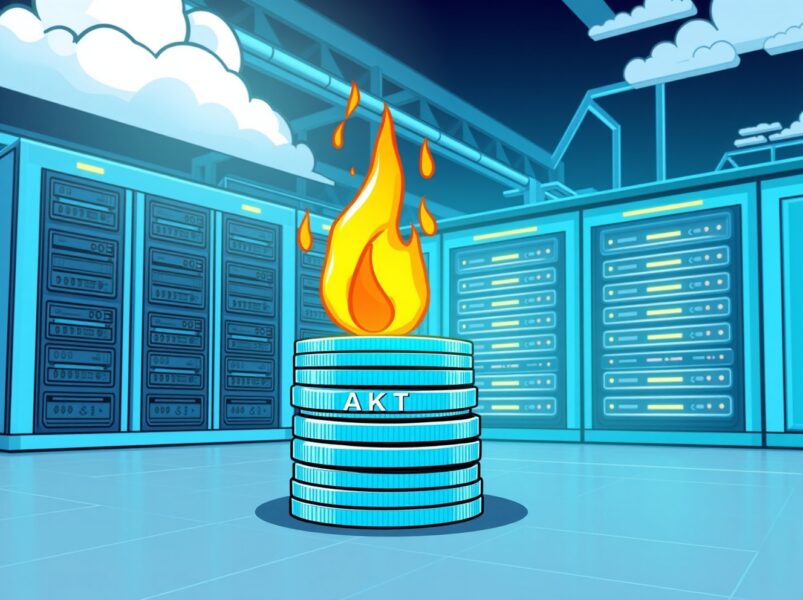
Akash Network’s Strategic Move: A Crucial Burn for AKT’s Future

Akash Network’s Strategic Move: A Crucial Burn for AKT’s Future

BitcoinWorld Akash Network’s Strategic Move: A Crucial Burn for AKT’s Future In the dynamic world of decentralized computing, exciting developments are constantly shaping the future. Today, all eyes are on Akash Network, the innovative supercloud project, as it proposes a significant change to its tokenomics. This move aims to strengthen the value of its native token, AKT, and further solidify its position in the competitive blockchain space. The community is buzzing about a newly submitted governance proposal that could introduce a game-changing Burn Mint Equilibrium (BME) model. What is the Burn Mint Equilibrium (BME) for Akash Network? The core of this proposal revolves around a concept called Burn Mint Equilibrium, or BME. Essentially, this model is designed to create a balance in the token’s circulating supply by systematically removing a portion of tokens from existence. For Akash Network, this means burning an amount of AKT that is equivalent to the U.S. dollar value of fees paid by network users. Fee Conversion: When users pay for cloud services on the Akash Network, these fees are typically collected in various cryptocurrencies or stablecoins. AKT Equivalence: The proposal suggests converting the U.S. dollar value of these collected fees into an equivalent amount of AKT. Token Burn: This calculated amount of AKT would then be permanently removed from circulation, or ‘burned’. This mechanism creates a direct link between network utility and token supply reduction. As more users utilize the decentralized supercloud, more AKT will be burned, potentially impacting the token’s scarcity and value. Why is This Proposal Crucial for AKT Holders? For anyone holding AKT, or considering investing in the Akash Network ecosystem, this proposal carries significant weight. Token burning mechanisms are often viewed as a positive development because they can lead to increased scarcity. When supply decreases while demand remains constant or grows, the price per unit tends to increase. Here are some key benefits: Increased Scarcity: Burning tokens reduces the total circulating supply of AKT. This makes each remaining token potentially more valuable over time. Demand-Supply Dynamics: The BME model directly ties the burning of AKT to network usage. Higher adoption of the Akash Network supercloud translates into more fees, and thus more AKT burned. Long-Term Value Proposition: By creating a deflationary pressure, the proposal aims to enhance AKT’s long-term value, making it a more attractive asset for investors and long-term holders. This strategic move demonstrates a commitment from the Akash Network community to optimize its tokenomics for sustainable growth and value appreciation. How Does BME Impact the Decentralized Supercloud Mission? Beyond token value, the BME proposal aligns perfectly with the broader mission of the Akash Network. As a decentralized supercloud, Akash provides a marketplace for cloud computing resources, allowing users to deploy applications faster, more efficiently, and at a lower cost than traditional providers. The BME model reinforces this utility. Consider these impacts: Network Health: A stronger AKT token can incentivize more validators and providers to secure and contribute resources to the network, improving its overall health and resilience. Ecosystem Growth: Enhanced token value can attract more developers and projects to build on the Akash Network, fostering a vibrant and diverse ecosystem. User Incentive: While users pay fees, the potential appreciation of AKT could indirectly benefit those who hold the token, creating a circular economy within the supercloud. This proposal is not just about burning tokens; it’s about building a more robust, self-sustaining, and economically sound decentralized cloud infrastructure for the future. What Are the Next Steps for the Akash Network Community? As a governance proposal, the BME model will now undergo a period of community discussion and voting. This is a crucial phase where AKT holders and network participants can voice their opinions, debate the merits, and ultimately decide on the future direction of the project. Transparency and community engagement are hallmarks of decentralized projects like Akash Network. Challenges and Considerations: Implementation Complexity: Ensuring the burning mechanism is technically sound and transparent will be vital. Community Consensus: Achieving broad agreement within the diverse Akash Network community is key for successful adoption. The outcome of this vote will significantly shape the tokenomics and economic model of the Akash Network, influencing its trajectory in the rapidly evolving decentralized cloud landscape. The proposal to introduce a Burn Mint Equilibrium model represents a bold and strategic step for Akash Network. By directly linking network usage to token scarcity, the project aims to create a more resilient and valuable AKT token, ultimately strengthening its position as a leading decentralized supercloud provider. This move underscores the project’s commitment to innovative tokenomics and sustainable growth, promising an exciting future for both users and investors in the Akash Network ecosystem. It’s a clear signal that Akash is actively working to enhance its value proposition and maintain its competitive edge in the decentralized future. Frequently Asked Questions (FAQs) 1. What is the main goal of the Burn Mint Equilibrium (BME) proposal for Akash Network? The primary goal is to adjust the circulating supply of AKT tokens by burning a portion of network fees, thereby creating deflationary pressure and potentially enhancing the token’s long-term value and scarcity. 2. How will the amount of AKT to be burned be determined? The proposal suggests burning an amount of AKT equivalent to the U.S. dollar value of fees paid by users on the Akash Network for cloud services. 3. What are the potential benefits for AKT token holders? Token holders could benefit from increased scarcity of AKT, which may lead to higher demand and appreciation in value over time, especially as network usage grows. 4. How does this proposal relate to the overall mission of Akash Network? The BME model reinforces the Akash Network‘s mission by creating a stronger, more economically robust ecosystem. A healthier token incentivizes network participants, fostering growth and stability for the decentralized supercloud. 5. What is the next step for this governance proposal? The proposal will undergo a period of community discussion and voting by AKT token holders. The community’s decision will determine if the BME model is implemented on the Akash Network. If you found this article insightful, consider sharing it with your network! Your support helps us bring more valuable insights into the world of decentralized technology. Stay informed and help spread the word about the exciting developments happening within Akash Network. To learn more about the latest crypto market trends, explore our article on key developments shaping decentralized cloud solutions price action. This post Akash Network’s Strategic Move: A Crucial Burn for AKT’s Future first appeared on BitcoinWorld.
Paylaş
Coinstats2025/09/22 21:35