

Contextuality 101: What “POM Success Probability” Means for AI

Table of Links
Abstract and 1. Introduction
-
Operational theories, ontological models and contextuality
-
Contextuality for general probabilistic theories
3.1 GPT systems
3.2 Operational theory associated to a GPT system
3.3 Simulations of GPT systems
3.4 Properties of univalent simulations
-
Hierarchy of contextuality and 4.1 Motivation and the resource theory
4.2 Contextuality of composite systems
4.3 Quantifying contextuality via the classical excess
4.4 Parity oblivious multiplexing success probability with free classical resources as a measure of contextuality
-
Discussion
5.1 Contextuality and information erasure
5.2 Relation with previous works on contextuality and GPTs
-
Conclusion, Acknowledgments, and References
A Physicality of the Holevo projection
4 Hierarchy of contextuality
4.1 Motivation and the resource theory
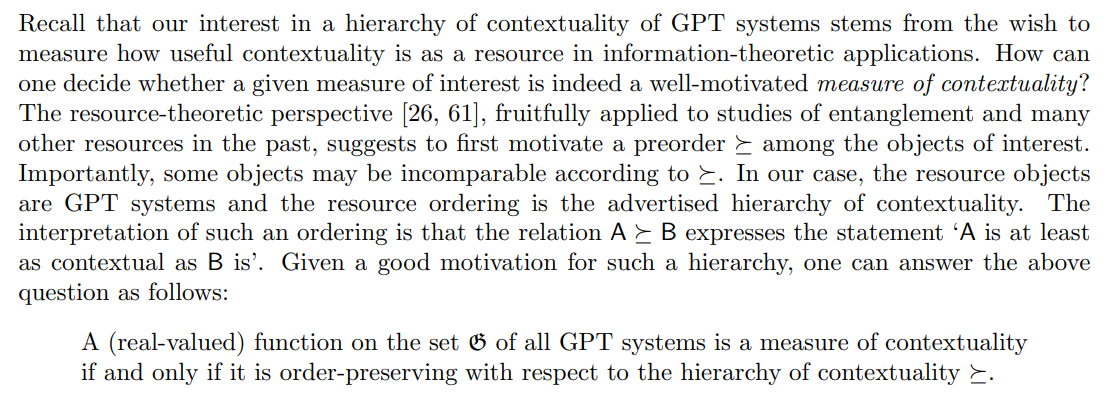
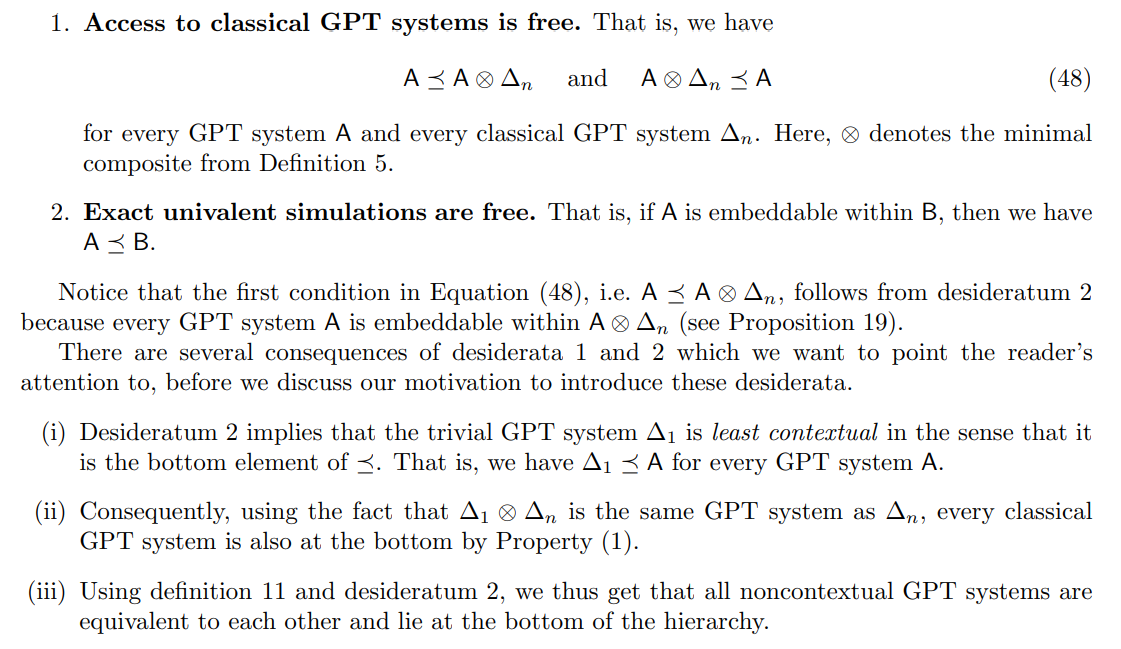
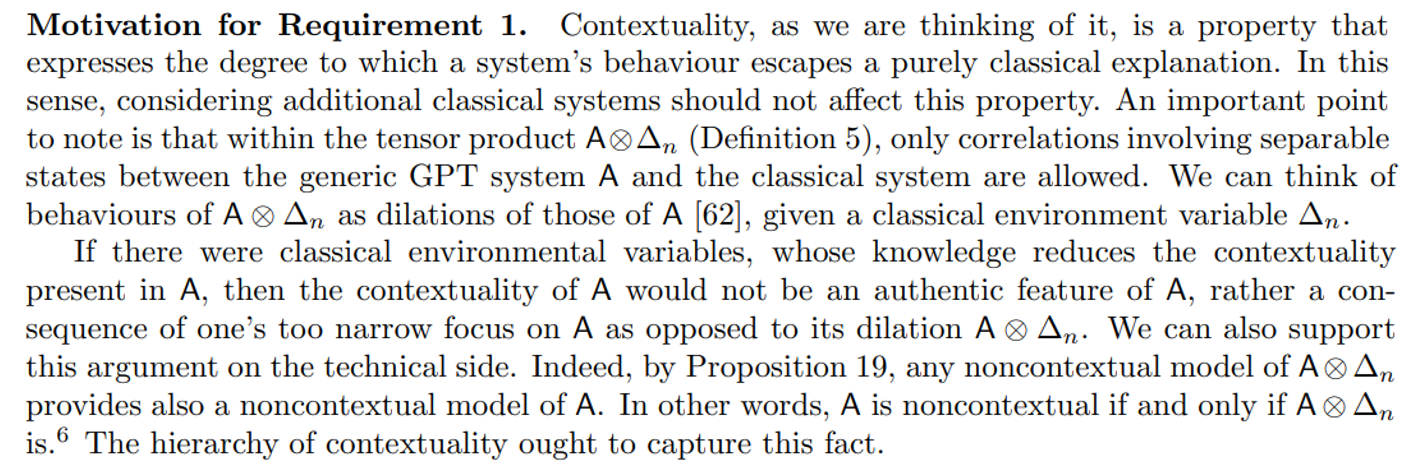
Let us now list and discuss our desiderata for a sensible hierarchy of contextuality among GPT systems. They are:
\ 
\ 
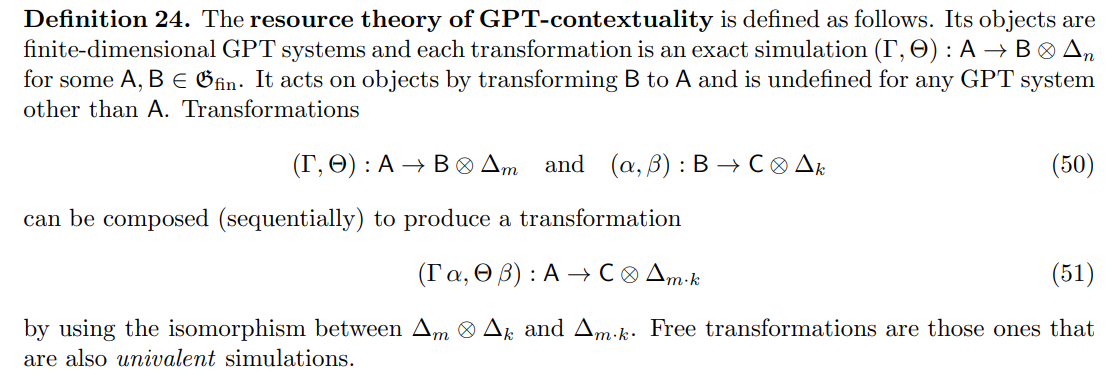
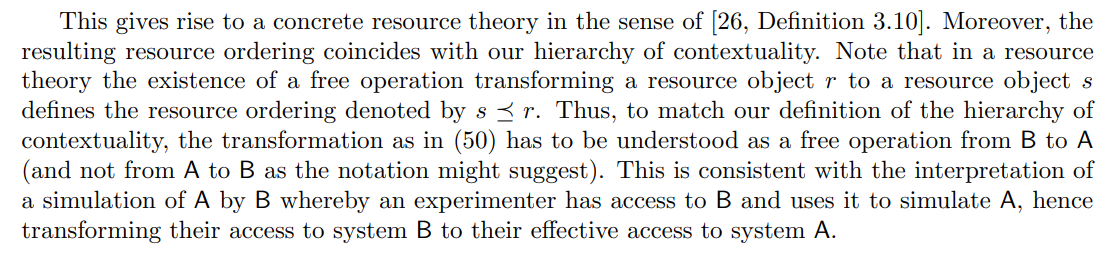
\ Motivation for Requirement 2. We can also think of contextuality (of a GPT system) as the inability to provide a noncontextual model (Definition 11) for its statistical behaviours. If a GPT system A can be exactly simulated by a GPT system B via a univalent simulation, then any obstruction to constructing such a noncontextual model for A must already be present in B. In this sense, we think of B as being “at least as contextual” as A is. Indeed, provided with a noncontextual model of B, i.e. an exact univalent simulation of B by a classical GPT system, one can construct a noncontextual model of A by composition with the simulation of A by B.
\ 
\ 
\ 
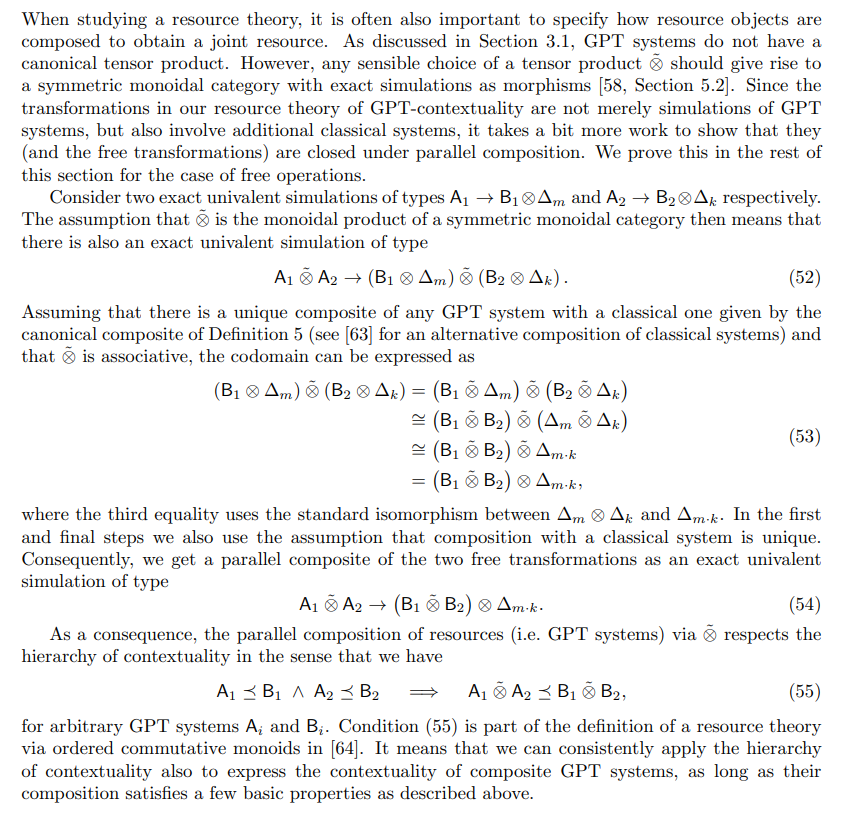
4.2 Contextuality of composite systems
\ 
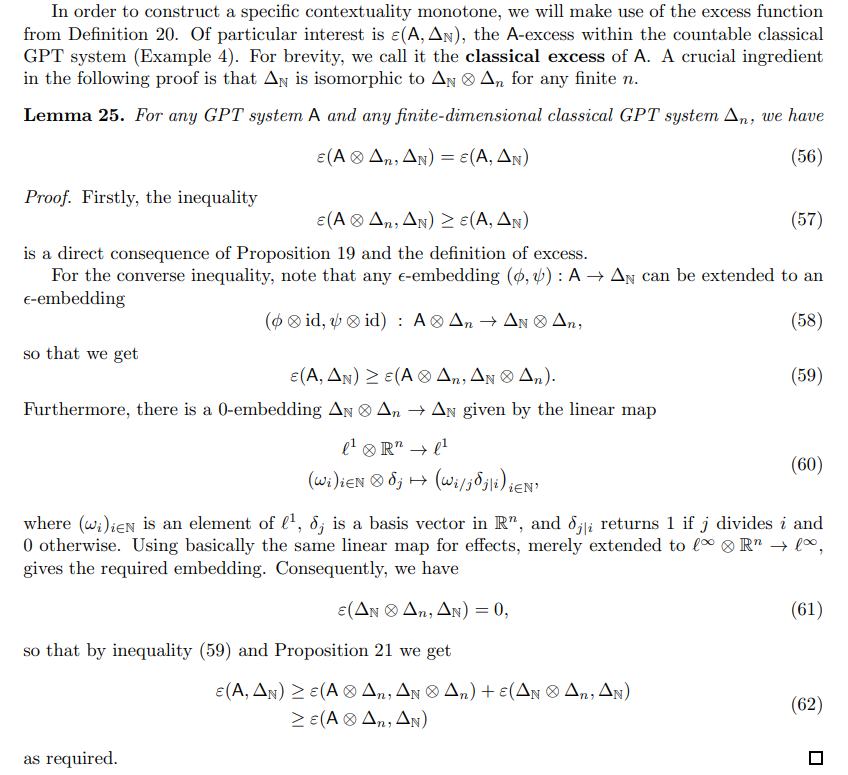
4.3 Quantifying contextuality via the classical excess
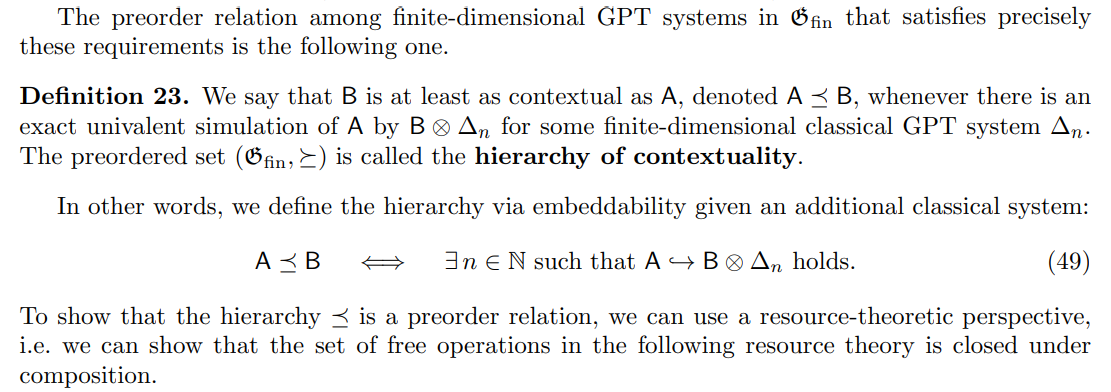
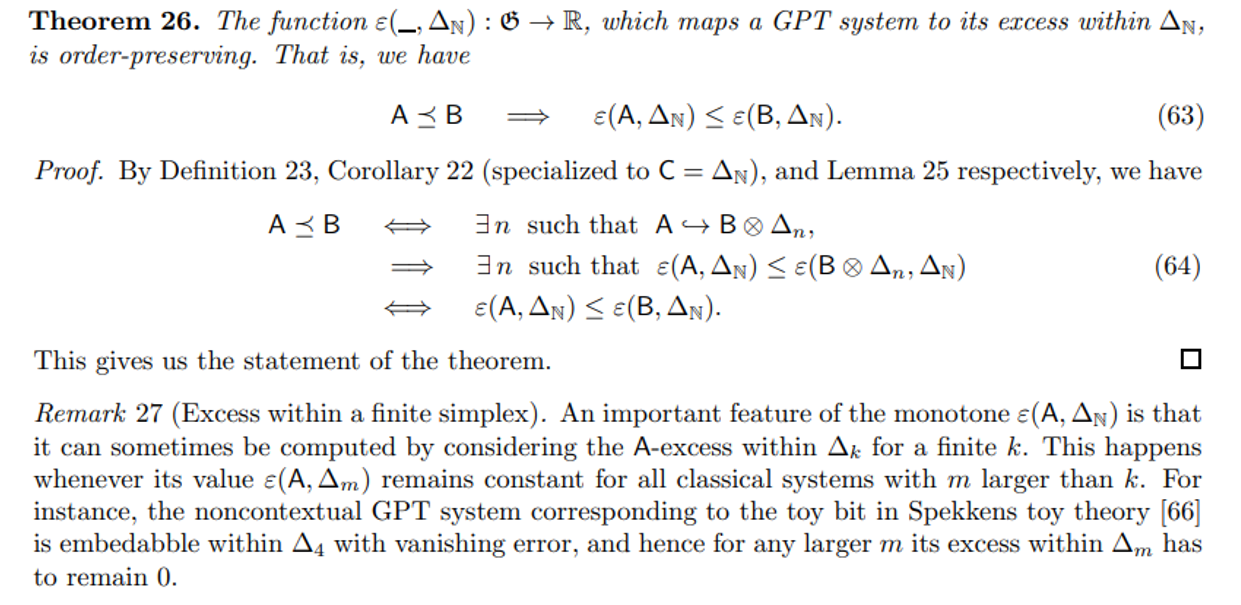
As is common in resource theories [65], we can use monotones— i.e. order-preserving functions from resources to numbers— to study the hierarchy of contextuality. On the one hand, these can provide a lens through which to extract properties of the preorder. On the other hand, they can be used as quantitative measures of contextuality. The latter perspective is particularly useful when the monotones come equipped with an (operational) interpretation that allows one to identify which aspect of contextuality they are measuring.
\ \ 
\ \ \ 
\
4.4 Parity oblivious multiplexing success probability with free classical resources as a measure of contextuality
Having introduced the hierarchy of contextuality as well as a new contextuality measure in the form of the classical excess, we now build a measure of generalised contextuality based on the parity oblivious multiplexing (POM) [10] game. The latter is a protocol that is powered by preparation contextuality and has raised significant attention in recent years [67–74].
\ \ 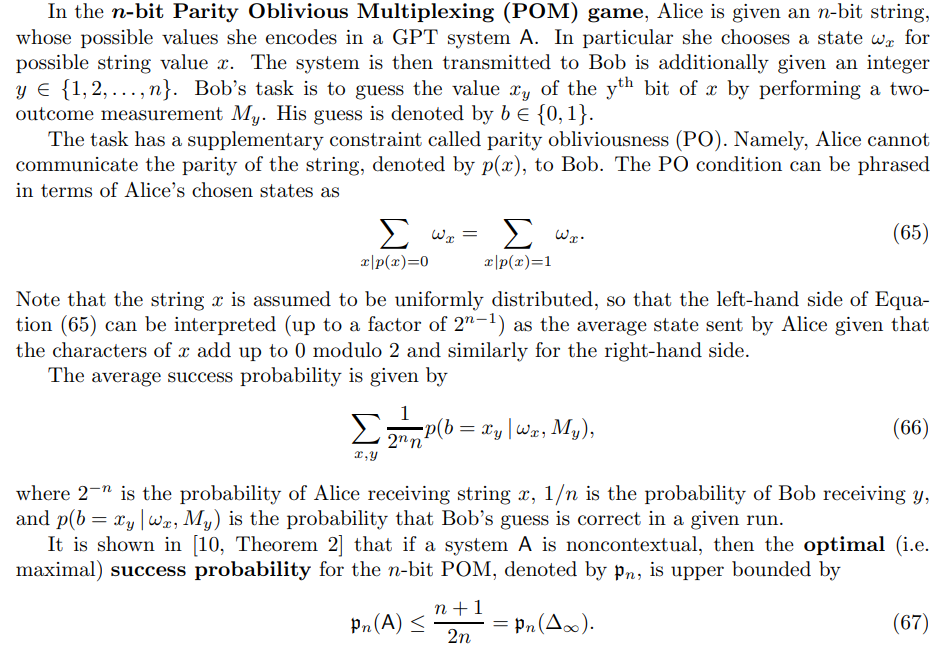
\ \ The success probability for POM can be thus used as a witness of contextuality.
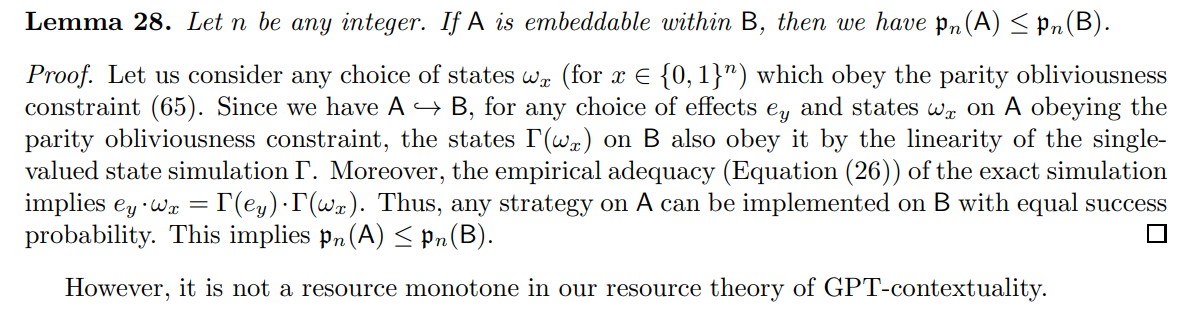
\ We now prove that for the embeddability preorder the POM success probability is also order-preserving.
\ \ 
\ \ \ 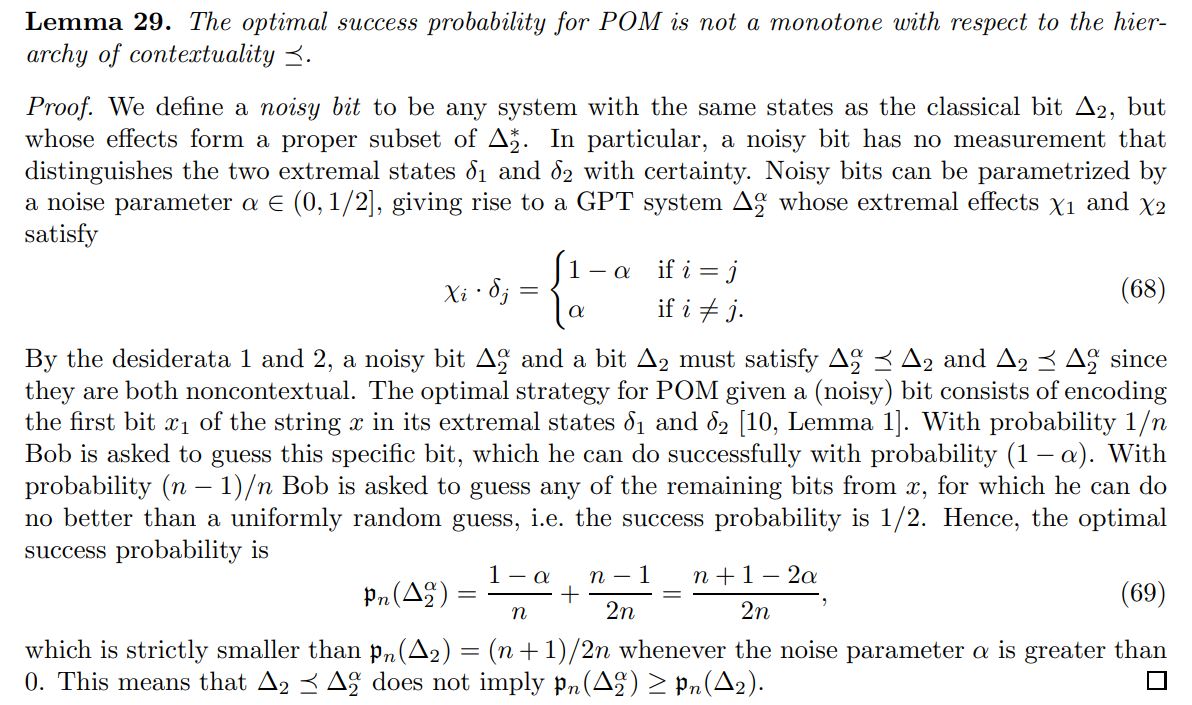
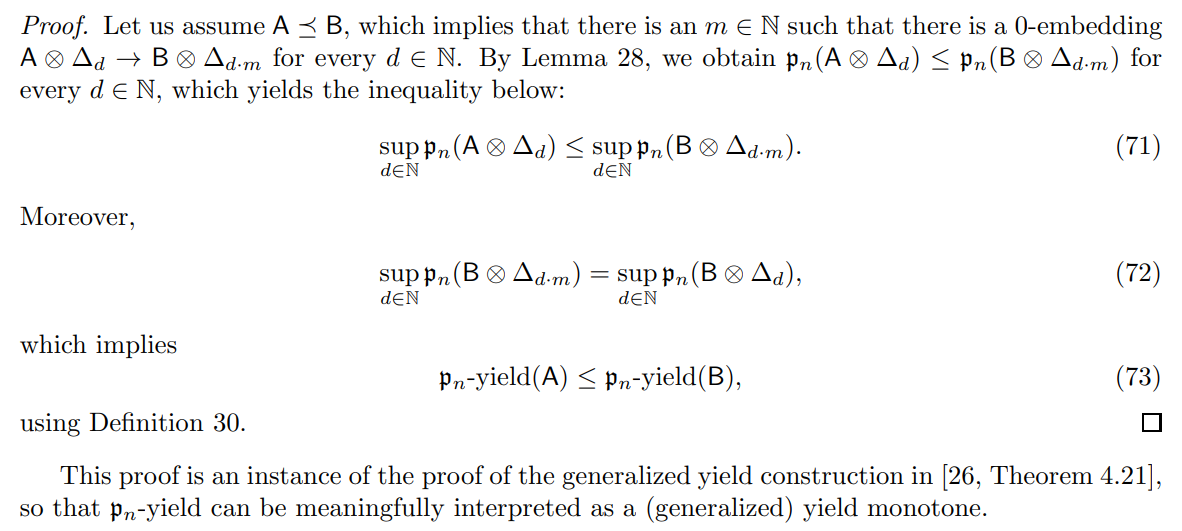
\ \ We can see that the POM success probability cannot serve as a monotone because the POM game does not allow the use of classical systems for free. This can be remedied by the so-called generalized yield construction [65, Section 3.1].
\ Definition 30. Given a GPT system A we define the optimal POM success probability with free classical resources as:
\ \ 
\ \ Proposition 31. pn-yield is a monotone on the resource theory of GPT-contextuality.
\ \ 
\ \ \
:::info Authors:
(1) Lorenzo Catani, International Iberian Nanotechnology Laboratory, Av. Mestre Jose Veiga s/n, 4715-330 Braga, Portugal (lorenzo.catani4@gmail.com);
(2) Thomas D. Galley, Institute for Quantum Optics and Quantum Information, Austrian Academy of Sciences, Boltzmanngasse 3, A-1090 Vienna, Austria and Vienna Center for Quantum Science and Technology (VCQ), Faculty of Physics, University of Vienna, Vienna, Austria (thomas.galley@oeaw.ac.at);
(3) Tomas Gonda, Institute for Theoretical Physics, University of Innsbruck, Austria (tomas.gonda@uibk.ac.at).
:::
:::info This paper is available on arxiv under CC BY 4.0 DEED license.
:::
[6] Note that under the minimal tensor product of Definition 5 allowing access to arbitrary noncontextual systems (and not just classical systems) would lead to the same hierarchy, which follows from the fact that access to classical systems already places all noncontextual systems at the bottom of the hierarchy.


You May Also Like

Seychelles and Japan deepen economic cooperation

NZD/USD remains subdued below 0.5900 as market caution lifts US Dollar




