By Chloe, ChainCatcher On the 26th of last month, Tron implemented its largest-ever fee cuts. Justin Sun stated, "This proposal is a real benefit for users, with a 60% fee reduction. Ordinary networks don't have the courage to do that." He also mentioned that this will have an impact on the short-term profitability of the Tron network, as network fees have been directly reduced by 60%, but long-term profitability will be enhanced because more users and more transactions will occur on Tron. The latest gasfeesnow data shows that even after the fee was halved, Tron's USDT transfer cost is still as high as $2.02-4.22, far exceeding other major blockchain networks. The contrast is clear from the fee comparison: even at the TronCastle-optimized price of $1.09-2.21, it is still 15 times higher than Arbitrum ($0.10), 302 times higher than Solana ($0.0036), and even 3,633 times higher than Polygon ($0.0003) at the time of writing. Aptos has a minimum price of $0.0001 USD. Why were costs so high before the cuts? Tron doesn't use ETH's gas model; instead, it utilizes a unique bandwidth + energy model. Bandwidth provides users with a daily free quota, enabling simple transfers. Energy is used for contract execution, and transferring USDT (TRC-20) requires energy. Assuming that a USDT transfer consumes approximately 130,000 units of energy, if the user has no resources in their wallet, the system can only burn TRX directly, resulting in high transaction fees. In contrast, Ethereum's Layer 2 solutions, such as Arbitrum and Optimism, use a simpler gas model and offer a more user-friendly experience. Solana, through its unique Proof of History (PoH) and parallel execution architecture, achieves a processing capacity of 2,600 transactions per second while maintaining ultra-low fees. After reducing fees, Tron intends to successfully counter the "price reduction" with "incremental" Tron's 60% fee cut represents a significant market adjustment and a proactive move by the project to boost user growth. According to CryptoQuant, Tron's daily fee revenue fell to $5 million on September 7th, its lowest level in a year. Prior to the August 28th reduction, daily revenue was $13.9 million. According to DeFi Llama on-chain data, Tron's average revenue in September did experience a cliff-like drop compared to the previous month, with a decrease of nearly 50%. Despite the decrease in revenue, on-chain activity has actually increased. Daily transaction volume and the number of active wallets have surged, and the number of newly added smart contracts each day also indicates a continued influx of users and dApp developers. According to Token Terminal data, Tron still accounted for 92.9% of the total revenue of L1 public chains over the past seven days. And over the past 90 days, Tron's total fee revenue was still far higher than that of Ethereum, Solana, BNB Chain, and Avalanche during the same period. Tron and Justin Sun originally expected that as long as users and transaction volume continued to grow, revenue would eventually recover and become more sustainable, which was equivalent to using "incremental growth" to counter "declining unit prices." Although Tron currently appears to maintain an advantage in terms of revenue, with the passage of the GENIUS Act in July this year, the competitive landscape of the future on-chain market is undergoing fundamental restructuring. When facing stricter registration, audit and reserve requirements, stablecoin issuers may re-evaluate the cost-effectiveness of deploying assets on Tron, thereby indirectly affecting the network's stablecoin trading volume and ecological activity. This change poses a major hurdle for Tron. Wall Street giants are entering the market, and CBDC is maturing. The passage of the GENIUS Act has received mixed reviews, with both advantages and disadvantages for the crypto market. Supporters believe this milestone brings greater credibility to stablecoins and increases the willingness of financial institutions and consumers to use them. Opponents argue that the bill allows the president and related individuals and institutions to profit, creating a conflict of interest with the crypto market. Wall Street giants like BlackRock and JPMorgan have also begun building their own blockchain empires. BlackRock's BUIDL tokenized money market fund has reached $2.2 billion, deployed on multiple networks including Ethereum, Avalanche, Aptos, and Polygon. JPMorgan's Kinexys platform focuses on institutional-grade DeFi and programmable digital cash, providing on-chain lending and digital asset collateral services to corporate clients. The advantages of these traditional financial institutions are: 1. Regulatory compliance: they have deep cooperative relationships with financial regulatory agencies in various countries; 2. Financial strength: BlackRock manages more than trillions of US dollars in assets; 3. A large corporate client base: they already have a mature institutional client network and trust relationships, as well as the technical integration capabilities to seamlessly integrate blockchain into existing financial infrastructure. Tron's compliance gaps are definitely not comparable to the regulatory relationships with BlackRock and JPMorgan. Furthermore, its adoption rate among Fortune 500 companies is extremely low, not to mention the ongoing SEC lawsuit, which is impacting institutional trust. Last week, two US Democratic lawmakers sent a letter to the SEC, demanding an explanation for its decision to suspend Sun's enforcement case, suggesting the decision may be related to Sun's "substantial investment" in crypto projects linked to President Trump. The lawmakers also questioned Tron's recent listing on the Nasdaq, arguing it could pose financial and national security risks and urging the SEC to ensure the company meets stringent listing standards. Furthermore, 98% of global GDP is already covered by central bank digital currency (CBDC) projects, with 19 G20 countries currently developing or piloting CBDCs. CBDC projects in major economies, such as China's digital renminbi (e-CNY), the EU's digital euro, and India's digital rupee, will directly compete with Tron in cross-border payments and large-value settlements. McKinsey research shows that 2025 will be a turning point in the development of stablecoins. The stablecoin market is expected to grow from the current US$150 billion to US$3 trillion in 2030, but this huge increase will mainly be divided up by compliant institutional stablecoins and CBDCs. The market believes that Tron must complete this transformation within this critical timeframe or face marginalization. The crypto market is clearly transitioning from experimental technology to core infrastructure, and only a few platforms will survive this transition.By Chloe, ChainCatcher On the 26th of last month, Tron implemented its largest-ever fee cuts. Justin Sun stated, "This proposal is a real benefit for users, with a 60% fee reduction. Ordinary networks don't have the courage to do that." He also mentioned that this will have an impact on the short-term profitability of the Tron network, as network fees have been directly reduced by 60%, but long-term profitability will be enhanced because more users and more transactions will occur on Tron. The latest gasfeesnow data shows that even after the fee was halved, Tron's USDT transfer cost is still as high as $2.02-4.22, far exceeding other major blockchain networks. The contrast is clear from the fee comparison: even at the TronCastle-optimized price of $1.09-2.21, it is still 15 times higher than Arbitrum ($0.10), 302 times higher than Solana ($0.0036), and even 3,633 times higher than Polygon ($0.0003) at the time of writing. Aptos has a minimum price of $0.0001 USD. Why were costs so high before the cuts? Tron doesn't use ETH's gas model; instead, it utilizes a unique bandwidth + energy model. Bandwidth provides users with a daily free quota, enabling simple transfers. Energy is used for contract execution, and transferring USDT (TRC-20) requires energy. Assuming that a USDT transfer consumes approximately 130,000 units of energy, if the user has no resources in their wallet, the system can only burn TRX directly, resulting in high transaction fees. In contrast, Ethereum's Layer 2 solutions, such as Arbitrum and Optimism, use a simpler gas model and offer a more user-friendly experience. Solana, through its unique Proof of History (PoH) and parallel execution architecture, achieves a processing capacity of 2,600 transactions per second while maintaining ultra-low fees. After reducing fees, Tron intends to successfully counter the "price reduction" with "incremental" Tron's 60% fee cut represents a significant market adjustment and a proactive move by the project to boost user growth. According to CryptoQuant, Tron's daily fee revenue fell to $5 million on September 7th, its lowest level in a year. Prior to the August 28th reduction, daily revenue was $13.9 million. According to DeFi Llama on-chain data, Tron's average revenue in September did experience a cliff-like drop compared to the previous month, with a decrease of nearly 50%. Despite the decrease in revenue, on-chain activity has actually increased. Daily transaction volume and the number of active wallets have surged, and the number of newly added smart contracts each day also indicates a continued influx of users and dApp developers. According to Token Terminal data, Tron still accounted for 92.9% of the total revenue of L1 public chains over the past seven days. And over the past 90 days, Tron's total fee revenue was still far higher than that of Ethereum, Solana, BNB Chain, and Avalanche during the same period. Tron and Justin Sun originally expected that as long as users and transaction volume continued to grow, revenue would eventually recover and become more sustainable, which was equivalent to using "incremental growth" to counter "declining unit prices." Although Tron currently appears to maintain an advantage in terms of revenue, with the passage of the GENIUS Act in July this year, the competitive landscape of the future on-chain market is undergoing fundamental restructuring. When facing stricter registration, audit and reserve requirements, stablecoin issuers may re-evaluate the cost-effectiveness of deploying assets on Tron, thereby indirectly affecting the network's stablecoin trading volume and ecological activity. This change poses a major hurdle for Tron. Wall Street giants are entering the market, and CBDC is maturing. The passage of the GENIUS Act has received mixed reviews, with both advantages and disadvantages for the crypto market. Supporters believe this milestone brings greater credibility to stablecoins and increases the willingness of financial institutions and consumers to use them. Opponents argue that the bill allows the president and related individuals and institutions to profit, creating a conflict of interest with the crypto market. Wall Street giants like BlackRock and JPMorgan have also begun building their own blockchain empires. BlackRock's BUIDL tokenized money market fund has reached $2.2 billion, deployed on multiple networks including Ethereum, Avalanche, Aptos, and Polygon. JPMorgan's Kinexys platform focuses on institutional-grade DeFi and programmable digital cash, providing on-chain lending and digital asset collateral services to corporate clients. The advantages of these traditional financial institutions are: 1. Regulatory compliance: they have deep cooperative relationships with financial regulatory agencies in various countries; 2. Financial strength: BlackRock manages more than trillions of US dollars in assets; 3. A large corporate client base: they already have a mature institutional client network and trust relationships, as well as the technical integration capabilities to seamlessly integrate blockchain into existing financial infrastructure. Tron's compliance gaps are definitely not comparable to the regulatory relationships with BlackRock and JPMorgan. Furthermore, its adoption rate among Fortune 500 companies is extremely low, not to mention the ongoing SEC lawsuit, which is impacting institutional trust. Last week, two US Democratic lawmakers sent a letter to the SEC, demanding an explanation for its decision to suspend Sun's enforcement case, suggesting the decision may be related to Sun's "substantial investment" in crypto projects linked to President Trump. The lawmakers also questioned Tron's recent listing on the Nasdaq, arguing it could pose financial and national security risks and urging the SEC to ensure the company meets stringent listing standards. Furthermore, 98% of global GDP is already covered by central bank digital currency (CBDC) projects, with 19 G20 countries currently developing or piloting CBDCs. CBDC projects in major economies, such as China's digital renminbi (e-CNY), the EU's digital euro, and India's digital rupee, will directly compete with Tron in cross-border payments and large-value settlements. McKinsey research shows that 2025 will be a turning point in the development of stablecoins. The stablecoin market is expected to grow from the current US$150 billion to US$3 trillion in 2030, but this huge increase will mainly be divided up by compliant institutional stablecoins and CBDCs. The market believes that Tron must complete this transformation within this critical timeframe or face marginalization. The crypto market is clearly transitioning from experimental technology to core infrastructure, and only a few platforms will survive this transition.

Even with a 60% fee reduction, it still can't compete with Solana? The compliance and ecosystem game behind Tron's fee dilemma

2025/09/26 18:00

By Chloe, ChainCatcher

On the 26th of last month, Tron implemented its largest-ever fee cuts. Justin Sun stated, "This proposal is a real benefit for users, with a 60% fee reduction. Ordinary networks don't have the courage to do that." He also mentioned that this will have an impact on the short-term profitability of the Tron network, as network fees have been directly reduced by 60%, but long-term profitability will be enhanced because more users and more transactions will occur on Tron.

The latest gasfeesnow data shows that even after the fee was halved, Tron's USDT transfer cost is still as high as $2.02-4.22, far exceeding other major blockchain networks.

The contrast is clear from the fee comparison: even at the TronCastle-optimized price of $1.09-2.21, it is still 15 times higher than Arbitrum ($0.10), 302 times higher than Solana ($0.0036), and even 3,633 times higher than Polygon ($0.0003) at the time of writing. Aptos has a minimum price of $0.0001 USD.

Why were costs so high before the cuts?

Tron doesn't use ETH's gas model; instead, it utilizes a unique bandwidth + energy model. Bandwidth provides users with a daily free quota, enabling simple transfers. Energy is used for contract execution, and transferring USDT (TRC-20) requires energy.

Assuming that a USDT transfer consumes approximately 130,000 units of energy, if the user has no resources in their wallet, the system can only burn TRX directly, resulting in high transaction fees.

In contrast, Ethereum's Layer 2 solutions, such as Arbitrum and Optimism, use a simpler gas model and offer a more user-friendly experience. Solana, through its unique Proof of History (PoH) and parallel execution architecture, achieves a processing capacity of 2,600 transactions per second while maintaining ultra-low fees.

After reducing fees, Tron intends to successfully counter the "price reduction" with "incremental"

Tron's 60% fee cut represents a significant market adjustment and a proactive move by the project to boost user growth. According to CryptoQuant, Tron's daily fee revenue fell to $5 million on September 7th, its lowest level in a year. Prior to the August 28th reduction, daily revenue was $13.9 million.

According to DeFi Llama on-chain data, Tron's average revenue in September did experience a cliff-like drop compared to the previous month, with a decrease of nearly 50%.
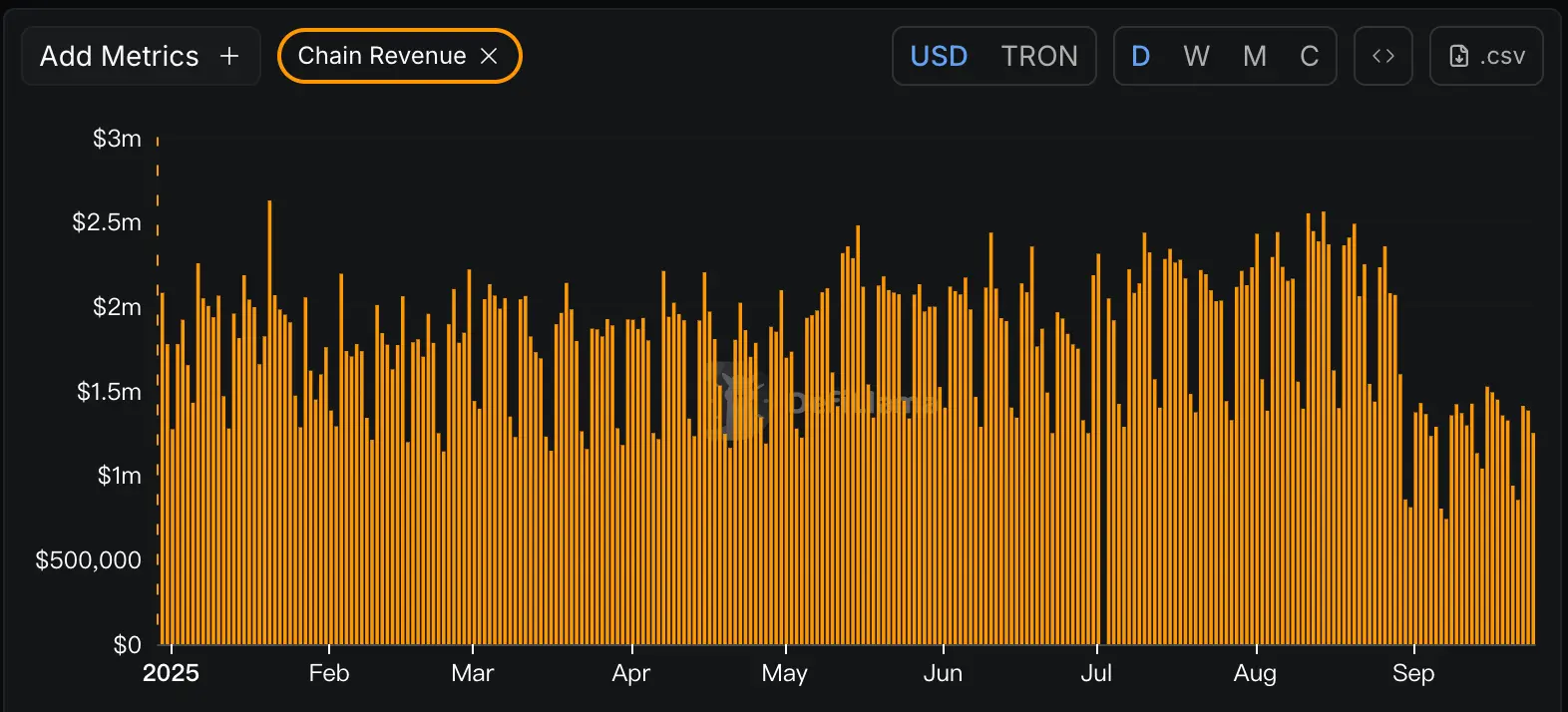
Despite the decrease in revenue, on-chain activity has actually increased. Daily transaction volume and the number of active wallets have surged, and the number of newly added smart contracts each day also indicates a continued influx of users and dApp developers.

According to Token Terminal data, Tron still accounted for 92.9% of the total revenue of L1 public chains over the past seven days. And over the past 90 days, Tron's total fee revenue was still far higher than that of Ethereum, Solana, BNB Chain, and Avalanche during the same period.
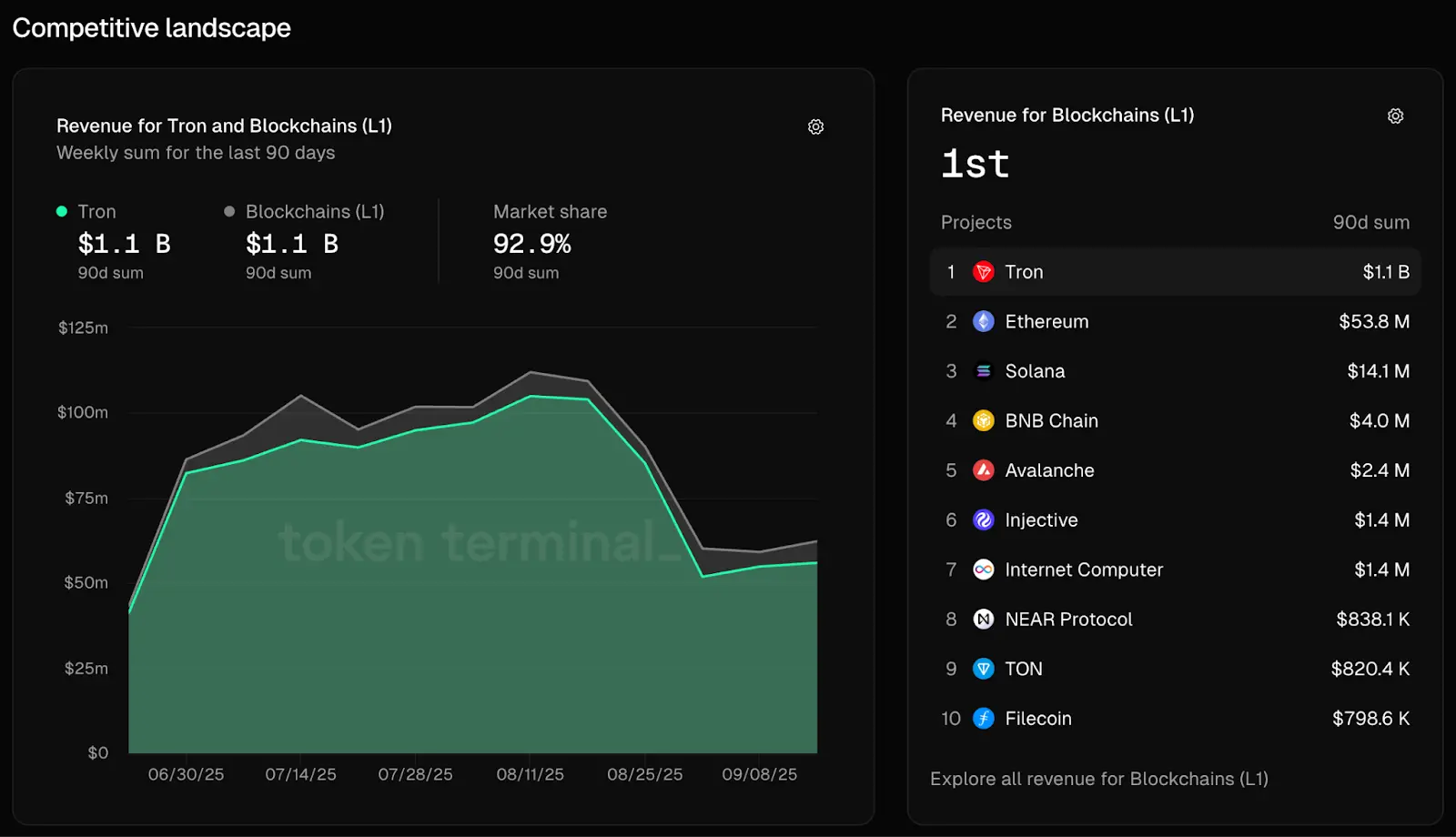
Tron and Justin Sun originally expected that as long as users and transaction volume continued to grow, revenue would eventually recover and become more sustainable, which was equivalent to using "incremental growth" to counter "declining unit prices."

Although Tron currently appears to maintain an advantage in terms of revenue, with the passage of the GENIUS Act in July this year, the competitive landscape of the future on-chain market is undergoing fundamental restructuring. When facing stricter registration, audit and reserve requirements, stablecoin issuers may re-evaluate the cost-effectiveness of deploying assets on Tron, thereby indirectly affecting the network's stablecoin trading volume and ecological activity. This change poses a major hurdle for Tron.

Wall Street giants are entering the market, and CBDC is maturing.

The passage of the GENIUS Act has received mixed reviews, with both advantages and disadvantages for the crypto market. Supporters believe this milestone brings greater credibility to stablecoins and increases the willingness of financial institutions and consumers to use them. Opponents argue that the bill allows the president and related individuals and institutions to profit, creating a conflict of interest with the crypto market.

Wall Street giants like BlackRock and JPMorgan have also begun building their own blockchain empires. BlackRock's BUIDL tokenized money market fund has reached $2.2 billion, deployed on multiple networks including Ethereum, Avalanche, Aptos, and Polygon. JPMorgan's Kinexys platform focuses on institutional-grade DeFi and programmable digital cash, providing on-chain lending and digital asset collateral services to corporate clients.

The advantages of these traditional financial institutions are: 1. Regulatory compliance: they have deep cooperative relationships with financial regulatory agencies in various countries; 2. Financial strength: BlackRock manages more than trillions of US dollars in assets; 3. A large corporate client base: they already have a mature institutional client network and trust relationships, as well as the technical integration capabilities to seamlessly integrate blockchain into existing financial infrastructure.

Tron's compliance gaps are definitely not comparable to the regulatory relationships with BlackRock and JPMorgan. Furthermore, its adoption rate among Fortune 500 companies is extremely low, not to mention the ongoing SEC lawsuit, which is impacting institutional trust.

Last week, two US Democratic lawmakers sent a letter to the SEC, demanding an explanation for its decision to suspend Sun's enforcement case, suggesting the decision may be related to Sun's "substantial investment" in crypto projects linked to President Trump. The lawmakers also questioned Tron's recent listing on the Nasdaq, arguing it could pose financial and national security risks and urging the SEC to ensure the company meets stringent listing standards.

Furthermore, 98% of global GDP is already covered by central bank digital currency (CBDC) projects, with 19 G20 countries currently developing or piloting CBDCs. CBDC projects in major economies, such as China's digital renminbi (e-CNY), the EU's digital euro, and India's digital rupee, will directly compete with Tron in cross-border payments and large-value settlements.

McKinsey research shows that 2025 will be a turning point in the development of stablecoins. The stablecoin market is expected to grow from the current US$150 billion to US$3 trillion in 2030, but this huge increase will mainly be divided up by compliant institutional stablecoins and CBDCs.

The market believes that Tron must complete this transformation within this critical timeframe or face marginalization. The crypto market is clearly transitioning from experimental technology to core infrastructure, and only a few platforms will survive this transition.


Market Opportunity
Threshold Logo
Threshold Price(T)
$0.009457
$0.009457$0.009457
+1.53%
USD
Threshold (T) Live Price Chart
Disclaimer: The articles reposted on this site are sourced from public platforms and are provided for informational purposes only. They do not necessarily reflect the views of MEXC. All rights remain with the original authors. If you believe any content infringes on third-party rights, please contact service@support.mexc.com for removal. MEXC makes no guarantees regarding the accuracy, completeness, or timeliness of the content and is not responsible for any actions taken based on the information provided. The content does not constitute financial, legal, or other professional advice, nor should it be considered a recommendation or endorsement by MEXC.

You May Also Like

Q4 2025 May Have Marked the End of the Crypto Bear Market: Bitwise

Q4 2025 May Have Marked the End of the Crypto Bear Market: Bitwise

The fourth quarter of 2025 may have quietly signaled the end of the crypto bear market, according to a new report from digital asset manager Bitwise, even as prices
Share
CryptoNews2026/01/22 15:06
CEO Sandeep Nailwal Shared Highlights About RWA on Polygon

CEO Sandeep Nailwal Shared Highlights About RWA on Polygon

The post CEO Sandeep Nailwal Shared Highlights About RWA on Polygon appeared on BitcoinEthereumNews.com. Polygon CEO Sandeep Nailwal highlighted Polygon’s lead in global bonds, Spiko US T-Bill, and Spiko Euro T-Bill. Polygon published an X post to share that its roadmap to GigaGas was still scaling. Sentiments around POL price were last seen to be bearish. Polygon CEO Sandeep Nailwal shared key pointers from the Dune and RWA.xyz report. These pertain to highlights about RWA on Polygon. Simultaneously, Polygon underlined its roadmap towards GigaGas. Sentiments around POL price were last seen fumbling under bearish emotions. Polygon CEO Sandeep Nailwal on Polygon RWA CEO Sandeep Nailwal highlighted three key points from the Dune and RWA.xyz report. The Chief Executive of Polygon maintained that Polygon PoS was hosting RWA TVL worth $1.13 billion across 269 assets plus 2,900 holders. Nailwal confirmed from the report that RWA was happening on Polygon. The Dune and https://t.co/W6WSFlHoQF report on RWA is out and it shows that RWA is happening on Polygon. Here are a few highlights: – Leading in Global Bonds: Polygon holds 62% share of tokenized global bonds (driven by Spiko’s euro MMF and Cashlink euro issues) – Spiko U.S.… — Sandeep | CEO, Polygon Foundation (※,※) (@sandeepnailwal) September 17, 2025 The X post published by Polygon CEO Sandeep Nailwal underlined that the ecosystem was leading in global bonds by holding a 62% share of tokenized global bonds. He further highlighted that Polygon was leading with Spiko US T-Bill at approximately 29% share of TVL along with Ethereum, adding that the ecosystem had more than 50% share in the number of holders. Finally, Sandeep highlighted from the report that there was a strong adoption for Spiko Euro T-Bill with 38% share of TVL. He added that 68% of returns were on Polygon across all the chains. Polygon Roadmap to GigaGas In a different update from Polygon, the community…
Share
BitcoinEthereumNews2025/09/18 01:10
WWE Royal Rumble 2026: Confirmed Entrants, Updated Card

WWE Royal Rumble 2026: Confirmed Entrants, Updated Card

The post WWE Royal Rumble 2026: Confirmed Entrants, Updated Card appeared on BitcoinEthereumNews.com. DUESSELDORF, GERMANY – JANUARY 12: Liv Morgan and Roxanne
Share
BitcoinEthereumNews2026/01/22 15:14