Bitcoin price is trying to push its way back above the $95,000 mark after sinking to a local low near $89,000, a drop that sparked a sharp rise in implied volatility. BTC was trading around $92,858 at press time, up…Bitcoin price is trying to push its way back above the $95,000 mark after sinking to a local low near $89,000, a drop that sparked a sharp rise in implied volatility. BTC was trading around $92,858 at press time, up…

Bitcoin price fights to reclaim $95K resistance as implied volatility spikes double digits

2025/11/20 14:21
3 min read
For feedback or concerns regarding this content, please contact us at crypto.news@mexc.com

Bitcoin price is trying to push its way back above the $95,000 mark after sinking to a local low near $89,000, a drop that sparked a sharp rise in implied volatility.

Summary
  • Bitcoin price is attempting to break $95K after dropping from $126K all-time highs.
  • Rising implied volatility and options skew indicate that traders are bracing for bigger swings.
  • Technical indicators hint at a brief relief bounce, but the downtrend remains intact.

BTC was trading around $92,858 at press time, up about 1.8% on the day, but still down 9% over the past week and 14% over the past month. Since its Oct. 6 all-time high of $126,080, Bitcoin has now pulled back 26%.

Spot trading has slowed noticeably. Daily Bitcoin (BTC) trading volume dipped 2.3% to $83.8 billion, suggesting traders are stepping back and waiting for a clearer direction. Derivatives, however, tell a different story. 

Futures volume is up nearly 15% to $123.2 billion, and open interest rose 3.9% to $67.4 billion. Rising open interest during a downturn typically means traders are hedging or leaning into short positions, not betting on a quick recovery.

On-chain signals show soft demand

A Nov. 19 GlassNode Insights report shows Bitcoin is now trading below the short-term holder cost basis and the −1 standard deviation band.

This puts many recent buyers in the red and makes the $95,000-$97,000 area a major resistance zone. The first indication that the market is regaining stability would be a clear move above that zone.

The report also notes significant increases in implied volatility across all maturities, the unwinding of speculative leverage, and large withdrawals from spot exchange-traded funds. With traders paying more for downside protection, especially around the $90,000 strike, the options skew is still strongly tilted towards puts. 

At the same time, the DVOL index, which tracks how volatile options traders expect the market to be, has hit a monthly high, meaning bigger price swings could be coming.

Selling pressure has led to short-term holders’ realized losses reaching $523 million per day, their highest level since the FTX collapse. The next crucial level of support is the Active Investors’ Realised Price, which is approximately $88,600.

With $82,000 serving as the last significant structural support, a clear break below that level might trigger a more severe bearish phase.

Bitcoin price technical analysis

The chart shows Bitcoin trading below all major moving averages, with the Bollinger Bands widening as price rides the lower band. This indicates strong downward momentum and a market looking for support. At 36, the relative shows that there is little momentum but not yet severe oversold conditions.
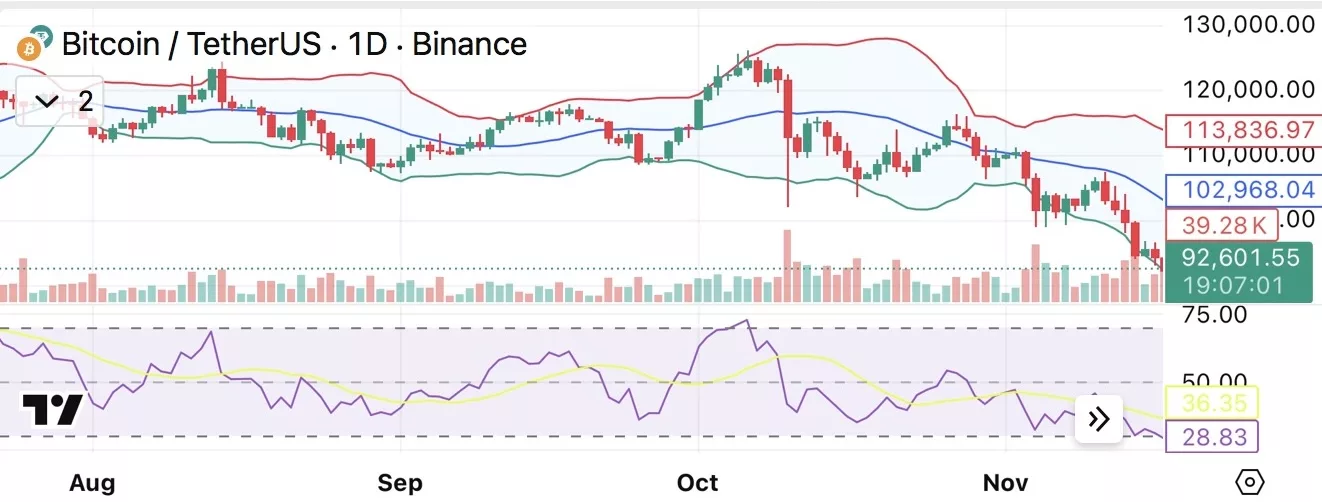
Bitcoin price fights to reclaim $95K resistance as implied volatility spikes double digits - 1

Most indicators are sitting in neutral territory, but a few are starting to show some bullish signs. The commodity channel index and Momentum have both turned positive, suggesting that if volatility eases, we could see a short-lived relief bounce. Still, the MACD remains deeply negative, and the average directional index at 40 shows the downtrend is still firmly in place.

For sentiment to shift, Bitcoin needs to close back above $95,000, and ideally $97,000. If it can’t reclaim those levels, the market remains at risk of another retest of $90,000, with a possible slide into the high-$80,000 range if sellers take control again.

Market Opportunity
EPNS Logo
EPNS Price(PUSH)
$0.011791
$0.011791$0.011791
-0.02%
USD
EPNS (PUSH) Live Price Chart
Disclaimer: The articles reposted on this site are sourced from public platforms and are provided for informational purposes only. They do not necessarily reflect the views of MEXC. All rights remain with the original authors. If you believe any content infringes on third-party rights, please contact crypto.news@mexc.com for removal. MEXC makes no guarantees regarding the accuracy, completeness, or timeliness of the content and is not responsible for any actions taken based on the information provided. The content does not constitute financial, legal, or other professional advice, nor should it be considered a recommendation or endorsement by MEXC.

You May Also Like

The Channel Factories We’ve Been Waiting For

The Channel Factories We’ve Been Waiting For

The post The Channel Factories We’ve Been Waiting For appeared on BitcoinEthereumNews.com. Visions of future technology are often prescient about the broad strokes while flubbing the details. The tablets in “2001: A Space Odyssey” do indeed look like iPads, but you never see the astronauts paying for subscriptions or wasting hours on Candy Crush.  Channel factories are one vision that arose early in the history of the Lightning Network to address some challenges that Lightning has faced from the beginning. Despite having grown to become Bitcoin’s most successful layer-2 scaling solution, with instant and low-fee payments, Lightning’s scale is limited by its reliance on payment channels. Although Lightning shifts most transactions off-chain, each payment channel still requires an on-chain transaction to open and (usually) another to close. As adoption grows, pressure on the blockchain grows with it. The need for a more scalable approach to managing channels is clear. Channel factories were supposed to meet this need, but where are they? In 2025, subnetworks are emerging that revive the impetus of channel factories with some new details that vastly increase their potential. They are natively interoperable with Lightning and achieve greater scale by allowing a group of participants to open a shared multisig UTXO and create multiple bilateral channels, which reduces the number of on-chain transactions and improves capital efficiency. Achieving greater scale by reducing complexity, Ark and Spark perform the same function as traditional channel factories with new designs and additional capabilities based on shared UTXOs.  Channel Factories 101 Channel factories have been around since the inception of Lightning. A factory is a multiparty contract where multiple users (not just two, as in a Dryja-Poon channel) cooperatively lock funds in a single multisig UTXO. They can open, close and update channels off-chain without updating the blockchain for each operation. Only when participants leave or the factory dissolves is an on-chain transaction…
Share
BitcoinEthereumNews2025/09/18 00:09
Pump.fun (PUMP) Has Spiked by 200%: Can the Rally Survive?

Pump.fun (PUMP) Has Spiked by 200%: Can the Rally Survive?

Between July and now, the price of Pumpfun (PUMP) has spiked by more than 200%. The rally has been strong, and the sentiment is still high. However, do we expect to continue seeing these highs, or is the price showing signs of crashing already? We will consider this by taking insights from a video by
Share
Coinstats2025/09/18 01:30
World Gold Council plans to build shared infrastructure platform for digital gold

World Gold Council plans to build shared infrastructure platform for digital gold

The post World Gold Council plans to build shared infrastructure platform for digital gold appeared on BitcoinEthereumNews.com. The World Gold Council (WGC), a
Share
BitcoinEthereumNews2026/03/20 14:45